
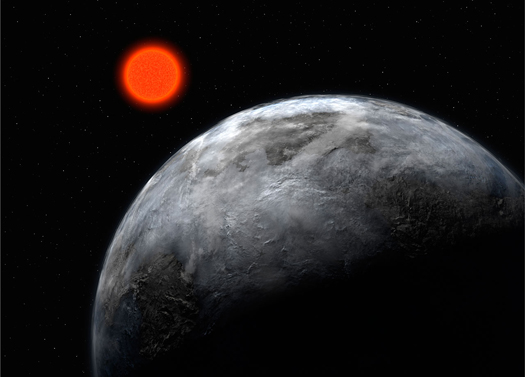
As if there wasn't enough excitement swirling around the discovery of a potentially habitable planet circling the star Gliese 581 just 20 light years away, one of the scientists behind yesterday's announcement upped the ante during a press briefing yesterday afternoon, declaring "my own personal feeling is that the chances of life on this planet are 100 percent."
Steven Vogt, a professor of astronomy and astrophysics at UC Santa Cruz, said he had "almost no doubt" (which seems slightly different than 100 percent sure) that life exists on Gliese 581g, an exoplanet Vogt and colleagues discovered via the Keck Observatory that is orbiting in the "habitable zone" surrounding the red dwarf Gliese 581. The "habitable zone" -- a term some scientists are loath to use given the many variables at play in planetary science -- is the sweet spot that is neither too far or too close to the star such that surface water might exist there.
Vogt's statement might make for a bold prediction -- especially given the number of life-bearing planets we've found thus far -- but his statement is more an endorsement for the persistence of life than a declaration that he's found it elsewhere in the galaxy. "Personally, given the ubiquity and propensity of life to flourish wherever it can, I would say, my own personal feeling is that the chances of life on this planet are 100 percent," Vogt said to reporters.Meaning, even if there is life on the planet as Vogt seems to think there is, there's no telling what kind of life it might be or whether it might be any degree of intelligent -- though an Australian sky-watcher did pick up a mysterious radio signal from nearby Gliese 581e a couple of years ago. Just to be safe, we'd like to extend warmest greetings to our Gliesian readers.

[Space]
Five amazing, clean technologies that will set us free, in this month's energy-focused issue. Also: how to build a better bomb detector, the robotic toys that are raising your children, a human catapult, the world's smallest arcade, and much more.


Online Content Director: Suzanne LaBarre | Email
Senior Editor: Paul Adams | Email
Associate Editor: Dan Nosowitz | Email
Assistant Editor: Colin Lecher | Email
Assistant Editor: Rose Pastore | Email
Contributing Writers:
Rebecca Boyle | Email
Kelsey D. Atherton | Email
Francie Diep | Email
Shaunacy Ferro | Email
What are we going to call the humanoids there? Gliesians? 581g isn't a good starting point.
BTW, I heard that they only have one toe on there feet, but they have ten legs, so their math should be decimal based as ours is.
Any scientist that would say the odds are "100%" or "almost no doubt" are poor scientist. Short of a signal, it is only speculation. I believe alien life can exist, but at this point I would lump these guys into the same category as the UFO people.
Too much belief and not not enough evidence.
And I shall name this planet...REACH
given the planet has 3x earth's mass, it's good to know we'll be a lot bigger than the first aliens we'll meet ;)
also, the star is a red dwarf; do we know if it is the collapsed remnant of a larger star? if so, its supposed atmosphere has already been blown away, right?
Thank you popsci for posting more info on Gliese.
I wish nasa or jaxa would do more with the planets in this solar system.
the ´mysterious radio signal´ noticed in australia actually wasn´t near gliese 581.
I'd be willing to bet there is some kind of life on there or at least the remnants of life.
They found that this planet has an orbit that casts a permanent shadow on half of the planet - that would cause so many differences in how that planet maintains equilibrium compared to Earth - the weather and geology would be so different. And I haven't heard anything yet on atmosphere and the levels of radiation hitting the surface of this planet.
VERY interesting though, I hope they can find out more and soon. Maybe we can figure out a way to send them a signal to kindly stop messing with our nukes. :)
@JohnR: Yep, I agree without you. Statements without any kind of proof except some assumed probability are just hyperbole.
On the other hand, I think the guys are just acting like people usually do, which is being carried away by the situation. They will probably be a bit embarrassed once the party feeling dies down and things are back to normal routine.
I would have limited my statement to that if the planet has a general chemistry that contains the basic building blocks of life, it would be somewhat surprising if it turns out that the planet doesn't have any kind of life at all.
Intelligent life is an altogether different issue, and as the joke goes, we must first find it here on Earth before we start to look for it in other places.
Wow, 100%certainty and "propensity of life to flourish wherever it can". I can understand a scientist getting excited and putting in their personal feelings but no scientist should ever speak in absolutes and the circular logic of life existing where it can makes my stomach turn.
Ok it is a step in finding a planet that meets ONE criteria for habitability. There are at least 50 or so other conditions that would have to be met to be hospitible to life.
For instance if the planet does not rotate as the earth does there would be no magnetic field to protect against radiatiion making for yet another dead planet.
Also, elsewhere it is noted that the planet circles it's star in aboout 37 days. This would be too short to produce any kind of meaningful plant growing cycle. Scientists are just a little to cavalier about what needs to happen for life to flourish considering we as of this very moment know of ONE place in the universe wehre even microbial life exists. Yes, this could change tomorow if Titan is found to contain microbial life but that has not happened YET.
I often hear the argument that there are so many candidates out there that there must be life based on the probabilities. And yes there is a stagging amount of planets we will soon find to be candidates. But equally staggering is the probability of specific conditions that must me met before life can develope. I think we are really all just being over optimistic in finding complex life forms anytime in the near future.
I could be wrong and we find life tomorow but I'll bet we will still be having this argument 50 years from now.
@mrwright85
Nice!
"Welcome! to the Federation Starship SS Buttcrack!!!"
I hope this planet isn't another Mars. T_T that would be tragic for any living organism there. Well, I can't wait to see the extreme environments if there is life! Think about it! maybe near the sun-side there's a huge desert and on the other side is an ice cap, much like Antarctica. The desert side would have the hardiest organisms, most likely underground. The ice caps may be home to migratory animals that migrate when the planet is farthest away from its sun. Then, at the "dawn-zone" between the dark and light side is a huge biosphere probably. Photosynthetic plants that are very efficient due to the little light might be there. Then again its assuming that it Gliese 581 g is capable of supporting multicellular or macroscopic life. I certainly hope it is!
www.dotgeekblogs.blogspot.com
So I'm guessing this guy is going to get flamed to no end until we point a strong enough telescope at the planet to actually see it's surface.
In the event that we do see living creatures on the planet, the flamers will still flame this guy to no end because he was right...
I don't care for this article. The only news is the statement. The article doesn't really discuss it, just drags us out waiting for the full context of the quotation (a snippet of the title, a longer version in the lead, and the full quotation, with all hedges and hints that this is purely wishful thinking on the part of the scientist, at the end.)
Not to say that I'm not hopeful - it's just anyone's guess right now, and his guess isn't any better than anyone else's.
@43LX I think we should name it Eden Prime instead.
How do we know there will be humanoids?
"How do we know there will be humanoids?"
The point is that this planet is just a wobble in the data. How far can you go with that?
Bad prediction by a scientist "100%", but equally bad assumption by the people on here to read "life" as "humanoid", or even intelligent. A one cell organism is "life".
John R. your argument of a scientist saying 100% is wrong is quite flawed because a scientist can say that if i drop a ball on earth that 100% of the time it will hit the ground. the extraterrestrial beings do not have to as intelligent as us for there to be life on that planet. there can be primitive life. as quantum warrior mentioned there is a high possibility of the majority of the organisms to be in the "dawn-zone" but there can be ones in the arid desert part of the planet or the freezing tundra. i personally believe this planet could be used as a human colony in the case we do create and master wormhole technology. i personally feel that the first fusion reactor will be completed in 2012 instead of the apocalypse and quantum computers soon after
SlushiTee3092, your statement, "John R. your argument of a scientist saying 100% is wrong is quite flawed because a scientist can say that if i drop a ball on earth that 100% of the time it will hit the ground."
Is incorrect for two reasons. I can certainly drop a ball and have it not hit the ground (I just have to put out my hand). Second the 100% the scientist is claiming is wrong because it is based on speculation not proven fact.
meh... i'd only be excited if i could make it there within my lifetime, and only if i wasn't a vegetable at that.
Einstein was just one man, who's to say someone equally or more talented describes a more profound science in the coming years. We only know what we currently comprehend. There is no unified principle so what do we really know? Also public opinion is to send people, but why not drones that can gather intelligence, and to that effect swarms of micro drones, such that could be propelled with less effort. The mars rovers proved that drones are the next wave in exploration. Of course I too dream of the day where we can be a warp riders bending space. Slipping between the curves in the exploration of space and time.
@V3RTIGO well because of time dilation, using a project orion-like nuclear pulse propelled spacecraft, You would only age a few months or years during the trip... everyone you know and love would probably be dead but you would still have decades to live to tell the tale.
And I would like to remind everybody that just because we haven't found life elsewhere doesn't mean it isn't there or even common. on earth, wherever there is liquid water and usable energy, there has been life. These conditions are not unique to the earth; Europa, Ganymede, Titan, and possibly Mars or even the upper atmosphere of venus could all posses these two key traits and now we can likely add Gleise 581g (which I will also call Reach) to that list.
Quite frankly, life is tenacious. Once it gets its foot in the door, theres no getting rid of it. I'd personally give life better than even odds of existing on this new world. Regardless, when we eventually do find life elsewhere in the universe, even if its nothing more than pond scum, it will be the greatest discovery since fire. And who knows? perhaps we're the ones lighting the proverbial torch.
I don't recall the detection method used. The article doesn't say either. I'm too tired to look it up, but wouldn't it be great if it's not one planet but a binary?! I mean *if* it was detected with the "wobble" method, it couldn't be ruled out. Could it? The orbit might be too close for a stable binary I suppose. Anyone know?
The scientists can only infer that *a* planet in that orbit would be tidally locked. They haven't imaged it directly. I don't believe any binary planets/planetoids have been confirmed outside our solar system, therefore they wouldn't jump to such a conclusion without some evidence. Of the kind that might be seen with the solar transit method.
That, if it is possible, would mean two even more earth-sized bodies. And with all of the surface of each livable rather than just a ring around one. It would have to be an awesome spectacle. Closest thing we'd ever see to a real life Pandora...
...I mean with the hovering rocks and all, not the assumption there is any sort of life. Though, I wouldn't be that surprised.
I love how you all are so doubtful and think you know more than actual astronomers who work in this field everyday. Well looks like all we need to do is have you guys trade jobs with these obviously idiotic scientists. You guys should now be the astronomers and they can work at game stop in the mall.
I'm pretty sure this statement was in complete error, and by the wrong scientist. This guy is an astronomer, NOT an astrobiologist. A planet that is tidally locked with its parent star is not likely to have active geology, simply because of the fact that the lack of rotation of the planet would slow the molten iron core to a halt.
The proximity it would have to be to a red dwarf would also cause some problems with the magnetosphere.
So, lack of iron core means it probably has a lack of a magnetosphere. Lack of magnetosphere means lack of protection from solar winds and solar radiation, AND solar storms.
Solar winds rip the atmosphere right off of a planet if they have no magnetic protection to carry the charged particles away from the planet.
This would also cause a lack of protection from radiation, and would also mean that even though the planet is in the habitable zone, there would be a lack of pressure on the surface of the planet, meaning water would instantly turn into vapor and be blasted out of the atmosphere after the next storm.
I really think this statement was made in complete error. But wouldn't it be nice if he was correct?
@rghensley- I believe the throught behind popsci is that a "common" man can take an interest in science too and that anyone has the ability to think and reason. YOU are the worst kind of elitist who believes nothing can come from someone who does not have a phD to their name. Sometimes the "pros" get so caught up in their little area of expertiese that they fail to see the big picture. Are you so closed minded as to feel threatened by a group of individuals who want to discuss their thoughts? Besides what does it say about you?
The scientist who made the 100% statement is having his statement taken to task and rightfully so because it is sloppy and irrisponsible.
@edisonkenevil "37 days. This would be too short to produce any kind of meaningful plant growing cycle"
This would make some kind of sense if we had any indication that this planet was orbiting in an irregular orbit, or that the planet was not tidally locked, seeing as axial shift is not possible on a tide-locked planet, and axial shift is what creates seasonal patterns on earth.
It's pretty interesting that earth's weather would not be stable at all if it weren't for our moon. Leading to the idea that complex life would be unable to easily survive the constant change in axis of the planet, and our day/night cycle would be about 8 hours, due to brakes the moon throws on our planet's spin.
Then there's the issue of only having a solar tide. Life itself was helped severely by our moon's close proximity to the earth. When life was just getting started on earth, tides went in and out in excess of 50 feet high per day. This could have covered hundreds of feet of shore in tide pools, causing the soup of chemical elements to thicken and increase the odds of spontaneous generation of life from dissolved minerals.
In my opinion, in order to support complex life, a solar body needs several basic things, a solute, an energy source (geothermal, tidal friction, direct sunlight), protection from radiation (magnetosphere, ice, ocean cover, extreme distance, a gas giant in the outer solar system (to ward off constant impacts), and comets to carry excess building blocks for life to he planet. I think either being a moon, or having a moon would also be something that is necessary for long-term stability necessary for complex life to evolve.
These factors are also figured into Drake's Equation, so I'm pretty sure these are popular views in science.
@XIII: Those are all valid problems. But for instance, the problem with solar radiation. Aside from occasional flare-ups that are associated with red dwarfs, isn't the radiation output of a red dwarf paltry compared to most stars? in which case the radiation (except during a flare.) might not be powerful enough to strip the atmosphere away.
I could be wrong, the problem is that until we can get there ourselves(or with machines.) there are just too many variables involved to make any determinations about it. But from our current amount of data on it, it seems likely to be habitable. New data might change it, or reinforce that point, we ultimately don't know, but it's fun to think about. :)
It might be valid that a red dwarf being cooler would reduce the strength of solar storms and solar winds, but we also have to keep in mind that the habitable zone in a red dwarf system is much closer to the star, which would increase the intensity of any radiation hitting the surface in the first place.
It may well have an atmosphere, but I am quite skeptical because of the lack of geothermal activity (of course, geothermal activity is not fully understood in much of the universe, to include our own solar system. We have no idea why the core of our planet is as hot as it is... Many theories involving lunar tides causing friction from the core flexing, radioactive materials, etc. are all worth some study)
But it is probable that a planet with no axial rotation would likely be geologically dead.
As for the likely to contain life, I'm sure you are aware that we're talking about two factors out of possibly thousands when it comes to life. Size and temperature are hardly indicators for habitability. By our reckoning, Venus and Mars are in the habitable zone, and the right size, the real problem is that both of them inexplicably died.
Its about time... someone raised the bar enough to have cause to make such a statement even if only educated opinion (until there is proof it is opinion and I'm sure he is aware of that as much as we are).
No PHD here (yes I read other posts here), but just some plain ol country sense?
We know we live in the midst of a vast universe, if it is impossible for life to exist in it, we wouldn't BE HERE.
Odds are, even if rare, (duh) there is going to be life elsewhere too, that is just common sense to me.
But the sooner we can find it and prove it, the sooner we can get on with our evolution in a direction more in keeping with that reality.
The odds are we are NOT the only life in the universe. But we need to wake up from the dark ages still. We still have people living in a world where its the sun that's moving across the sky every day, where WE are the center of the entire universe that is revolving around US.
Just NOW learning to not call the First Americans, Indians because thats where Columbus first thought he was (India).
Living on a flat stationary world where the resources go on "forever" and will never run out, where we can dump toxins into the atmosphere to magically disappear....
The sooner we can pull out of that world and live in the real one, the sooner we can start living more realistically.
We need to get off this rock, so those who want to live "off of it" can, and leave those who want to live WITH it, able to do so again.
Earth: Love it, or leave it.
Getting humans off this planet who want to burn it up, sterilize it, toxicity its atmosphere so I cant even drink the rain anymore, is essentual to human survival.
Those people should have the right to live that way, someplace it wont destroy life, personally I think more important than finding life on another world, will be when we find gold on a sterile one so these people will leave sooner.
The sooner we develop inexpensive environmentally safe means of reaching escape velocity, the better.
When the dangers of radiation outside the protective bubble emitted by our star becomes, the more respect people will have for this planets ability to sustain life, rather than destroying it with indifference.
This is a recycled laptop powered by wind generators built from recycled parts. I've been doing this 38 years because I cant talk the talk unless I walk the walk. And this way I dont tell others to change, I change myself.
Leaving this earth, is the means those who want to rip it apart can go do that, someplace else so we don't have to tell them to stop, just, do it someplace else. Rather than force the rest of life on earth for generations to come, to live with their mess. Using "hoax" as an excuse to trash the world as if they aren't doing just that.
The more we learn how rare life in the cosmos is, the more we are going to see the wealth of this world is not in coal or oil or gold, but in biodiversity. The more LIFE on this planet, the more real wealth it has.
The more we learn about the universe around us, the sooner we are going to learn that fact and start protecting, this planets greatest asset, as the jewel in the cosmos it really is.
I talk on this forum because I find the arguments have merit and are usually thought out well. I don't want to run anyone in the mud I just think we need to be very cautious about assuming life is going to be everywhere until we have more information.
People often cite examples of extreem lifeforms that can exist in high areas of radiation or acid as proof that life can develop even in the harshest environments. I'm not sure if that is correct being we are still not entirely sure where the first DNA came from (yes we can create RNA but DNA not yet). Did our extreem lifeforms develop here first or are they just highly adapted descendants from an otherwise genter place. This original process may be just one and only one very specific set of conditions that we have no idea what the probability of occuring are.
It is entirely possible that there is a near earth twin out there commplete with moon, gas giant, ect. that is still barren because this genisis process just has'nt happened and won't happen anytime sooon. You could bring life to this planet but it would never develop on its own.
My point is until we know otherwise we should probably treat life on this Earth as extreemly special because it may be exceedinly rare in the universe.
When we look out to space, we are looking back in time, which means we are on the bleeding edge of it all, which means we may be the first and everything else has to catch up. Logical?
I have an astrophysicist friend who has a more realistic attitude toward such things - He believes that, at least in our galaxy, there probably is NOT any life outside of ours. We would have discovered it by now, or they would have discovered us. I tend to agree with that. When it comes to areas of much greater distances from us, then the ideas can take shape.
"I have an astrophysicist friend who has a more realistic attitude toward such things - He believes that, at least in our galaxy, there probably is NOT any life outside of ours. We would have discovered it by now, or they would have discovered us. I tend to agree with that. When it comes to areas of much greater distances from us, then the ideas can take shape."
How would we discovered it by now? We are just getting to the point of being able to identify exoplanets, let alone finding life on those planets. As for discovering us, are you assuming that other life would be further advanced than us?
While making a claim that 100% chance of life on this planet is sort of absurd, it's not unbelievable.
The fact of the matter is, dustmuster, there are a lot of factors as to why we have yet to discover intelligent life. Saying we would have discovered it already implies many things that just can't be known.
What if intelligent life doesn't necessarily imply a curiosity for other intelligent life? What if other intelligent species simply aren't looking? What if intelligent life is common in our galaxy, and has moved past the need for radio communication? What if intelligent life doesn't even use ray-based communication, but uses quantum entanglement to communicate?
Then we start thinking about "extrasensory" communication. What if an alien intelligence had no need for vocal communication? Transmission of information could have been acheived through other senses, such as heat, light, touch, or smell, or even other means that we couldn't possibly imagine, given our crippling lack of scope on the subject.
I think most peoples' problem with picturing alien life, is that they imagine evolution as a roadmap, and not a complex web. There are no "checkpoints" that a species must meet to be considered intelligent. Bipedal alien species might not even be common. It really depends upon what stresses the environment puts upon a species during their development.
So really, we're just at the infancy of SETI, and if there are species out there looking for intelligent life as well, the chances that they will be in our cosmic horizon, or that there won't be any sort of interference, or that they are transmitting and listening via a medium we can mutually recognize, is probably pretty low.
Let's face it, it's a big galaxy, and an even bigger universe. If life happened here, it's absolutely certain that it happened elsewhere. The question really, is how common is it? And the conditions that produced us within this galaxy are present elsewhere in this galaxy, and as such, it's completely unreasonable to expect that we are the only ones in our cosmic back yard, not just our arm of the galaxy, and certainly not the galaxy itself, let alone the entire universe.
if you believe in evolution then you should belive that life on any planet would theoretically be the same. not every species on our planet looks the same. If there are "humans" there then they have to be at some point of the evolutionary process like we are. They could be hundreds of thousands of years behind us....or hopefully hundreds of thousands ahead of us. Perhaps they will share their secrets with us, seeing as though that had to have been in our position once, and if their cave men oh well, we can scare them and move on.
@Tree
Wow, you sound like a giant ecofreak. Even if humans get off this planet and go to the other, it will be the same. History repeats itself always, no exceptions. Eventually, something or someone will come along and mess it all up. Why don't YOU start living in the real world. Global Warming is bullshit, and even if it isn't, nothing of importance or danger will be happening in your life time. Really, you greenies are the pollution that's making everything worse. I drive a hummer just to piss you off, and I have plenty of money to pay for more gas. If I got the chance, I'd go to this other planet and drive my Hummer on that one too.
@masat01
So we should call this new planet 'NEXT!' ?
@drinny26
Not necessarily like us - I'm reminded of an idea that life could be silicon based rather than carbon. The intricacies of silicon are as wide as carbon. It's the basis of transistor technology. Imagine them standing around vibrating info to one another at that level, meaningless to us. Where their technology would grow would be way off track from ours.
If they were aggressive, maybe our defence would be moss. ;-)
@ifurgf - What would be really depressing is being on the first vessel to travel out to the planet using a drive which allows time dilation, finding out for some reason that it's useless for human life, and then turning back to find the Earth long since burned to a lifeless husk by some natural or human caused epic disaster.
Personally, I'd give "life" minimal, but respectable, odds for being present. Most likely, under those conditions, nothing too advanced in relation to humanity.
@masat01
Wow you're the biggest douche bag I have ever seen. Why the hell are you on a website dedicated to science if you don't believe in something that is easily proven with science? Honestly if you don't believe something "of importance" is going to happen, we can already see the effects of Global Warming in the world. If your point is the whole "Oh it's getting colder where I live so Global Warming must not be real" idea, you don't understand the principal of the thing. Global Warming is really a misnomer. The average temperature of the Earth only raises a few degrees but this is enough to completely screw everything up. Also, I hope someone puts a brick through your Hummer's window. The fact that you would drive something so useless is mind blowing. But seriously GTFO of this site you annoying pile of excrement. If you don't have anything useful to contribute, we don't want to waste the seconds it takes to cut through your idiotic post.
Anyways, to the article. We don't understand exactly how life works, but we get that it's ridiculously tenacious. I believe that chances of life are high not because this scientist said so but due to the fact that if something has a chance of happening, it will happen, given enough time.
To the people complaining about the guy that pointed out the fact none of us (or very few of us) are scientists: We have every right to speculate but that doesn't change the fact that we do not have training or any special education in this field. While we don't need a PhD in something to understand it, it sure helps. I'm positive that a scientist wouldn't say something is 100% without having enough evidence on that side of things to back it up. If he wasn't sure he would have written a retraction of his statement because saying things like that and being wrong or even appearing to spread false information is a great way to lose your job in the respectable scientific community.
Also, just out of curiosity, why are there so many people with poor grammar and spelling on this website? Seriously, if you want to be taken seriously, at least make sure you spend enough time to make sure you spell simple things correctly.
I think the main problem i have with a lot of these comments is the term "aliens." An alien could be something as simple as a plant the grows somewhere that is not Earth.
@deegeezee this also means that an "alien could be as simple as a microorganism
"alien"
In the event that we do see living creatures on the planet, the flamers will still flame this guy to no end because he was right...
www.shopcartcn.com
How's this for a name: ExoTerran?