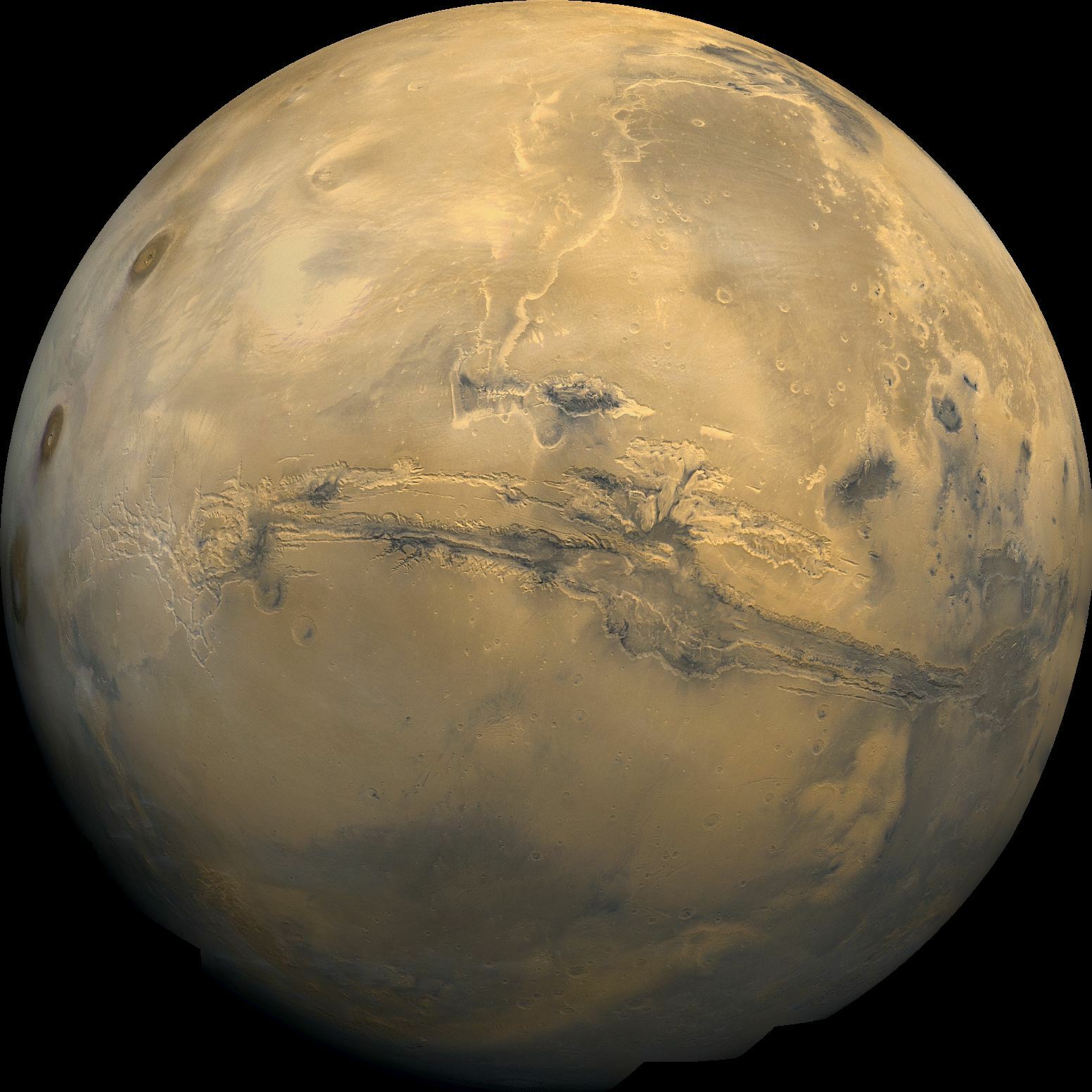
Unexpected radio bright spots discovered around the South Pole of Mars could be caused by a layer of ice on volcanic rocks, according to a new study.
In 2018, a team of researchers spotted a region with unusually bright radio reflections at the ice cap of Mars’s South Pole, using data from a radio instrument called MARSIS on the European Space Agency’s Mars Express Orbiter spacecraft. That detection launched a scientific debate that hasn’t slowed since.
Pockets of liquid water under the surface could have explained the readings, says Cyril Grima, a planetary scientist at the University of Texas and lead author of the study published in the journal Geophysical Research Letters. But that was a puzzle for the scientific community because water, underground but not too deep, would generally require a lot of salt and a source of heat to stay liquid on a world where surface temperatures hover around minus 80°F.
To study a problem such as this, researchers typically substitute a material on Earth for what they expect to exist on Mars. By testing the properties of this analog, they’ll see whether they can recreate the strong radio reflections that MARSIS recorded.
But that method has an important limitation. No matter how closely researchers study a material on Earth, they can’t know if and how the exact same thing exists on Mars. Instead, Grima and his team took a different approach, using years of radio data from MARSIS that cover the entire planet.
Exploring that data allowed them to ask the question: Would it be possible to produce equivalently bright radio regions outside of the Martian South Pole, if the layer of polar ice extended across the entire surface of the planet?
The team modified the MARSIS data to simulate the way the radio signals would change passing through a global sheet of dirty ice. In their simulation, they found that this sheet of ice could, in fact, produce similar radio bright spots, providing another plausible explanation. That makes it less likely the readings were caused by liquid water, Grima says.
In contrast to relying on analog materials on Earth, researchers have a pretty good idea of the contents of Mars’s polar ice, he says. Grima’s team used the same estimate of its composition as the 2018 team.
[Related: Sorry, there’s probably no water under the South Pole of Mars]
It’s a good study, though like all hypotheses surrounding the bright spots, “it also requires its own assumptions in order to make it work,” says Gareth Morgan, a planetary geologist at the Planetary Science Institute who specializes in icy and volcanic planetary terrains and works with data from a similar radio instrument called SHARAD. He points out that what scientists know of the polar ice’s composition is limited to the same kind of measurements—radio—as the subsurface measurements. He hopes in coming years scientists will be able to more precisely determine the composition of the poles to answer these questions.
Only certain types of salt water might be able to stay, just barely, in liquid form at such low temperatures, Grima says. Researchers have explored other materials that could produce similar signals. Some clays could produce the radio signals, or possibly patches of volcanic basalt rock if it’s “really dense and really rich in iron,” Grima says. There could also be a combination of clay and basalt rock that explain this, he says.
It’s also possible that the Martian bedrock is covered in layers of frozen carbon dioxide plus frozen water. This would alter the way they reflect light, possibly causing a bright spot, sort of like how “when you have your glasses that are coated with a very thin film, you change the reflectivity properties of it,” Grima says.
Despite the myriad of possible explanations, the debate over what caused the polar bright spots is far from settled.
“I think that the approach is interesting,” says Elena Pettinelli, of Grima’s study. Pettinelli is a geophysicist at the Roma Tre University in Italy who was part of the 2018 team that discovered the bright spots and proposed liquid water as the explanation. Pettinelli is an author on a new study that tried to show why clays and salty ices couldn’t explain the bright spots. The authors used a combination of in-depth material measurements in the lab and theoretical models to scrutinize these alternate explanations.
She’s also critical of the idea that basalt can generate such strong radar signals and thinks, based on her team’s previous work. Basalt rock “would explain only 25 percent of the strong reflections detected by MARSIS,” she says. Salty liquid water could explain all the bright spots, in her view.
Pettinelli’s paper will be part of a continued back and forth between research teams, Morgan says. “The paper is really important because what it shows is that this is going to take a lot of work to get to the bottom of.” But that debate is a good thing, he says, because of the “huge implications” of finding liquid water on Mars.
In fact, the field of planetary science hasn’t seen this kind of rush of new Mars papers in decades, Morgan says. Perhaps only the Allan Hills 84001 meteorite, found in 1984 which some scientists believed contained evidence of Martian microbes, has caused such a stir.
Grima’s study was based on three years’ worth of MARSIS data, which is now 10 years old. The instrument has been continuously collecting more in the meantime, Grima says, which means there’s about 15 years of data that hasn’t yet been used. He hopes to delve into it in future research to answer these questions.