
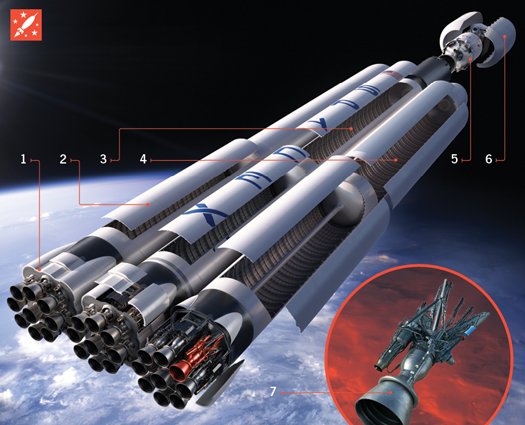
When the firm SpaceX launches its Falcon Heavy rocket into space late this year, the craft will become the mightiest rocket in the world. Only NASA’s Saturn V, which sent Americans to the moon, has ever generated more power. In rockets, the most important measure of power is thrust. Falcon Heavy’s 27 individual booster engines together generate 3.8 million pounds of thrust—enough to lift the 3.1-million-pound rocket and its 117,000-pound payload toward low-Earth orbit. The rocket’s success is critical for both SpaceX and the U.S. space program: The Air Force has already hired SpaceX and its Falcon Heavy to send two satellites into orbit sometime in 2015.
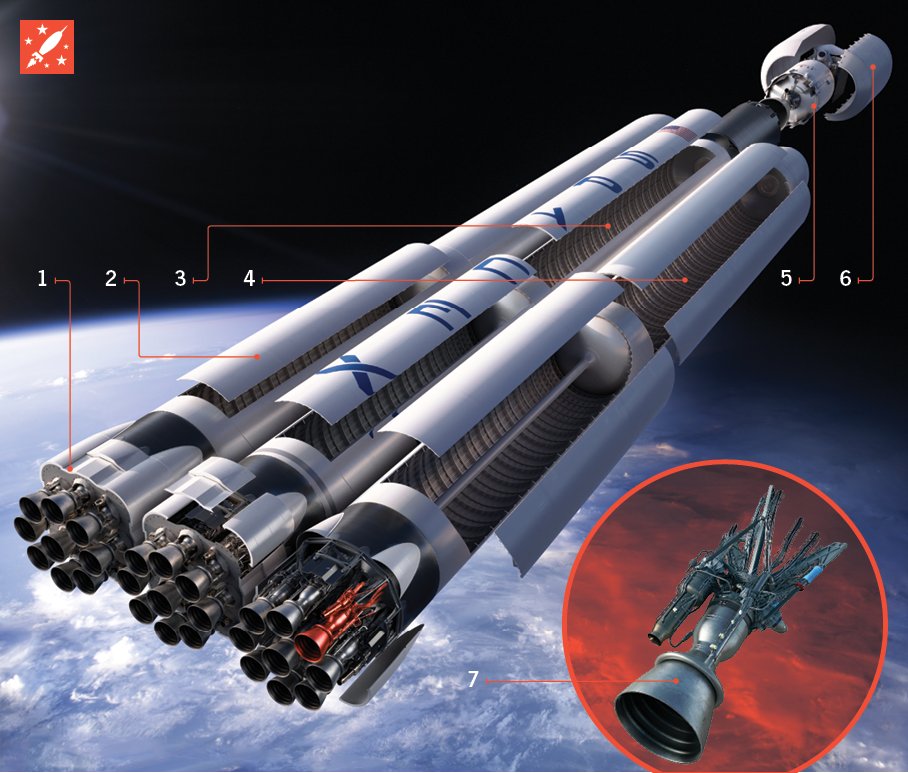
The Falcon Heavy Rocket
The Falcon Heavy Rocket:  Nick Kaloterakis

1) ENGINE CLUSTER
Nine SpaceX Merlin 1D engines sit at the bottom of each of the craft’s three cores, or boosters. The engines are identical to those on SpaceX’s Falcon 9 rocket.

2) FIRST STAGE: THREE ROCKET CORES
Falcon Heavy’s first stage consists of three cores. All three cores operate together at liftoff. About T+2:45 minutes into flight, the center core throttles down while the two side cores continue at full thrust until their fuel is nearly spent. At that point, pneumatic separators release the side cores, which plummet into the ocean, and the center core throttles up.

3) CENTER CORE
For payloads heavier than 100,000 pounds, Falcon Heavy uses a cross-feed system to run fuel from the side cores to the center core, leaving the center core almost fully fueled after the side boosters separate. What’s left is the equivalent of a complete Falcon 9 rocket already high in space.

4) FUEL TANKS
A liquid-oxygen tank at the top of each core feeds the engines through a center tube; the lower portion of the tank contains rocket-grade kerosene. The propellants are turbo-pumped into each Merlin engine’s injector, where they are mixed and fed into the combustion chamber.

5) SECOND STAGE
Powered by a single Merlin 1D engine modified to operate in the vacuum of space, the second stage delivers the final push that gets the payload into orbit. The engine can shut down and reignite as needed, enabling Falcon Heavy to deliver multiple payloads to different orbits.

6) FAIRING
Falcon Heavy can carry either a Dragon capsule—SpaceX’s free-flying spacecraft, currently used to resupply the International Space Station—or up to 117,000 pounds of payload (think multiple military and commercial satellites) enclosed in a shell 45 feet long and 17 feet in diameter. The fairing consists of two clamshell-style halves made of an aluminum honeycomb core and carbon-fiber face sheets. When the second stage nears the desired orbit, pneumatic pushers split the halves apart, exposing the payload.

7) MERLIN 1D ENGINE
A single Merlin 1D generates 147,000 pounds of thrust at sea level, burning rocket-grade kerosene and liquid oxygen fed by a turbo-pump into the combustion chamber. Falcon Heavy’s liquid propellant has an advantage over solid fuel: Liquid-fueled engines can stop and restart in flight, whereas solid-fuel engines burn until they are spent. Through proprietary adjustments that SpaceX won’t disclose, engineers recently lightened the engine to increase its efficiency, making it the most efficient rocket booster engine ever built.

Peek Inside
Peek Inside: The SpaceX Falcon Heavy will be the world’s most powerful rocket when it launches later this year. It can carry a payload of up to 117,000 pounds in its clamshell fairing. The fairing is shown here open with the payload exposed, but on a mission it would remain closed until the first stage has separated and the second stage has nearly reached orbit.  Nick Kaloterakis

TIMELINE OF A LAUNCH

T – 3:00:00
Falcon Heavy is ready on the launch­pad at Cape Canaveral. Engineers time liftoff to achieve the optimal flight path and desired orbit.

T – 0:10:30
The countdown begins. All actions from here forward are pre-programmed, although Mission Control can abort the mission at any time.

T – 0:02:30
The launch director issues the final launch command.

T – 0:00:40
Propellant tanks are pressurized.

T – 0:00:03
First-stage engines ignite.

0:00:00
The onboard rocket computer commands the launch mount to release. Liftoff.

T + 0:01:25
The rocket reaches maximum aerodynamic pressure; mechanical stress peaks.

T + 0:02:45
The rocket has now burned enough fuel (thus decreasing its mass) that the center core engines can throttle down.

T + 0:03:00
The side cores separate and fall into the ocean, while the center core’s nine Merlin engines continue to burn for approximately 30 seconds.

T + 0:03:30
The second stage separates from the remaining first-stage core. The second-stage engine ignites and continues toward orbit.

T + 10–20 MINUTES
When the rocket nears the desired orbit, the two halves of the clamshell fairing open and fall away. When in position, the payload separates from the second stage. Both the fairing and second stage eventually fall back to Earth.

STATS

Total Thrust: 3.8 million pounds
Maximum Payload: 117,000 pounds
Number of Engines: 28
Size of the Fairing: 45 feet by 17 feet in diameter

See the rest of the articles from our 2013 How It Works section here, and see all of our April issue here.

33 Comments

lanredneck

from Northfield, Vt

better question....can i use this design in kerbal space program....

Trust is too slow to move an object, it is like dragging a heavy object into motion, why not pulse? the heart beat burst the blood before blood thrust anther blood to circulate in our body. try to build a rocket with same size as bullet, I am sure that the bullet can blastoff 4-10 times faster than a rocket. Firing a bullet it is like a pulse. A continues pulsated bullet can double the blast off. (JUST A THOUGHT)

"Only NASA’s Saturn V, which sent Americans to the moon, has ever generated more power."

Everyone always forgets about Energia

The author got the quote a bit wrong. The Space Shuttle and Energia/Buran both had more thrust (power) than the Falcon Heavy. But the Falcon Heavy can carry a larger payload to orbit than either, the largest in fact since the Saturn V. Hence the confusion.

If the Energia program had been continued they doubtless would have finished development of an upper stage capable of placing a payload into orbit without using Buran. This would have resulted in a much higher payload than the Falcon Heavy, but the only rocket which reached orbit required Buran to do so.

Wouldnt it be time to STOP usign pounds - specially in a science related newspaper.

To Roboy23 - indeed firing a bullet is like a pulse - however to reach the velocity of 8 km/s to place a payload on an orbit you need a huge gun: the bullet velocity depends upon the lenght of the gun - remember the failed 50 m long gun constructed by Saddam Hussein to hit Iranian targetts few hundred kms away, during the Iraki-Iranian war. It never worked.
Another problem with such a "pulse" approach: the huge acceleration - most of the equipement/satellites could not sustain such accelerations.
And the solution is impractible to send human being into space!

Pulse! Sending human goo into orbit.

Could the Falcon Heavy do moon missions? If you weren't going to send 117,000 pounds up, would you be able to go far enough?

According to Wikipedia, Energia could and did carry a larger payload than Falcon Heavy(Buran/Polyus).

Bagpipes, good question

Saturn V
Payload to LEO (Low Earth Orbit) 260,000 pounds (120,000 kg)
Payload to TLI (Trans Lunar Insertion) 100,000 pounds (45,000 kg)

Falcon Heavy
Payload to LEO 117,000 lb (53,000 kg
Payload to TLI Unspecified

It seems one Falcon Heavy would not be up to the job, however, two could do the job. The first falcon would launch the unmanned Lunar Orbit Tranfere Modual and Lander, the second Falcon would launched the manned crew modual which would dock with the former and off ya go. If the LOTM could be made resuable then it could be parked near the I.S.S. inbetween missions. A smaller Falcon could refuel the LOTM.

Our economy will not build any of this; sadly it’s all fantasy at the moment.

Perhaps times will change after that money-pit fusion energy making machine ever gets working...

maybe.

I know the shuttle was not an economical proposition, but it seems such a waste to "drop" the boosters after a couple of minutes use. I hope Space X can compete internationally. Apparently they are working on a way to recover and re-use their boosters and I hope they will be successful.

@Anylcon

You do realize that the rocket has been built and demonstrated already, right?

Pretty drawings, but littered with factual errors.

1. "Through proprietary adjustments that SpaceX won’t disclose, engineers recently lightened the engine to increase its efficiency, making it the most efficient rocket booster engine ever built."

The Merlin 1D is not, in fact, the most efficient liquid rocket engine ever. It may have the highest thrust to weight ratio, but that does not make it the most efficient. Rocket engine efficiency is measured in a unit called specific impulse, much like the the MPG of a car. The unit is determined by dividing the thrust of the rocket (lbf) by the mass of the fuel consumed per second (lbm). For example, a rocket engine with a thrust of 1000 pounds (1000 lbf) and a propellant burn rate of 10 pounds per second (10 lbm / sec) has a specific impulse of 100 seconds (the force and mass units cancel).

The Merlin 1D has an Isp (specific impulse abbreviation) of 311 seconds in a vacuum. The most efficient rocket engine in the world, the Space Shuttle Main Engine (SSME) has a vacuum Isp of 452 seconds, making it more than 45% more efficient than the Merlin 1D. This is due to many reasons, including a more advanced staged combustion pump system and using LH2 (liquid hydrogen) as a fuel instead of RP-1 (rocket-grade kerosene).

Does the higher thrust/weight ratio of the Merlin 1D have advantages? Absolutely. The decreased mass of the engines make the rocket lighter with the same amount of thrust. However, the higher specific impulse of the Space Shuttle Main Engines are far more advantageous as they are far more efficient. This is derived from the Tsiolkovsky rocket equation, which can be written as Δv = Isp * G0 * ln(Mf/Me), where Δv is the change in velocity, Isp is the specific impulse, G0 is standard gravity (32.2 ft/sec^2), and Mf/Me is the ratio between mass of the vehicle fully loaded with propellant and the mass of the vehicle after propellant depletion.

To keep things simple, the 45% higher Isp of the Space Shuttle Main Engine means that if all things were equal, the Space Shuttle Main Engines would be able to accelerate the vehicle to a speed 45% faster than that of the Merlin 1D. The lighter weight of the Merlin 1D comes into play, but because the change in velocity is directly correlated only with the natural logarithm of the mass ratio (full / empty), and because the mass of the engines is relatively insignificant compared to the mass of the rest of the vehicle (if the Merlin 1D were to have the same thrust/weight ratio as the Space Shuttle Main Engine, the full mass would increase by ~1%), the higher thrust/weight ratio of the Merlin 1D is pretty much insignificant.

The significance of the Merlin 1D is in its affordability and simplicity—not its efficiency.

2. "When the rocket nears the desired orbit, the two halves of the clamshell fairing open and fall away."

The fairing of the Falcon Heavy (and the Falcon 9) would be jettisoned almost immediately after first stage separation. At that point (over 100km in altitude), the vehicle is well above more than 99.9% of the atmosphere and the fairing would not be needed to protect the payload from aerodynamic loads. There's no reason to expend propellant (and thus decrease the useful payload) accelerating the fairing to near orbit. Additionally, keeping the fairing suborbital would cut down on space junk (although an object with a drag area / mass ratio as high as a composite payload fairing in a non-ideal orbit would undergo rapid orbital decay and fall back to earth).

3. "For payloads heavier than 100,000 pounds, Falcon Heavy uses a cross-feed system to run fuel from the side cores to the center core, leaving the center core almost fully fueled after the side boosters separate. What’s left is the equivalent of a complete Falcon 9 rocket already high in space."

That's not the most important part. Rockets spend the vast majority of their propellant reaching orbital velocity (>17,000 mph), not gaining altitude.

*************** bit.ly/YniJRv **********
I'm creating $86 associate degree hour engaging from home. i used to be appalled once my neighbour told Pine Tree State she was averaging $95 however I see however it works currently. I feel most freedom currently that i am my very own boss. this is often what I do,
*************** bit.ly/YniJRv **********

Just think of all the fuel they could have saved if they would launch from 10,000 feet or more. Might even use earth based energy to get a push start.

Better still, I like the natural gas cannon idea. Build a large cannon powered by a propellant that can propel a projectile into orbit. You'd need some pretty strong packaging but stuff like water, food and other items could be blown into orbit.

"Just think of all the fuel they could have saved if they would launch from 10,000 feet or more. Might even use earth based energy to get a push start."

Not much—most of the fuel is spent accelerating the vehicle to orbital speeds (>17,000 mph), not gaining altitude. A higher launch would be advantageous in that the engines can be designed to accommodate a narrower range of ambient pressure, but not much besides that. Furthermore, there is no practically way of launching a rocket this big from 10,000 feet.

"Better still, I like the natural gas cannon idea. Build a large cannon powered by a propellant that can propel a projectile into orbit. You'd need some pretty strong packaging but stuff like water, food and other items could be blown into orbit."

Ignoring the feasibility (or lack thereof) of such an idea, the aerodynamic forces acting on the projectile would be enormous. It would be like traveling eight times the speed of a SR-71 but at sea level.

Euphanized09,
D'Oh! LOL

THE STORY OF ELON MUSK IS THE STORY OF THE AMERICAN DREAM. THE FACT THAT THIS YOUNG MAN WAS BORN AND RAISED IN SOUTH AFRICA THEN MOVED TO CANADA THEN MOVED TO THE UNITED STATES OF AMERICA WHERE HE FOUNDED SEVERAL HIGHLY SUCCESSFUL COMPANIES AND TODAY IS CHANGING THE WORLD THROUGH SPACE X SOLAR CITY AND TESLA MOTORS. SPACE X IS REVOLUTIONIZING THE SPACE INDUSTRY SOLAR CITY IS REVOLUTIONIZING THE ENERGY INDUSTRY AND TESLA MOTORS IS REVOLUTIONIZING THE AUTOMOTIVE INDUSTRY. SPACE X IS CHANGING THE GAME AND HOW THE GAME IS PLAYED AND ELON MUSK WILL CONTINUE TO SUCCEED BECAUSE IN ORDER TO BE SUCCESSFUL AS A BUSINESSMAN OR BUSINESSWOMAN YOU HAVE TO HAVE MONEY BUT YOU ALSO HAVE TO HAVE A VISION AND ELON MUSK HAS BOTH.

SPACE X MAKES UNITED LAUNCH ALLIANCE (BOEING & LOCKHEED MARTIN) AND OTHERS IN THE SPACE INDUSTRY LOOK LIKE AMATEURS

madscientist8;

Your information is accurate and interesting, however I think a little off base.
1. The article should have read that the Merlin 1D is the most efficient kerosene powered rocket engine. You are correct in that hydrogen engines and other types such as ion drive have higher isp.
2 & 3. This is for general public and not a scientific paper. Terms such as near orbit or high in space do not have precise meanings and you are being overly picky providing your own definitions of these terms, then saying they are not accurate.

It is also a bit disingenuous to compare the Falcon Heavy to the Saturn V. The Saturn V launcher was rated for manned missions, while the Falcon Heavy is currently not.

@Roy_H

1. Actually the Merlin 1D is not the most efficient kerosene liquid rocket engine. I don't know which engine is but just off a quick Wikipedia search, the RD-180, which powers the Atlas V vehicles, has a SL/vac Isp of 311/338, whereas the Merlin 1D is 282/311. Like I said earlier, the Merlin 1D is notable for its affordability and simplicity, the latter of which undoubtedly contributes to its high thrust-to-weight ratio.

The Merlin 1D may be the most efficient gas-generator cycle kerosene rocket engine, but that's far less significant than the title of being the most efficient rocket engine, which is what the article erroneously claims.

2. I'm interpreting the terms used by the article pretty literally. "Near orbit" to me is somewhere close to being in the state of orbit. The Falcon launch vehicles (and almost all other rockets for that matter) jettison the fairings just a few seconds after second-stage ignition. At that point, the vehicle is traveling at less than half its orbital altitude, less than a third of its orbital speed, and about three minutes into a ten-minute mission. I don't see how that is anywhere "near orbit." The article puts fairing separation at T+10 minutes when it should be around T+3 minutes.

3. This is one of the biggest misconceptions in orbital spaceflight and PopSci, in this case, is just fanning the flames. Reaching orbit is not about altitude, it's about speed. So no, the concept of a Falcon 9 already high in the atmosphere is not an accurate depiction of what the Falcon Heavy does. I think this is a completely reasonable expectation of a science-based magazine.

@riff_raff

The Falcon Heavy is, like the Falcon 9, man-rated by design. That means it meets the NASA criteria for carrying humans, but it hasn't gone through the certification process yet.

"...time to stop using pounds."

Nope, this is an american publication, meant for public consumption, and as such should use the units common to our country. That is the standard system, not the metric system. Want to read everything in metric? Read the euro version.

"SPACE X MAKES UNITED LAUNCH ALLIANCE (BOEING & LOCKHEED MARTIN) AND OTHERS IN THE SPACE INDUSTRY LOOK LIKE AMATEURS"

Yeah, I see what you mean. Being able to use boeing/lockheed/nasa designs and engineers to model 1 new rocket designed solely for orbital missions. That clearly is superior to the decades of building rockets from nothing, r/d, and missions from orbit to now interstellar space.

Spacex is pretty cool. ..that in no way means that the other companies havent accomplished more, and r equivalently awesome things in their time.

Thanks madscientist8 for your detail insight.
That's probably why there's a rumor they may switch to staged cycle type for the Merlin 2...

Btw, since there's additional separation of the booster from the center core make Falcon Heavy a 3 stage rocket system ?

Belatedly, MD1 efficiency:
I've read often over the past few months about how the MD1 isn't the most efficient rocket engine ever and IMO there's a small mis-communication involved.
I don't think that Musk ever intended to imply a higher Isp to the engine. I think that he could've been clearer in what he meant, which (again IMO)was that SpaceX has the best engine for economically (money and effort) getting to orbit. It kind of fits the way he speaks in general.
While the SSME is arguably the most awesome and energy efficient chemical rocket engine built, when you consider the cost, maintenance, and length of turnaround time it shines less in the light of practicallity. With present technology at least the T/W issues of present LH/LOX engines and the increased weight of the rocket itself to accommodate LH fuel effect time ratio of vertical flight to horizontal flight you have the Earth taking back much of the theoretical "top speed" the engine can supply before getting to orbit.
I've no aptitude for engineering but it seems an engineer/entrepreneur would see "efficiency" a little different than a scientist or pure engineer.
I would love to be corrected if I'm offbase.

Okay: M1D

@Rain1

"Btw, since there's additional separation of the booster from the center core make Falcon Heavy a 3 stage rocket system ?"

Ehh, sort of but not really.

While the Falcon Heavy uses two boosters that are identical to the first stage, the boosters wouldn't necessarily be considered an additional stage. Imagine if the boosters stayed attached to the vehicle all the way until first stage separation—in that case, it's just a bigger first stage system. The detachment of the booster cores before first stage separation doesn't really change this.

On the other hand, the space shuttle used two solid rocket boosters which detached, and yet the space shuttle isn't considered a single stage system. This form of staging is called parallel staging. Why isn't the Falcon Heavy's boosters considered parallel staging and thus part of a three-stage system? Because historically, heavy variant of launch vehicles with side boosters weren't considered to have an extra stage.

So technically speaking, does the Falcon Heavy have three stages? Yes. Does anyone consider the Falcon Heavy a three stage launch vehicle? Not really, simply out of habit.

Regarding the rumored staged combustion cycle for the Merlin 2, I've definitely seen this and it'll be interesting to see how they decide what to do for the Merlin 2. Staged combustion is much harder than a gas generator cycle, but the Isp tradeoff may be worth it. An alternative is to feed the turbopump exhaust into the nozzle, forming sort of a kind of film cooling system (much like the F-1 engine).

@leapalong

I found SpaceX's descriptions of the engine to be completely technically correct—the problem is that people misinterpret what they say and mistake T/W ratio for efficiency.

Regarding efficiencies/performance/cost-effectiveness, I definitely think what SpaceX is doing is on the right track. The SSME engineers figured that if they were going to build the premiere space transportation system for the next few decades, they might as well make it ultra-efficient. I guess nobody thought it would end up costing as much as it did and be as hard as it ended up being.

But, LH2 is certainly not obsolete from a cost-effectiveness standpoint. It'll be interesting to see how this works out in the future but LH2 is still considered the ultimate chemical propellant and if space is to be normalized, I can definitely see the investment of LH2 engines to be worthwhile.

SpaceX used to publish direct lunar injection capability for falcon 9 and falcon heavy on there website, but that's been gone for several years now. Wikipedia speculates that it has 35,000 lb lunar injection capability. But unless your sending people you'd be better off having the propulsion built into your LEO payload and doing a low energy transfer instead of a direct injection. A chemical low energy transfer could allow you to double your payload, you could get even more if you used an electric propulsion.

@madscientist8

:On the matter of efficiency you must also account for the non trivial mass increases of using a cryogenic fuel especially hydrogen with its very low density which leads to a huge tank and lots of insulation. Liquid hydrogen is a rather unattractive choice in fuel these days, solid hydrogen slush on the other hand may very well be the fuel of the future. My favorite would be a kinetically launched ram jet first stage liquid lithium tripropellant second stage and a CH4 O2 orbital stage.

:The cross fed configuration of a falcon heavy will approach the efficiency of a three stage rocket.

Since the huge amount of propellant required to lift the heavy rocket is mostly used to get from a standing start to 30% of escape velocity, why not eliminate the standing start and give the rocket a boost using low tech and reusable options.

For instance putting the rocket in a tube on a cylinder head and then using hydraulic pressure from the weight of water and gravity to lift the cylinder perhaps up to several ten's of metres per second, the rocket itself would not need to be started until the cylinder reached near ground level. Gravity can be enhanced with additional pressure from gas, steam or a mechanical device.

Water can be stored slowly over time in huge elevated cylinders connected to tubes and a telescoping cylinder that effectively starts the initial lift and rapid acceleration of the whole rocket from under ground in a silo similar to older model ICBM's.

The water is reusable, the lift cylinder collapses as the water is removed and pumped back into the reservoirs and a larger payload or longer range rocket can be used to make space lifting more affordable.

@adaption true the Energia was much more powerful then Falcon heavy and infact was comprable to the Saturn V INT-21.
In fact if they ever built the full version of Energia the Vulkan with eight Zenit boosters and an upperstage it would have displaced the Saturn as the most powerful LV in history lifting 175 tons.

@leapalong It is partly true the Merlin 1D is the most effiecent gas generator cycle kerolox engine ever built beating out the F1 and the RS-27.
As far as ISP goes just about any staged combustion engine such as the AJ-26 or hydrogen engine such as a SSME or RS-68 will beat it.
But the Merlin is much cheaper to produce then most other engines because of it's simplicity.
ISP is not as important as thrust to weight on a first stage which is while many rockets make use of solid stages which have even worse ISP then a GG cycle hydrocarbon engine.

bmxmag-ps