
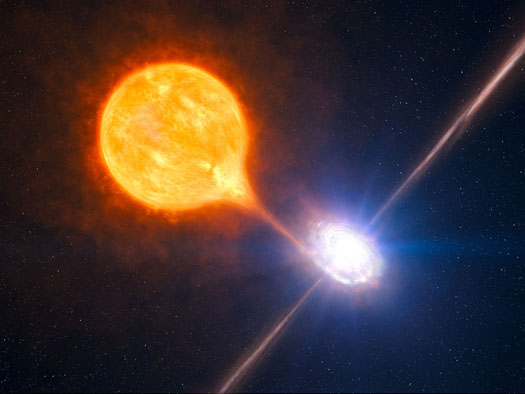
The ESO's Very Large Telescope, with help from NASA's Chandra X-ray Observatory, has found the most powerful pair of jets ever witnessed ejecting from a small, stellar-sized black hole. But while the black hole (by black hole standards, anyhow) is small enough to be classified a microquasar, the jets are anything but tiny, sufficiently powerful to spawn a giant, fiery gas bubble 1,000 light years across.
The gas bubble is twice as large and tens of times more intense than gas bubbles associated with other microquasars. The gas bubble feeds on the collimated jets emanating from the black hole, which pump fast moving particles into the interstellar gas surrounding the black hole. As that gas heats up and expands, the bubble inflates at a rate of nearly 621,000 miles per hour.
On a cosmic scale, those numbers may not seem so exciting, but it's the relative size of the black hole that's so astonishing. Robert Soria, one of the co-authors of the Nature article reporting the discovery, puts it into perspective: "If the black hole were shrunk to the size of a soccer ball, each jet would extend from the Earth to beyond the orbit of Pluto."Judging from the size of the bubble, researchers determined that the hot jet activity must have been going on for at least 200,000 years. But at 12 million light years away, this bright, white-hot ball of gas is tougher to get a good look at then one might think. Lucky for you, you can get a high-res look at the above pic, courtesy of the European Southern Observatory, via the link below.

138 years of Popular Science at your fingertips.
Each issue has been completely reimagined for your iPad. See our amazing new vision for magazines that goes far beyond the printed page
Stay up to date on the latest news of the future of science and technology from your iPhone or Android phone with full articles, images and offline viewing
Featuring every article from the magazine and website, plus links from around the Web. Also see our PopSci DIY feed
Science is reinventing play, from extreme sports to gamification to ridiculous roller coasters to the playgrounds of tomorrow, and this issue is chock full of fun. Also, on a less fun note: Did global warming destroy my hometown?
The image is just an artist rendering, I don't know of the existence of such detailed image of a star in a faraway galaxy.
I think the actual images are in the paper: www dot eso dot org/public/archives/releases/sciencepapers/eso1028/eso1028.pdf
Much less exciting, I know, but real.
I thought only Hawking radiation escaped from a black hole. Why doesn't the black hole swallow the gas bubble? How does the gas which apparently accelerates to escape velocity get propelled from it?
Things can orbit a black hole same as any massive object. As for the rest of your question, there are a lot of numbers and symbols in the answer.
Looks more like the black hole is drawing off matter from a red dwarf to me
Things can orbit a black hole, yes, but it looks/sounds like "stuff" is feeding the bubble. Like Ian1108, I didn't think much could escape a black hole, except at the ends where those jets are.
Those are not jets creating the fire bubble. The black hole is pulling on the the fire bubble. Nothing can escape the gravity of a black hole. Also I don't think it's a fire bubble. It's probably a dead or dying star.
@Alfi2009
Love that show.
I've looked a couple other places, and apparently the mini black hole belongs to a binary system, feeding off that star. The jets at the ends produce the bubble (not pictured here) that is referenced in the article. At least I'm pretty sure.
@boka Some particles do, hence the jets at the end of intense radiation.
the image is a bit misleading. it's a black hole siphoning gas off of a companion star.
while its true matter cant escape a black hole AFTER it crosses the event horizon, as matter is swirling in toward it the gravity is still weak enough to allow fast moving particles to escape. so while gas is being pulled in some of it is forced through the jets at ridiculous speeds (i think it has something to do with the black hole's magnetic field.)
the gas bubble is not pictured here, probably because the edge of the bubble is hundreds or thousands of light years away from the black hole.
Hmm I'm surprised no one has expressed humor in the fact that the black hole is passing gas.
@a posteriori: Well played, sir... Well played.
just posing the question: if it's siphoning off bubble/star why is it growing?
Wow! It looks as if the black hole was an exit point of travel and the matter being slowed down to a point of reconstruction is forming up to its' size again! I wonder if black holes are the existence of travel faster than sound and light? It would make sense that only energy could be consumed in its' existence! It would mean that one could only see the exit points of matter through light, but nothing could be seen through the entrance end for all matter is being transferred elsewhere at a speed faster than one could see! At the entrance it would look as if everything is being sucked in and de-constructed!
I just read the other comments and just wanted to point out that the article states the fiery object is being ejected not sucked into the black hole. If it were being sucked in, it may not show light around the hole for black holes would suck all of the light in. I could be wrong about that, but it seems logical at the moment! An object to be sucked into a black hole should look like it is just being distorted and/or de-constructed. In this case, passing gas would be correct!
It never ceases to amaze how much people will speak with such authority on things they know very little about. A black hole does not just consume, it also ejects material. The Chandra Space Telescope found that the gravity of Black Holes actually attract more matter than they can consume. The remaining material is jettisoned away from the black hole.
Nobody understands black holes. No one can speak with authority on black holes because they are all theories. Including yourself. We're talking about looking at a picture 4 billion years old and telling a story about exactly what is going on in that picture. Try to keep an open mind and not worry about being right or wrong, but by thinking of all the possibilities. Saying every black hole is the same is like saying every planet is the same.
I have to wonder if this picture is being misinterpreted by this article. The "bubble" in this artist’s rendition seems to depict a sun being devoured by a small black hole. The impressive feature of this quasar is: the proportions of the relatively small 15 km radius, and the jets streaming out hundreds of light-years on either side: An interesting micro quasar indeed.
I don't like the rendition, it doesn't show the whole thing...very misleading. It's drawing off a star, and the actual gas bubble forms around the star and black hole...ever seen pics of those big butterfly shaped nebulas? That's the bubble. The edge of the gas bubble is really, really far away from the star and black hole. It's 'fiery' because the particles being jettisoned from the black hole move so fast that it ignites the gas.
Well Im no Astro physicist but it would appear that according to the data from the story they are discussing, the accreation disk that appears to be building around the black hole is expanding at such a rate as to suggest that in another billion years or so we may see the birth of a new galaxy. I pay no mind to artists renderings as they are imaginings of the mind. If a black hole attracts enough particles, those particles should coalesce into huge gas clouds that evenutally will seperate according to mass and begin to form stars and planets and other stellar phenomena. I believe We are witnessing somthing akin to watching a zygote begin its transformation into a living being. A galaxy is born!
Yes of course a black hole will consume all matter around it eventually but truth be told, a black hole has a limited appetite and for all intents and purposes a finite existance. A black hole is like a very large mouth in space but evne a large mouth has its limits and while still collecting all matter to it, cannot swallow it all at once. Therfore I submit that were we able to watch this black hole over a period of a billion or so years we would see its growth. The milkyway galaxy is nothing more than the accretion disk of the supermassive black hole at its center.
I'm not an astrophysicist either, but my college roommate was. The bubble is caused by radiation pressure. Radiation emitted some distance away from a black hole can still escape. You don't think *we* are getting sucked into this black hole, do you? Of course not, we are too far away. Also, the black hole is spinning incredibly fast - matter accreting onto it accelerates this rotation. This rotation creates a dynamo effect - a superpowerful magnetic field. This is what accelerates the jets and tears apart atoms into ions that then are accelerated along magnetic field lines and collide, etc, forming exotic high-energy radiation like in a the new Large Hadron Collider... and it is this radiation pressure that pushes the clouds of gas away to form an empty bubble. The edge of the bubble is like the heliopause around our solar system -- it is where the black holes gravity is in equilibrium with the outward radiation pressure. They can measure the age of the black hole only from the length of the jets -- because those particles achieved escape velocity.
By "nothing escapes a black hole," it is only meant "once you've been absorbed into a black hole, you can never come back." Not that a black hole will eventually suck up the hole universe. There are balancing outward forces.
the idea of a black hole sucking up everything is completely ridiculous, but the explanation of it as a giant mouth is perfect, think of it as a really fat guy who eats for billions of years and then just stops eating, he can only eat things that are small enough for him to trap so when he finished there would still be everything big enough to escape him, he would have created an environment surrounding him in which only certain things could survive and would have created an ecosystem, within that ecosystem smaller ecosystems would develop, and within those even smaller systems, that is basically a universe created by that one realy fat guy. just a thought.