
We may earn revenue from the products available on this page and participate in affiliate programs. Learn more ›
It’s more affordable than ever before to take your home media viewing experience to new heights thanks to streaming services, smart TVs, and soundbars. With this increased content availability enriched by new surround sound audio formats, a whole new world of entertainment possibilities comes to light. One of the easiest, most space-efficient ways to drastically improve the quality of your TV (or 4K projector) audio is by upgrading to a soundbar to give you sound as vivid as the 4K video you’re probably enjoying. The top soundbars are compact, quick to install, and an unbeatable way to present your movies, music, and video games with elevated volume, clarity, and immersion. And many of them—like our best overall, the Sennheiser AMBEO Plus—sound great on their own but can be expanded with matching subs and satellites if you decide you want a bigger home theater experience down the road. If you’re looking for a quick and cost-effective way to upgrade your home theater system, we’ll help you find the best soundbars to do the job.
- Best overall: Sennheiser AMBEO Plus
- Best compact: Bose TV Speaker
- Best 2.1: Samsung BW-H550/ZA Soundbar
- Best 5.1: JBL Bar 700
- Best for music: Sonos Arc Ultra
- Best budget: Roku Streambar Pro
How we chose the best soundbars
We’re nerds about everything here at PopSci, but audio is especially special to us. The PopSci writers and editors even include a few certified audiophiles, so we know a solid speaker when we see it. We used a mixture of online research and hands-on experience to survey dozens of models on the market. We were looking for the right mix of fidelity, features, and price.
Most of the items on this list are relatively affordable, and that’s by design. There are some ultra-high-end multi-speaker Dolby Atmos and wireless surround options, but a components system is specific to very demanding users. If you’re looking to get into the soundbar world, these are great models to get you started and upgrade your TV’s puny audio performance.
The best soundbars: Reviews & Recommendations
Every living room, bedroom, and home theater is different, making finding the right soundbar frustrating. Our recommendations—both standalone units and soundbar + subwoofer combos—span various sizes and prices, so you can find the one that suits your space and budget. Unlike a traditional speaker system with an A/V receiver, a soundbar usually requires only a single connection to your television to switch between sources. These systems are often Bluetooth-compatible from the get-go, so you can also sync your tablet, phone, and other streaming devices. They’re versatile but able to fit into almost any room. However, we also focused on finding soundbars designed to work with additional speakers, allowing you to upgrade your home theater system over time as your budget and space change.
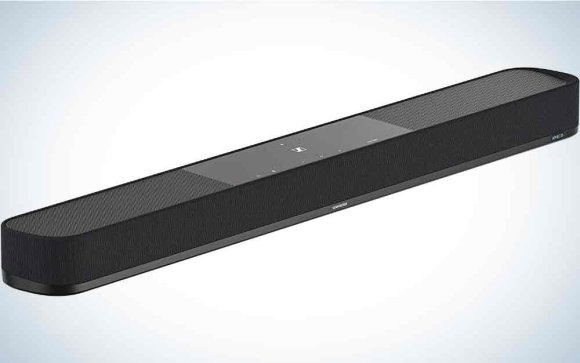
Best overall: Sennheiser AMBEO Plus
Pros
- Carries on a tradition of No. 1 all-in-one Dolby Atmos soundbars
- Proprietary Dolby Atmos virtualization is convincing and captivating
- Small than its predecessor without too many sacrifices
- Can be augmented with a subwoofer
Cons
- No option for physical surround speakers
- Pricey
- Subwoofer is an additional $599
- HDMI ports are 2.0a, so they don’t support all next-gen gaming console protocols passthrough
Specs
- Dimensions: 41.38 x 4.76 x 3.03 inches
- Surround sound: Simulated 7.1.4 Dolby Atmos
- Subwoofer: Built-in, with an additional wireless subwoofer sold separately
Why it made the cut: If you prize dynamic tonality, this is the premier soundbar … with a premium price tag.
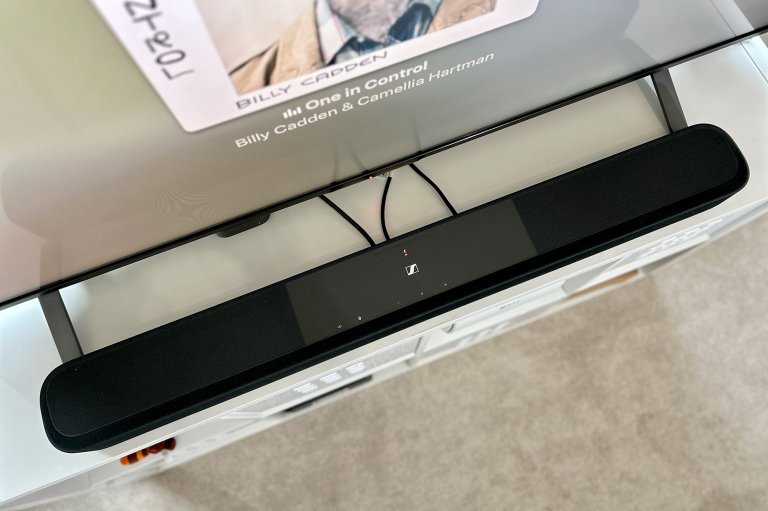
Descended from the Sennheiser AMBEO Max, a 40-pound behemoth of a soundbar, the AMBEO Plus is a $1,499 indulgence that’s not quite as extravagant as its predecessor yet remains nearly as affecting. Featuring seven full-range speakers and dual 4-inch subwoofers in its rounded-off chassis, the 14-pound Plus can virtualize a 7.1.4-channel Dolby Atmos system with striking clarity and precise imaging thanks to proprietary processing (an AMBEO batch physically lights up on the soundbar whenever engaged).
Coming from a venerable brand renowned for audiophile headphones imbued with rich midrange and spacious staging, the AMBEO Plus is every bit a Sennheiser. It’s sonically expressive without even a tinge of artificiality and technically adept enough to conjure every directional cue, even height effects—helped by an automated calibration system. A well-appointed Smart Control app (iOS and Android) lets you tweak soundfield effects, voice enhancement, voice assistants, night mode, EQ, and more, plus view information on your connections/audio streams. Whether watching movies or listening to music, the 400W AMBEO Plus is adept at scale and strength, preserving detail without sacrificing impact—bass reaches nearly 40Hz. The original 13-driver AMBEO—aka the rebranded Max—is still superior in terms of gripping slam and dazzling reflections (and $1,000 more expensive), as the AMBEO Plus folds channels in more like a 5.1.2. Still, the rumble gap narrows noticeably if you pair the AMBEO Plus with the wireless 8-inch 350W Sennheiser AMBEO Subwoofer.
In terms of connectivity, there any multiple HDMI ports with 4K Dolby Vision passthrough, though not 120Hz for gaming. Dolby Atmos, DTS:X, and Sony 360 Reality Audio are all decoded, and Bluetooth 5.0, Apple AirPlay 2, Spotify Connect, TIDAL Connect, and Chromecast give you access to content from basically any and every source. Yes, the AMBEO Plus is the most expensive soundbar in our selection, but it’s undeniably the best all-in-one soundbar to transform a room with limited room. If you’re investing in an OLED TV, you deserve audio that’s equally vibrant.
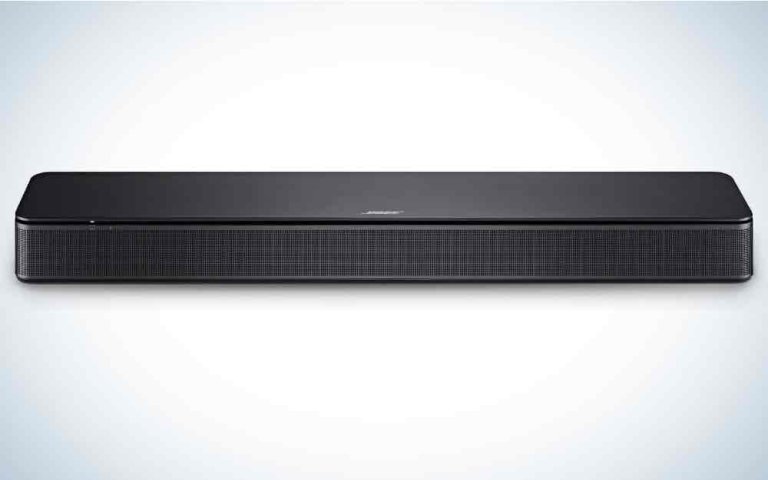
Best compact: Bose TV Speaker
Pros
- Compact size
- Selectable sound modes
- Voice enhancement
Cons
- No smart features
Specs
- Dimensions: 4.02 x 23.38 x 2.21 inches
- Surround sound: No
- Subwoofer: None
Why it made the cut: The TV speaker will provide great sound without taking up much space.
At 23.4-inches wide the Bose TV Speaker is almost half the size of other soundbars we’re recommending in this guide, but it stands tall when it comes to dialogue enhancement. The teeny, tiny shell houses a three-driver audio system featuring a pair of full-range drivers angled outward and a single tweeter pointed forward. This configuration is designed to offer the best audio quality from a 2.0 soundbar while presenting the widest-possible soundstage. The TV Speaker won’t be able to stand toe-to-toe with longer soundbars when it comes to stereo separation—this is physics, not Bose’s lack of engineering chops—but it’s good to see the company use the space it had as efficently as possible.
You can fill out the TV Speaker’s sound by connecting a Bose wired subwoofer to the system—though the price of adding low-end is $500. Thankfully, this augmentation won’t be necessary, as the TV Speaker’s sound should be sufficiently better than the audio system built into your set. Despite the TV Soundbar’s small size, Bose allows you to connect this soundbar to your TV using an HDMI or optical audio cable. It also features an AUX input, so you can plug an audio device into it directly, and Bluetooth support if you’d like to stream music to the soundbar from your phone, tablet, or computer.
Bose managed to fit most of the features found in its higher-end soundbars into the TV Speaker, but it had to cut support for Amazon’s Alexa. This isn’t a huge deal, but something to consider if you’re looking for a soundbar that doubles as a smart-home controller in your room. If that’s not a concern, and you want a compact audio system for your room, this is the soundbar to get.
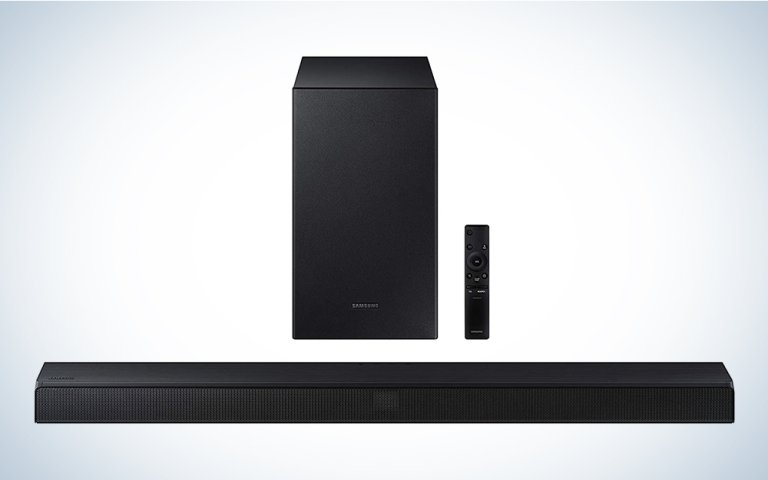
Best 2.1: Samsung BW-H550/ZA Soundbar
Pros
- Great sound
- Included subwoofer
- AI-driven sound adjustments
Cons
- Lacks Dolby Atmos
Specs
- Dimensions: 33.9 x 3 x 2.3 inches
- Surround Sound: Dolby Audio and DTS: Virtual X
- Subwoofer: Wireless included
Why it made the cut: This straight-ahead system doesn’t get bogged down with tons of features you won’t use and, instead, focuses on performance.
This Samsung soundbar sports three-channel audio and includes a dedicated center speaker and a satellite subwoofer for powerful, enhanced bass and 3D surround sound effects. It offers superior multi-connectivity via Bluetooth, allowing two smart devices to remain paired at once, and the HDMI ARC interface allows for single-cable audio connections to and from a TV with a compatible port.
Regarding surround, this bar supports DTS: Virtual X to simulate a system with many more speakers installed around the room. Samsung’s Smart Sound technology analyzes the content you’re watching and automatically adjusts its performance to match it best. That also helps keep subtle sounds like ambient horror sounds or important dialog from getting lost. But, if needed, you can manually trigger a Voice Enhancement mode. Want more rumble? A bass boost is available at the push of a button. Need less bass? There’s also a Night Mode.
The relatively basic black design is refreshing compared to more complex devices. It melts into the room, and you hear it but don’t necessarily see it. This is undoubtedly the best Samsung soundbar on a budget (though if you want a truly immersive experience, the $1,699 HW-Q990D is the best Samsung package, full stop).
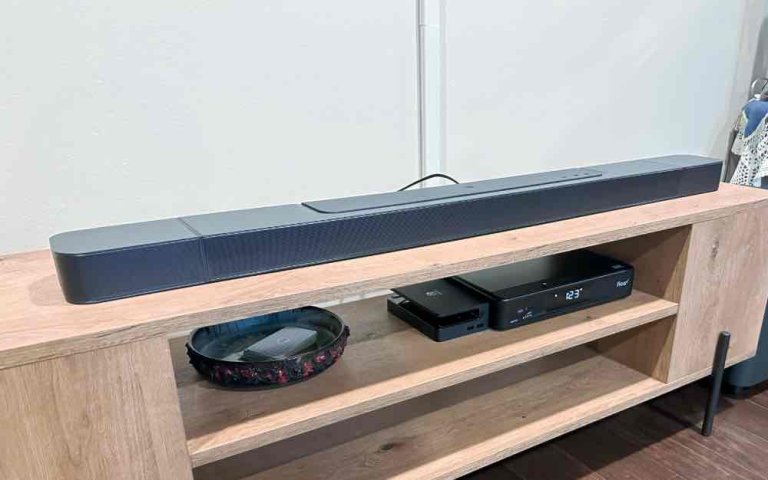
Best 5.1: JBL Bar 700
Pros
- Detachable speakers make it very flexible
- Powerful wireless subwoofer
- True surround sound
Cons
- Long when fully attached
Specs
- Dimensions: 4.7 x 46.2 x 2.2 inches
- Surround sound: 5.1 Dolby Atmos
- Subwoofer: Wireless included
Why it made the cut: This soundbar’s detachable, battery-powered speakers offer a truly authentic 5.1 surround experience.
There are a lot of soundbars that list support for surround sound as one of their features, but that’s not really the case. Designers can create a more 3D sound experience by supporting the right audio formats and positioning drivers in different positions to mimic a traditional 5.1 surround sound system, but it’s not the same as having a true multi-speaker system. JBL’s Bar 700 is different.
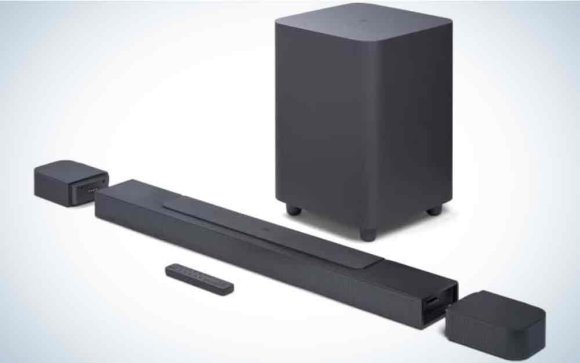
The 46.2-inch soundbar has a pair of battery-powered detachable speakers, which can be placed behind you to create a true 5.1, Dolby Atmos-compatible system, with the bar handling the front right, front left, and center channels. All of these speakers are synced up to a wireless 10-inch subwoofer, which adds enough bass to round out the sound without being unnecessarily boomy. I was skeptical about whether this system would work, but its 620W of convenient cinematic sound passed every test with flying colors.
It’s worth noting that the Bar 700 is pretty long when the rear speakers are attached, so you’ll need to ensure your media center/credenza has enough space. It’s a soundbar best paired with a TV that’s 55 inches in size minimum, and it’s easily connected via HDMI eARC (plus there’s an HDMI input with 4K and Dolby Vision passthrough). Beyond that, this soundbar is an excellent addition to your living room or home theater. The center channel has enough separation from the right and left that I could always hear dialogue clearly, even in movie or TV scenes with a lot of action. The center driver was good enough that I could also differentiate between different voices even if characters spoke in the same register.
My biggest concern about the Bar 700’s modular speaker system was that attaching and detaching the rear speakers would be a pain, but that was never the case. The magnetic attachment mechanism JBL developed makes these processes easy while also ensuring these additional speakers never accidentally pop out. The only other problem I foresaw with the Bar 700 was desynced audio. JBL mitigates this by running you through a setup procedure using its app (iOS and Android), which takes about five minutes to complete. The soundbar and rear speakers fire off audio to get a sense of the size and shape of your room. Once the setup was complete, I never had an issue with desyncing audio.
Bluetooth 5.0 and WiFi-equipped, the Bar 700 Wi-Fi comes with AirPlay, Alexa Multi-Room Music, and Chromecast built-in, so you can cast music/content from your phone if you don’t want to fire up your streaming device. And you can customize modes, voice assistant, and EQ with the JBL app. If you’ve longed for a surround sound system with discrete rear speakers but don’t have enough space (or outlets) to set up separates, JBL’s Bar 700 is a great solution. Just pop off the soundbar’s endcaps, fire up the rears on the couch corners, then reassemble at the night’s end or when it’s time to recharge the batteries (rated for 10 hours).
Like this concept, but want to kick it up several notches? The JBL 1300X is a 11.1.4-channel soundbar with detachable surround speakers and wireless subwoofer, though all those extra channels take the price from $899 to $1,699.
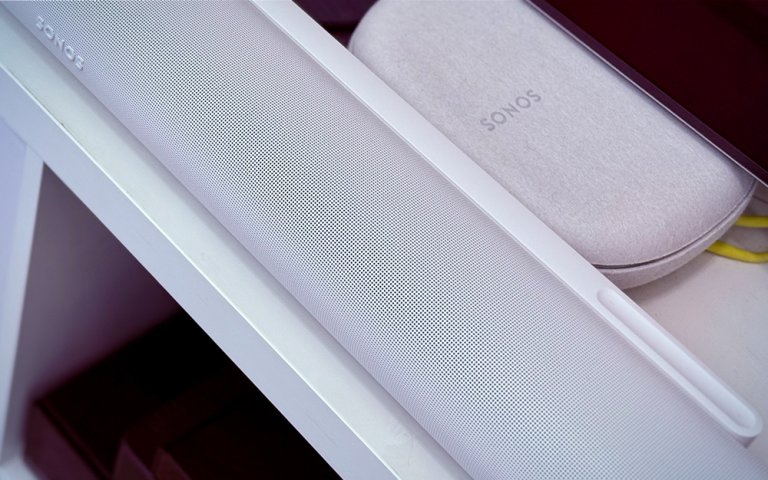
Best for music: Sonos Arc Ultra
Pros
- Midrange intelligibility and standout bass response
- Support for Dolby Atmos
- Can be augmented by additional speakers
Cons
- Cost
Specs
- Dimensions: 4.35 x 46.18 x 3.13 inches
- Surround sound: Yes, Simulated Standalone or True Dolby Atmos with additional components
- Subwoofer: Wireless sold separately (can support two)
Why it made the cut: The Sonos Arc Ultra is a futureproofed soundbar perfect for music lovers and cinephiles alike.
Four years in the making and worth the wait, the Arc Ultra is the second-generation flagship Dolby Atmos soundbar from Sonos, improving on its predecessor in many important ways. It’s a heightened experience in a slightly more low-profile form; it’s 12mm shorter, so you avoid blocking your screen, and it packs more drivers (14 total), so you get even more immersed in it. These include a new component Sonos calls Sound Motion—a four-motor, dual-membrane flat transducer that makes a noticeable difference in low-end and, shouldering the bass, aids in overall headroom and high intelligibility.
Sound Motion is why the Arc Ultra consistently one-upped any soundbar we’ve tested for bass performance. Any low frequencies, be it in movies we watched or music we streamed, were twice as visceral. Better still, this attention to bass didn’t detract from the Arc Ultra’s midrange or treble performance. With more reinforcement being handed off to Sound Motion, the six mid-woofers—combined with their custom waveguides—can concentrate on audibility. We got the sense that we were hearing what the audio engineers producing albums or soundtracks had in mind when mixing and mastering their sound. While we relied on speech enhancement settings in the past, the new array brought center-channel clarity that made toggling it optional.
This crisp, coherent presentation is carried over when experiencing audio in stereo as well as surround sound. There’s a surprising amount of Left/Right channel separation, though nowhere near the soundfield/imaging of discrete stereo speakers. Still, you could use the Arc Ultra as your sole living room speaker in a small space and not be disappointed (the addition of Bluetooth 5.3 alongside AirPlay 2 over Wi-Fi 6 makes it more convenient). But it’s spatial audio that really makes the Arc Ultra soar.
The Arc Ultra still supports all the same audio formats as the original Arc—including every flavor of Dolby, but still no DTS:X—and it shines while playing spatial audio albums and movie soundtracks. The 3D effect of audio coming from all sides is real and will be especially pronounced if you install the Arc Ultra in a square room where sound from the seven angled silk dome tweeters can reflect off the walls and ceiling. Adding additional Sonos speakers—like a pair of Era 300s as dedicated rear speakers—makes sound even more immersive, though it’ll roughly double the cost of your home theater setup. Similarly, pairing the soundbar with Sonos’ new Sub 4 will improve bass performance further. (You can pair any generation of Sub or Sub Mini, but you’ll need a Gen. 3 or 4 if you want a dual-subwoofer setup.)
While the Sonos Arc Ultra is undoubtedly a splurge, it’s worth the investment for anyone who wants an all-in-one home theater system with room for expansion as space and budget constraints allow. (And definitely consider your available surface, as the Arc Ultra is wide at 46 inches.) We wish it had more than one HDMI eARC port, but console gamers probably already have a TV with a dedicated slot.
We were also able to test the Arc Ultra using Sonos’ new Ace headphones, which have a feature that allows you to hand off audio from the soundbar to your ears. The Ace headphones support spatial audio, including head tracking, so music and movie soundtracks with a Dolby Atmos mix sound just as expansive and active. The effect of watching a movie on a big screen and seamlessly listening to it on headphones with a couple of button presses was thoroughly enjoyable.
Best budget: Roku Streambar Pro
Pros
- Built-in 4K media streamer
- Can be augmented with additional speakers
- Sharp look
Cons
- No surround sound
- No built-in soundbar
Specs
- Dimensions: 32.2 x 3.9 x 2.8 inches
- Surround sound: None
- Subwoofer: Wireless sold separately
Why it made the cut: Roku’s Streambar Pro has features you can’t find in soundbars several times its price.
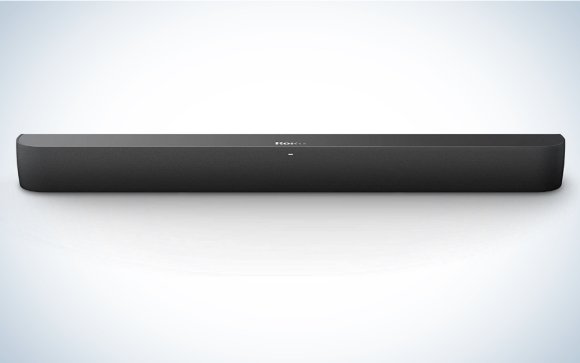
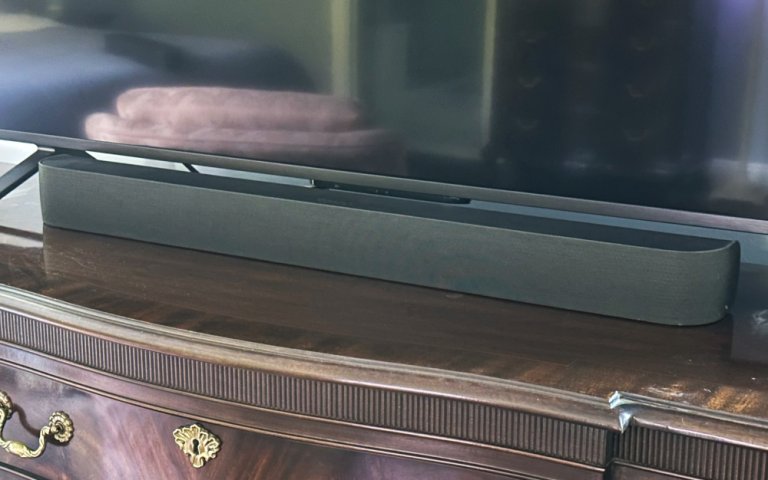
We’re typically wary of two-in-one gadgets, but Roku’s Streambar Pro is a very notable exception to our rule. The soundbar actually has an entire 4K Roku media streamer built into it, which you can use to turn an old TV smart. This is especially nice if you’ve recently cut the cord and want an easy way to stream TV shows and movies from online services. You don’t need to use the Streambar Pro’s built-in Roku, but the value of this feature is part of what makes this soundbar such a great deal.
The Streambar Pro’s other strong suit is its surprisingly good sound. We say surprisingly because we didn’t expect quite as much vocal clarity or stereo separation from a soundbar at its price point. If you’ve struggled to hear what people are saying in movies or find the sound of explosions lacking in action-packed sequences, this is your answer. Roku was smart not to pack any surround sound features into the soundbar itself, instead redirecting those engineering resources into developing its Wireless Bass Pro subwoofer and Roku Wireless Speakers. Adding those components will allow you to enjoy your media in true surround sound without connecting them with cables.
It’s telling that Roku bundles the Streambar Pro plus the aforementioned additional speakers in a multi-piece bundle that costs just over $500 (hence its prominence in our best soundbars under $500 roundup, also home to additional options from JBL, Samsung, and Sonos, appropriately). Bose charges roughly the same price for just a subwoofer. There are very few true values in home theater audio, so we couldn’t be happier for Roku’s Streambar Pro to stand out for its audio quality and cost.
Things to consider when buying the best soundbars
How big or small should your soundbar be?
One of the most convenient features of most soundbar systems is the understated form that helps them blend in with your existing entertainment center. It’s generally recommended that you choose a soundbar that doesn’t exceed the length of your television for aesthetic reasons. The length and size of the soundbar don’t always translate to volume and power, so you won’t be making too many compromises by going with a smaller soundbar.
The most important consideration when choosing a soundbar for its size is that it retains flexibility and versatility despite its understated appearance. Many miniature soundbars pack Bluetooth connectivity, subwoofers, and other special features into their cases without a hitch. You don’t have to worry about sacrificing essential features to ensure that your smaller rooms don’t get cluttered. After all, you’re buying a soundbar for its major improvements over your television’s speaker system.
What kind of surround sound are you looking for?
Some basic soundbars offer typical stereo sound, but many have adopted surround sound technology that can add an entirely new dimension to the content you watch. The most relevant thing to notice in modern soundbars is Dolby Atmos. This object-based surround sound standard works with the most popular streaming services and provides an overall excellent experience with some consistency, assuming the sound designer has done something compelling with the 100+ sonic placements available to them.
Balance tuning versus power
An oft-overlooked factor while shopping for a soundbar is its ability to adequately translate cinematic audio and dialogue in the best way for your room. For example, a soundbar with a high wattage rating and high maximum sound pressure level might appear loud on paper. Still, if this sound is muddy or if the device’s design renders dialogue muffled and unintelligible, it completely defeats the purpose of adding a soundbar to your system in the first place. In this way, volume and power capabilities don’t always translate to better sound for your space. Suppose you’re looking to max out your entertainment system’s volume with a soundbar. In that case, it’s important to consider a model combining high wattage and maximum volume with manufacturer-designed tuning.
The system used to tune a soundbar—or any sound system, for that matter—involves using equalization to boost certain frequencies and cut others, which can enhance the audio in home environments. Unless you’re investing in a high degree of sound treatment for your theater room, chances are that there are some undesirable resonances in your space that can exacerbate poorly tuned audio. This effect becomes even more pronounced at higher volumes, so it’s important to pick out a tuned or tunable system if you’re going to listen loud or if you’re in a smaller room. With a properly tuned soundbar, dialogue becomes clear, action sequences retain impact without being ear-piercing, and most importantly, it drastically cuts the need for constant turning up and down of your television volume. If any of these issues apply to your situation, a tuned soundbar is the only way to go.
Is your home a smart one?
Smart home systems run via Alexa and Google Home transform how we live and work around the house and beyond. Activities that were once interrupted by the need to pick up the phone, sit down at the computer, or fumble with a device have been made quicker and easier thanks to voice control integration across a whole gamut of home appliances. And since your entertainment center is a focal point of your time spent at home, it only makes sense to consider a soundbar system that offers voice control compatibility, whether you’re planning on expanding your current smart home system or starting from scratch.
One of the biggest perks of choosing a soundbar with smart home compatibility is its elevated ability to play high-volume music and media while still being able to hear your voice over the noise and execute your commands without turning the volume down or pressing pause. Think of a voice control-enabled soundbar as a more souped-up version of a traditional smart home speaker: you can turn the music up and down, resume and pause programming, check the status of your smart cooker, air quality, temperature, and so much more from the comfort of your seat. A system with this capability also eliminates the need for a separate smart speaker for your TV area or living room altogether, which is a plus if you’re trying to save space or retain a minimalist sense of decor.
Do you want to connect to Bluetooth?
Bluetooth is one of the most prevalent and useful interfaces for wirelessly streaming audio from your devices to your speaker systems, and most soundbars on the market do offer some form of Bluetooth connectivity. Options like this allow the soundbar to work for you and help you get more out of your system whenever you’re listening to music or podcasts around the house. Most televisions don’t come standard with a Bluetooth audio receiver, so not only does this technology open up your entertainment center as a location for streaming audio, but it’s also an incredible improvement over a traditional portable Bluetooth speaker.
Do you need to connect multiple devices?
HDMI is the most commonly used wired interface for soundbars to receive audio from and send it to your TV. Some soundbar systems also use this connection to receive volume information directly from your TV remote. Suppose you’ll deal with sound from numerous sources like Blu-ray players, video game consoles, and streaming services. In that case, it’s important to consider whether your soundbar has enough connectivity to support your needs and how efficiently it can interface with various devices (and that you have appropriately rated HDMI cables). Generally speaking, more connectivity is always better due to the flexibility that it affords, as devices that play well with others make your life easier and require less tinkering. Increased connectivity options come at a price of both cost and size, so it’s important to weigh your needs for flexibility against these factors.
FAQs
Yes. If you’re dissatisfied with the sound from your TV’s built-in speakers but don’t have enough space for a traditional audio system, soundbars are a good compromise. Soundbars are compact, have a built-in amplifier, and some can even be augmented with additional speakers.
Yes. All soundbars are compatible with every TV because the two components are connected by either an HDMI or optical audio cable. HDMI and optical audio ports have been universal standards on TVs for over a decade, and won’t be replaced anytime soon. If you get a soundbar today and upgrade your TV in a couple of years, your current audio hardware won’t need to be changed.
Increasingly more soundbars support Dolby Atmos, but object-based audio hasn’t become a standard feature yet. We expect this to change over the next few years as more music, TV shows, and movies are released with a Dolby Atmos mix. For now, Dolby Atmos is a feature exclusive to more mind-tier and high-end soundbars.
This depends on its size, number of drivers, other audio hardware, and smart features. You can spend well under $200 or over $1,000 based on your needs.
Final thoughts on the best starter soundbars
- Best overall: Sennheiser AMBEO Plus
- Best compact: Bose TV Speaker
- Best 2.1: Samsung BW-H550/ZA Soundbar
- Best 5.1: JBL Bar 700
- Best for music: Sonos Arc Ultra
- Best budget: Roku Streambar Pro
A soundbar is an easy choice for drastically improving the quality of your home theater, thanks to the easy setup and maintenance that these systems provide. The wide range of choices in this product category ensures that there’s an option out there for every budget and need, from compact single-bar systems to fully fledged surround sound setups. In looking for a soundbar system, consider the size of your space and the connectivity your home theater needs to ensure that your add-on provides the best cinematic experience for you.
