
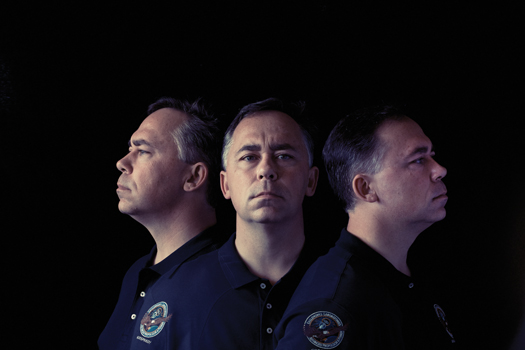
A NASA scientist claims to be on the verge of faster-than-light travel: is he for real?

Harold White
Harold White: Sonny White runs an advanced propulsion lab called Eagleworks at Johnson Space Center in Houtson.  Jack Thompson
Last September, a few hundred scientists, engineers and space enthusiasts gathered at the Hyatt Hotel in downtown Houston for the second public meeting of 100 Year Starship. The group is run by former astronaut Mae Jemison and funded by DARPA. Its mission is to “make the capability of human travel beyond our solar system to another star a reality within the next 100 years.”

For most of the attendees at the conference, advances in manned space exploration have been frustratingly slow in coming. Despite billions of dollars spent over the last few decades, space agencies aren’t capable of much more than they were in the 1960s. They may be capable of less. 100 Year Starship intends to accelerate the process of interstellar travel by identifying and developing promising technologies.

Over the course of several days, attendees could join symposia on such exotic topics as organ regeneration and organized religion aboard a starship. One of the most anticipated presentations was titled “Warp Field Mechanics 102,” given by Harold “Sonny” White of NASA. A nine-year agency veteran, White runs the advanced propulsion program at Johnson Space Center (JSC), down the road from the Hyatt. Along with five others, he recently co-authored the agency’s 16-year “In-Space Propulsion Systems Roadmap,” which outlines NASA’s goals for the future of space travel. The plan calls for all manner of propulsion projects from improved chemical rockets to far-forward systems like antimatter and nuclear engines. White’s particular area of research is perhaps the most far-forward of them all: warp drive.

Put plainly, warp drive would permit faster-than-light travel. It is, most assume, impossible, a clear violation of Einstein’s theory of general relativity. White says otherwise. For half an hour at the symposium, he outlined the physics of a potential warp drive—walking attendees through things like Alcubierre bubbles and hyperspace oscillations. He explained how he’d recently computed theoretical results that could pave the way for an actual warp drive and that he was commencing physical tests in his NASA lab, which he calls Eagleworks.

It almost goes without saying that functional warp drive would have tremendous implications for space travel. It would free explorers not only from Earth’s orbit, but from the entire solar system. Instead of taking 75,000 years to get to Alpha Centauri, the star system nearest to our own, warp-equipped astronauts, White says, could make the trip in two weeks.

In the wake of the shuttle program’s termination and given the increasing role of private industry in low-Earth orbit flights, NASA has said it will refocus on far-flung, audacious exploration, reaching far beyond the rather provincial boundary of the moon. But it can only reach those goals if it develops new propulsion systems—the faster the better. A few days after the 100 Year Starship gathering, the head of NASA, Charles Bolden, echoed White’s remarks. “One of these days, we want to get to warp speed,” he said. “We want to go faster than the speed of light, and we don’t want to stop at Mars.”

* * *
Miguel Alcubierre
Miguel Alcubierre: Physicist Miguel Alcubierre developed the model for warp drive after watching an episode of Star Trek.  Courtesy Campus Party Mexico
The first mainstream use of the expression “warp drive” dates to 1966, when Gene Roddenberry launched Star Trek. For the next 30 years, warp existed purely as a construct of one of science fiction’s most enduring series. Then, a physicist named Miguel Alcubierre found himself watching an episode of the show. At the time, he was doing his graduate work in general relativity, and he asked himself what it would take to make warp drive physically plausible. He published a paper outlining the physics in 1994.

Alcubierre envisioned a bubble in space. At the front of the bubble, space-time would contract, while behind the bubble, space-time would expand (somewhat like in the big bang). The deformations would push the craft along smoothly, as if it were surfing on a wave, despite the tumult around it. In principle, a warp bubble could move along arbitrarily quickly; the speed-of-light limitation of Einstein’s theory applies only within space-time, not to distortions of space-time itself. Within the bubble, Alcubierre predicted that space-time would not change, leaving space travelers unharmed.

Warp drive would free explorers not only from Earth’s Orbit, but from the entire Solar System.Einstein’s equations of general relativity are very difficult to solve in one direction—figuring out how matter bends space—but going backward is fairly easy. Using them, Alcubierre determined the distribution of matter necessary to create such a warp bubble. The trouble was, the solutions called for an obscure form of matter called negative energy.

In the most basic of definitions, gravity is the attractive force between two objects. Every object, no matter how small, exerts some attractive force on surrounding matter. Einstein’s insight was that this force is a curvature in space-time. Negative energy, though, is gravitationally repulsive. Instead of drawing space-time together, negative energy would push it apart. Roughly speaking, for his model to work, Alcubierre needed negative energy to expand the space-time behind a craft.

Though no one has ever measured negative energy, quantum mechanics predicts that it exists, and scientists should be able to create it in a lab. One way to generate it would be through the Casimir effect: Two parallel conducting plates, placed very closely together, should create small amounts of negative energy. Where Alcubierre’s model broke down is that it required a vast amount of negative energy, orders of magnitude more than most scientists estimate could be produced.

White says he’s found a way around that limitation. In a computer simulation, White varied the strength and geometry of a warp field. He determined that, in theory, he could produce a warp bubble using millions of times less negative energy than Alcubierre predicted and perhaps little enough that a space craft could carry the means of producing it. “The findings,” he says, “change it from impractical to plausible.”

* * *
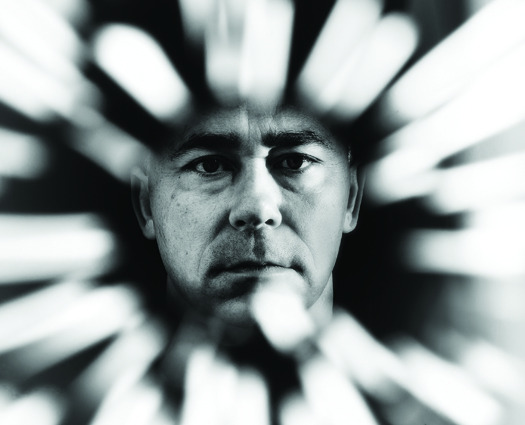
NASA Engineer
NASA Engineer: NASA engineer Harold “Sonny” White runs the Eagleworks lab at Johnson Space Center, where he works on advanced propulsion. White is trying to distort space-time, research that he says could one day lead to a warp drive.  Jack Thompson
Johnson Space Center sprawls beside lagoons where Houston gives way to Galveston Bay. It has the feel of a suburban college campus, albeit one geared to the training of astronauts. The day I visit, White meets me in Building 15, the low-rise warren of hallways, offices, and labs that contains Eagleworks. He is wearing a polo shirt embroidered with the Eagleworks emblem, which depicts an eagle, mid-swoop, soaring over a futuristic starship.
White did not start his career in propulsion. He studied mechanical engineering, and he joined the agency in 2004 as part of its robotics group, having worked at JSC as a contractor since 2000. Eventually, he took command of the robot arm on the International Space Station while working on a Ph.D. in plasma physics. It was only in 2009 that he shifted his responsibility to propulsion, which had been a long-standing interest of his and the reason he came to work for NASA in the first place.

“Sonny is a pretty unique person,” says his boss John Applewhite, who heads the Propulsion Systems Branch within the JSC engineering directorate. “He’s definitely a visionary, but he’s also an engineer. He can take his vision and turn it into a useful engineering product.” About the time he joined Applewhite’s group, White requested permission to open his own lab, dedicated to advanced propulsion. He dreamed up the name Eagleworks—a patriotic riff on the famous Lockheed Martin Skunk Works—and had NASA create a logo to his specifications. Then he got to work.

White leads me to his office, which he shares with a colleague who is looking for water on the moon and then takes me down the hall to Eagleworks. As we walk, he tells me about his quest to open the lab, which he frames as “a long arduous process of trying to find ways for advanced propulsion to help human space exploration.” He speaks with a slight drawl, a product of many years spent in the South—first at college in Alabama and then 13 years in Texas.

White shows me into the facility and ushers me past its central feature, something he calls a quantum vacuum plasma thruster (QVPT). The device looks like a large red velvet doughnut with wires tightly wound around a core, and it’s one of two initiatives Eagleworks is pursuing, along with warp drive. It’s also secret. When I ask about it, White tells me he can’t disclose anything other than that the technology is further along than warp drive. A 2011 NASA report he wrote says it uses quantum fluctuations in empty space as a fuel source, so that a spaceship propelled by a QVPT would not require propellant.

White’s warp experiment is tucked into the back corner of the room. A helium-neon laser is bolted onto a small table pricked with a lattice of holes, along with a beam splitter and a black-and-white commercial CCD camera. This is a White-Juday warp field interferometer, which White named for himself and Richard Juday, a retired JSC employee who is helping White analyze the data from the CCD. Half of the laser light passes through a ring—White’s test device. The other half does not. If the ring has no effect, White would expect one type of signal at the CCD. If it warps space, he says “the interference pattern will be starkly different.”

When the device is turned on, White’s setup looks cinematically perfect: The laser is bright red, and the two beams cross like light sabers. There are four ceramic capacitors made of barium titanate inside the ring, which White charges to 23,000 volts. White has spent the last year and a half designing the experiment, and he says that the capacitors will “establish a very large potential energy.” Yet when I ask how it would create the negative energy necessary to warp space-time he becomes evasive. “That gets into . . . I can tell you what I can tell you. I can’t tell you what I can’t tell you,” he says. He explains that he has signed nondisclosure agreements that prevent him from revealing the particulars. I ask with whom he has the agreements. He says, “People come in and want to talk about some things. I just can’t go into any more detail than that.”

* * *
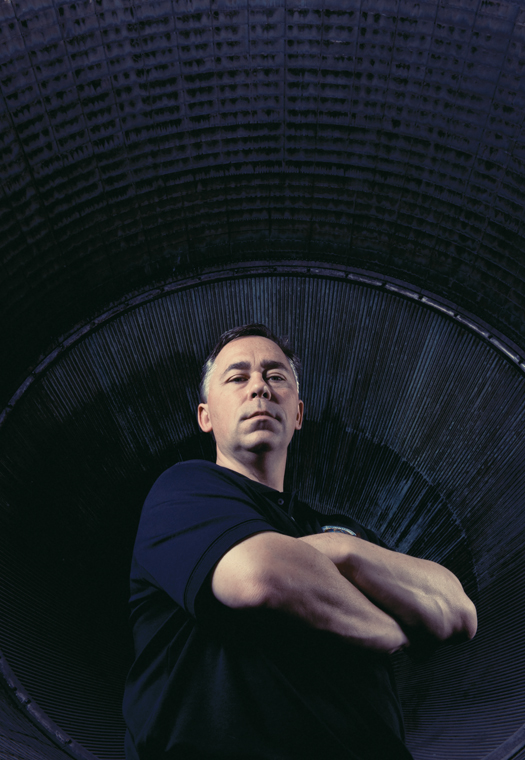
Saturn V
Saturn V: At Johnson Space Center, White works in the shadow of the Saturn V rocket.  Jack Thompson
While the theory of warp travel is intuitive enough—deform space-time to create a moving bubble—it suffers from a few significant obstacles. Even if White can drastically reduce the amount of negative energy that Alcubierre required, it may still be much more than scientists can produce, says Lawrence Ford, a theoretical physicist at Tufts University who has published dozens of journal articles on negative energy over the last 30 years. Ford and other physicists say there are fundamental physical limitations—not just engineering challenges—on the amount of negative energy that can exist in one place for any length of time.

Another challenge is that in order to create a warp bubble that moves faster than light, scientists would need to distribute negative energy around a craft, including ahead of it. White doesn’t think this is a problem; when I ask him about it, he says rather vaguely that a warp drive would work because of an “apparatus you have that’s creating the conditions that you need.” But creating those conditions in front of a ship would mean generating a distribution of negative energy that travels faster than light, a violation of the theory of general relativity.

In saying that a warp drive is
feasible, White is also saying that he can create a time machine.
Finally, warp drive poses a conceptual problem. In general relativity, faster-than-light travel is equivalent to moving about in time. In saying that a warp drive is feasible, White is also saying that he can create a time machine.

Those obstacles raise some significant doubts. “I don’t think any normal understanding of physics predicts he’s going to see anything in his experiments,” says Ken Olum, a physicist at Tufts University, who served on a panel debating exotic propulsion at the 100 Year Starship gathering in 2011. Noah Graham, a physicist at Middlebury College who read two of White’s papers at my request, wrote in an e-mail: “I don’t see any valid science in either paper beyond the summaries of previous work.”

Alcubierre, now a physicist at the National Autonomous University of Mexico, is also doubtful. “Even if I’m in a spaceship in the middle and I have the negative energy, there’s no way I can put it where I need it,” he told me by phone from his home in Mexico City. “It’s a nice idea. I like it because I wrote it myself. But it has a series of limitations that I’ve seen through the years, and I don’t see how to fix them.”

* * *
Warp Travel
Warp Travel:  Jack Thompson
To the left of the main gate at Johnson, a Saturn V rocket lies on its side, its stages disconnected to show some of its guts. It’s massive. Just one of its many engines is nearly the size of a small car, and, laid on end, the rocket is a few feet longer than a football field. It is a quiet testament to the difficulty of space travel. It is also four decades old, and the time it represents—when NASA was part of a grand national effort to send a man to the moon—has long passed. Today, JSC feels like a place that once touched greatness but has since fallen from its orbit.

A breakthrough in propulsion could spell a new age at JSC and NASA, and to a degree that age is already upon us. Dawn, a probe launched in 2007, is exploring the asteroid belt using ion thrusters. In 2010, a Japanese team deployed Ikaros, the first interplanetary craft driven by a solar sail, another type of experimental propulsion. And in 2016, scientists plan to test VASIMR, a plasma-based system designed for high-thrust propulsion, on the ISS. While those systems might one day carry astronauts to Mars, they still will not be able to send astronauts beyond the solar system. To do that, White says NASA will need to embrace riskier projects.

Warp drive is perhaps the most far-fetched of all NASA’s propulsion efforts. The greater scientific community says White cannot create it. Experts say he’s working against the laws of nature and physics. Nonetheless, NASA is behind it. “He’s not funded at a very high level in terms of what he’s trying to accomplish,” Applewhite says. “I think there’s very much interest within the directorate to continue growing his work. These are the kinds of theoretical concepts that, if they come to fruition, would be game changers.”

In January, White packed up his warp interferometer and moved it to a new facility. Eagleworks had outgrown its first home. The new lab is larger and, he says enthusiastically, “It’s seismically isolated,” meaning it is shielded from vibrations. But perhaps the best thing about the new lab is also the most telling. NASA assigned White to a facility that was built for the Apollo program, the same one that put Neil Armstrong and Buzz Aldrin on the moon.

Konstantin Kakaes is a Schwartz fellow at the New America Foundation.

This article appeared in the April 2013 issue of Popular Science Magazine.

46 Comments

The real reason Sonny White can't get into why the capacitor ring generates negative or exotic matter is that he would have to give credit to a non-NASA scientist by the name of Jim Woodward to do so. Woodward has been working on developing the "Mach Effect", which seeks to use the ability of capacitors to vary their mass based on their charge to exploit a loophole in the law of inertia, aka Mach's Principle. The capacitor ring was actually designed by Woodward, but White can't give credit to the creator of the actual test article, because he's trying to create his own theory for why it works, so he can steal the idea and stamp his own name on it.

Mike:

The capacitor ring used in White's Warp-field interferometer experiment does not rely on Woodward's Mach-Effect (M-E) mass fluctuations for its function. In fact it is currently being driven by high voltage dc, which just creates a steady-state E-field based torodial energy distribution in the cap-ring capaitor's high-K dielectric. This torodial energy concentraion in turn creates a VERY SMALL spherical spacetime distorion field around the cap ring that Dr. White hopes to measure using his red laser interferometer. As to who designed and built this cap-ring for this experiment, it was Paul March who works for Dr. White in the NASA/JSC Eagleworks Lab.

As I was reading this article I realized this was the April issue. The more I read, the more I had trouble putting the thought out of my mind that this was a clever attempt at an April Fools' hoax.

Go back to magnets and gravity, when you understand this your answer may come about

APRIL 1st 2013, 11:11am
The four above comments are posted prior to today article posting. AMAZING!

Wow, sorry Anylcon, I just reported your comment because I read Reply to this comment XD I guess I'm a little more sick than I thought 0_o But yeah, I saw that too. I guess they're from the future and used a warp drive and got threw back in time by accident...

My above comment did not mean to indicate anything really negative to the article, since this article speaks about warm speed and time travel. The above 4 comments with the article in mind was rather funny! I suppose a person did not like my observation of the 4 prior comments, lol, oh well. Excuse me for reading the article and paying attention to the comments.

Note to all:

I thoroughly enjoy that paulmarch66 explains that the builder and designer of White's project is Paul March. I do not believe this to be a coincidence. If true, nice work, Paul! We are rooting for you!

Oh please say it ain't so! I was getting my hopes up. :(

“The nation that controls magnetism will control the universe”

Of course the real problem is that, ever since science offered up itself for money, a lot of science, popular or not, is a joke.

Ummm Popsci could you offer some clarification if you are kidding us? Seriously it is April 1 so i am somewhat skeptical. If you aren't kidding us, thats awesome. If you are... happy April Fools!

anyone else notice that paulmarch66 addressed mlorrey as "Mike"? Just a thought. I would probably have to say they are all PopSci employees or people involved in making the article, how else would they be able to post something before it was released online. I've also noticed that the few times I've also been told about some magazine content before that didn't make online until about 2-3 weeks later. the article being the one on the Italian physicist who claims to have achieved cold fusion

Why are there nondisclosure issues with taxpayer-supported NASA science? Military applications?

And FYI, for those wondering if this is an April 1 joke, I was reading about this guy some weeks ago about his work on the Alcubierre drive. Probably a Google search will come up with previous articles.

check this out on mike lorrey

http://tech.groups.yahoo.com/group/spacedrives/message/604

sorry it's a reply to mike lorrey's email to some andrew, still interesting though

OK, here's an article from 11/26/12:
http://io9.com/5963263/how-nasa-will-build-its-very-first-warp-drive

As weird as this sounds and the fact that it was posted 4/1 it actually is a real project at NASA.

Look at the "Faster-Than-Light Drive" article on PopSci. It has the same occurrence of before April posts. Actually all 9 of the posts as of right now were posted before today and all but one were posted by the same guy.

So he hasn`t even tested anything, his idea depend on many unknowns yet he claims to be on the verge of faster then light travel. NASA can`t even launch astronauts anymore. The US has lost the race in particle physics to Europe with CERN yet the claims and paper projects at NASA are becoming ever bigger while budgets are getting cut. And i have seen to many NASA projects fail overtime. From a return to the moon to a manned mission to Mars under Bush to many replacement over the years for the Space Shuttle. They all failed and were abandoned.

Faster then light travel is such an extreme project and would require so many physical breakthroughs let alone centuries of development. They have been working on Fusion energy for a hundred years yet the best project the ITER Fusion reactor in France is still 15 years away from coming online. CERN is the biggest producer of antimatter and the biggest researcher on antimatter and they don`t have anything that could get large scale production. Now if you want to power a faster then light spacecraft you would certainly also need huge amounts of energy. THIS in itself would require massive advancements in Fusion or matter antimatter energy sources to make it work and then downsize it considerable.

Again; That is assuming you can get all the physics right in the first place. Let alone needing artificial gravity to keep passenger having a healthy trip. Engineering wise it would cost hundreds of times the cost of a human mars mission and we can not even get that of the ground after 50 years of trying.

So please just keep working on getting the physics right and go from there. CERN has 10.000+ physicists and a massive research budget. Yet this man knows more without any tests!!! Let alone actual peer reviewed papers (and certainly noble prizes)! Please Stop making outlandish claims because i will not see faster then light travel in my lifetime. Unless perhaps i take the Eric Cartman route and i freeze myself and they can unfreeze me in the future.

Funny article with a hint of truth to confuse the readers of it being a real\serious article, and an April FOOLS joke and having 4 comments prior to April 1st via time travel, funny funny!

To all those who laugh and say its impossible I would watch my words carefully. Many times in the past when the majority said something was impossible they were wrong. Yes this seems far fetched but so did space flight less than a hundred years ago. They even thought the sound barrier could not be broken. I'm a firm believer that superluminal flight is possible, will it be challenging most definitely, All I'm saying is the science of the present is not set in stone. It always confused me why so many would almost get angry at the thought that it could be possible as if they want it to be impossible. We need more dreamers, people with child like imaginations not a bunch of stubborn old thinkiers so afraid of failure that they stay stagnent in their ways. Could this man be wrong, yes but he's brave enough to try the impossible. Where would we be without people like that, people crazy enough to think they can change the world. I don't know about you guys but I'm rooting for him, I hope he rattles the very foundation of modern physics.

" I think therefore I am"

http://www.theregister.co.uk/2012/09/18/nasa_eagleworks_warp_drive/

note the date of the article September 18th, 2012 I doubt this is an april fools joke 7 months in the making...

" I think therefore I am"

Interesting thoughts, warp speed. Makes me think about how this might relate to the age of the universe. Perhaps our universe is not even close to the largeness of age we give it. Maybe this gives some clues about how the universe was spread out in its beginning, and this whether we can ever make it work for ourselves.

i prefer people like E.Musk whos working at 200% for near term "impossible" accomplishments

---
No facts, No response...

What a shameful waste of time and money. Shut this nonsense down now and start doing real work.

HAHAHAHA Look up Bob Lazar u idiots .... see the truth.

If you think Rose`s story is incredible,, won weak-ago my friends sister basically got $6080 putting in a ninteen hour week at home and there friend's step-aunt`s neighbour has been doing this for nine months and actually earned over $6080 part time from a pc. use the instructions from this site, -- Buzz80.ℂOM

Comment 30. Made you look, lol.

“We already have the means to travel among the stars, but these technologies are locked up in black projects, and it would take an act of God to ever get them out to benefit humanity. Anything you can imagine, we already know how to do.”
Ben Rich Lockheed Skunk Works director

I can think of two ways to artificially create space-time curvature; A quantum superfluid circulating at near light speed velocities would create Lense-Thirring frame dragging. It would have to be magnetically confined but the numbers are consistent with GRT. The other is to construct a gravitational traveling wave amplifier. Rapidly contra rotating disks of relativistically dense matter would create a modulated gravitational beam which would also distort space. If quantum fluctuation is indeed being tapped then there would more than enough energy available to power either one of these devices.

A warp drive can become technologically implementable with phased standing waves. www.youtube.com/watch?v=sgAwyr5Udzw

If deep down within your whole being you do not believe that people can do this you are much different than I am. Our destiny is to explore and investigate the boundaries of our imaginations in a way that is immensely rewarding to our lives. It is not our nature to be afraid and enslaved by doubt. I for one will stand back and be reasonably patient of anyone as promising as this man and applaud if what he says is true. We Dont have anything to lose and everything to gain. Our own social, religious, political government systems and the rather predictable human condition have and probably will continue to control and hold us back. Could we have been wrong all along? That doesn't make sense. I am Not religious but even the Christian bible says to go forth and have dominion over the planet and there isn't anything written there about waiting for anyone to tell us it is okay to explore other earth like planets. Just the opposite. There are more references in all ancient texts that suggest that it is our compulsion or destiny to explore beyond earth.

This is suspiciously close to what was suggested in the Philadelphia Experiment, and Back to the Future... polarity reversal of the EM Fields with the proper use of magnets and capacitors resulting in a time warp in the field, and something that I thought about some 30 years ago while taking physics in college long before either of those... maybe there is something to it after all.

Wow! Shall I assume that the 'warp bubble' will insulate me from all effects of the normal world? Like the eye of a storm or the womb of a mother!!!

Else,

1. Assuming uniform acceleration to the halfway point, the travelers would experience a continuous G-force of ONLY 5675 G's. Not sure how they will handle that. Imagine some REAL INTENSE training or serious feats of bio-engineering.

2. Further, I will assume that the bubble being a space-time distortion field will tunnel through this universe, so all obstacles like quasers, pulsars, black holes, simple suns like ours and planets would be momentarily displaced/moved aside as the distortion wave passes.

What am i missing here? Mind you, I am a simple 9-5 office guy with high school science knowledge.

Would appreciate any insight here :)

Perhaps I should loan Dr. White my wife. She comes with enough negative energy to propel the Enterprise to the Andromeda galaxy.

It is a damned shame that an entire month's worth of "science" articles has to be round-filed just because this magazines editorial staff never matured past the age of kindergarten, with their inane "April Fools" BS. What is even worse is that one can never be certain they are doing it each year. So the only recourse is to trash anything published in the month of April every single year.

To my knowledge there are only two who have discovered things faster than light;

CERN and myself

I love that "on the verge" comment. Although I salute NASA for building a few impressive rockets, their real claim to fame is the developing the famous theory of relative money where Money = Productive result * speed of light squared. How else can you blow a BBBBBBillion dollars on a single launch of the shuttle. Wow, $100,000/pound to put something into space. It's easy when it's other people's money. I'll take any bet that if and when warp drive is discovered, it won't be by a bureaucracy.

@realguy32, mass inside the warp bubble does not accelerate, the contracts, then expands.

@ PSCIZ; Sony White is a real person and really does work for NASA.

http://en.wikipedia.org/wiki/Harold_Sonny_White_%28NASA_Scientist%29

However, the head line of this story should be "A NASA scientist claims to be on the verge of a SEMI-PLAUSIBLE THEORY OF faster-than-light travel".

If they could use the inherent gravity/attraction of matter as a means, amplification of those forces would be something which might allow a much superior propulsion system to what we currently have? Negative energy seems to be a red herring from what I have read and understand? Though I do believe that we need to continue to experiment with new ways and theories which may possibly yield breakthroughs which would allow advanced technologies to be developed for potential faster than light travel? Even if some of these 'theories' seem fantastic, we still need to explore them, even if only to rule them out? After all Einstein defined insanity as doing something the same way over and over and yet expecting different results?

This is either a 1st of April joke or a charlatan's baloney.
There will not be any cosmic flying around in the future.

....So in order not to not be affected by the laws of gravity you would need to somehow be super statically charged to enter a nook or crevice to zip through!??! Does anybody remember the movies 'Clocktstoppers' or 'Honey, I blew up the kid' where after being in this state, all their particles couldn't stop accelerating!?!?

Well... even if this proves to be impossible, proving that would be learning something. Maybe something else useful will come from it along the way. And if... (I'm not hopeful here but) if this ends up working then that would be awesome!

@realguy32

Nope. No G's here. None at all. What you are missing is that with this kind of propulsion the ship does not actually move. Space moves (stretches) around it. Yeah, it's kind of hard to wrap your mind around but theoretically it is possible. Now possible in a practical way... that is the current debate.

Hi buddy :

Updated daily shoes :

in order to thank everyone, characteristic, novel style, varieties, low price and good quality, and the low sale price Thank everyone

http://al.ly/3pN

http://al.ly/3pN

http://al.ly/3pN

http://al.ly/3pN
fghjuktyasfghjytkty


140 years of Popular Science at your fingertips.


Popular Science+ For iPad

Each issue has been completely reimagined for your iPad. See our amazing new vision for magazines that goes far beyond the printed page


Download Our App

Stay up to date on the latest news of the future of science and technology from your iPhone or Android phone with full articles, images and offline viewing


Follow Us On Twitter

Featuring every article from the magazine and website, plus links from around the Web. Also see our PopSci DIY feed


April 2013: How It Works

For our annual How It Works issue, we break down everything from the massive Falcon Heavy rocket to a tiny DNA sequencer that connects to a USB port. We also take a look at an ambitious plan for faster-than-light travel and dive into the billion-dollar science of dog food.

Plus the latest Legos, Cadillac's plug-in hybrid, a tractor built for the apocalypse, and more.


Online Content Director: Suzanne LaBarre | Email
Senior Editor: Paul Adams | Email
Associate Editor: Dan Nosowitz | Email
Assistant Editor: Colin Lecher | Email
Assistant Editor:Rose Pastore | Email

Contributing Writers:
Rebecca Boyle | Email
Kelsey D. Atherton | Email
Francie Diep | Email
Shaunacy Ferro | Email

circ-top-header.gif
circ-cover.gif