
Even without a telescope, it’s possible to look off the summit of Mauna Kea and see, 14,000 feet below and dozens of miles in the distance, wide swaths of rain forest touching the whitecapped Pacific. Down there, people are doing what people come to Hawaii to do: hiking to waterfalls, lying in the sand, exposing their skin to tropical solar radiation. Up here, there is no vegetation, no warmth and very little atmosphere. And as the sun sets over the parabolic aluminum dishes of the Submillimeter Array observatory, it’s time to work.
Sheperd Doeleman, the 45-year-old MIT researcher in charge of tonight’s experiment, is setting up a piece of the radio telescope that, if all goes well, will synchronize with other radio telescopes in California and Arizona to observe matter on the verge of disappearing into a black hole. Doeleman and his counterparts on the mainland are using a technique called very long baseline interferometry to simulate a much larger instrument, which they call the Event Horizon Telescope. The longer the baseline, the higher the resolution, so these astronomers have for the past decade or so been hauling their delicate and expensive hand-built equipment to remote sites around the world, installing it anew for each observation. The work is highly improvisational, but to see what they want to see, there is no other way.
Outside the Submillimeter Array’s control-room windows, patches of snow speckle the summit. The storm that deposited them several days ago has since traveled 2,500 miles east, where it has been blocking all observation at the station in California, thus delaying the whole observing run. Things are going better tonight. Or at least they’re starting to. “It looks like we’re actually recording something,” Doeleman says. “Which is nice.”
“The Mark 5Bs are recording,” says Nicolas Pradel, a postdoctoral researcher from Taiwan’s Academia Sinica Institute of Astronomy and Astrophysics. The Mark 5B recorders are connected to the James Clerk Maxwell Telescope next door, which is contributing its 15-meter dish to tonight’s effort. “The Mark 5Cs”—the newest, highest-bandwidth recorders, and the ones hooked up to the Submillimeter Array—”are not.”
Doeleman, a slight man with a runner’s build, sprints out of the room and runs downstairs, where the recorders are installed. A few minutes later, he darts back into the control room, panting in the thin mountain air. He sits back down at his computer, pounds out a few keystrokes and mumbles something technical and reassuring to the postdocs and telescope operators. The recorders appear to be working.
A black hole should cast a shadow. The goal is to capture an image of that shadow.Three arrays is just a start. Doeleman and his cohort have been operating this same network of radio telescopes since 2007, when they pointed the array at the galactic center and detected “structure on the event-horizon scale,” a deeply obscured blip in space whose dimensions match the predicted size of Sagittarius A* (pronounced “A-star”), the four-million-solar-mass black hole at the center of the Milky Way. After that, with encouragement from colleagues, Doeleman decided that peering deeper into the galactic center, deep enough to actually take a picture of the very edge of Sagittarius A*, was not as implausible as it sounds. Detectors were becoming more sensitive every year; data storage and processing power had never been so cheap. If he could add the right telescopes to his network, taking a picture of Sagittarius A* should be, as Doeleman puts it, “eminently doable.”
Over the next few years, Doeleman says, he and his group will combine as many as a dozen of the world’s most sophisticated radio-astronomy installations to create “the biggest telescope in the history of humanity”—a virtual dish the size of Earth, with 2,000 times the resolution of the Hubble Space Telescope. Tonight the Event Horizon Telescope astronomers have a more limited goal: They want to catch as much light from Sagittarius A* as possible and study its polarization to learn about the black hole’s magnetic field. But eventually (if all goes well) astronomers using the fully scaled-up Event Horizon Telescope—a machine with resolution high enough to read the date on a quarter from 3,000 miles away—will see the silhouette of an object that is, in itself, unseeable.

Immediately after Albert Einstein published his general theory of relativity in 1915, physicists began trying to figure out what his equations said about the actual operation of the universe. One of them was a German astrophysicist-turned-soldier named Karl Schwarzschild. Working from a trench during World War I, he found a way to calculate the curvature of space-time around a highly idealized, perfectly spherical star. He mailed his equations to Einstein, who presented them in Schwarzschild’s stead at a January 1916 conference in Berlin. Four months later, Schwarzschild died of illness on the eastern front.
Einstein was impressed by Schwarzschild’s math, but he rejected one of his predictions—that a dense enough star would collapse under its own gravity into an infinitely small, infinitely dense point. Einstein insisted that some force of nature that Schwarzschild had ignored would prevent this implosion. The most prominent physicists of the era agreed with Einstein. Black holes, as we now call them, violated so many intuitive ideas about how the universe should work that they met with what the California Institute of Technology theorist Kip Thorne called “widespread and almost universal 20th-century resistance.”
Yet in the following decades, physicists became increasingly convinced that Schwarzschild was right. In 1939 Robert Oppenheimer, the physicist who would later lead the Manhattan Project, built on Schwarzschild’s work (plus two additional decades of research on general relativity) to develop the most persuasive case yet that certain stars, upon exhaustion of their nuclear fuel, would collapse under their own gravity. In the 1950s, using computer models coded to simulate the detonation of hydrogen bombs, both American and Soviet physicists independently generated the most sophisticated mathematical arguments yet that when sufficiently massive stars die, implosion is inevitable.
In the 1960s astronomers started finding empirical evidence, however indirect, that black holes weren’t merely mathematical constructs, but that they actually existed. Nothing but enormous black holes, for example, could power quasars—points of light, some of them at the edge of the observable universe, that shine with the luminosity of hundreds of galaxies. In the 1990s astronomers found that stars near the center of galaxies were orbiting at millions of miles per hour. Such speeds made sense only if those stars were orbiting black holes.
Most physicists now accept the existence of black holes—regions of space where gravity becomes infinitely powerful, matter becomes infinitely dense, time freezes and light becomes trapped. Black holes come in two main varieties: stellar-mass holes, which remain after a star collapses, and supermassive ones, which scientists now say sit at the core of all galaxies. At the center of every black hole is a singularity, a point at which our understanding of the laws of physics breaks down. At the edge of every black hole is a boundary called the event horizon, which separates the hole from the rest of the universe. The event horizon is, as Doeleman says, “a one-way membrane in space-time” that leads to “someplace causally distinct from where we are now.” It’s an exit door from the universe with a strict reentry policy: What passes through can never come back.
No one has ever seen an event horizon, but they should be seeable. Theorists predict that the extreme warping of time and space around a black hole’s event horizon should create a telltale shadow, a pitch-black circle surrounded by a blazing ring of light. The ultimate goal of the Event Horizon Telescope is to capture an image of that shadow.
The project’s success would make it possible to see how the theory of general relativity holds up at the edge of a black hole, the most extreme environment in the universe. It would also provide unequivocal evidence that black holes exist—something often taken for granted but not yet proven. “Now we can ask the question,” says Avery Broderick, a theorist at the University of Waterloo and an EHT collaborator. “That really will motivate a discussion. There’s no point arguing about how many angels can dance on the head of a pin until you can find an angel dancing on the head of a pin.”
* * *
One hundred fifty thousand trillion miles from Mauna Kea, Sagittarius A* is spinning radiation into the cosmos. Electrons and ions that once belonged to dust clouds and stars orbit the black hole at nearly the speed of light, whirling around its 140-million-mile circumference once every 24 minutes and along the way throwing off radiation that spans the electromagnetic spectrum. A tiny fraction of the radiation that fled Sagittarius A* 26,000 years ago will tonight make its way to Earth. An even tinier fraction of that radiation will fall on the summit of Mauna Kea, some of it striking the collecting dishes of the mountain’s radio-telescope antennas.
If everything works properly, the collecting dishes will funnel the arriving radio waves into helium-cooled receivers, which will beam them to the control room through buried fiber-optic cables. The signals will be amplified, digitized and time-stamped by a hydrogen maser, a $300,000 air-conditioner-size atomic clock that loses only one second every 10 million years. Next, the signals will be recorded on 8-terabyte hard-drive packs, which the astronomers will then FedEx back to the EHT’s “lens”—a supercomputer-powered correlator at MIT’s Haystack Observatory outside Boston.
At Haystack, a technician will take the data packs from all three sites involved in the observation—the Submillimeter Array and James Clerk Maxwell Telescope in Hawaii, the Combined Array for Research in Millimeter-wave Astronomy (CARMA) in California, and the Submillimeter Telescope (SMTO) in Arizona—and attempt to sort the signal from the noise. Despite being cooled to four degrees above absolute zero, telescope receivers produce a steady thrum of noise 100,000 times as powerful as the signal from the cosmos. “Riding on top of the noise is a little bit of a signal that—except for a time difference and a bit of a frequency shift—is the same from station to station,” explains Jonathan Weintroub, the astronomer and electrical engineer who is in charge of the EHT’s instrumentation at the Submillimeter Array. “The signal that is the same from station to station is the signal from the source.”
For maximum clarity, all of this has to work properly at every station. And at the Submillimeter Array, at least, everything does appear to be running properly. A little after 7 p.m., with the software cross-checked, the antennas phased up and the recorders finally working, the 12-hour observation sequence begins. Doeleman passes around a duffel bag filled with snacks from Trader Joe’s. (“You have to try the mission figs!”) I sit down next to Ryan Howie, a 20-something telescope operator who’s been working at the Submillimeter Array since this group’s first observations in 2007, and ask whether tonight’s warm-up was abnormally chaotic. Not at all, he says. “Things are actually going much more smoothly than they did on the first couple of runs.”

The weather tonight is immaculate. To put it in radio astronomer-speak, the tau is 0.028. Tau is the central variable in the equation astronomers use to measure the obscuring effect of atmospheric water vapor. And even on this mountain, a spot chosen for its anomalously sweet average figures for tau, nights this clear come only 10 or 15 times a year. Weather like this, Doeleman says, is “like being in space.”
The conditions at the other sites are far from ideal. The tau at CARMA is disturbingly high. The tau at SMTO is excellent, but so far, airborne ice crystals have prevented the telescope operators from opening the dome and exposing the satellite dish to the atmosphere. Passable weather at those sites will have to do, though. The snowstorms in California and Arizona over the past three days have forced Doeleman and crew to cede their telescope time to other astronomers and spend their nights brooding 5,000 feet below at Hale Pohaku, the dorm where astronomers sleep and eat and prepare for their observations.
Tonight is the second-to-last chance the Event Horizon Telescope will have this year to do its work. Telescope time is a scarce resource; the time-allocation committees at the various observatories have given Doeleman and his group three nights for this run. To increase the probability of getting good weather at all three sites, they can pick any three nights during an eight-night window. They could, in theory, observe more than once a year, but that would require more money, more travel and more logistical wrangling. They could also, in theory, get a longer observation window (and they have in the past), but it would require everyone to spend even longer on this mountain, waiting for the spheres to align.
The Event Horizon Telescope could provide the first unequivocal evidence that black holes do, in fact, exist.Each day around noon, Doeleman gets the weather forecasts for all three sites and makes the call for the night: Go or no go? “It drives Shep crazy,” Weintroub says. They’re working on ways to make this decision less painful. A crucial step will be to permanently install the EHT’s custom digital equipment at every station in the array, so that when the weather is good at all sites, they could trigger an observation remotely, on short notice. This is mostly a matter of securing cooperation from the committees that control the telescopes and raising the money to install the equipment. Better weather forecasts would also help. On Mauna Kea, getting accurate weather information is not a problem. Because the mountain is home to 11 observatories, many of them the most powerful instruments of their kind, Mauna Kea has its own dedicated weather station. That’s not the case at smaller observatories such as SMTO and CARMA, and that makes it hard for Doeleman to know when to observe.
Around midnight, the Submillimeter Array has its dishes trained on the black hole at the center of the nearby galaxy M87, which rises four hours before Sagittarius A*. Doeleman picks up a landline phone (cellphones are forbidden because they would interfere with the instruments) and calls the telescope operator in Arizona to find out when they’ll be opening the dome. After a few seconds, he hangs up. “Yes!” he says. “SMTO’s opening the dome and should be observing in about 30 minutes.”
“Just in time to get two scans on M87,” says Rurik Primiani, the 25-year-old MIT graduate monitoring the Submillimeter Array’s antennas.
The good news has Doeleman feeling talkative. He spends a little time telling the postdocs about the technological impediments he faced 15 or 20 years ago as a grad student being introduced to the laborious art of very long baseline interferometry. The fieldwork is what attracted Doeleman to astronomy. He was never, as he puts it, the kid who played with telescopes. But he was the kind of kid who thought that spending the winter in Antarctica sounded like fun. At the age of 22, after graduating from Reed College in his hometown of Portland, Oregon, he joined a yearlong expedition to Antarctica to study cosmic rays. Afterward, he enrolled in graduate school at MIT. He chose to focus on very long baseline interferometry in part because of the high probability of spending weeks on top of cold, dry mountains in remote places.

Thirty minutes have passed since Doeleman last spoke to the station at Arizona, so he walks over to a phone and calls them back, just to confirm that the dome is open and the station is online. He’s quiet for several moments. “You’re lying,” he says. “No, you’re lying.” It does not seem as if the person on the other end of the line is lying.
“What did I break?” Weintroub says from across the room.
Doeleman hangs up the phone and explains that for some reason, the SMTO is not yet working. Details are sketchy. But we’re already on the 12th scan of the night, and the conditions in Arizona are fantastic—the tau there has now dropped to 0.05, as good as it gets in the continental U.S.—so after pacing around the control room for a few minutes, Doeleman calls back for an update. “Now it’s what?” he asks. “‘Going crazy’? Is that a technical term?” A muted, guilty snicker spreads among the postdocs.
Sheperd Doeleman collapses into a folding aluminum chair. “As you can see,” he says, “this is hard.”Two hours from now, Sagittarius A* rises. The stakes tonight are higher than usual: NASA’s Chandra satellite is joining in, watching Sagittarius A* for x-ray flares that, when combined with the data from the EHT, could provide information about how the black hole changes by the hour. Such a finding would at least be enough for a paper in a major journal, and certainly enough to justify the money and man-hours spent conducting this observing run. So Doeleman exercises all the control he possibly can. He asks the telescope operator to call the chief faculty member at the University of Arizona in the middle of the night and ask him to get there immediately. “Tell him, ‘Shep threatened my life unless I called you.'”
Half an hour later, Doeleman receives an e-mail from Arizona and reads aloud: “There is ‘no chance whatsoever’ ” that they will be back online tonight. The group now faces a decision. It’s still relatively early. They could cede the remainder of tonight to other astronomers. Or they could continue with the two-station array. They weigh the options.
Weintroub swivels away from his laptop and says to Doeleman, “You’ve got the satellite coverage tonight from Chandra.” Doeleman nods. Satellite coverage is not something to squander. After a moment Doeleman says, “If Chandra detects a flare, we could do some very interesting science.”
And after all, they are here. The station in California is observing. They’re running out of nights. And so the observation continues, with the first scan of Sagittarius A* scheduled for 2:05 a.m. Decision made, Doeleman collapses into a folding aluminum chair and says to me, “As you can see, this is hard.”
Even on the clearest nights under the clearest skies on Earth, the galactic center and the dense cluster of stars around it are all but invisible to the human eye. Visible light can’t make it through the clouds of dust and plasma that clog the Milky Way’s glowing central globe. But radio waves can. That much became known in 1932, when a Bell Telephone Laboratories physicist named Karl Jansky noticed that whenever the galactic plane rose above the horizon, the sky exploded with radio transmissions. Since then, radio astronomers have discovered several means by which to bring the galactic center into increasingly sharp focus.
The first and most important method was the same one the Event Horizon Telescope uses today—connecting multiple geographically distant radio telescopes to form an interferometer, which adds together waves collected at different telescopes to produce a new, stronger wave. In the early 1960s, almost as soon as the National Radio Astronomy Observatory in Green Bank, West Virginia, was completed, astronomers started pointing its two-station interferometer at the galactic center. Then in 1966, observing relatively low-frequency radio waves, astronomers there detected the first signs of what we now know as Sagittarius A*. The resolution was far too low to yield a definitive observation, but eight years later, Green Bank astronomers using an upgraded interferometer capable of capturing higher-frequency waves proved that something extremely dense and bright existed at the center of the galaxy. Something was sitting at the core like a gyroscope, hovering in place while the rest of the Milky Way churned around it. Eight years later, one of the astronomers named the object—which, when viewed from Earth, appears to lie in the constellation Sagittarius—Sagittarius A*.
Since then, increasingly sensitive detectors and more powerful computers have enabled radio astronomers to observe at ever-higher frequencies and peer deeper into the center of the galaxy with greater clarity. Higher frequency radiation, which consists of shorter wavelengths, provides finer resolution. More important, the radiation that comes from the most extreme environment in the galactic center—the very edge of the event horizon—tends to be very high-frequency. At wavelengths longer than two millimeters, observing the galactic center is “like looking through frosted glass in the bathroom,” Doeleman says. At wavelengths of one millimeter and below, the frosted glass “magically clarifies.”
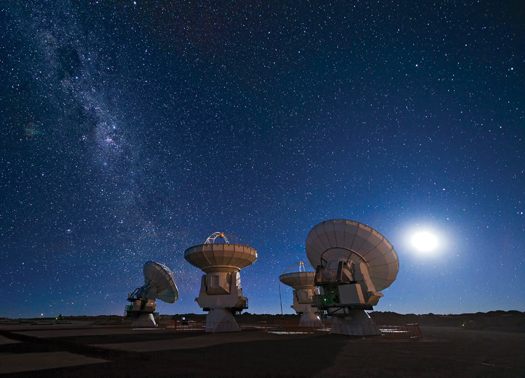
To capture those one-millimeter waves, astronomers have to travel. Atmospheric water vapor blocks waves in the one-millimeter range, which is why high-frequency radio telescopes are built in places where the atmosphere is thin and arid enough to let the one-millimeter light in. High, dry places like Mauna Kea. Places like the 17,000-foot plateau in Chile’s Atacama Desert (the world’s driest) where the Atacama Large Millimeter Array is under construction.
The telescope should see a disc of darkness surrounded by a glowing halo.ALMA, soon to become the world’s most powerful radio-telescope array, is expected to join the Event Horizon Telescope array in 2015. Once it does, it will become the critical station in Doeleman’s planet-spanning array. With ALMA on board, the EHT needs to add two, maybe three more key telescopes to approach the data-gathering capacity it will take to see Sagittarius A*’s event horizon. The EHT crew will also need to install their most advanced equipment—including the new recorders currently under development at Haystack, which should record data eight times as fast as the ones they use today—at every station. But once that’s done, their virtual telescope should be able to gather enough data to make an image.
Like all radio-telescope images, the picture will be an encoded map of a small patch of sky—a map of the immediate vicinity of Sagittarius A* in which the brightness of each pixel represents the intensity of radiation coming from that speck of space. It could take one excellent night to get it; it could take several very good nights of combined data. But at the end of some observing run, there will be a picture.
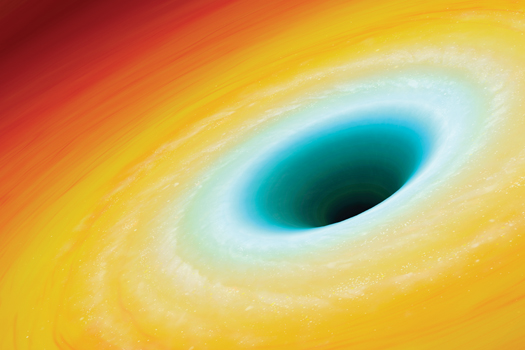
Theorists have used supercomputers to predict what the picture should look like. If the black hole is calm, the telescope should see a disc of darkness surrounded by a glowing halo, like an eclipse. One side of the disc may contain a fat blob of light. That’s a hotspot, a clumped-up cloud of accreting matter orbiting the event horizon. If Sagittarius A* is caught consuming some giant cloud of matter, the black hole may look like a ball of fire.
Doeleman is quick to emphasize that the EHT will be gathering data years before and after Sagittarius A*’s shadow first comes into focus. The more telescopes Doeleman can add, the finer the detail they’ll be able to resolve. Yet some theorists argue that, scientifically, the picture is almost beside the point. “I don’t think the end-all and be-all of this is producing an image,” Broderick says. “Eventually there will be an image, but it won’t tell us much more.” Viewed this way, the image is candy. Viewed this way, the Event Horizon Telescope is a science project designed to generate, almost by accident, a work of art.
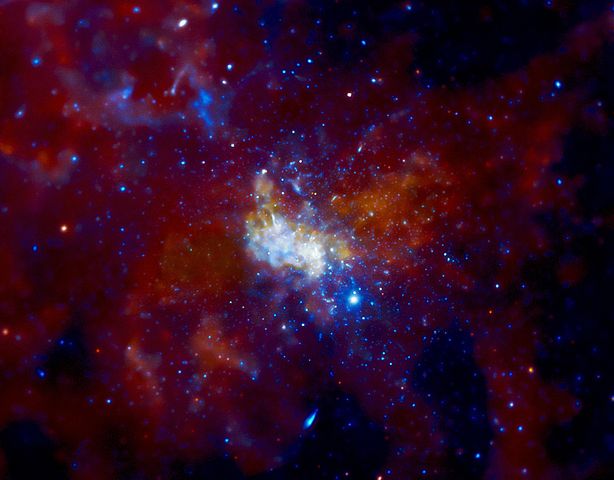
By 2:30 a.m. local time, two-thirds of the Event Horizon Telescope is recording transmissions from Sagittarius A*, which now hangs low over the horizon. Primiani reads the data streaming in over his terminal and breaks the silence: “Man, Sag A Star is bright tonight.”
The news is almost painful. Sure, if the data from tonight turns out decent and Chandra detects a flare, then the night could yield interesting findings, despite the failure of the telescope in Arizona. And there’s always tomorrow. But for now, the crew appears to be treating the night’s observation as an exercise in perseverance.
Doeleman leans back in an office chair and closes his eyes. Weintroub lies down on the floor and promptly falls asleep. Everyone else continues monitoring their computers. Two and a half hours pass in which nothing happens, which is really the way these things are supposed to go. Boring is good for radio astronomy. In his 1987 book First Light, the writer Richard Preston describes sitting in the control room at the Palomar Mountain observatory in California with some of the greatest astronomers of the age, watching dozens of galaxies never before seen by human eyes scroll across the observation screen. It doesn’t work like that here. For now, the EHT is like a half-built long-exposure camera that yields clues and promises rather than actual pictures.
By 5 a.m., everyone is awake, and Rurik Primiani, still sitting behind his control monitors, is getting restless. “Think we have enough data now?” he asks Doeleman. “The question is whether we’re getting any data,” Doeleman replies. “Who knows what CARMA’s doing. Pretty sure we know what SMTO’s doing.”
Things become very still. Inspired by the witching hour, I ask Doeleman a question I had asked him before: Why black holes? “A black hole is the only place in the universe where you can go but you can’t come back,” he says. “In theory, if you could build the right spaceship, you could go to the center of the sun and come back. You could go to the center of a neutron star. You’d be like, ‘Whoa, it’s so dense in here!'” he says, waving his arms in a mime’s struggle to escape from a neutron-star box. “But you could come back,” he says. “You could never come back from a black hole. And that’s creepy. It creeps me out.”
A little after 6 a.m., as Doeleman rouses the postdocs and prepares to power down the machine, Weintroub and I decide to go watch the sun rise. “That was frustrating as hell,” he says, as we drive up the paved road to the true summit. All this preparation, perfect weather in Hawaii—all crippled by a broken drive motor on the telescope in Arizona. But, then, if the SMTO group can get their telescope fixed, and the weather holds at all three stations, tomorrow night could be good. “One good night makes it all worthwhile,” he says.
* * *
Scientists estimate that the Milky Way alone could contain millions of black holes. The ubiquity of something so violent, so absurd, so incomprehensible is enough to needle at our sense of existential unease. Black holes are creepy. They remind us, as philosophers have been reminding us for centuries, that we never see the world in itself. We only see its shadows.
The following night, Doeleman later told me, went quite well. Technicians fixed the malfunctioning motor at SMTO. The weather held at all the sites. And our picture of the black hole at the center of the galaxy grew a little sharper.
A few weeks later, looking for perspective on the Event Horizon Telescope’s prospects for success, I called Fred Lo, the director emeritus of the National Radio Astronomy Observatory and a participant in the early hunt for Sagittarius A*. He said that what Doeleman and his team are trying to do is difficult but not without precedent. During the Cold War, he said, American astronomers coordinated with their Soviet counterparts on very long baseline interferometry observations. The American scientists would stop in Washington, D.C., to calibrate their atomic clocks and receive security clearance and then fly to Moscow, atomic clock in tow. Doeleman and company have plenty of problems to solve, but crossing the Iron Curtain is not one of them. “This is the sort of thing this community has always done,” Lo said. “It will get done.”

1. Submillimeter Array; James Clerk Maxwell Telescope; Caltech Submillimeter Observatory Mauna Kea, Hawaii
2. Combined Array for Research in Millimeter-wave Astronomy Cedar Flat, California
3. Submillimeter Telescope Mt. Graham, Arizona
4. Atacama Large Millimeter Array; Atacama Submillimeter; Telescope Experiment; Atacama Pathfinder Experiment Chajnantor Plateau, Chile
5. Large Millimeter Telescope Sierra Negra, Mexico
6. South Pole Telescope South Pole, Antarctica
7. Plateau de Bure Interferometer Grenoble, France
8. IRAM 30-Meter Telescope Granada, Spain
Seth Fletcher is a senior editor at Popular Science and the author of Bottled Lightning: Superbatteries, Electric Cars, and the New Lithium Economy.
