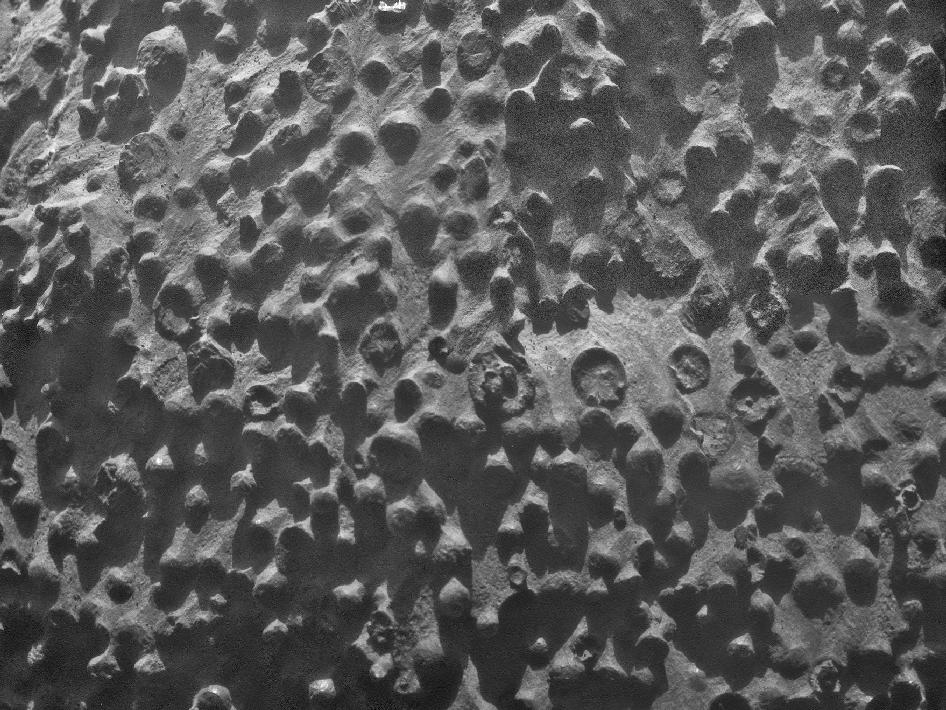
Strange new spheres on the surface of Mars have planetary geologists buzzing–they might be the result of water, they could be left over from a major crater-causing impact, or they might be something else. And they’re not even from NASA’s new rover. The bumpy spherules could be one of the most exciting finds of the Mars rover Opportunity’s already long life, NASA scientists say.
“To me, it feels like the beginning of the mission, and we’re back at [landing site] Eagle Crater. It really, really does,” Opportunity’s principal investigator, Steve Squyres of Cornell University, said in an interview. “I think this is going to turn out to be a more subtle, perhaps more difficult problem to solve, but we have eight and a half years of experience under our belts.”
Though the team is still gathering evidence, and no one is sure exactly what the spherules are, deputy principal investigator Ray Arvidson said he is working on two hypotheses already.
“One idea is these represent impact deposits, left over on the rim of Endeavour, or they represent an older section of a sedimentary deposit and happen to be preserved on the rim,” he said. “I go back and forth. We have a lot of data to acquire. Both hypotheses are viable in my head.”
Since the onset of Martian spring earlier this year, Opportunity has been rolling along the rim of Endeavour Crater, a huge pit hundreds of meters deep and stretching 14 miles wide. The crater is deep enough to harbor evidence of ancient water, which may be less acidic than the past lakes Opportunity has already found elsewhere.
A few months ago, spectral evidence from the Mars Reconnaissance Orbiter’s CRISM instrument (Compact Reconnaissance Imaging Spectrometer for Mars) indicated there were clay minerals at Opportunity’s latest outpost, Cape York, on the side of Endeavour Crater. Clays form in the presence of water, so the rover team wanted to check it out. Arvidson, a professor at Washington University in St. Louis, picked a spot to turn uphill.
My intuition tells me we’re on to something very special.
“Either by blind luck, or good spectral signatures–which I think is the case–it turns out where we drove uphill is one of the most exciting spots we’ve seen in the entire mission,” he said in an interview. “But we don’t know what the story is yet.”
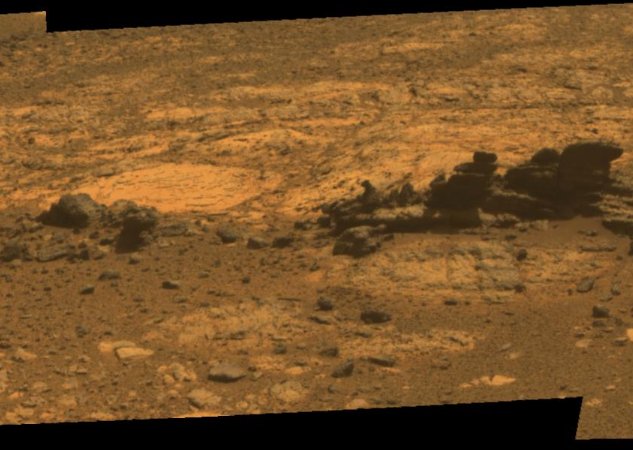
Opportunity spotted a rocky outcropping, characterized by wind-eroded fins, and moved in to take some closeups. The speckly, pebbly surface is covered in spherules a few millimeters across, which reminded many team members of the Mars “blueberries,” one of Opportunity’s earliest finds. But the blueberry spherules have a lot of iron oxide and hematite, whereas these new things are made of basalt–they may look similar, but they’re totally different. The rover team is excited, to put it mildly. It may be even more important than the rover’s news of a gypsum vein last fall, Arvidson said.
“It indicates that water has been moving through these outcrops and depositing materials in the veins. If this is sedimentary, it’s really a bonus–it might be as exciting as the initial measurements we made after we landed in Eagle Crater,” he said. “We can have a conversation in about two months, when we have all the measurements done. But my gut tells me, my intuition tells me, we’re on to something very special.”
The spherules are special in part because they’re unique–they’re the densest accumulation of spherical objects found to date on Mars, and they appear to be crunchy on the outside and softer in the center. If they’re evidence of sedimentary deposits, this would be exciting because it would be yet more evidence that water has had a major influence on the history of Mars. If they’re relics of a crater impact, that’s interesting because they haven’t been seen before, so planetary scientists will have to work out how and why they happened here. But at this point, how they formed is still a geologic puzzle, Arvidson and Squyres said.
Squyres said he won’t rule out any possibilities: “It would be foolish at this point to rule out any plausible hypotheses. This is Mars–it’s a complicated place.”
The spot has been dubbed Kirkwood, after a mine in the Sudbury impact crater in Canada. Oppy later bumped further uphill toward a lighter, slabby formation dubbed Whitewater, where it is sitting today and taking some measurements, Arvidson said. “This is such an important site that we’ll be here for a while,” he said.
During the coming weeks, Opportunity will grind some of these rocks and perform further analysis with its Alpha Particle X-Ray Spectrometer to determine what they contain. It will move up and down the formation, driving laterally, to explore as many sections as it can, Arvidson said.
All of the planning meetings for this new discovery are happening on the fifth floor of the Jet Propulsion Laboratory, where Squyres and Arvidson are living on Mars time for the Curiosity mission. Curiosity is on the fourth floor. This week, the rovers’ shifts happened to coincide — Opportunity now works on Earth time, while Curiosity’s human controllers will live on Mars time for another two months. Squyres, who has been flying back and forth between Pasadena and Ithaca, N.Y., joked that he was confident he was on the West Coast Tuesday, but don’t ask him what time zone that is.
“It is extremely rewarding, and more than a little bit exhausting, to have such exciting things going on with two different vehicles on different sides of the planet,” he said.