
As NASA's robotic 'naut tweets away its dying breath, the blogosphere pays its respect

Day is Done . . .: Time to whistle "Taps" for the Phoenix Mars Lander.  NASA
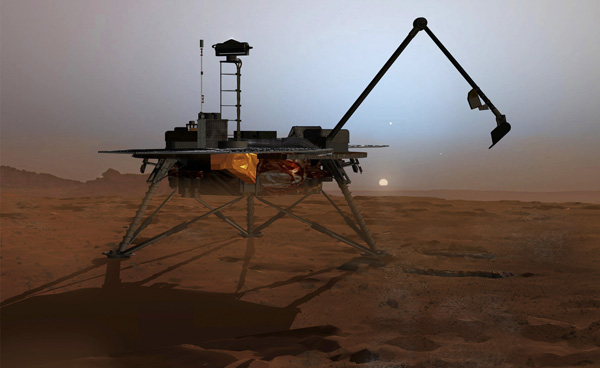
NASA has begun bidding a planned goodbye to its Phoenix Mars Lander. The lander relies on solar panels and the sun's golden touch to reawaken it each day, but a dust storm has hastened the end in the face of the oncoming Martian winter.

However, the lander's cold fate has evoked an outpouring of netizen love. Wired hosted a pithy epitaph contest to mark the occasion. Phoenix also polished its geek credentials by guest-blogging for Gizmodo about its mission. Readers can still catch Phoenix's personal Twitter stream from the popular social networking site, complete with robotic tweets such "Space exploration FTW!"

Personable messages from a robotic spacecraft may sound quaint, but space exploration is indeed a winner here. Following a May 25 landing on Mars, Phoenix directly identified water ice on the red planet for the first time. It even detected falling snow with a laser remote sensing instrument. Samplings of Martian dirt have helped reveal the chemical makeup of a planet that could have harbored life.

The Phoenix mission also highlighted both the advantages and disadvantages of robotic space exploration. Some observers grumbled about the lander's earlier troubles with scooping up dirt samples and delivering them to its test ovens – a problem that a human astronaut could probably have fixed in minutes, not days.

Yet a human mission to Mars currently remains out of the question. Even if new technologies can protect astronauts against radiation during the months-long journey, the need to provide life support and return systems dramatically boosts mission costs. NASA also doesn't seem eager to give astronauts one-way tickets to Mars, although Buzz Aldrin might say otherwise.

By contrast, Phoenix can cheerfully tweet away the final days of its suicide mission. Sure, it lacks human drama, but that hasn't stopped human interest in our robotic brethren. Earlier surveys suggested that younger people found more excitement in the predecessor Mars rover missions than in the idea of human missions to Mars. Similarly, space enthusiasts howled when budget cuts threatened to end the rover missions this year.

Can social networking further encourage a human stake in robotic space exploration? If Phoenix is any indication, NASA's SUV-sized Mars Science Laboratory should get to work on its blogging voice.

The Phoenix lander was named one of PopSci's top 100 innovations of the year. Read about it here, where you can also check out all of Best of What's New 2008.

Want to read more articles on the military, aviation, and space? Subscribe to Popular Science and enter to win $5,000!

10 Comments

Eulogy:

"Farewell Phoenix Mars Lander,
We have gained so much knowledge about Mars because of you
And with this knowledge that you were able to gather
We will be guided on what we are going to do henceforth
You will always be remembered in our hearts for giving us these precious info...
And one day when we are all prepared... We shall clean you up and dust you off and you will no longer be a memory but a shining symbol of what technology we had in the past... just like we keep our precious stamp collection or our precious baseball cards, we will enshrine you in the first Space Musuem that we will build there someday... Till we meet again, Phoenix Mars Lander..."

Homo Sapiens 11-14-2008

Guys and gals, with the precious info that we got, we could use it to plan improvements on the next rovers if we decide to gather more data. Then after that "baby steps" perhaps till our ultimate goal of putting up a biosphere there or terraforming a small place... maybe "acre by acre" or "hectare by hectare". Again, it's your call but I suggest that there should be no - one way ticket for us humans. We just have to build better rovers or better robots. It's different back then in those ages when the first explorers ventured forth to visit foreign lands. We are so advanced now that a few more improvements would hopefully help us to reaching our ultimate goal or what we want to achieve ... which is... I dunno, it's all up to you...

"waits enthusiastically for future developments..."

We have GOT to get rid of these crazy old men running NASA. Multimillion dollar robots cannot move as fast or as far as a $50 balloon on Mars. Robots cannot explore Mars five square inches at a time. We need to use Martian winds to blow aircraft, inflatables, around and take data randomly from winch down equipment. For the cost of one of these silly robot mechanical monsters, we could have close up images and data from hundreds of square miles by now.

But what would happen if a dust storm came, if we have aircraft there is would have to be more stable than a balloon, and that would cost money. Also how would we get it up there? How do you get a $50 balloon to Mars? Also, how are you going to power it? If it runs on solar power, it is going to be expensive. A $50 (cheap) balloon on Mars is just not practical.

jamesmicoff

from Jacksonville, Florida

James Micoff

Well that should make me a pop buck

DarkFx

from Winnipeg, Manitoba

When Will it Be Replaced?

Farewell Phoenix! I agree to an extent about aerial research of Mars. I think it would be a great thing to get going, but they are doing great as it is to discovering and testing the material they are interested in. They want to look for life, they have to stay on the ground and test samples to do that. They have a proven track record of some failures, but many successes of pin point placement accuracy across millions of miles to get the lander to the right spot for testing. They can/have already mapped the ground using extremely advanced photography and digital topography techniques from orbiting satellites (just as on earth.) So as it looks right now, mechanical labor drilling or miles long roving devices are working just fine for the information we want to learn right now.

Mike Cook

from Kent, WA

Illustrates the great virtue of using a nuclear power source. Nukes are more reliable (really!) and provide much more power, which would have really speeded up digging operations and would allow higher energy smelting operations, as well as ground penetrating radar and faster data transmission back home.

Oh Mars Lander, you have showen us so much, but my favorite shot is this one: http://www.outofthisworldoutfitters.com/blog/post/2008/05/New-Mars-Phoenix-Lander-Photo.aspx and this one: http://www.outofthisworldoutfitters.com/blog/post/2008/08/Montauk-Monster-and-Water-on-Mars.aspx . What will we do without you?
Aaron, COO-OOTWO @ www.ootwo.com

Oh lander, you have given us so much. What ever will we do without you. My favorite images are this: www.outofthisworldoutfitters.com/blog/post/2008/05/New-Mars-Phoenix-Lander-Photo.aspx and this: www.outofthisworldoutfitters.com/blog/post/2008/08/Montauk-Monster-and-Water-on-Mars.aspx . Sorry to see you go. be ever still your shovel.

Aaron, COO-OOTWO @ www.ootwo.com

What yu say is true mike cook. But can you imagne the mess it would make if it blew up on launch? I think solar power is the best way to go for now. At least until we can improve other more reliable and stable power sources.


Download Our iPhone App

Stay up to date on the latest news of the future of science and technology from your iPhone with full articles, images and offline viewing


Follow Us On Twitter

Featuring every article from the magazine and website, plus links from around the Web. Also see our PopSci DIY feed


Become a Fan On Facebook

Share links with friends, comment on stories and more


November 2009: Astronaut 3.0

Inside NASA's astronaut bootcamp and the grueling new training regimen for deep space. Plus, ten young geniuses shaking up science today, one writer's quest to analyze every man-made chemical in her body and more.

Check out the issue's full contents online here

Popular Science Photo Pool


Share your photos in the Pop Sci pool at www.flickr.com!
tags_sprite.png
POP_embeddedForm_cover_May09.jpg
