megapixels

Megapixels: Thinking Cap

Tiny surface electrodes could help paralyzed people move

Bundles of microelectrode wires fan out over a small area of a human brain. These electrodes were placed by neurosurgeons at the University of Utah to see if they could detect precise brain activity associated with motor movements. To their surprise, the hair’s-width microelectrodes, originally designed to study epilepsy, picked up the firings of small groups of neurons despite being merely set on the surface of the brain.

[ Read Full Story ]

Fowl Line

The U.S.-Mexico fence protects the border but could endanger animals

A trio of turkeys peacefully gobbles cornmeal on a cattle ranch in northern Mexico. But a fence may cut off the chuckwagon. Last February, Roy Toft, a fellow at the International League of Conservation Photographers, photographed these turkeys for an ILCP project documenting wildlife around the first few hundred miles of the 18-foot metal wall that the U.S. Department of Homeland Security is building along the border.

[ Read Full Story ]

Kurtsystems "Equine Training System" Means Faster Steeds, Fewer Injuries


Racing Form:  Courtesy Kurtsystems/Revolve Technologies
A horse trots along a dirt road in Turkey, encased by the Kurtsystems Car equine training system. What may look like a complex horse-drawn carriage is actually a high-tech way to automate the delicate process of training racehorses.

[ Read Full Story ]

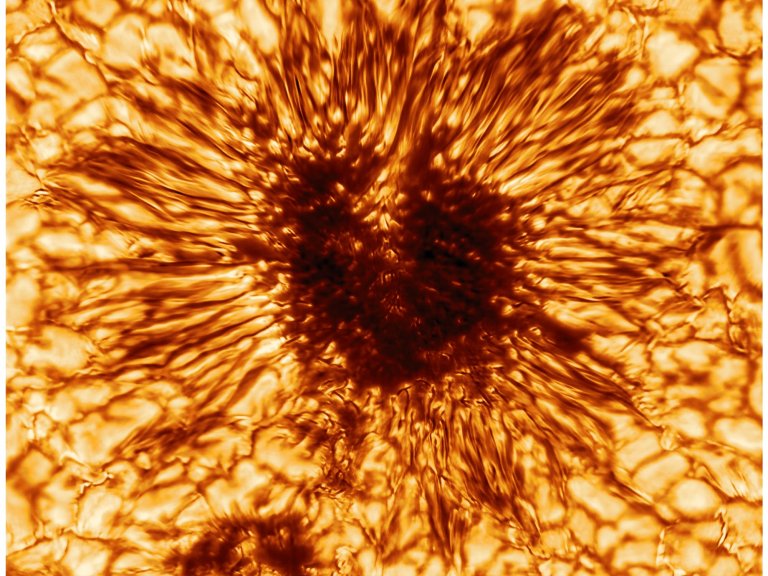
The World's First Image of an Entire Sunspot's Structure


Solar Force Field:  University Corporation for Atmospheric Research
The first computer-generated model of an entire sunspot—a magnetic anomaly on the surface of the sun—tracks the magnetic fields in the area, helping researchers figure out how the sun releases energy around the spots. At the dark center, or umbra, the field is so strong—about 1,000 times the solar average—that it blocks the solar gases that typically bubble to the surface.

[ Read Full Story ]

Mites Keep Cockroaches Mold-Free

Thinking of keeping a giant roach as a pet? Make sure it's infested with beneficial parasites first

What’s more disgusting than cockroaches? Mites that feed off cockroaches. Here, mites munch moist debris from around the breathing holes of a Madagascar hissing cockroach, an insect sometimes kept as a pet that, unfortunately, can trigger allergies.

[ Read Full Story ]

Megapixels: A Living, Beating Pig Heart in the Lab, No Pig Necessary


Open Heart Surgery:  Roger W. Winstead
This is a pig heart, procured from a slaughterhouse, beating on a heart-pumping machine called the Heart Cart. Because pig hearts share many anatomical similarities with humans', scientists often use them to test new medical devices and surgical procedures. Instead of operating on the entire, living hog, which costs about $2,500 for each experiment, the Heart Cart lets researchers work on just the hearts, dropping that cost to $25, by pumping them with a saline solution to make the heart valves move realistically.

[ Read Full Story ]

16-Megapixel Infrared Satellite Camera Can Monitor An Entire Continent In a Single Shot


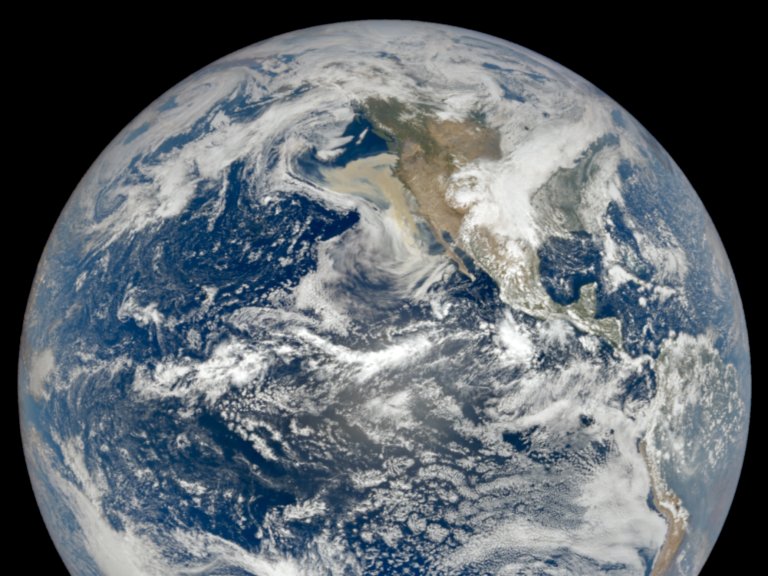
Have you ever been taking pictures of an entire country from space and thought, "you know what, this is ok, but I want to photograph the entire hemisphere at once,"? Well, with Raytheon's new 16-megapixel infrared sensor, you can.

Or, more precisely, the government can. Designed to work as part of a satellite, the sensor uses 4,096 pixel rows and columns to produce what the company calls, "an 'unblinking eye' over an entire hemisphere."

[ Read Full Story ]

Sailing On the Ground, at 126 MPH

Greenbird smashes a decade-old speed record for wind-powered craft

Running Like the Wind: The Greenbird uses an airplane-wing-like sail to obtain ground speeds of 126.2 mph  Colin Leonhardt (See the Greenbird up close!)
The wind may be restless, but the fastest air-powered ground vehicle is surprisingly steady as it sails over the dusty ground. Called Greenbird, it was developed by English engineer Richard Jenkins and the U.K.'s largest private green electricity supplier, Ecotricity.

On March 26 in a dry lakebed in California, the craft broke the world land-speed record for wind-powered vehicles by more than 10 miles an hour, setting the new record at 126.2 mph.

[ Read Full Story ]

Meet Lemur IIa, the Autonomous Space Handyman Robot

Versatile robots will rule the heavens, or at least ensure that they run efficiently

Lemur IIa is a robot designed to autonomously inspect and maintain in-orbit space equipment such as the Orion crew exploration vehicle. Shown below on a model space telescope, the Lemur IIa was envisioned as an orbital Swiss Army knife. Each limb has four degrees of freedom and a "quick connect” feature, allowing astronauts to swap in different repair tools as needed.

[ Read Full Story ]

Color-Coded Ants Reveal their Efficiency


Artful Insects: Biologist Anna Dornhaus color-coded 1,200 ants using paint to identify individuals and set them on various tasks.  Photograph by Alex Wild

[ Read Full Story ]
READ MORE ABOUT > , , ,
Page 1 of 4 1234next ›last »


Download Our iPhone App

Stay up to date on the latest news of the future of science and technology from your iPhone with full articles, images and offline viewing


Follow Us On Twitter

Featuring every article from the magazine and website, plus links from around the Web. Also see our PopSci DIY feed


Become a Fan On Facebook

Share links with friends, comment on stories and more


November 2009: Astronaut 3.0

Inside NASA's astronaut bootcamp and the grueling new training regimen for deep space. Plus, ten young geniuses shaking up science today, one writer's quest to analyze every man-made chemical in her body and more.

Check out the issue's full contents online here

Popular Science Photo Pool


Share your photos in the Pop Sci pool at www.flickr.com!
tags_sprite.png
POP_embeddedForm_cover_May09.jpg