
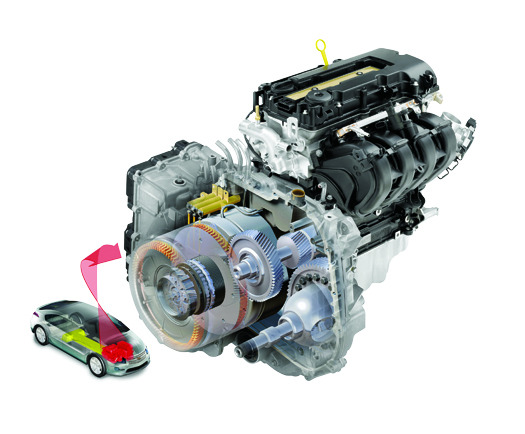
A look at the inner workings of GM's plug-in car

Chevy Volt Engine Kevin Hand

In principle, the Chevrolet Volt is simple: It’s an electric car with a gas-powered generator for backup. Yet the machinery under the hood is complex. The overarching goal is to wring maximum miles out of the Volt’s lithium-ion battery and, when gasoline is necessary, to use it frugally. This requires the Volt’s drivetrain—composed of two electric motors, a gasoline engine, three clutches and a planetary gearset—to blend power from different sources to find the perfect balance in every driving situation. Here’s how it happens.

One-Motor EV Mode

Driving around town at up to approximately 40 mph, power flows from the 400-pound, 16-kilowatt-hour lithium-ion battery to a large permanent-magnet motor, which moves the car.

Two-Motor EV Mode

The harder you push the car, the more stressed the primary motor becomes—until a second, smaller motor joins in, allowing the larger one to spin more slowly. The two motors connect
to the planetary gearset, which blends power from the pair into torque that drives the car.

One-Motor Extended-Range Mode

Between 25 and 50 miles into your drive, the battery will dip to 35 percent charge, and the gas engine will start. Here, the gas engine drives the small electric motor, using it to generate electricity (an electric motor run backward is a generator) to sustain the battery’s charge.

Two-Motor Extended-Range Mode

With the battery low, at highway speeds, the primary electric motor continues to drive the car. But now the gasoline engine mechanically connects to and powers the secondary electric motor, which in turn helps the primary motor drive the wheels.

Verdict

Critics have argued that, because under some circumstances the gas engine helps power the wheels, the Volt is nothing new—a glorified Prius. But that’s not true. Efficient as it is, the Prius is a primarily gas-powered car. The Volt, in contrast, always drives like an electric car, and for up to 50 miles a day you’ll never burn a drop of gas.

Want to keep track of the latest concept cars, automotive innovations, and more? Subscribe to Popular Science today, for less than $1 per issue!

25 Comments

This just won north american car of the yr. Its really awesome that american ingenuity is blossoming in this vehicle. I am concerned though of the lifespan of the components compared to a conventional engine. hopefully they have a good warranty to give consumer confidence on the vehicle

The difference between a Prius and the Volt is pretty minimal. They're both hybrids. Toyota just announced they'll be producing a plug-in electric version of the Prius (finally), upping the ante in the fuel-economy war and further erasing those minor differences.

Here's the rub. Toyota has been selling the Prius for 13 years; 10 years in North America. They've built more than 2 million of them. It took GM this long to finally catch up? What? It's symptomatic of their inept executive team and management; the ones that drove the company into the ground...well not actually into the ground, they sold it to us, the taxpayers and now we're propping up their ineptitude. Awesome.

Despite my criticism of management, I still think there are some great engineers at GM and the Volt is proof of that. They're just really late to the party...thanks to (mis)management.

If you're going to argue hybrid against hybrid, consider that GM has been building hybrids for quite a while now. Silverado, Tahoe, Malibu, Aura to name a few.

I can imagine the complexity - 'the Volt’s drivetrain—composed of two electric motors, a gasoline engine, three clutches and a planetary gearset' - is going to be one of the Volts downfalls.

I would bet that the reliability of this complex drivetrain will cause huge warranty problems for GM within 3 years of release of the Volts.

Imagine how the accelerator recalls have hurt Toyota and multiply that by a factor of 10.

The preferred complexity is the far more simpler Nissan Leaf which uses no gas engine, no clutch, no gearsets. In other words, it's a marvel of simplicity just like your typical electrical race car you buy at your local hobby shop!

Well, not the electronics ha.

that is one complex drivetrain. I like it though. I won't be buying one, but still think its pretty cool

So, what I get out of this is tha in the last mode, the gas engine spins the secondary electric one, and it drives the wheels in parallel with the primary electric motor.

Seems to be a fairly complex way to effectively parallel the gas and electric motors.

There are two types of engines such as external combustion engine and internal combustion engine. The car engine is an internal combustion engine which creates energy by burning the petrol inside the engine.
http://leanspaacai.org/

This is rather disappointing considering how its been hyped/explained/shown over the past few years.
And I'm sorry to say If the gas engine has, in any way, a physical mechanical connection to the drive train, It's a Hybrid not an EV.
While, yes it does use the electrical side more so if not better than current Hybrids(the Prius), it's still one.
And like other have pointed out here, the shear complexity of what should be a rather simple design will be it's downfall.

I agree with the comment made by someone who compared it to a glorified Prius. The Chevy Volt essentially works very similarly to the Prius. The only difference being that for the first 40 miles or so the Volt relies exclusively on the electric motor until the battery is depleted. The Prius, on the other hand, used Synergistic logic to power the electric from the battery, electric from the generator powered by the gas engine or combination electric and gas power to the wheels. Like the other commentator said, the Prius has been out for 13 years and it took GM this long to come up with essentially the same technology at TWICE the price.

The backup engine should be Cyclone Power Technologies external combustion engine.It burns any liquid/powdered fuel without the need for a catalytic converter.

regardless of the fact that the chevy volt is primarily an electric car we must ask ourselves, where does this electricity come from? It comes from the burning of coal which is yet another form of fossil fuel. Mass media portrays the use of electric cars the way of the future and how it doesn't release any carbon dioxide into the air, its all lies to put a big fancy price tag on the new generation of cars that will be sold to people everywhere who think this will actually make a difference. believe it or not eventually we WILL run out of fossil fuels and electricity will be a scarcity, production of almost everything will stop! As a human race the greed for money has corrupted our natural instincts as animals. It's a shame that as a species we have lost our connection with our planet (Michael Ruppert). All we care about is how to do useless tasks better and faster, when the most important tasks of survival which were hardwired into our existence has been masked by the conveniences of fossil fuels, for example: running fresh water, heat, transportation, FOOD; everything has been taken over by fossil fuels. The governments of the world know of this crisis but choose not release any legitimate evidence of how much oil everyone actually has, because of the fear that the numbers will drive some countries into chaos. Make no mistake, unless we find a way to co-exist with our planet it will shake us off like a small cold, and our children will be paying for our conveniences!

Cars like the Volt,I'll admit,are charged from a variety of power sources,some dirtier than others.Where I live,for example,electricity is from hydro-electric generators.You have to remember that coal fired plants can be fitted with scrubbers to capture CO2,while cars can't,so central power generation is still better than millions of gas powered autos.
Oil supplies will not run out overnight.Oil will gradually become more and more expensive,forcing the adoption of alternate energy sources.I am more optimistic things will work out for the better.

@Newbeak5

I agree. That makes more sense. Burner fossil fuels is still the best way for producing electricity, but methods for reducing pollution is what will keep us from killing the ecosystem we rely on to live on this rock. Cars can and do, do the most ecodamage in consideration to electric plants, however the concern addressed by rfazy3 is of running out of fossil fuels.

@rfazy3

For this, research has been on going for decades into the generation of energy via other methods (more radical, less traditional) that would help preserve the ecosystem and our industrious way of life. The most practical right now would be hydro-electric, solar power, and wind farms. These methods don't generate as much power as burning coal does, but that doesn't mean that there are not concepts that will revolutionize energy generation and help put the archaic methods to rest in the interest of preserving the ecosystem of our planet.

One promising prototype is the Bloom Box generator. Such technology will revolutionize the energy industry because these generators would be used to power individual faciilties and/or multiple facilities in a given area. Not only is it green technology that doesn't pollute to generate electricity, it would restructure many longstanding electric grids across the globe, and be far less expensive than traditional methods, making energy more available to the rest of the world (one less thing to go to war over).

And, let's not forget the one thing that such research and development will eventually help us bring; an end to reliance on petroleum products. With more efficient ways of generating and utilizing energy other than oil and other fossil fuels, we won't have to rely on one particalur group of nations to maintain our industrial complexes. Oil companies won't have the monopoly on energy anymore (they don't now), and with cheaper more efficient and eco-friendly methods of energy generation, we can develop a strong cornerstone to the foundation for building towards world piece.

Besides how cool would it be to just by a car and charge it with your Bloom Box, and not have to pay for gas (and electricity) ever again? I say keep blazing the trail.

phoenix1012:Please reread my previous comment.I did address the comment by rfazy3.My point is market forces will force adoption of a hydrocarbon alternative when hydrocarbons become significantly more expensive.

Jesus,has anyone seen tighter security on any other website than this one? TWO word challenges and now a final capcha!
Signing on to the Pentagon website is probably easier!

When one type of energy is changed to other type of energy, energy loss happens always. That was the main reason the idea, "regenerating electricity by burning gas", had not been adopted until recently.

To generate electricity for home and "recharge station" for EV cars, the energy sources are diversified and some are cheap to get and hard to use by putting in a car. (e.g. tidal power) So, in that case, generating electricity is reasonable.

However, Volt clearly uses an engine to generate electricity on the fly.
Then is there any official GM's document or any information saying that "generating electricity by burning gas is more efficient than or equally efficient to rotating wheels directly by burning gas"?

If it is not more efficient or equally efficient, the Volt mechanism is disguising.

I think the reason the Volt's backup engine is more efficient in charging batteries is because it is designed to operate solely at it's most efficient speed,whereas if it was directly driving the wheels,it would operate in a wide band of RPMs,most of which are not at peak efficiency.
Of course,the idea is to spend as much time as possible using battery power alone,while still having a backup engine available for times when travel distance exceeds 40 miles a day.

When you all keep saying its a glorified prius, im disgusted. The prius is just an ass-ugly car. This is the first electric/hybrid car that looks decent. f not, more than decent. Id buy this car and cut off a finger before having to drive a prius. Maybe not many engine differences, but it sure as hell is a lot more appealing!

wltsstab1: Me too! Thing thing about Prius is that it is a parallel hybrid-except at low speed and for short distances,both batteries and engine power it.Cars like the Volt are series hybrids-batteries are what drives the car,and the engine is only there to keep a minimum charge in the batteries.I'm not sure about this,but I believe under certain conditions at highway speeds,the engine directly powers the electric motors.I don't believe there is a mechanical connection involved at any time between engine and wheels,although I am possibly wrong here.

@Newbeak5. I am almost sure that youre right about the engine. At least, thats what i got out of this article.

Why even use gas or electricity?? Why not use hydrogen; it's been around for years, already been proven, and it's as free as one could possibly hope for. Maybe that's the problem...the cost.

@henry3308 the problem with hydrogen fuel cells i that, if in a collision, they explode violently and quickly, producing a large release of energy. This would instantly obliterate the car and the driver. THATS why we dont use hydrogen. At east, not now.

One question, do you have to run the gas engine all the time durning the winter months? How does the heater work?

No you don't. The battery would also run that. If you've been to northern states or countries, they plug their cars into outlets when parked to keep the battery goin to run the heater and keep the engine and internal workings from freezing. So i would strongly believe the same technology is in this car.

@henry3308 Hydrogen may be all around us, but it is chemically bound to other elements. There is no "free" hydrogen to be had on Earth, and it costs energy to liberate hydrogen from compounds such as water. Right now, the most efficient mechanism we have for generating hydrogen is from methane and steam -- producing carbon dioxide in the process, and directly consuming a fossil fuel (natural gas) in the process.

@wltstab1 The problem is not the fuel cells, it is the expense of producing hydrogen and the safe storage of hydrogen. Heavy walled containers for compressed hydrogen are heavy, and still leak hydrogen into the environment over time. Metal hydrides can store hydrogen, but are also heavy and need to be heated to release the hydrogen. I have never read of a modern fuel cell exploding in the manner that you describe (there's a reason NASA uses fuel cells on spacecraft to generate electricity and pure water, after all), but I have read plenty of reports of hydrogen storage tanks exploding. Check your references and/or cite them if you're going to make that kind of claim about fuel cells.


July 2013: The Future Of Flight

The incredible innovations, like drone swarms and perpetual flight, bringing aviation into the world of tomorrow. Plus: today's greatest sci-fi writers predict the future, the science behind the summer's biggest blockbusters, a Doctor Who-themed DIY 'bot, the organs you can do without, and much more.


Online Content Director: Suzanne LaBarre | Email
Senior Editor: Paul Adams | Email
Associate Editor: Dan Nosowitz | Email
Assistant Editor: Colin Lecher | Email
Assistant Editor: Rose Pastore | Email

Contributing Writers:

Kelsey D. Atherton | Email
Francie Diep | Email
Shaunacy Ferro | Email

circ-top-header.gif
circ-cover.gif
bmxmag-ps