
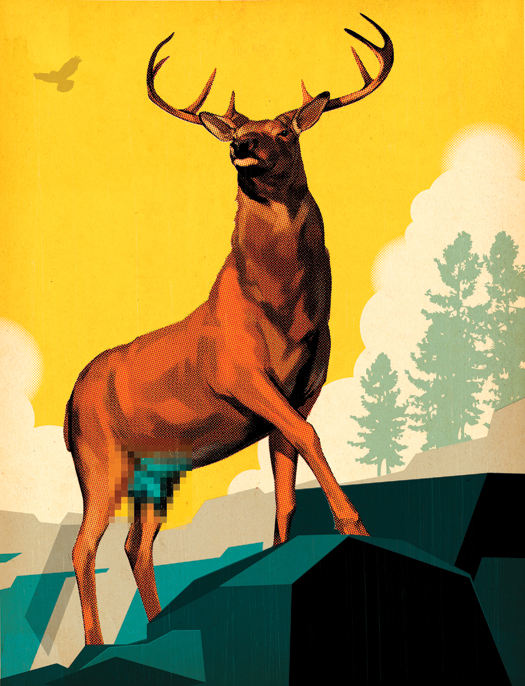
In 1989, researchers at the University of California at Davis invented PZP, the first birth-control vaccine for animals other than humans. When injected, PZP causes a female’s immune system to block sperm from her eggs, offering a humane method of keeping populations in check. The compound worked in elephants, donkeys and deer, but it had a troubling side effect: the animals stayed in heat longer than normal. In one trial, deer were fertile for six months instead of one.
An amorous deer is a dangerous deer. While pursued by stags, females often crash into backyards and run into traffic (deer cause about 1.5 million car crashes each year). Insurance claims for deer collisions are three times higher in November, when the animals are usually in heat. Finally, after three decades, a new form of animal birth control has appeared, this time without side effects.
The GonaCon vaccine for whitetailed deer is the first contraceptive approved by the Environmental Protection Agency for use in the wild. After a ranger traps a female, he gives the deer an injection, rendering four out of five females infertile, and thus unattractive to males, for up to five years. When injected, the vaccine, which was developed at the National Wildlife Research Center in Colorado, makes the immune system produce antibodies that bind to gonadatropin-releasing hormones, which inhibits the release of sex pheromones. This May, Maryland became the first state to add GonaCon to its list of approved deer-control devices, alongside bullets.
But trapping animals to administer vaccine injections requires a lot of labor. And in some cases, it’s very dangerous. Take, for example, the four million tusked, up to 400-pound feral hogs that cause more than $400 million in damage to the Texas economy every year by digging up sweet potato fields and rooting where they don’t belong. Feral pigs are intellegent, elusive, and sometimes violent. Duane Kraemer, a professor of veterinary medicine at Texas A&M university, is working on a pig contraceptive delivered out of a feeder. The feeder uses cameras and facial-recognition software to give a dose to pigs and not, say, raccoons. Kraemer says that he hopes to field-test his feeder this fall.

Five amazing, clean technologies that will set us free, in this month's energy-focused issue. Also: how to build a better bomb detector, the robotic toys that are raising your children, a human catapult, the world's smallest arcade, and much more.


Online Content Director: Suzanne LaBarre | Email
Senior Editor: Paul Adams | Email
Associate Editor: Dan Nosowitz | Email
Assistant Editor: Colin Lecher | Email
Assistant Editor: Rose Pastore | Email
Contributing Writers:
Kelsey D. Atherton | Email
Francie Diep | Email
Shaunacy Ferro | Email
Interesting article but the comment "deer cause about 1.5 million car crashes each year" seems way off considering there are about 5 million car accidents each year. That's 30% of all accidents are caused by deer, really?
As the Associate Director for Game Management for the Maryland wildlife agency, I can say that without exception we have never used or approved poisons for controlling deer. We did approve the use of GonaCon for deer just this year. As the article points out, the use of GonaCon will be both expensive and time consuming since it may only be injected via a hand syringe (and therefore not via dart). Nevertheless, we want to make it available should some group decide to apply to us to use it in the right situation. We do not intend to use state funds to adminsiter this contraceptive.
We work hard to have a progressive and responsive program for deer management in Maryland - but we certainly don't allow the use of poison!
Pete Jayne
Maryland Department of Natural Resources
Associate Director for Game Management
Wait, won't this select deer that are immune to this contraceptive for reproduction? After a few generations, we'll have a bunch of contraceptive-proof deer running around.
I'm basing this on the assumption that this only works on 4 out of 5 deer for genetic reasons, not chance.
Purely speculative and without any supporting information.... but I wonder if this would have any long term psychological effect on the lady deer. 5 years of being ignored by the opposite sex.... Ouch.
It would probably take more than a few generations to start seeing an effect, deer breed quickly but not THAT quickly.
I just noticed this.... Did they blur the deers genitals as an joke about the birth control, or was someone offended??
I have a cheap easy solution it inclides a box of ammo and making hunting season longer, food for people and population control. Everyone is happy the end.
@manhunter098 this isn't normal natural selection I'm talking about, this is an unusual event called a population bottleneck. It would take only one generation to start seeing a large chunk (not all) of the population become contraceptive-resistant. The amount of contraceptive-resistant deer would depend on the number of deer treated and the area covered.
BBQ, enough said. ;)
If they want to keep deer populations in check, just increase the amount of deer that can be hunted each season. That’s the best option; don’t introduce a poison into nature.
The word extinction comes to mind.
So does the word insane.
I nominate the inventor and all of the people who made this possible for the Darwin award.
The blur is "blue" 'cause he's not getting any, im assuming?
_____________________________________________
My FYI Question :)
http://www.popsci.com/science/article/2010-10/fyi-what-would-happen-if-every-element-periodic-table-came-contact-simultaneously
There are no deer overpopulation issues where hunting is allowed - only in places where they are not (protected wildlife refuges and inside cities with shooting bans).
To be honest, if you can trap a doe to administer this, you can kill a doe for less money and effort.
It is not about extending seasons and bag limits, but about culling the cities as well as the countryside - by offering incentives to bowhunters or hiring trained eliminators.
Am I the only one that noticed, according to the article, the feral hogs have "four million" tusks? Yikes! Where do they fit them all?? Oh, wait....
One of the main reasons I hunt is to eat meat that has not been messed with. I would much prefer keeping nature natural so we don't have the potential for a repeat of history like the thalidomide disaster. I would also like to know in advance who will be responsible when problems arise and what the solution will be. Eliminating species due to negligence and stupidity? When there are other methods that work or work better and cheaper? What happens when other species eat injected animals? Do unprocessed byproducts leave the animal through waste and contaminate plants and water supplies? Is this ultimately a political "compromise" to those who do not support hunting but still want to regulate animal population? Perhaps revisiting our current management rules, regulations and methods should occur, saving money, helping feed the needy with a lower likelihood of negative side effects.
4cmail.com, Every year there are over 70,000 REPORTED deer car accidents in New York alone. I know personal that they don't all get reported. As for using birth control on wildlife the cost do and effect do not make it worth doing. Many of our rivers are home to he\she fish caused by human birth control. Now the people against other form of herd control want to spread these same products over our back yards and forest. To get the desired effect the birth control would need to be ingested daily. The only way to do this would be through baiting. Baiting brings wildlife in to the same area daily which involves having the food\drug supply left daily by humans. When wildlife feeds together the chances of spreading decease through the heard increases greatly. This is why there are federal and state laws against feeding wildlife. Each year hunters spend millions toward wildlife habitat making the herd healthier. Groups against hunting seldom spend a dime toward their cause. Wildlife birth control would cost hundreds of millions of tax payer dollars which in the end could cause more damage then good.Our local state college over Xmas break is hiring a company to cull of the campus deer herd. The deer density on campus is between 60 and 90 deer per square mile. The nature preserve on campus has little low brush\cover for wildlife.Endangered plants are vanishing from over browsing . Culling is the quickest cost affective way to rebuild the eco system .