
PopSci provides chilling answers to your burning questions

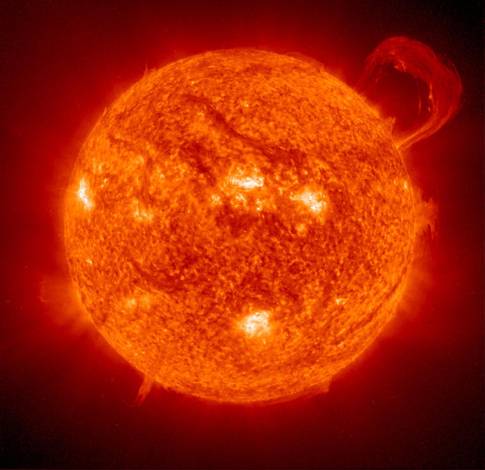
If The Sun Dies NASA

If you put a steamy cup of coffee in the refrigerator, it wouldn’t immediately turn cold. Likewise, if the sun simply “turned off” (which is actually physically impossible), the Earth would stay warm—at least compared with the space surrounding it—for a few million years. But we surface dwellers would feel the chill much sooner than that.

Within a week, the average global surface temperature would drop below 0°F. In a year, it would dip to –100°. The top layers of the oceans would freeze over, but in an apocalyptic irony, that ice would insulate the deep water below and prevent the oceans from freezing solid for hundreds of thousands of years. Millions of years after that, our planet would reach a stable –400°, the temperature at which the heat radiating from the planet’s core would equal the heat that the Earth radiates into space, explains David Stevenson, a professor of planetary science at the California Institute of Technology.

Although some microorganisms living in the Earth’s crust would survive, the majority of life would enjoy only a brief post-sun existence. Photosynthesis would halt immediately, and most plants would die in a few weeks. Large trees, however, could survive for several decades, thanks to slow metabolism and substantial sugar stores. With the food chain’s bottom tier knocked out, most animals would die off quickly, but scavengers picking over the dead remains could last until the cold killed them.

Humans could live in submarines in the deepest and warmest parts of the ocean, but a more attractive option might be nuclear- or geothermal-powered habitats. One good place to camp out: Iceland. The island nation already heats 87 percent of its homes using geothermal energy, and, says astronomy professor Eric Blackman of the University of Rochester, people could continue harnessing volcanic heat for hundreds of years.

Of course, the sun doesn’t merely heat the Earth; it also keeps the planet in orbit. If its mass suddenly disappeared (this is equally impossible, by the way), the planet would fly off, like a ball swung on a string and suddenly let go.

Send your questions to fyi@popsci.com. Can't wait a month? Look for answers on our Web forum, popsci.com/fyilive.

29 Comments

Reminds me of a science fiction short story I read decades ago by Fritz Leiber, called "A Pail of Air." Here it is:
http://www.webscription.net/chapters/0743498747/0743498747___6.htm

Very interesting write up. The most interesting part that they make reference to is that life would go on at the bottom, warmest parts of the ocean. Exactly why Europa must be reseached. Alien ocean? Check. Possible warm waters heated by the planets core? Check. Life? Yup, see it here:www.ootwo.com/europa.asp Like I said, pretty interesting stuff.

well, warm ocean bottom or not, it would still SUCK if the sun went out...but thats just me...

I agree, there could be life on europa.....SO STOP LOOKING AT MARS!!!!!

And this supports it.

-THE KID

If the sun was suddenly gone then the earth would fly off out of orbit instanly ? Does this mean that gravity is faster than the speed of light? I t takes about 8 minutes for light to reach earth from the sun. But the planet would instanly fly off into space if the sun was suddenly gone? Am I crazy or is Einstein's theory wrong that nothing is faster than light?

Sounds exciting; can't wait to live in Iceland or the ocean.

Also, pirate941, gravity isn't a particle, it's a force, whereas light is EMR (which can be treated somewhat as a particle). Einstein's theory was that no object or particle could travel faster than light. So yes, if the sun disappeared, we would be thrown out of orbit instantly but would still have light for 8 minutes.

In response to pirate941. Yes it would be immediate. Because just like electricity and magnetism, gravity is a field. It creates a potential energy on an object at a certain point is space without any regard to time. Look it up in your favorite physics textbook.. but theres your answer.

It would suck to be people who hate the cold or have never seen snow

more importantly, what would we eat to sustain the surviving population

really interesting but a little bit cold.

anyone else hear that if the sun stopped it's fusion process right now it would take 1,000,000 years for the light to surface because of the suns denisity and mass? because thats what i heard and NASA space camp. so really we would have 1,000,000 years and 8 minutes to live untill that starts to happen

To pirate, polohunk, aznacorn.
No, no, no and a little more of no.

Nothing goes faster than light, (maybe tachyons ;-) ).
It would take 8min for us to lose the gravity grip.
It goes for things, fields, information and the lot.

If it was true that gravity was instant you could build
a device to comunicate, with gravity waves, over lightyears
in an instant. Wiggle your local black hole and and the guys
at the Andromeda galaxy could pick it up now (2mega ly)

Does gravity travel faster than the speed of light?

Newton himself called the idea of instantaneous gravity "absurd."

The real answer is that we do not know. Many believe that it does not, but if you do not assume that the speed of gravity is instant, and you try and calculate the orbits of the planets, you come up with unstable orbits.

But special relativity concludes that nothing can travel faster than the speed of light, and that would have to include gravity.

This, however, does not fit with our observations of the universe - ie how can gravity escape black holes while light cannot, how can binary stars predict each other's orbit, etc. General relativity tries to get around this with curved space time, then perturbations propagate at the speed of light, gravitational radiation, etc etc blah blah blah. And while I can agree with curved space time, the rest of the math just gets way too messy. The answer to all of that is that relativity simply is wrong. It's close - but in the end it is a theory, not a fact. It is good to describe many things, just not this.

Even the Earth and Moon's orbits would not be possible if we accounted for an 8.3 minute gravitational delay (same as light) from the Sun - they would be unstable to the point of collapse. It is true that "gravitational waves" are bound by the speed of light, but they are altogether something different from gravity itself (think of ripples in the space time fabric caused by a quickly rotating neutron star with a large mountain on it) - since "gravitational waves" has the word gravity in it, I think that must be what causes this misconception that gravity travels as slowly as light.

Since we don't yet have the math to describe an upper limit (special relativity fails miserably at this), we can at least deduce a lower limit on the speed through scientific observation. Some recent numbers I've come across peg the speed of gravity to be at least 2*10^20 c.

You idiots, if the sun instantly disappeared, the gravity of the sun would do so too. Thus you would be a-sling shot into the vast of space. And the light of the sun would still reach you, but it would take a little longer than eight minutes. That being of course because you'd be a good ways further than ninty something million miles from where the sun had once existed. Though something i cant figure out, would the earth stay spinning as long as it doesn't come into contact with another gravitational pull, and doesn't get smashed by a huge astroid? And secondly, would the moon still orbit the earth regardless of wether it would stay spinning or not?

i dont think i would heat things up it was ont what if the middle of winter you would die duh!!!!!!!

Nova_8768

Assuming that the earth did not come into contact with another gravitational force, the earth would keep spinning. Newton's first law explains this. An object at rest remains at rest; an object in motion remains in motion unless acted upon by an unbalanced force.

As for the moon, because of its proximity to the earth, I'm pretty sure it would remain in orbit. The earth's gravity would still be the greatest force acting on it. So it would still behave as it usually does.

OK people, in theory if the sun went out then it just mean that the heat it produces stop but gravity will still be there to make more heat as it causes nuclear fission, so in my opinion the person/people that think the sun is going to go out is arent that bright, and "if" it does the chances the life "mircoorganism on earth is going to survive for a long time is really low due to the fact that we can crash into mercury, venus, mars, astroids metors and a whole bunch of space object in out solar system while flying out of control.
imagine earth and mars and the moon hitting, WOW thats a really big explosion

you guys are retarded... if the sun vanished into thin air. with no explosion. we wouldnt know for 8 minutes, because the light AND gravity wont go away for 8 minutes. life on the SURFACE would almost seize to exist, but humans, who can build habitats to stay warm. they could also create plant life using man made light, and if the habitats were big enough they could have farms with cattle. Assuming we dont hit another planet or object in space, humans can survive. Just not like we do now.

wait hold on, so if the sun went out! and the earth went spinning out to the universe! then would earth still survive? if the earth was not in orbit!?

People who call others idiots in a public forum should check their spelling and grammar, lest they reveal more about themselves than they intend.

First of all, thank you for the grammar comment. That was really getting on my nerves!

My father, who is not college educated, and I just did all the math in about 5 minutes... The sun is 91,377,000 miles from the Earth. That's 147,053,006,100 meters. The speed of light is 299,792,458 m/s. So you take 147,053,006,100 m and multiply it by 1 second/299,792,458 m and then multiply 1 min/60 seconds. That will give you approximately 8.17 minutes for the effects of the sun's death to reach Earth.

You're welcome.

Interesting, I've not heard this explained before and the concept is fascinating. We take for granted that the sun will continue to shine and increase in size to a Red Giant phase, only to decrease to a white dwarf. Even if the Earth were lucky to survive and any possible life 4 or 5 billion years from now, the amount of sunlight from the white dwarf will be what Pluto recieves at this distance.
The short term theory or the long term theory, life will eventually become non existant upon the Earth. Glad there happens to be a few billion years left.

I would have thought a reasonable answer would be a couple of million years. The Kelvin contraction time for the sun is about 20 million years, so if the fusion was turned off the gammas at the centre would be provided by compression heating. In fact, I suspect that the surface of the sun would get hotter as it shrank and it would only start to get cooler when the core hit total degeneracy and its structure started to look more like a white dwarf. juegos de bob esponja

If the sun were simply turned off--like the flip of a switch--life on earth would most likely die of a Vitamin D deficiency.

If the Sun went out we would see the night sky eight minutes after the sun went out....a boon for amateur and professional astronomers

Icirix probably made THE most sense out of anyone here. Anyone of you other people making statements as if it were known fact are close to out of your minds.

The greatest and most exciting thing about space and science is that we only know what we as humans know! We did not create the Universe and our explorations, discoveries and theories certainly shall not single handedly define its nature and existence.

As far as theories go, they aren't fact, entirely, but constructed from KNOWN facts to create a general hypothesis.
Take it from Barbosa.. They're really more like guidelines.

If the sun were to vanish a ripple in the fabric of space-time would emanate outwards at the speed of light (precisely the speed of light) and take about eight and a third minutes to knock earth off its orbit.

Now as to what happens to life on earth. It boils down to the effect of the sudden change in velocity (and acceleration, both linear and angular).

The sudden release of the gravitational force between the earth and the sun would cause the earth to lurch out of its orbit and travel along the path tangent to its previous orbit.

(Martians would be blissfully unaware for several more minutes)

Imagine you have a tiny toy sailboat in the middle of pool into which you do a canon ball a few feet away.

Copied and pasted an excerpt from the article at: http://www.csa.com/discoveryguides/gravity/overview.php

As it turned out, the Jovian weather cooperated, and everything did go well, until the big day itself. On September 8, the telescope at Saint Croix malfunctioned because of serious tape recording problems. Fortunately, it turned out that the data from other telescopes could compensate for the loss. Although Kopeikin and Fomalont also had to discard about 15 percent of their data because of bad weather on Earth, this still left enough data to carry out the analysis. They compared the position of J0842+1835 on September 8, 2002, with its average position on the off-Jupiter days. Plugging this into Kopeikin's formula for the gravitational field of the moving Jupiter gave them the answer they were looking for. Kopeikin and Fomalont became the first two people to quantitatively measure the speed of gravity, one of the fundamental constants of nature. They found that gravity does move at the same speed as light. Their actual figure was 1.06 times the speed of light, but there was an error of plus or minus 0.21. The results were then announced at the 2002 American Astronomical Society annual meeting in Seattle, Washington

Although some microorganisms living in the Earth’s crust would survive, the majority of life would enjoy only a brief post-sun existence.www.thaicartrick.com

The -400º is in farenheit... du'h took me a while to see that it wasn't a mistake


June 2013: American Energy Independence

Five amazing, clean technologies that will set us free, in this month's energy-focused issue. Also: how to build a better bomb detector, the robotic toys that are raising your children, a human catapult, the world's smallest arcade, and much more.


Online Content Director: Suzanne LaBarre | Email
Senior Editor: Paul Adams | Email
Associate Editor: Dan Nosowitz | Email
Assistant Editor: Colin Lecher | Email
Assistant Editor: Rose Pastore | Email

Contributing Writers:
Rebecca Boyle | Email
Kelsey D. Atherton | Email
Francie Diep | Email
Shaunacy Ferro | Email

circ-top-header.gif
circ-cover.gif