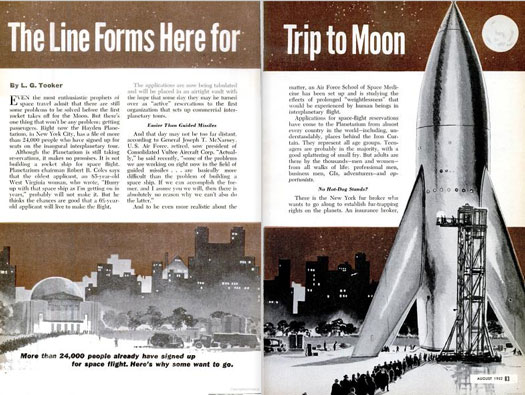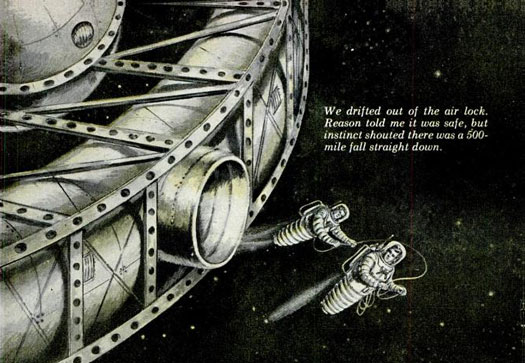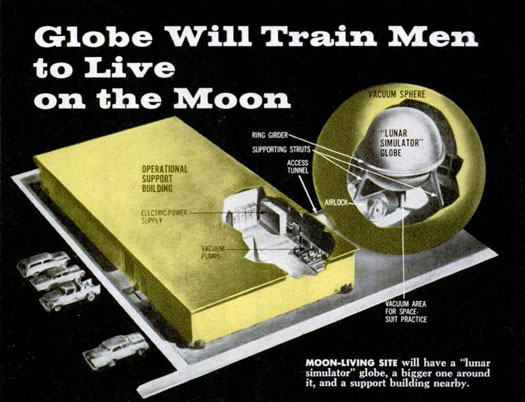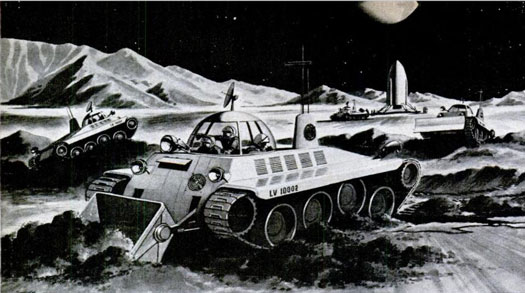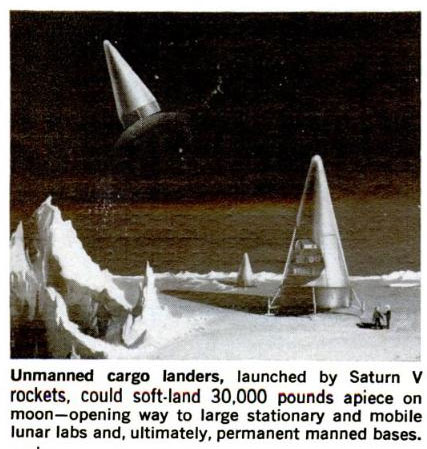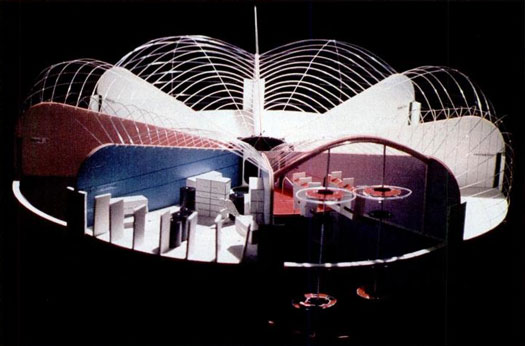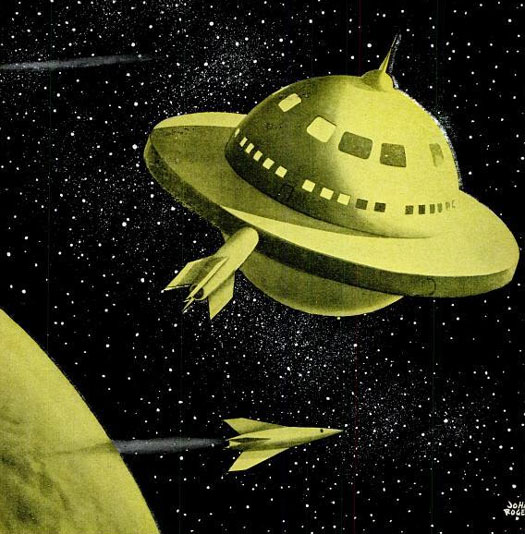
Let's face it, sometime within the next century or so, overpopulation, the exhaustion of natural resources, an alien invasion -- or perhaps the optimistic spirit of adventure -- will force us to leave Earth in search of a new habitat. Earlier this week, NASA and DARPA announced a preliminary "Hundred-Year Starship" program for sending pioneers on permanent missions to Mars. To many, relocation from Earth sounds like a glorified exile, but some retro-futuristic eye candy from the Popular Science archives will surely change their minds.
People living in the mid-1950's were famously optimistic about the future of space exploration and colonization. Establishing cities outside of earth would not only prolong the survival of our species, but it would allow us to sow a legacy of art and technology into the universe.
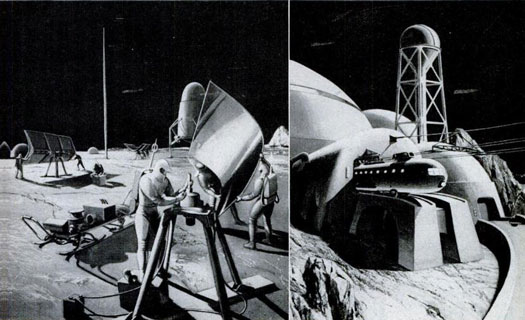
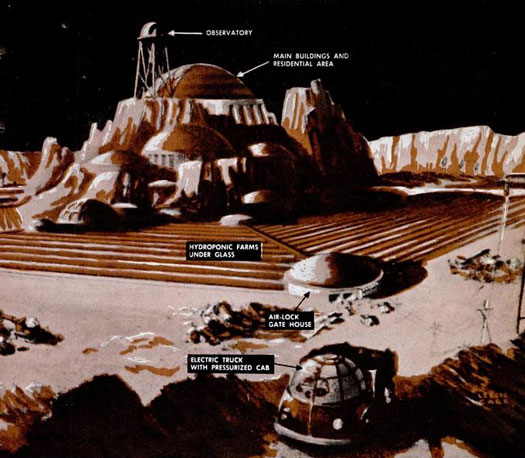
Renowned science fiction authors like Arthur C. Clarke produced literature that only fueled the public's excitement at the thought of living in orbiting space habitats or on lunar colonies. Someday we would land on the moon, and after that, we would pitch plastic bases resembling igloos. Lunar dust piled atop our residences would protect us from extreme temperatures, while algae farms would provide nutrition.
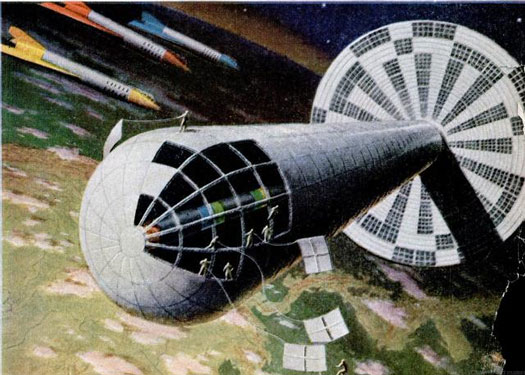
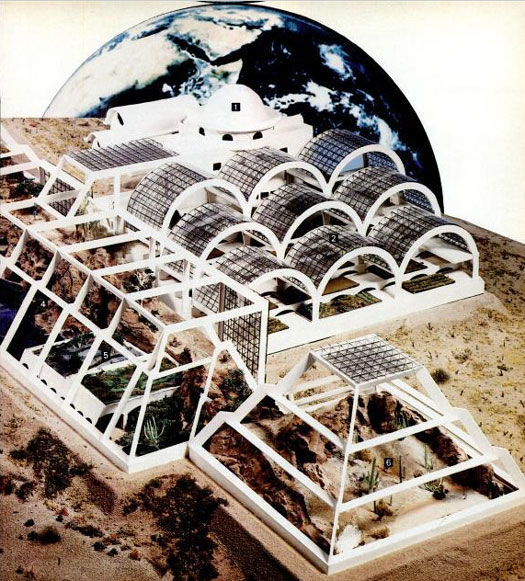
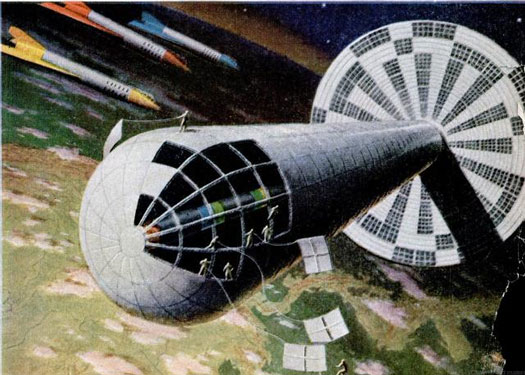
In the mid-1980's, Gerard K. O'Neill, an experimental physicist famous for his cylindrical space colony designs, merged his L5 society group with Wernher von Braun's National Space Institute to form the National Space Society. The era saw developments like the Biosphere II, an enclosed, self-sustaining habitat touted as a model for future space colonies.
As you can imagine, building space habitats is a complicated, politicized business, and at this rate, it'll take a few decades -- if not lifetimes -- before we voyage en masse to communities outside of our planet. In his novel Islands in the Sky, which we featured in 1953, Arthur C. Clarke briefly mentions a teenager born on Mars who visits Earth for the first time when entering college. As much as we enjoy watching sunsets and breathing fresh oxygen here on Earth, we can't be the only ones who read that without a strange sense of wonder and longing.
Click through our gallery to see the moon city, the booster tank houses, and more fantastic proposals for lunar colonies and orbital settlements.
The incredible innovations, like drone swarms and perpetual flight, bringing aviation into the world of tomorrow. Plus: today's greatest sci-fi writers predict the future, the science behind the summer's biggest blockbusters, a Doctor Who-themed DIY 'bot, the organs you can do without, and much more.


Online Content Director: Suzanne LaBarre | Email
Senior Editor: Paul Adams | Email
Associate Editor: Dan Nosowitz | Email
Assistant Editor: Colin Lecher | Email
Assistant Editor: Rose Pastore | Email
Contributing Writers:
Kelsey D. Atherton | Email
Francie Diep | Email
Shaunacy Ferro | Email
Knowing what we do now, none of the fanciful ideas displayed would have worked that well, and Biosphere 2 had to break it's air isolation when the Oxygen content got too low. Hopefully, the lessons learned from that will make future design efforts more realistic.
@ChuckLiddell
Looking at your avatar after reading the final "muahahhahha!!1" of your post made it that much more ominous and insane, but you're probably not too far off. :D
I think it's sill and fool hardy to try to colonize the solar system. Humans can't survive on other bodies outside of the planet earth. Are species is here for the duration.
Poineer10
Biosphere 2 was an experiment, no one realized the concrete used to build it would absorb so much oxygen, one thing I love about science, there is no such thing as a failed experiment, even the ones that do not go as you wish teach you what you need to model the next experiment better.
Boka? really?
If each generation of explorers listened to that kind of negative thinking we would still be living in caves in the African continent, No! wait, someone must have said going into that first cave was a bad idea, so we would all be standing out in the rain to scared to take the chance to get out of the rain, just like the animals in the wild getting soaked and waiting for the rain to end, because they cannot imagine a better thing to do.
Sorry Poineer10, let me rephrase that.
your right, most if not all of the old ideas would not have worked all that well, however if we had proceeded to try them we would have pushed our knowledge ahead much faster then we have and there is a very good chance we would have permanent colonies on the moon and maybe in orbit today.
but everyone is afraid if any failure these days, I am the first to say we need to do everything we can to prevent accidents and save lives but in the end every large project build by humanity has casualties, if we take all the time in the world to try and ensure perfect safety swaddling the explorers like babies in a cradle then we never get anything done, the loss of the first shuttle was a great tragedy, one that could have been avoided if not for greedy politicians and now the program is coming to an end, the majority of it's goals were never even tried. Indeed the shuttle program is about a near complete failure as far as I'm concerned
You might wonder why I said politicians?
The O ring that failed? there was two plans to make the boosters, one in a state far from Florida that required the boosters to be in modular sections, one that was from a company in Florida, just up river from the launch site, they would have made boosters in a single unit, collected the used one placed it on a barge and taken it right to the factory to be reused then barged back to Nasa, not only simpler and safer but cheaper.
Why did they go with the safer simpler cheaper idea?
A politician wanted part of the program in his state! So for a politician’s ego we lost a shuttle and the lives of the crew needlessly
err, I ment why did they NOT use the safer simpler cheaper idea
typos, we can put a man on the moon but even a spell checker is not infalable ;)
Yeah, nanotechnology will definitely do some amazing things! All our space problems will be solved with the help of this. Knock on wood. No, but really, the possibilities with this technology are immense! I haven't read any of Ray Kurzweil's books, but I have heard of some of his proposed concepts and they sound pretty incredible. He said that we will be able to put artificial blood cells into our bodies that would not require as much oxygen as normal blood cells witch would allow us to sprint at our full speed for long periods of time. I think he said like a couple of miles straight or something. The Singularity is near too. The Singularity is the point at which computers will be so advanced and they will have the required artificial intelligence that will allow them to appear no different than a human. People will then have the option too insert that computer knowledge (on a chip) into their brains allowing them to have a crazily amount of knowledge. From that point on, the possibilities are endless! There are many other awesomely cool things that he mentions that are in store for the future, but you'll just have to check it out for yourself. Google Ray Kurzweil or the Singularity, and there will be plenty of links to choose from!
All declassified information on a site would be considered Post Secret Archives and any Pictures would be considered Gallery. Do a search for declassified information.
http://mojoblastreview.com/
Damn. That's pretty freakin cool! Nanobots are awesome!