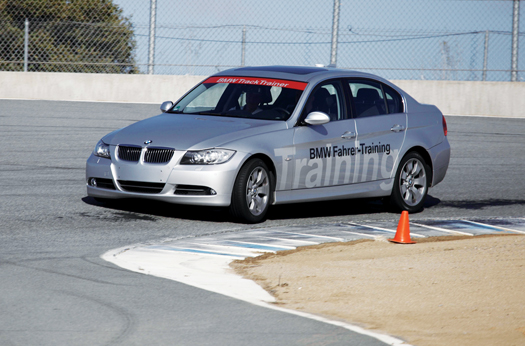
“You can grip the wheel very loosely,” the BMW engineer told me as I settled into the driver’s seat of the BMW Track Trainer. “Very loosely, to get a feel for how it is turning. But do not touch the pedals.” I detected in his tone an “unless” on the way. “Unless I yell stop! In which case you should grip the wheel tightly and stomp on the brakes.” He smiled. “Shall we go?”
With that, I released the brake and sat back as our unassuming 3 Series sedan accelerated of its own volition down a short straightaway, whipped ably into a right-hander, and then moved wide to set itself up for a fast curve to the left. I was, as instructed, holding on ever-so-slightly, but that felt weirder than just watching the wheel turn on its own, as if I were sitting in the lap of a ghost driver—which is pretty much what I was doing.
The BMW Track Trainer is a robot car: a fully autonomous automobile capable of racing the Mazda Raceway Laguna Seca in California’s Monterey County (or any other track it’s been programmed to run) at the limit of traction, mere seconds off the time a professional would run in the same model. BMW uses it to train drivers by showing them how the perfect racing line feels from the driver’s seat and by providing real-time feedback, with corrections, once they decide to take over the controls themselves. But the car is also a showcase for BMW’s Driver Assistance System, a series of radar and GPS sensors that work in concert with computer-operated steering, brake and power systems to achieve what BMW describes as “highly autonomous driving.”
BMW chose Laguna Seca because it is a difficult track, which makes barreling into turns at 100 mph all the more impressive, and because it’s a short drive from the company’s research lab in Silicon Valley, where engineers are busy reinventing the automobile for the information age. Since 1978, when microprocessors were first installed in the trip odometer of a Cadillac Seville, the number of chips in the average automobile has grown such that cars now contain anywhere from 50 to 200 processors and a mile of wiring. The increasing prevalence of hybrid and electric cars is accelerating that trend; the plug-in electric Chevrolet Volt, for example, requires 10 million lines of code, two million more than it takes to run a Boeing 787.
So carmakers are coming to Silicon Valley, where code is king. Mercedes-Benz opened a technology center here in 1995, BMW in 1998, Volkswagen in 1998, Toyota in 2001, General Motors in 2007, and Renault-Nissan in the past year—all in large part to tap the skills of the designers and developers and engineers and who have so ably sustained Google, Apple and Facebook. Include homegrown start-ups Tesla Motors, Mission Motors and the autonomous car division at Google itself, and the result is a sort of Detroit West, where California engineers continue to devise new ways to make powerful, affordable, easy-to-use computers—but now they also devise new ways to make them move very, very fast.
Exactly how I felt about all this is something I was chewing on when the Track Trainer crested the hill that leads into Laguna Seca’s infamous “corkscrew.” I had to trust that this robot racecar would remember how to negotiate one of the trickiest and most dangerous corners in the world, a hard left followed immediately by a hard right on a stretch of track that drops five and a half stories in 450 feet. Cresting the hill, the car managed not to panic and brake too soon, as humans tend to do. In fact, as we plunged into the turn, I thought for one terrifying moment that the car wasn’t going to brake at all—until it did, with perfect timing. As we safely exited, I realized I’d just hitched a brief ride into the future.
Click here to get an inside look at Silicon Valley’s automotive innovations.
Silicon Valley is a surprisingly big place. Getting around requires a lot of driving, which on California’s well-maintained roads is pleasant enough even without robot assistance. And as I drove my rental car from lab to lab, interesting relationships began to reveal themselves.
The engineers at the Volkswagen Electronics Research Laboratory (ERL), for instance, work in a white midrise office building just across a narrow marshy river from the headquarters of Oracle, the company best known for its database-management program. Managing data seemed to be about a different from what automakers do as any pursuit could be. But when ERL’s deputy director, an electrical engineer named Chuhee Lee, met me at the lab, he made it clear that this was not at all the case.
In a second-floor conference room, Lee launched a PowerPoint presentation that he had used many times to justify his lab’s existence to managers back in Munich. Combining data, it turned out, is the essence of new car design. Car engineers had long thought of the various data devices they installed—navigation systems, smartphone adapters, lane-detecting cameras—as independent gadgets with narrowly tailored functions. Now they’re beginning to link these devices to one another, to connect the data from a car’s many sensors and processors. And like the engineers at Oracle, they’ve found great value in these connections.
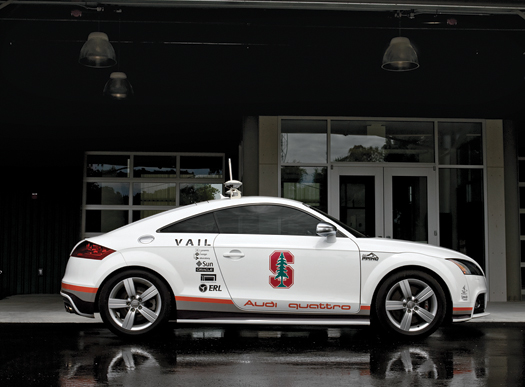
Most obviously, ERL engineers have used those connections to build a series of prize-winning robot cars not unlike the BMW Track Trainer. In 2005, a Touareg ERL modified in conjunction with the Stanford Artificial Intelligence Laboratory won the Darpa Grand Challenge, a Pentagon-sponsored desert race for driverless vehicles. In 2007 ERL’s robot Passat took second in DARPA’s Urban Challenge, an obstacle-course competition. And last fall, a lab-modified Audi TTS self-navigated the entire 12.4-mile Pikes Peak course in Colorado in just 27 minutes, reaching speeds of up to 45 mph.
I asked Lee how the kind of smarts on display in all these cars would first reach regular drivers. He played a short video for me that explained the lab’s work on what its engineers call the Affective Intelligent Driving Assistant. The product of a joint venture with two Massachusetts Institute of Technology labs, AIDA feeds inputs from multiple sensors to a central artificial intelligence that “observes” your habits and behaviors and tailors your car’s performance to them. AIDA can learn your favorite routes and stops, remember and remind you of important events, and over time anticipate other desires; it might know, for instance, which day you like to go to the grocery store because that’s when the wild Alaskan salmon arrives.
In other words, improvements in artificial intelligence will turn the car into a personal assistant. In time, we could even leave the driving to the assistant, because the sensors and software being developed for such applications will add up, the technology will evolve, and a difference in degree will become a difference in kind. “The idea is to change the relationship between human and machine,” Lee says. By 2030, cars could be smart enough that we’ll summon them to pick us up at the airport.
Engineers have already overcome most of the physical challenges. Computer processors regularly take control of the braking, steering and acceleration in many current high-end production models—such as when a stability-control system prevents drivers from spinning out on a wet road—and these same high-end cars are also increasingly encrusted with sensors (cameras, radar, LIDAR, infrared, ultrasonic) that gather data to feed those processors. The car will eventually know where it is and where it is going, and perhaps even how it will get there. Within a few years, differential GPS, which uses fixed ground stations to correct inaccuracies in satellite signals, will allow a car to reliably determine its location to within a few inches. Put these together, and pretty soon you have a Track Trainer that requires no engineer riding shotgun. It will be parked in your garage.
Cars are not especially good at learning right now, but engineers are working on that too. Rob Passaro has worked at BMW’s Group Technology Office in Silicon Valley since it opened in 1998, when the auto industry’s idea of an IT revolution was a car that could play MP3s. When I met him in the “office’s” spotless garage, though, he quickly explained that his primary mission was to “open the car as a platform for applications.” Cars are the most thoroughly computerized machines most of us will ever buy, he said, but unlike phones or laptops, they are nearly impossible to upgrade—you pay your money and then drive the thing unchanged until it’s scrapped. But connect a car to the Internet, and the possibilities become more interesting.
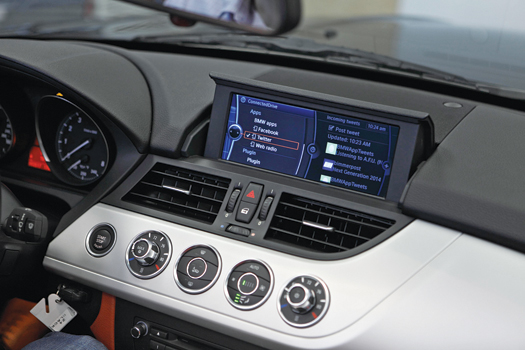
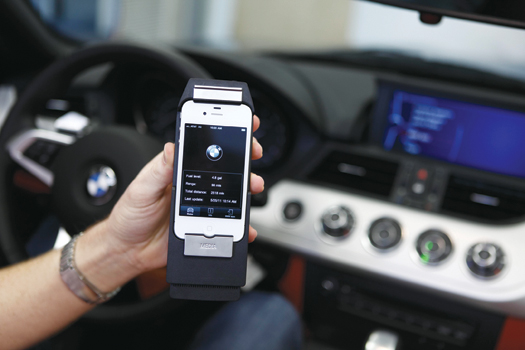
“The idea is to change the relationship between human and machine.”Passaro plopped a white iPhone into a cradle in the center console of a 5 Series sedan to demonstrate BMW Apps, a system available on all BMWs produced after March 2011 that connects the car to a website from which the driver can download BMW-specific iPhone apps. For now, BMW offers only customized versions of already-popular apps from companies like Pandora and Facebook. The interesting thing about these apps is not that they exist, however, but where they exist. They show up on the dashboard display, not on the iPhone, and their installation involves customizing software that car companies have traditionally treated as an unalterable, untouchable secret. Car companies are skittish about the possibility, but eventually it’s probably inevitable that someone will invent apps that work their way much further into the car’s vital functions—all the way, perhaps, into the fuel-injection or lane-detection systems.
Cars won’t just talk to the Internet. They will also gather information from their immediate surroundings. After Passaro finished his demo, he handed me off to another engineer, Darren Liccardo, who walked me out of the garage and into a wide, mostly empty parking lot surrounded by giant hedges.
A prototype 5 Series awaited. Its trunk was packed with off-the-shelf computer hardware running a popular open-source operating system called ROS, for Robotics Operating System, which is used in everything from housecleaning robots to self-piloting helicopters. In this case, it would help the car handle a basic traffic problem—negotiating a stoplight. After a drive around the Technology Office, Liccardo pulled back into the parking lot, stopped the car, drew a keyboard out from under his seat, and typed a few commands. A video-camera image of a traffic signal mounted at the back end of the parking lot appeared on the console screen. “This is what we call smart cars meet smart traffic lights,” he said.
The traffic signal had been modified to communicate with our car over a wireless Internet connection. Liccardo pointed to the console screen The light was red, but the screen displayed a countdown clock ticking off the seconds until it would turn green. He stepped on the gas, steered the car toward the red traffic light, and, confident that his vehicle-to-infrastructure communication system would let him know exactly when the light would change, accelerated. The light turned green, and we blew through it without slowing down.
That near-literal leap of faith illustrates a trade-off that we will all soon face. For Liccardo’s stoplight experiment to be safe in the real world, every car would have to communicate not just with the lights but also with every surrounding car. Yet some engineers dream of a system in which decisions about stopping and starting are left to computers. Humans, with our propensity for random and potentially disastrous action, would be removed from the equation, and the motion of individual cars would be coordinated like packets negotiating a journey across the Internet. Which sounds a bit frightening. But if we were to trust the system that much, to let go of the wheel entirely, we might gain a great deal. Cars could travel in self-guided traffic swarms, moving within inches of each other, cruising through stop lights with milliseconds to spare. Traffic would decrease, and fuel efficiency would increase—theoretically, at least.
It won’t happen immediately. But traffic engineers at the U.S. Department of Transportation are already studying the potential benefits of various vehicle-to-vehicle and vehicle-to-infrastructure communication systems. Could cars that can “see” one another reduce the approximately 5.8 million crashes and 37,000 deaths that occur on American roads every year? Could they ease the congestion that sucks 4.2 billion hours out of American lives every year? Could they make better use of the 2.8 billion gallons of fuel that are wasted in traffic every year? Engineers working for a DOT program called Intelligent Transportation Systems (which has existed since 1991 but which, under a new mandate set forth in 2009, is specifically focused on vehicle “connectivity”) are drawing on information from the auto labs in Silicon Valley to figure out whether autonomy would solve more problems than it would create.
The answers are unclear. In the meantime, the secretary of the agency, Ray LaHood, has raised concerns about what may be a transition period, when drivers are confronted by more and more data stimuli yet don’t have the safety benefit of greater automotive autonomy. Last year, LaHood called the increase in auto fatalities as a result of distracted driving “a deadly epidemic,” a problem not unlike drunk driving. A University of Utah study suggests that the loss of acuity caused by using hands-free phones is equivalent to that of having a 0.08 blood-alcohol percentage. In 2009, nearly 5,500 people died in crashes involving distracted driving. So far, legislatures in 34 states and the District of Columbia have enacted full or partial bans on phone use in cars. “I’m on a rampage about this,” LaHood told the New York Times, “and I’m not going to let up.”
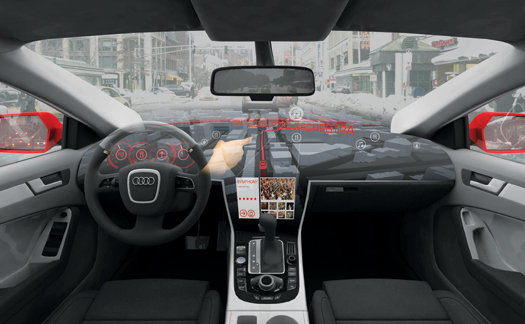
Distraction will be exactly what we seek as we while away our commute in self-piloted cars.Eventually, though, if the Silicon Valley engineers have their way, the cars will pass through the valley of distraction and into the realm of total autonomy—and then distraction will be exactly what we seek as we while away the commute in our idiotproof pleasure domes. In Europe, one Mercedes-Benz model is already available with an in-dash browser that connects to the Internet via cellular networks. When the car is stationary, you can use Facebook. When you’re moving, you can search for a nearby hotel using Google Maps. Johann Jungwirth, who directs Mercedes’s own Silicon Valley outpost, says the Web has just begun invading the cockpit. Soon, social-networking applications will allow drivers to communicate with one another as if chatting online. Then comes augmented reality: information about the landscape ahead being projected into the driver’s field of vision, like an annotated windshield. The road itself could become another layer of entertainment.
Control is the key. Who has the wheel? And cars themselves, as Byron Shaw, the managing director of General Motors’s Advanced Technology Office told me will increasingly have an opinion on the matter.
The GM office, tucked between an Equinox gym and a Fry’s Electronics, is among the newest and smallest of the automaker outposts. Standing in a room with high ceilings, exposed wood beams and abundant skylights, Shaw explained how a car could become aware of a driver’s wishes, and of that driver’s fitness to express them.
Somewhere in the office, he said, was a headset made by a local company called NeuroSky, which measures brain waves using EKG sensors and may one day allow for control using only thoughts. “You can put that on and be Luke Skywalker,” Shaw said. “You can bring the X-wing fighter up out of the swamp.” Seriously? “Not quite yet. But kids today are going to grow up with that as their game interface.” Earlier this year, researchers at Free University Berlin demonstrated a thought-controlled Volkswagen Passat, which they modified to run on brain-activity-mapping devices built by the Bay Area company Emotiv.
That control can run two ways, though. “Say you had a bad argument with your boss and you’re not thinking about driving,” Shaw said. “That can be measured, in a sense,” and the car can be programmed to respond. I had heard similar ideas at both Mercedes and BMW—that cars will one day monitor our vital signs using biometric sensors in the seats, and if they detected, for example, an oncoming seizure, they would navigate out of traffic and call 911.
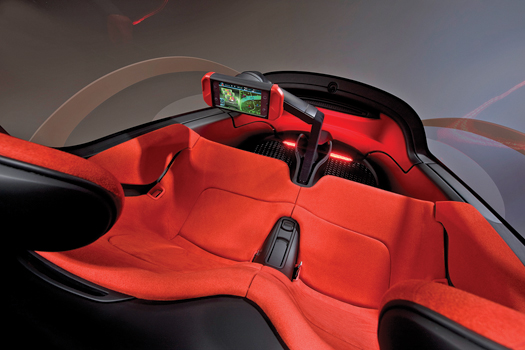
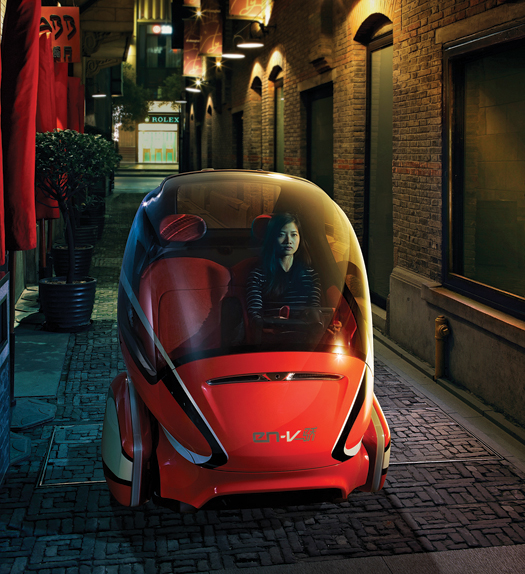
We walked into a small garage, and as Shaw pointed to a pair of large wooden air-freight crates stacked in a corner, our conversation shifted to fully autonomous cars. “Those are the EN-Vs,” he said. (We took a test-drive in the EN-V earlier this year–click here to check out our impressions.) Inside the crates were some two-person eggshells mounted on self-balancing, two-wheeled Segway-style platforms. In 2008, GM’s then-R&D director, Larry Burns, predicted that autonomous vehicles would be ready for the mainstream by 2018; the EN-V is one attempt to make his prediction come true. The pods are designed to shuttle people in dense, connected swarms.
The EN-V may seem odd, but it makes sense in the context of a growing market for mobility. “A confluence of forces is changing things right now,” Shaw said. “Electrification, concerns about our carbon footprint and domestic security, the rapid pace of technology development, globalization. All of them are happening at the same time.” In developing economies, Shaw said, “you have masses of people who never had any experience with owning a car and don’t necessarily have a preconceived notion of what owning a car is supposed to be like.” Maybe, he continued, car ownership shifts toward a cellphone model, in which drivers would get a free or highly subsidized car and sign up for a fee plan that includes fuel or access to charging stations.
Standing in the garage, staring at crates containing prototype autonomous pod-cars and thinking about cell plans and interfaces, it became clear that Silicon Valley was doing a lot more than making cars smarter. It was doing for the auto industry what it had done for the computer industry a generation ago: transforming unfathomably complex machines into consumer objects that require almost no skill to operate. An old IBM mainframe would arrive with a shelf of thick manuals. An iPhone requires almost no instruction. Users can think less about what is under the hood and more about whatever it is they want to do, whether it’s sending a text or driving to the corner store. All they have to do is let go of the wheel.
Whether it’s wise to put this much trust into our cars is another question, one that might be best answered a few exits up Highway 101 at Google’s massive campus in Mountain View. In 2007, Google hired Sebastian Thrun, a Stanford University artificial-intelligence researcher, to work on the company’s Street View program and then to lead its own autonomous car division. Google’s seven robotic cars (six Priuses and an Audi TT) have since logged more than 100,000 fully autonomous miles on California roads. In June, Google convinced the Nevada legislature to require the state DMV to write rules that permit the operation of autonomous cars. Thrun says robots are better drivers and that robot cars could cut the number of fatal traffic accidents (about 1.2 million per year worldwide) in half. That is the argument for giving up control. And it is true that in all the miles his cars have driven so far, there has been only a single accident—when a human-driven car rear-ended a robo-Prius at a light.