The roar of the chopper’s engines made it hard to hear. First Sgt. James Kelley signaled with his hands and yelled: “Five minutes!” In the murky light of the Chinook’s cargo bay, rows of helmeted figures sat surrounded by rifles and camouflage rucksacks. It was four in the morning. Bulldog Company from the U.S. Army’s 101st Airborne Division, along with dozens of Afghan National Army soldiers, forward air controllers, military intelligence officers, and bomb-dog handlers, were air-assaulting into enemy territory. Under the light of the full moon, rows of mist-shrouded grapevines and mud compounds rushed below.
The mission, Operation Lion Strike, was to land in a Taliban-controlled area in one of the most violent parts of Kandahar Province, southern Afghanistan. The soldiers would then push northward, into a cluster of villages Army command suspected of harboring insurgents and weapons caches. By landing before dawn, the soldiers hoped to surprise the insurgents, preventing them from setting up ambushes or laying improvised explosive devices, or IEDs. For added insurance, they had ordered F-15 jets to drop 500-pound guided bombs above the landing zone; the pressure wave would help trigger any IEDs the insurgents might have already hidden.
I had embedded with Bulldog Company to understand firsthand the conditions that forward-deployed infantry routinely experience during the course of combat—conditions that are causing a mental-health crisis in the military. Suicides among service members have outpaced combat deaths. In other words, the young men around me in the Chinook were more likely to die by their own hand than by the Taliban’s.
For an uninitiated civilian, an assault into Taliban-held territory is an overwhelming experience. My heartbeat and adrenaline spiked as my nervous system’s fear response kicked in. My sense of time shifted; events felt simultaneously rushed and glacial. Later, I noticed that my memory of the assault was filled with gaps.
Yet something different was unfolding in the minds and bodies of the soldiers of Bulldog Company. They had done this so many times during training that they were operating from muscle memory. The surge in stress sharpened their attention, heightened their performance.
Becoming good at war often involves becoming bad at peace.
The problem is, becoming good at war often involves becoming bad at peace. In every 20th-century conflict the U.S. has fought, more American soldiers have been psychiatric casualties than have been killed in combat. Since 2001, the Department of Veterans Affairs has diagnosed more than 200,000 veterans of the Iraq and Afghanistan wars with post-traumatic stress disorder (PTSD)—nearly four times as many as were injured or killed. And while most soldiers readjust well to civilian life, a significant portion struggle. In addition to the spike in suicides, cases of spousal or child abuse and neglect, and referrals for drug and alcohol abuse, have increased among service members.
The Chinook banked hard to the right, slowed, and sank rapidly, its tail dipping downward. A ripple ran through our lines as the men started to shrug on their gear and wield their rifles. We stood up, grasping at each other for assistance in the narrow confines of the cargo bay, then shuffled toward the open bay door. The moonlit field of grass, flattened by the downwash of the rotor blades, came into view as the chopper dipped its back ramp against the turf.
“Let’s go!” shouted Sgt. Kelley.
And then we were on the ground, jogging through the heat of the helicopter’s exhaust. The soldiers fanned out and hit the dirt, and the chopper’s engines screamed as it clawed its way into the night.
* * *
The trauma of war has been a subject of literature since Homer’s Iliad, but it only entered medical discourse during World War I, when doctors coined the term “shell shock.” They thought the new phenomenon of days- or weeks-long artillery bombardments were rattling the brains of soldiers, causing infantrymen to experience problems that ranged from nightmares to uncontrollable tremors. By the end of the war, however, doctors had come to understand that what they called shell shock was more than physical—it was also emotional.
During World War II, psychologists replaced shell shock with battle fatigue, which described the condition as overwhelming physical and mental exhaustion. After the Vietnam War, researchers better understood what the brain and body go through in combat. They knew that a complex mixture of psychological and physiological reactions trigger anxiety and intense flashbacks in many soldiers. And in 1980, PTSD—a term covering a variety of symptoms that occur after exposure to trauma, including hypervigilance, insomnia, flashbacks, and inappropriate emotional responses to everyday situations—entered the Diagnostic and Statistical Manual of Mental Disorders.
Over the past decade, the two million American service members deployed in combat zones have provided military researchers with the largest body of data on PTSD since the Vietnam War. Now the Army, in collaboration with the National Institute of Mental Health, has implemented a massive $65-million epidemiological study known as STARRS, which collects blood samples as well as surveys from more than 100,000 current soldiers and new recruits. The aim is to identify risk factors for combat stress and suicide. The study will wrap up next year.
That, of course, will be too late for soldiers who have already been deployed. For them, the Army has rolled out a variety of programs designed to fight PTSD. One, a $125-million initiative called Comprehensive Soldier and Family Fitness (CSF2), seeks not to treat PTSD but to prevent it—to create enduring soldiers for an age of enduring conflicts. It is an unprecedented, integrated training regimen designed to manage all aspects of the soldier’s well-being: emotional, social, physical, and even spiritual. But will it work? For that matter, can anything prevent PTSD?
* * *
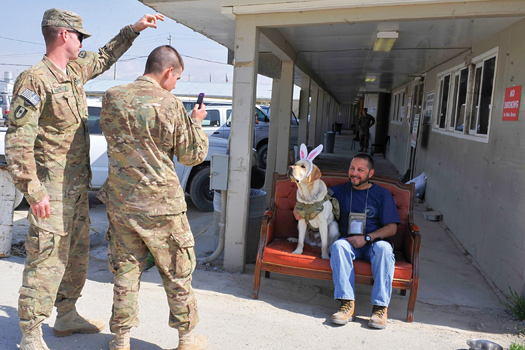
The Freedom Restoration Center at Bagram Airfield, the largest U.S. military base in Afghanistan, is a sort of retreat for soldiers who have experienced psychological trauma or stress while deployed there. It has a staff of behavioral specialists, plus overstuffed sofas, DVD players, an Xbox, and a specially trained therapy dog, a cartoon-eyed golden Lab named Major Timmy.
When I visited one sunny winter day, four soldiers were attending a class on relaxation techniques. We sat in a small plywood building with the lights off and the curtains drawn. Just a few strips of sunlight seeped through into the interior gloom. Outside, armored trucks crunched by on gravel roads, and departing jets roared in the distance.
A woman’s mellifluous voice filled the room. “Let yourself relax, and realize that an endless well of peace and tranquillity exists within you. . . .”
Around me, young men in combat fatigues slouched in their chairs, their eyes closed, their heads tilted back.
“Well, that was the deep-relaxation track,” drawled a young corporal leading the session. He fanned out small MP3 players across the table. “You’re welcome to take one for later. We also got some of the guided meditation tracks from yesterday.”
He looked around the room. “So, uh, what else do you do to relax?” the corporal asked after a moment’s silence.
“I like to take a nice, long, hot shower,” offered Daniel Piotrowski, a bullet-headed sergeant, his pale skin sunburned and freckled. “Just kind of get away and block everything out.”
There was another awkward pause. I asked Piotrowski if they had decent shower facilities at his base. He nodded slowly. “Well, we did, until they were destroyed by a 2,000-pound bomb.”
His company’s small combat outpost, named Dasht-e Towp, was located in the Tangi Valley in Wardak Province, a Taliban-controlled area the insurgents would mortar nearly every day. A highway ran alongside it. When Piotrowski’s unit from the 10th Mountain Division moved in, the senior sergeant took one look at a row of prefabricated barracks that abutted the road and ordered everyone to move into buildings and shipping containers on the other side of the base. Soon after, a dump truck carrying 2,000 pounds of explosives veered off the highway and half-demolished the compound. “Just for reference,” Piotrowski said, “the bomb at Oklahoma City was 4,000 pounds.”
The blast buckled the walls of the building he lived in and blew him out of bed. His sergeant’s foresight—earned the hard way, through several tours of duty—likely saved dozens of lives. Twenty-six people were wounded, but only the suicide bomber died. Piotrowski suffered a traumatic brain injury. He had been hit before, by a roadside bomb in Iraq, and the explosion brought back his old trauma. He started having problems sleeping. He couldn’t concentrate on his work. He felt like he was losing his grip, and so his commander suggested he check into the restoration center for a few days.
CSF2 is designed to enable Piotrowski and others like him—soldiers who have accumulated layers of injury and trauma—to withstand multiple deployments overseas by the use of “positive psychology.” Rather than focusing on distress and pathology, which has been the approach of psychologists going back to World War II, positive psychology seeks to encourage qualities like emotional awareness and self-control. It’s modeled on the Penn Resiliency Program, which researchers at the University of Pennsylvania have been using to teach resilience to nearby middle- and elementary-school students, with the goal of preventing depression and anxiety.
Martin Seligman, one of the founders of the field of positive psychology, directs the Penn Positive Psychology Center. Seligman has a long career in this sort of behavioral modification. He’s famous for developing the theory of learned helplessness, which explains psychological breakdowns in captivity as a result of losing a sense of personal agency. The theory was adopted by the military’s interrogation-resistance training programs and later used, controversially, under the Bush administration’s program of torture against high-value terrorism suspects after the 9/11 attacks. (“My career has been devoted to finding out how to overcome learned helplessness,” Seligman, who has condemned torture, said, “not how to produce it.”)
CSF2 divides resilience into five areas of fitness: emotional, physical, social, family, and spiritual. By embracing this philosophy, the Army has ostensibly become concerned not only with the ability of its soldiers to shoot straight, march far, and obey orders, but also with their feelings, friendships, marital relations, and spiritual beliefs (or lack thereof).
Clinics like the Freedom Restoration Center are just one component of the Army’s broader push to combat PTSD. As part of the CSF2 program, all new Army recruits now fill out a Global Assessment Tool, a questionnaire that will help evaluate their resilience and provide a baseline for tracking each soldier’s progress. Throughout their career, soldiers participate in individual and group training sessions. Psychologists and behavioral specialists even accompany some units during combat tours.
When the relaxation session at the Freedom Restoration Center came to an end, the soldiers quietly filed out, returning to their bunks for some downtime. They would have a few days before returning to their companies. Part of their struggle will be with the stigma typically associated with psychological troubles in the military. Piotrowski shrugged when I asked him about it. “I’m the first one to come here,” he said, “but hopefully now that I’ve come, some of the other guys will too.”
* * *
The hospital at Kandahar Airfield—the main military base in southern Afghanistan, about 10 miles from the village cluster of Pashmul and Bulldog Company’s patrol—sits at the end of an airstrip, so that wounded soldiers who arrive on medevac flights can be treated immediately. Next door, an outpatient-care facility known as Role 2 includes the 883rd Medical Company, a combat-stress detachment consisting of psychiatrists and behavioral-health specialists.
Lt. Col. Richard Toye, commander of the 883rd, bowed his head with a little smile as the roar of a fighter jet taking off momentarily filled the room, rattling the thin plywood walls. “As you can see, it’s quite relaxing here,” he joked.
In the U.S., Toye works as a psychiatrist at a state mental hospital. Here in Afghanistan, where he is deployed as a member of the Army Reserve, he helps monitor and care for the mental well-being of service members, any one of whom could be exposed to combat trauma through IEDs or gunfire. “Every part of the theater is the front line,” he said. His team’s job is to keep as many soldiers as possible functioning in their assigned units—a departure from civilian psychology, where the focus is individual, rather than group, welfare. “Our mission is to fix them and send them back.”
Toye’s staff engage in a variety of preventive and therapeutic techniques, most of which he considers to be commonly accepted practices. Still, he has his doubts about some components of the Army’s anti-PTSD effort. He is highly skeptical of CSF2, for example. “If we train you to be spiritual and to have a social network and to be physically fit and to have lots of hobbies, well, just because those are the characteristics of people who are stress-resilient, it doesn’t mean that I can take those demands and put them on your head and make you stress-resilient,” Toye said. “It is pseudoscience. And we put a lot of money into it.”
Psychologists are also divided about the significance of the Penn Resiliency Program’s results. Some children who participated showed increased resilience against depression and anxiety. Yet every major therapeutic approach—so long as both the therapist and patient have faith in its efficacy—tends to show some positive results, a kind of placebo effect.
And even if positive psychology works for children in the classroom, critics say, that doesn’t mean it will work for soldiers in combat. “The program is modestly effective with certain
populations—for example, kids with mild depression and anxiety,” says Roy Eidelson, former president of the nonprofit Psychologists for Social Responsibility. “The research itself is not nearly that persuasive in terms of how likely the program is going to be able to translate to combat situations.”
* * *
A war-related surge in government funding has stimulated a search for other means of treating and preventing PTSD, through the use of drugs, genetic screening, and new technologies. One study by the National Institute of Mental Health found that patients with PTSD had fewer of a certain type of receptor for the neurotransmitter serotonin; another study found that, after a shooting on their college campus, women with a serotonin-
transporter gene variant linked to increased anxiety were more likely to develop PTSD. Presumably, the Army could use this knowledge to predict which soldiers will be better suited to combat.
Meanwhile, researchers at the Sheba Medical Center in Israel have hypothesized that injecting patients with hydrocortisone immediately after a traumatic event could, by interrupting stress pathways, help stop symptoms of PTSD from later emerging. And in 2011, the Pentagon awarded $11 million to study whether the drug D-Cycloserine could help reduce fear associated with traumatic memories.
Research of this sort has long bothered some experts. In the 1980s, the military scholar Richard Gabriel advised against the development of a purely pharmacological solution to the problems of combat stress. His argument: A miracle drug that eliminates the trauma of killing would result in armies of sociopaths.
Soldiers throughout history have proved naturally averse to killing their enemies. During World War II, an Army researcher named Col. S.L.A. Marshall interviewed a large set of infantrymen immediately after intense combat and found that 80 to 85 percent, when faced with an enemy target, didn’t fire their rifles. While his methodology has been criticized, other researchers have come up with similar findings at battlefields such as Gettysburg, where 90 percent of 27,574 abandoned muskets recovered after the battle were still loaded.
The Army responded by introducing training tactics that more realistically simulated killing—for example, they switched from bull’s-eyes to man-shaped-silhouette targets. Today, as soon as they’re inducted into the Army, soldiers are placed in aggressive and stressful conditions. Their egos are broken down and rebuilt within the context of group unity and loyalty. The verbal abuse of the drill instructor, the firing drills, the hand-to-hand combat—all are intended to get them accustomed to violence. The shift in training has vastly improved the willingness of U.S. soldiers to fire their weapons in battle, from 55 percent in the Korean War to approximately 90 percent in Vietnam.
Throughout history, soldiers have proved averse to killing their enemies.
Soldiers are expected to spend months or years fighting and killing, then return to the U.S. as stable, well-adjusted citizens, spouses, and parents. The challenge, then, is achieving balance between the training that will enable soldiers to survive battle and the skills that will help them reacclimate to civilian life. Advocates of the CSF2 program point out that some people who undergo trauma experience what they call “post-traumatic growth.” So instead of allowing the experience of combat to lead them down a self-destructive path, soldiers could use the trauma as a motivating event, a reason to grapple with family or personal issues they may have had before ever going to war. If it works, CSF2 should, ideally, enable soldiers to leave the battlefield in better shape than when they went in.
* * *
As the sun rose over Kandahar Province, the soldiers of Bulldog Company and their Afghan allies were taking up positions in the muddy fields bordering Pashmul. We shivered as the mist dissipated, having waded through armpit-deep water in frigid canals to avoid crossing footbridges, which were more likely to contain IEDs.
The soldiers began to sweep through the villages, searching for insurgents and weapons caches. It was agonizing work, at once deliberate and improvised. They knew that ingeniously rigged booby traps—a buried piece of tire rubber that, when stepped on, pressed two wires together, or a trip line strung up in the trees to catch a backpack-radio antenna—could lurk around every corner. Bulldog Company had seen their friends killed by them.
The men went in hard but warily, weapons at the ready. They picked through haystacks, rifled through bedrooms. They detained several villagers when they found an AK-47 and rocket-propelled grenades buried in a yard. A knot of wide-eyed children gathered to watch as they bound and interrogated the men.
It was aggressive work, but work that the soldiers were trained to do. And the soldiers of Bulldog Company don’t mind admitting that sometimes, war can be very exciting. “It’s fun,
as long as you’re not dead,” said First Lt. Nick Williams, a platoon leader who had led his team through hellish engagements in Pashmul.
The next challenge that tens of thousands of soldiers like the members of Bulldog Company will face—readjusting to their lives back home—could be much less exciting than combat. But for some, it could be just as difficult.
Matthieu Aikins is a writer living in Kabul, Afghanistan. This article originally appeared in the March 2013 issue of the magazine.