
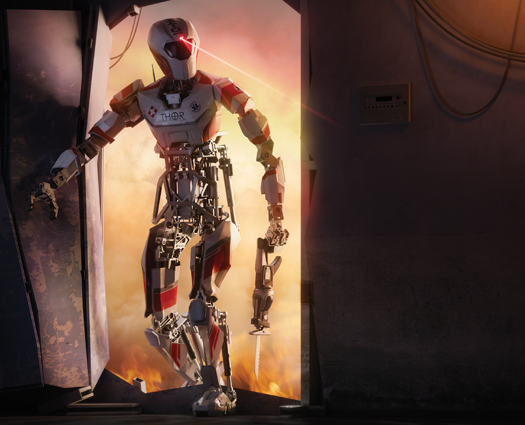
By the end of next year, robots will walk into a disaster zone. They won’t roll in on wheels or rumble in on treads. They will walk, striding across rubble, most of them balancing on two legs. Compared with human first responders, the machines will move slowly and halt frequently. But what they lack in speed, they make up for in resilience and disposability. Chemical fires can’t sear a robot’s lungs, and a lifespan cut short by gamma rays is a logistical snag rather than a tragedy.
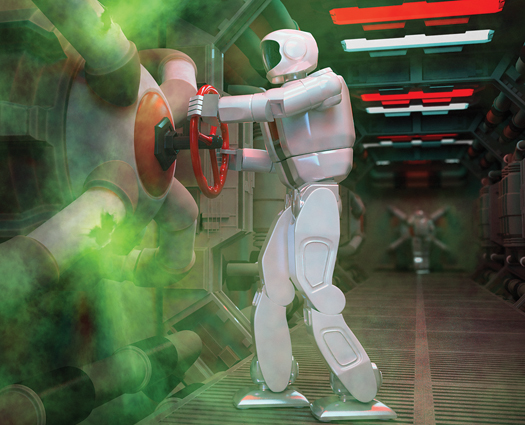
They’ll have the mobility to do what robots couldn’t at Fukushima, navigating a crisis that unfolds in an environment lousy with doors, stairs, shattered infrastructure, and countless other obstacles. Where previous humanoid bots could barely trundle over the lip of a carpet, these systems will have to climb ladders and slide into vehicles that they themselves drive. And while the ability to turn a doorknob is now cause for celebration even in top-tier robotics labs, these bots will open what doors they can and use power tools to hammer or saw through the ones they can’t.
Because disasters tend to degrade or knock out communication, the surrogates will have a surprising amount of responsibility. Very few, if any, will be tele-operated systems, driven remotely by people using a joystick or wearing sensor gloves. The humanoids will take orders from distant humans, but they’ll use their own algorithms to determine how to properly grip a Sawzall, where to start cutting, and for how long.
The catastrophe the robots will be walking into is, in fact, an obstacle course, built for the two-year-long DARPA Robotics Challenge, which launched last October. At stake is a $2-million prize, awarded to the team whose machine not only scores well in a head-to-head competition this December, but prevails at a second one in 2014. Bots will have to perform eight different tasks, demonstrating both mobility and manipulation skills, that might be required of human first responders.
“What we’ve seen in disaster after disaster, from Hurricane Katrina to Fukushima and now to Superstorm Sandy, is that there are often clear limitations to what humans can accomplish in the early stages of a disaster,” says Gill Pratt, program manager for the challenge. “DARPA believes that robots can substitute for humans where and when situations are too dangerous.”
The competition rules don’t explicitly call for a humanoid design, but the tasks and environment make one a logical choice. From the height of doorknobs to the placement of brake pedals, nearly everything will be positioned and proportioned for creatures that walk upright. The places we care about most in a disaster are where humans live and work—a robot made in our own image is a natural fit.
Completing just a few of the competition’s tasks would be a remarkable achievement. Nailing all eight of them would be something more. It could mean the birth of the viable humanoid, a machine that’s both competent and robust. Such robots could go where mankind has gone before but shouldn’t again, striding toward the toxic plume or the reactor in meltdown, into the fresh ruins of the built world. These robots could be heroes.
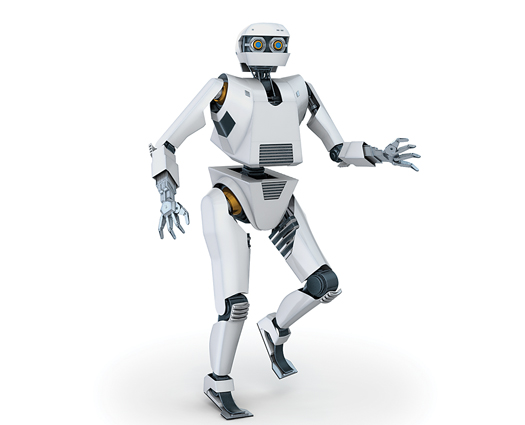
The robot walking toward me certainly looks impressive. Its face is a black, featureless plane, like a riot helmet flipped shut. The rest of its 26.5-pound, five-foot-tall body is white plastic or exposed alloy. If it were standing still, the robot might actually be a bit imposing.
But CHARLI-2 is moving—and clumsily. It shuffles across the green felt and white tape of a miniature soccer field, its entire body quivering with each short step. It waves as it walks, playing the part of affable celebrity. When the robot runs out of space on the elevated field, it fake scratches its head with a white, fingerless stump of an arm. Thankfully, CHARLI-2 doesn’t teeter off the edge. Unable to bend at the waist, it lacks the flexibility to fight its way back to a standing position.
This is the testing area for the Robotics and Mechanics Laboratory (RoMeLa), which occupies a handful of windowless, basement-level rooms at Virginia Tech. All of RoMeLa’s bots—or the ones with legs—take their first steps on this roughly 30-by-30-foot platform, which doubles as a practice field for the yearly RoboCup competition. CHARLI-2 won its division in the robotic soccer tournament in 2012, demonstrating world-class autonomy, agility, and speed for a humanoid.
Yet its gait tops out at around half a meter per second—two to three times slower than the average human walking pace. The makers of bipedal robots are a lot like new parents, marveling at their creations’ basic ambulation, shaking off each stumble or fall, and framing every setback or success against the most managed of expectations. In this respect, CHARLI-2 is like a proud toddler.
But its days are already numbered. Its successor stands nearby, waiting to be tested.
This other robot is not toddlerlike. A work in progress, it’s a pair of hulking aluminum legs and a lower torso, the upper body, arms, and head nowhere to be seen. The existing parts, however, radiate strength. Long, bicycle-pump-like actuators run along its legs and fan across what constitutes its lower back. This prototype is the foundation of a machine that will eventually be called THOR, or Tactical Hazardous Operations Robot.
“CHARLI-2 is old technology,” says Dennis Hong, director of RoMeLa. He then points at the unfinished robot. “This is the future, but with a big if—if successful. It does walk,” he says, “but will it really be able to do all of the things that DARPA requires?”

Team THOR comprises researchers from RoMeLa, the University of Pennsylvania, and two commercial robotics firms, with Hong acting as team leader. Though the first trial in the DARPA Robotics Challenge (DRC) isn’t until December, the team has already won one of the competition’s most coveted prizes—it is among the seven teams accepted into Track A and therefore eligible for up to $4 million for the development of both hardware and software.
But it’s not this achievement that makes Team THOR one of the front-runners. Nor is it RoMeLa’s past successes: CHARLI-2 and the lab’s smaller humanoid, DARwIn, which also won its size class at RoboCup. Hong’s secret weapon is this partial humanoid, which his lab started working on close to a year before the robotics challenge was announced. It’s also the prototype for an equally impossible-sounding humanoid project—SAFFiR, or Shipboard Autonomous Fire Fighting Robot.
SAFFiR is part of a contract from the Office of Naval Research to create a rugged, ultra-capable firefighting robot. Its job is similar to the one proposed by DARPA: It will have to walk into harm’s way, navigate where visibility is poor, and maintain its balance in an unstable environment—in this case, the halls and decks of a ship at sea. But SAFFiR’s job differs from THOR’s too—it must follow the spoken and gestured commands of a human and either toss fire-suppression canisters into a blaze or hose it down, point-blank, with a backpack-mounted system.

SAFFiR provides Hong’s team with a clear head start. Because the two programs have overlapping goals, research that has gone into SAFFiR will apply to THOR and vice versa. The same basic engineering, specialized with different tools and capabilities, could wind up doing both jobs. That’s the advantage, in theory, of a humanoid: the ability to adapt and accomplish a wide range of tasks, whether it’s stepping over the high “knee-knocker” doorsills found on vessels or crawling across shifting rubble at a disaster site on shore.
Up to this point, Team THOR has focused almost entirely on mobility. Manipulation—the ability to hold steering wheels and power tools and ladder rungs—will be important down the line, but getting around quickly, and with stability, is the most pressing problem. After all, if a humanoid can’t reliably reach its mission, who cares how well it handles an air hammer?
Bipedal movement has always been the great promise and peril of humanoid robotics. It would allow machines to better maneuver through a range of environments, particularly those built for people. But it’s damn hard. It’s also damn risky—nearly any fall can be catastrophic. That’s why bots like CHARLI-2 take such tentative steps, carefully modulating the exact location of each foot, using a system generally referred to as position control.
A robot such as CHARLI-2 or Honda’s Asimo—a humanoid “helper” that walks, hops, and dances around its own show at Disneyland’s Tomorrowland—typically has actuators embedded in its joints that can rotate to bend or straighten each leg. As its walking pace increases, those motors spin faster, but the robot hits a functional speed limit; it can’t allow momentum to take over, the way humans do as we break into a run. Their joints are too stiff, and their algorithms require a constant reckoning of the limbs’ whereabouts. They don’t move like people, with our moment-to-moment oscillation between imbalance and recovery. Robots that use only position control have to know the exact geometry of the terrain beneath them.
RoMeLa’s new robot, by comparison, incorporates force control. It is far more biological in design and function. “The main difference is linear series elastic actuators,” Hong says. “Ours is inspired by human anatomy. Our actuators extend and contract like a human muscle.”

Long and cylindrical, the actuators are placed roughly where muscles would go; they act like them too, with titanium springs that provide shock absorption for each step and the elasticity to bounce from one stride to the next. These qualities enable the robot to also use force control: It can turn up the speed of its actuation, working those simulated muscles harder and overriding the algorithmic panic that sets in when position-control software can’t perfectly predict each footfall. As a result, it also has more opportunities to recover its balance. Where CHARLI-2 might instantly topple over on stiff legs, this design might try to turn a stumble into a squat. By balancing force and position control, the robot can move with something closer to the loose, improvisational—ultimately more efficient and powerful—manner of a person.
The benefits of musclelike actuators and a more adaptable control scheme should be greater speed and stability and an end to the old guard of timid bipedal bots. This robot will take long, terrain-devouring strides, with a literal spring in each step. It will move boldly—because it needs to.
* * *
When he first read DARPA’s broad agency announcement for the DRC, Nicolaus Radford balked. As the deputy project manager for NASA’s Robonaut, a humanoid currently being tested on the International Space Station, he was familiar with what humanoids can and can’t do. “It sounded like a six-year-old wrote it,” he says. “And then we’ll have it drive a car, and then we’ll have it climb a ladder and then operate a pump!”
The DRC is hyperbolic by design, easily the hardest robotics competition in history. That audacity has proved irresistible to engineers. With the glaring exception of Honda—and Asimo could still show up in the unfunded Track D, which has later deadlines—the DRC has attracted the best humanoid robotics labs on the planet. Along with Team THOR, Track A includes two teams from NASA, one from Carnegie Mellon University (the institution that won DARPA’s last robotic challenge, a self-driving car race), a company spun out of the University of Tokyo, and a wild-card entry from defense contractor Raytheon.
Teams in Tracks B and C design only software, but they’ll be competing to use robots built by Boston Dynamics (best known for the four-legged BigDog system). This government-provided bot, which Boston Dynamics has based on its PETMAN and Atlas prototypes, is shaping up to be one of the most capable humanoids to date; powerful hydraulic actuators allow it to leap across gaps. The 2014 finals will feature eight robots reflecting the highest overall scores from all tracks, so a showdown between the Boston Dynamics robot and the best of Track A is practically inevitable.
What’s less certain is whether any of the robots in the final competition can physically complete all eight tasks. First, there are mobility challenges: Robots must travel over debris and through industrial settings. But no humanoid robot has demonstrated the ability to navigate uneven terrain for an extended period, and insect-inspired hexapods, while more stable, move at an achingly slow pace across rocks and rubble. Team THOR sees its actuators as a major advantage here. The Tokyo-based SCHAFT Inc. team has also previously demonstrated an extremely robust humanoid lower body, the HRP3. That robot’s rock-solid balance and powerful, liquid-cooled motor drivers could be a huge asset. Both THOR and SCHAFT Inc.’s robot will be well suited to ladder climbing, a task that, according to Hong, can be handled almost entirely by powerful legs, with hands that simply close around the rungs to keep the bot from toppling.
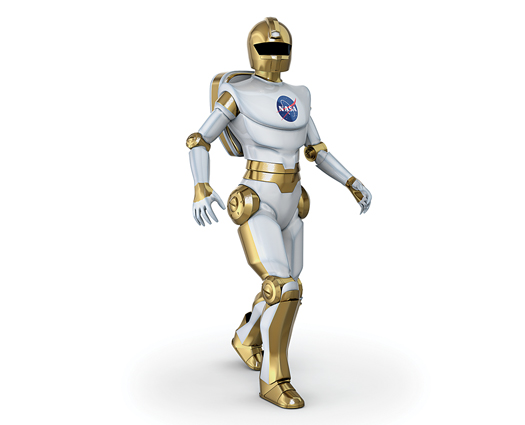
The manipulation-based tasks, which include opening doors and closing a leaking valve, aren’t as risky: A fumbled screwdriver is much less likely than a face-plant to knock a robot out of competition. But for now, none of the entrants has a clear advantage. Radford’s team at Johnson Space Center (JSC) is fielding a robot whose core technology is derived in part from Robonaut, which has extremely dexterous five-fingered hands. Robonaut can already handle tools and interfaces used by astronauts during spacewalks, either autonomously or through tele-operation. If JSC’s unnamed entry is as nimble as Robonaut and if the team adds a lower body capable of reaching the various destinations in the course, it might perform brilliantly at such tasks as replacing a component and using power tools.
There’s also the possibility that, despite the human-centric challenges, the most versatile robot takes another form entirely. There is a good reason humanoid robots haven’t yet walked into our lives: Replicating our own triumphant, two-legged, two-armed physiology with steel and lithium-ion batteries is difficult to do. “Humans are 15 times more energy-efficient at walking than the best humanoid robots,” says Radford, “and human fat stores energy at 30 times the density of batteries. That’s a significant disadvantage for those systems, right out of the box.”
“Robots don’t have to be restrained by our evolution. If we need a camera in some particular place, we put it there.”Carnegie Mellon University’s Track A entry, the primate-inspired CHIMP, will shift freely from two- to four-limbed movement to better scramble over obstacles. NASA’s other Track A team, from its Jet Propulsion Laboratory (JPL), plans to field a version of its four-limbed RoboSimian, a pastiche of biomechatronic diversity whose design and movements resemble sea creatures as much as they do a monkey.
“While some of the robots in the DARPA Robotics Challenge will be humanoid in form, we know that others will not,” says DARPA’s Pratt. “It is compatibility with humans that we are after.” Victory for CHIMP or RoboSimian could not only torpedo the other team’s chances at the $2-million prize, but also fundamentally alter the entire field of humanoid robotics—shifting them to jobs where it’s more important to look like a human than to move like one. Why pursue a two-legged hero when a four-legged robot is more competent?
JPL cherry-picked traits and approaches from a wide swath of nature to build RoboSimian; its tentacled, near-radial symmetry mimics that of a starfish. “Humans have these very derivative structures,” says Brett Kennedy, supervisor of the Robotic Vehicles and Manipulators Group at JPL. “Our heads and necks and the way some of the rest of our bodies are laid out, it’s about putting specific functions, like sight, where we need them to be. But robots don’t have to be restrained by our evolution. If we need a camera in some particular place, we put it there.”
RoboSimian doesn’t have a front, rear, or sides. And that ruthlessly efficient design could make it a formidable competitor in ways that won’t be obvious until December. Where other robots might range from hilariously awkward to perilously off-balance while getting in and out of a utility vehicle—humanoids would have to pivot and reorient themselves—RoboSimian should be able to simply crab walk into the driver’s seat. And having deployed a trio of competent Mars rovers, JPL has learned how to push its robots to perform through harsh, unpredictable environments with limited energy reserves and communication lines. Those systems respond to commands, but with an eight-minute radio lag between Earth and Mars, they must carry out nearly all of them autonomously. For Kennedy and his team, the DRC could be simply another day at the office.
Hong, who worked with Kennedy years ago on one of the predecessors to RoboSimian, expects stiff competition from every Track A team. But in JPL he sees an existential threat. “Will nonhumanoid forms actually be able to do all those things?” says Hong. “If they can, it’s going to completely kill my whole philosophy of why we need humanoids”—to maneuver in a human environment. “But if they can’t, it’s a good thing for us,” he says. “It could prove me completely wrong or prove me completely right.”
On the same testing field that CHARLI-2 just crossed, the precursor to both THOR and SAFFiR takes its first steps of the day. There’s real menace in this thing: Its actuators whine with each movement, and the blue indicator lights at the apex of its truncated torso are just the right amount of ominous. It walks while tethered to a wheeled carbon-fiber and aluminum gantry (to catch it should it fall) with an amber warning light and bright-red emergency-stop buttons. The arms, which are still being built, will have roughly the same strength as an adult man. But the legs are superhuman. According to the team members from RoMeLa, the legs unexpectedly sheared through aluminum alloy that they placed as a buffer between the heels and ankles. This robot is already more powerful than the team predicted, able to whip its legs forward faster than the eye can track.
But its movement isn’t exactly the stuff of sci-fi nightmares. For all its power and musculature, the prototype is slow. Of course, this is only its third day of walking, and the algorithm it’s using is borrowed from CHARLI-2. So while its footstep is longer and its actuators are faster, I’m seeing only a fraction of its eventual speed. RoMeLa hopes to prove that bipedal robots can use energy more economically too; if the linear series elastic actuators perform as expected, they could cut into the efficiency gap between the living and the robotic. A humanoid that burns only five times more energy while walking than a human would be a significant engineering breakthrough.
Power is always a cause for concern in robotics, but it’s particularly problematic during today’s test walks. One of the advantages of this humanoid’s design is that the actuators can recover a small amount of energy during each step, similar to regenerative braking
in a hybrid-electric vehicle. But the right knee is acting up. It’s recovering too much energy, so the electricity spikes and triggers an automatic shutdown, which causes the robot to tip over. That’s the hypothesis, at least. Later, as the robot stands still, actively balancing itself, Hong boosts himself onto the machine. Its 66-pound frame takes his entire body weight without buckling or suffering a crippling power spike. The knee can’t be stressed into failing. Its power surges seem to be happening at random.
First, they’ll save lives. Later, they can save the weekend from chores.The RoMeLa team records the data and moves on. There are months, maybe years of troubleshooting ahead. Some of the solutions will be specific to the tasks at hand. But others will apply to the larger enterprise of bots that function in a human world. “The greatest example of a high-risk, high-payoff project is a humanoid,” Hong says. “If it can fight a fire, then you can use it for mopping the deck, cooking the food, delivering stuff to you. That’s why I call it the Swiss Army knife of robots. If you succeed, you can use it for most everything.”
That’s the long-term promise of THOR, SAFFiR, and other humanoid prototypes: that they will lead to initial generations of restricted, million-dollar systems, and as complex components get field-tested and mass-production kicks in, everything will become cheaper. Robots for military and medical missions will have paved the way for consumer models, the ones that assist the aged and disabled, weed gardens, and do laundry. First, they’ll save lives. Later, they can save the weekend from chores.
The initial public test of RoMeLa’s engineering will occur this November, when SAFFiR is scheduled to step aboard the U.S.S. Shadwell, a decommissioned World War II–era ship currently docked in Mobile, Alabama. It probably won’t spray any hoses or lob any canisters, but rather walk around and get its proverbial sea legs. A month later, THOR will compete in the first of its tasks. Other trials will follow, including a Navy pallet fire and DRC’s simulated disaster, both slated for 2014.
Whatever the results of the DARPA Robotics Challenge—even if it points toward a hybrid robot made up of the best-performing limbs, postures, and control schemes—the real question isn’t whether robots will ever be ready for active, meaningful deployment. Just as DARPA’s Grand and Urban Challenges accelerated the development of robotic cars and ultimately led to Google’s self-driving Priuses, the Robotics Challenge will drive progress toward a truly capable robot. After the competition, it will be only a matter of when they enter society and how.
It could take a decade or two for the robots to appear in hospitals, helping patients in and out of beds, or at construction sites in the coldest winter months, working the all-robot graveyard shift. But before then, you could see humanlike machines march into a disaster. Perhaps they’ll show up online, glimpsed in shaky cameraphone footage. Or maybe you’ll see one in person, looming forward through the smoke, its hand reaching for yours.
Erik Sofge wrote about future space-suit technology for the November 2012 issue of Popular Science_. This article appeared in the February issue of the magazine._
