
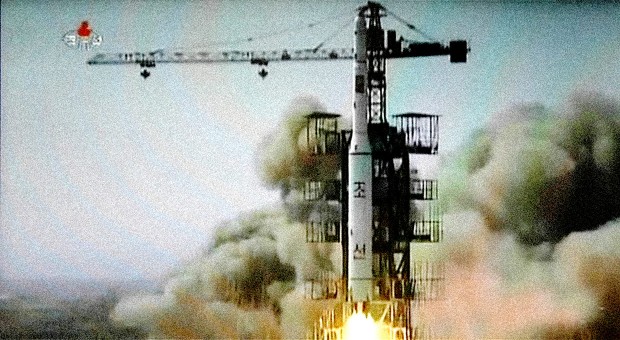
Late yesterday, North Korea joined the spacefaring nations club, when it successfully launched a rudimentary satellite that now appears to be in orbit. North Korea being North Korea, this was a troublesome development. The nation’s insular, military leadership is widely regarded as a rogue regime. It has brazenly developed a nuclear weapons program in the face of international objection and regular economic sanctions. And its “peaceful” space program is largely (and by my most expert accounts, accurately) perceived as a front for intercontinental ballistic missile technology.
So after four failed attempts at space launches stretching back to 1998, North Korea is finally in space. But what does that really mean? Taking the temperature of the Intenet today, it seems that it could mean anything from immediate doom to nothing at all. It certainly has implications for the future of geopolitics, but does this launch significantly shift the balance of power? And is there really anything to worry about?
The answer is yes. And no. As with most complex geopolitical matters, there are many facets to this story. But the important thing to remember is that this is not the end of the world. It’s not even the beginning of it. Allow us to explain.
Why did North Korea do this?
Because it wants to be taken seriously. The DPRK’s young leader Kim Jong-un is a bit desperate to solidify his standing as North Korea’s supreme leader, one worthy of filling his father’s (Kim Jong-il’s) shoes. And because North Korea seems to get its kicks from being the craziest kid on the block. The nation has long sought to come to the international table as an equal on par with the world’s great powers, and it seems to think that building nuclear weapons and demonstrating an intercontinental strike capability is one way to do that. Keeping in mind that yesterday’s launch was purely part of North Korea’s “peaceful space program,” of course.
What did North Korea launch exactly?
That’s actually a two-part question. The system that went skyward yesterday was both a launch vehicle and a satellite payload that was deposited into orbit when the launch vehicle was spent. The satellite, if it is indeed what North Korea says it was, is rudimentary to say the very least.
“Colleges launch satellites now that are much more advanced.””There’s an important point that no one has talked about yet, and maybe its too soon,” says Nick Hansen, a non-resident affiliate at the Center for International Security and Cooperation and expert on foreign weapons systems. “But the satellite, if its the same one that was displayed to the media in April–and they say it was–that satellite by any standards is primitive. It was homegrown technology, and we have no idea if it even works. It got up there, no question. But there’s no way to know if it works.”
If it does work, it is fitted with some low-resolution weather imaging technology and some middling communications equipment. “Colleges launch satellites now that are much more advanced,” Hansen says. That’s a significant point, because when it comes to rocket threats payloads are everything. More on that later.
The launch vehicle itself was a roughly 100-foot, three-stage, liquid-fueled rocket–pretty standard fare for long-range rockets going back to the late 1950s and 1960s. No real surprises there.
So North Korea built its own space rocket?
Not exactly. We don’t know everything about the Unha-3 rocket North Korea used for this flight, but we do know that the technology used to construct it isn’t homegrown. Western analysts are fairly certain that the first stage is actually built from four scud missile engines–developed by the Soviets in the ’50s and ’60s–that have been upgraded and lashed together into a single rocket stage (the upgraded scud engine is sometimes known as a “Nodong”). Incidentally, this is where the North Koreans were previously having trouble with their rockets. As recently as April they tried to launch a satellite to orbit only to have the rocket fail during first-stage firing.
We’re less sure about the second stage, although there is widespread speculation that it is powered by an SS-N-6 rocket motor (also Soviet in parentage). And the third stage, necessary for more nuanced movement to place a payload in a precise orbit, is likely made up of small vernier engines–small rocket thrusters used for finer attitude adjustments once most of the heavy lifting is out of the way (vernier thrusters are used by a variety of nations and rockets; they were even used on the Space Shuttles).
North Korea also has a cozy relationship with fellow wannabe nuclear power Iran, with China, and possibly even with Russia (through proxies). The point being that North Korea isn’t exactly on its own when it comes to rocket technologies. The nation’s Unha-3s are a mixed bag of components designed for various other rockets. These components have been upgraded and reconfigured by North Korean engineers (with possible outside help) to provide the thrust and flight characteristics necessary for spaceflight.
The point being that North Korea definitely has built a rocket capable of spaceflight. But that’s not exactly the same thing as building each of those components and capabilities from scratch the way the Americans and Soviets did during the space race.
So what changed between April’s launch failure and now?
Again, we’re moving into speculative territory here, since the DPRK hasn’t been terribly forthcoming. But clearly they’ve solved whatever held them back before.
“They must have learned something from the April failure,” Hansen says. “The reports on that attributed it to some kind of first-stage engine failure. They must have figured that out.”
And they must have figured it out somewhat cleverly, Hansen points out. Yesterday’s launch caught the entire world off guard. The North Koreans had issued a launch window starting on December 10, but on Monday reports from Pyongyang said engineers had found a problem with the rocket’s engine. Most analysts thought that meant the rocket would be removed from the launchpad and launch would be delayed for several days at least.
As yesterday’s launch clearly shows, that wasn’t the case. “They must’ve learned something about a faulty component, and when it was on the pad they tested it and it came back faulty, and they fixed it,” Hansen says.
So North Korea now has both nuclear warheads and the know-how to launch long-range rockets.
Not so fast. First, there is a difference between launching one tiny, primitive satellite into space and harboring an intercontinental nuclear launch threat.
“My opinion is that the threat is overblown, but it does relate to a threat that they’re trying to make us perceive that they have,” Hansen says. “[The rocket] is 100 feet tall. It’s liquid-fueled so you can’t keep it fueled for very long. There’s only two places in the country they can launch from, one in the east, one in the west. Is this a viable weapons program? I don’t think so.”
That’s not to imply that this space launch doesn’t mark a step toward a long-range, intercontinental ballistic missile threat. It does. But it’s a very preliminary step–and the following steps aren’t even all about rocketry. One significant technological obstacle will be shrinking a nuclear warhead to fit the size and weight parameters of North Korea’s rocket designs. Recall, those designs have blown up four times during launch and reached space successfully exactly once. Then there’s the problem of what-goes-up-must-come-down.
“One thing they haven’t demonstrated in the least is a re-entry vehicle,” Hansen says. And the ability to re-enter the atmosphere successfully, without burning up the payload, is key to any manned spaceflight or terrestrial payload delivery system like the kind that would deliver a warhead across the Pacific. That makes for two major technical hurdles between North Korea and a tactical intercontinental ballistic missile (or between North Korea and the United States, if you want to look at it grimly).
So there’s no need to panic?
That’s right. Relax. Enjoy your Christmas. Let death at the hands of a North Korean missile be the furthest thing from your mind. Congratulate the DPRK on their fantastic achievement in spaceflight capability (“Welcome to 1957, you guys.”). The world is a dangerous place, and it would be naive to say that this development isn’t troublesome. Just don’t take it out of the larger context. You are safe.
For now.
