
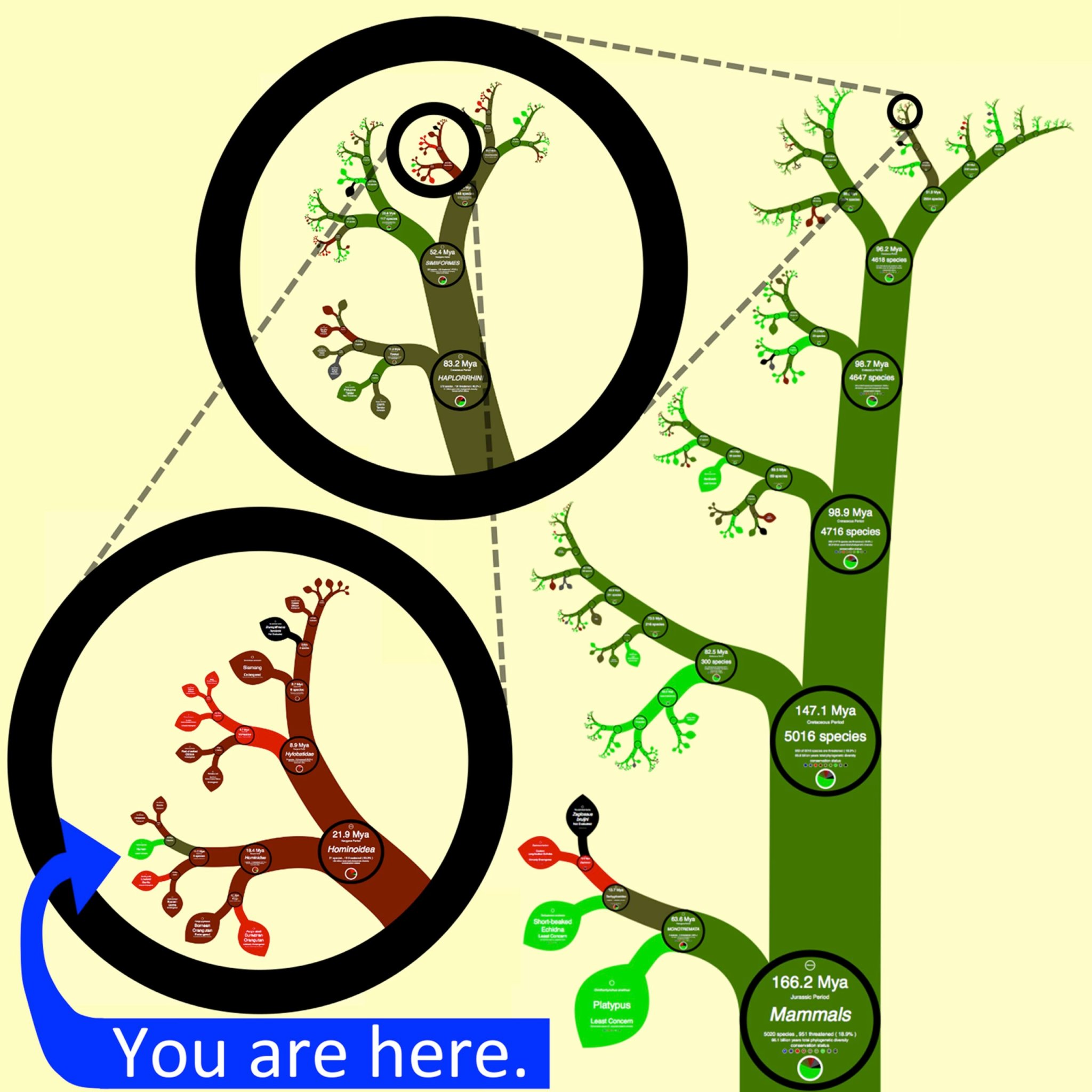
From protozoans to people, there is a lot of life on this planet, and it’s all connected to a common ancestor from which everything descends. It’s hard to imagine, let alone visualize, all of the commonalities and shared heritage of all of that life. But now you can do it with fractals.
A new website launching today lets you explore all of the evolutionary tree of life, zooming in and out like you would use an online map. It’s called OneZoom and it’s built on a fractal pattern that repeats the same branching form, no matter how expanded or collapsed your view. James Rosindell, a professor in the department of Life Sciences at Imperial College London, conceived the idea and programmed OneZoom in collaboration with Luke Harmon, a biologist at the University of Idaho.
The project was somewhat of a happy accident, Rosindell said in an interview. Fascinated by fractals, the evolutionary biologist wanted to use a fractal zooming interface to display large and complex data sets, but it took a collaboration with Harmon to decide on the tree of life as his subject.
A tree is an apt metaphor for the history of life (among many other things) because it starts with a clearly defined beginning, offering both a timeline and a vast canopy of interconnected information. In a tree of life, the trunk generally represents the first life on Earth, and then it splits into boughs and branches for different kingdoms, like plants and animals. Those split into smaller branches, say for fish, mammals, birds and so on; and those break down into smaller and smaller twigs, representing families and groups, and finally leaves representing species. But try putting all of that information on a single tree, and it’s impossible, Rosindell said. It wouldn’t fit on a single page, neither a plant-derived one nor a digital one.Rosindell said this prevents scientists and the public from fully appreciating the phylogenetic connections among millions of different species. While other scientists and data-visualization experts have visualized tree-of-life connections using other forms, like concentric rings, Rosindell believes a zoomable tree is a more comfortable-feeling interface. He said he was partly inspired by Google Maps, which offers a zoomable, pannable view with as much or as little detail as a user wants to see.
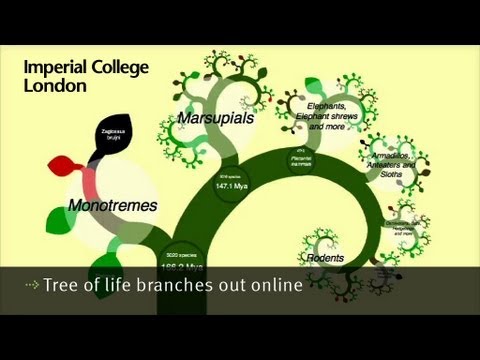
“A fractal view already has this implemented,” he said. “No matter how far you go, you get more and more information. What I would like to do is build the Google Earth of biology.”
At its start, OneZoom looks like a tree, with a trunk, branches, twigs and colored leaves. Zoom in on the first branches, and you start seeing more detail. Around 166 million years ago, for example, you see that monotremes evolved, followed by marsupials and placental mammals. The tree spirals toward the future, with more and more branches representing more and more detail. The links between species serve somewhat like roads on a map, displaying clear connections. At the leaf level, you can tell which species are threatened with extinction--represented by red and green leaves--along with links to more information. Eventually, Rosindell will add photographs, too.
There's no limit to the metadata it can handle, and you can even view it in different fractal forms, from a Julia spiral to a feathery tree.
The data comes from the open Tree of Life Project, a collaboration among biologists and other scientists around the world. It contains decades’ worth of work in phylogeny, evolutionary history of and relationships among groups of organisms. The project is about a year away from a complete tree of all life, Rosindell said. He wanted a system in place that could visualize it as soon as it’s ready.
Right now, OneZoom only contains mammals, but that’s still more than 5,000 species, all correlated with each other and color-coded according to their threat levels. Rosindell has big plans for the rest, and he even wants to build a searchable app for smartphones, showcasing the history and relationships between all life on Earth.
“What I’d like to do is visualize information about each species, information about each connection, with their intermediate forms, fossils, and all the wondrous information that exists about the history of life on Earth in one place,” he said.
OneZoom was scheduled to go live at 5 p.m. Eastern time today--check it out
here. A paper describing Rosindell's and Harmon's methods will be published in the "Cool Tools" series of the open access journal PLOS Biology.

Five amazing, clean technologies that will set us free, in this month's energy-focused issue. Also: how to build a better bomb detector, the robotic toys that are raising your children, a human catapult, the world's smallest arcade, and much more.


Online Content Director: Suzanne LaBarre | Email
Senior Editor: Paul Adams | Email
Associate Editor: Dan Nosowitz | Email
Assistant Editor: Colin Lecher | Email
Assistant Editor: Rose Pastore | Email
Contributing Writers:
Kelsey D. Atherton | Email
Francie Diep | Email
Shaunacy Ferro | Email
The problem with phylogenetics is that the mathematical models used to generate these trees disagree with each other if you use different metrics. Which mathematically means that no such tree exists.
If real this tree would dwarf the big trees in Avatar....
gizmowiz,
Sir, a fictional tree from Avatar can always be made larger, lol.
Love my job, since I've been bringing in $82h… I sit at home, music playing while I work in front of my new iMac that I got now that I'm making it online… Red97.c om
Evolution has nothing to do with science, much less with popular science. Evolution is just another pagan religion which suites the hubris of the modern day "enlightened" pagans. True science by definition can not offer explanation to the origin of life.
Capt_Tight_Pants
http://yourlogicalfallacyis.com/personal-incredulity
Capt_Tight_Pants,
There is the old traditional religious point of view to the origin of life, "Poof there it is!", which if you leave off time constraints, it also fits nicely with the big bang, too. And there is some theorist that considers the possibility the big bang has happen a number of times, too.
The cosmos is 13.7 billion years old, as far as we know. The Earth is said to be 4.54 billion years old, as far as we know, too. None of us were there in the beginning and all comments are theories to how it all began really.
I am just happy to be alive today. Thank you God. ;)
Capt_Tight_Pants "Evolution has nothing to do with science, much less with popular science. Evolution is just another pagan religion which suites the hubris of the modern day "enlightened" pagans. True science by definition can not offer explanation to the origin of life."
You are correct that evolution is not science, but wrong to say that it has nothing to do with science. You also misinterpret a model of the tree of life.
A tree of life only shows the similarities between species (by form, adaptation, or genetics). It speaks of relationship - not necessarly causality. The evolutionist seems those similarties and says that either:
(1) A is like B because it developed out from B (dogs out from wolves) or
(2) A is like B because they both developed in the same way due to similar external influences (a tiger and a zebra are both striped for camoflauge)
A creationist notes those similarities and says that either:
(1) A is like B (and they are all like most other things) because they have a common source of creation (everything with a spine has two eyes) or
(2) A is like B because there were both made to live in similar environments (whales and sharks both need fins)
Philosophically, those are very similar arguements because they are based on identical observations.
True science is based on evidence and experimentation, and results in those identical observations. Specualtion as to causality (creation or evolution) are equally non-science, but that does not make them non-scientific, since sience makes room for theory.
Theories are niether true nor untrue - only accurate or inaccurate, or better yet, useful or non useful, for explaining unknown or unknowable information (even an experiement that proves evolution can and does occur would not prove that it DID occur).
That does not make evolution (or creationism) a religion. They become religion when they are believed by faith, irreguardless of evidence.
So, someone who says, "I use evolution, because it is the best model I have found so far to explain life - but I would gladly change if convinced with superior evidence" is a good scientist and is not engaging in religion.
Someone who says, "Evolution is how life developed on this planet and anyone who disagrees is wrong, stupid, and responsible for fabricating any evidence against evolution" is someone who has adopted a religion of evolution and is a poor scientist.
From: Alex
What?
To: Capt_Tight_Pants
Signature:
First of all, Time travel is not possible and never will be. Even existing in the past would leave a quantum fingerprint that could cause a whole PARADOX.So you see? Time travel will never ever be possible. Also because if you were to do something in the