
Feature
How to make sure there are no giant unfortunate explosions as space tourism starts to take off

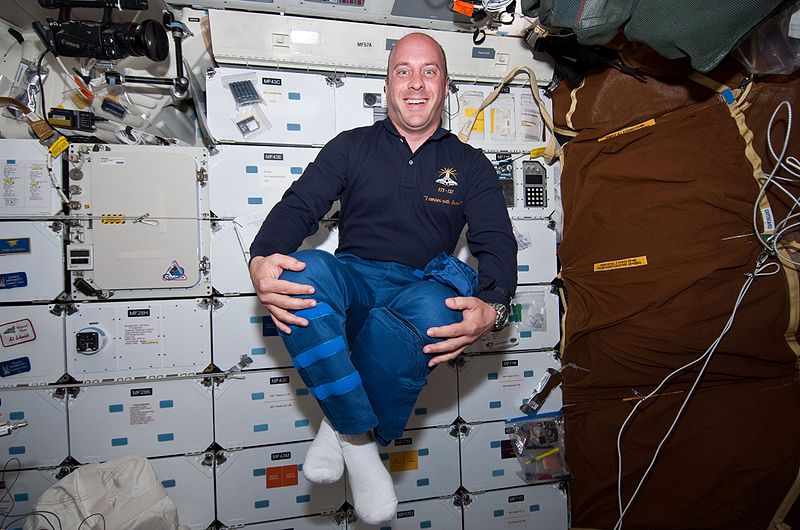
Garrett Reisman, Aboard STS-132 Now at SpaceX, Reisman is using his spaceflight know-how to help build what the commercial space company hopes will be the safest spacecraft the world has ever known. NASA

With a crucial test flight of its Falcon 9 rocket and an unmanned Dragon capsule slated for later this month, commercial space outfit SpaceX is nearing the crescendo of its unmanned space launch program--a robotic rendezvous with the International Space Station. Next up for SpaceX: doing the exact same thing, but this time delivering humans rather than cargo into orbit.

To that end, SpaceX announced last week that it would convene an independent safety advisory panel staffed with former astronauts and NASA researchers to provide an objective review of the Falcon 9 and the DragonRider, SpaceX's crew-capable variant of its Dragon capsule. The company says it wants to create the world’s safest human spaceflight system--no easy feat considering how very dangerous place space can be.

So as SpaceX shifts its focus from unmanned rocket launches to the future of manned spaceflight, PopSci caught up with SpaceX’s own Dr. Garrett Reisman, former NASA astronaut and ISS crew member now bearing the title of DragonRider Project Manager in SpaceX’s manned spaceflight program, to talk about the process of building a manned space launch vehicle from the ground up and how exactly SpaceX plans to build the safest spacecraft the world has ever known.

PopSci: Why convene this independent safety advisory panel? Naturally SpaceX wants to boost human safety across the board, but what do you hope to learn from this particular group of individuals that SpaceX doesn’t already know?

Reisman: We’re entering a new phase here where we’re focusing more and more on flying people into space. There’s a big difference between flying a bunch of cargo up to the space station and flying people up to the space station. The level of safety and concerns, the implications of something going wrong--it’s an entirely new and different ballgame.

" What you worry about are the unknown unknowns--the things that you haven’t prepared for."We want to make sure we have every opportunity to catch any potential problem that could lead to a safety issue. So we’re creating this independent safety advisory panel with these leading experts outside of NASA. By bringing in all their experience, we feel like we’re getting the best possible set of advisors that can ensure we’re moving in the right direction. But it’s important to note that NASA itself performs a very similar function through the commercial crew program. They have both an insight team and an oversight team that will be providing us with excellent advice. So this panel will supplement that. We feel that the skilled team that we have here at SpaceX coupled with the experience of NASA and all their lessons learned as well as these independent safety experts puts us in a really good place to ensure that our manned vehicle achieves a level of safety that’s going to be better than anything that’s preceded it.

After so many trips into low Earth orbit, it’s easy for many people to look at human spaceflight as fairly routine even though we’ve been tragically reminded a few times that it is in fact a very dangerous undertaking. Are there any specific places in the overall human spaceflight scheme--any particular points of worry--that SpaceX is focused on?

There are a lot of particular technical areas that have been problematic--the main propulsion system or the thermal protection system--where we’ve learned the painful lessons of the past. What we’ve striven to do is to build a vehicle that is much more safe than anything available now or that was available in the past. One of the ways we do that is by minimizing possible things that could fail. A lot of safety comes from simply having a robust and straightforward design that minimizes the number of failure modes.

But a lot of times when you have an accident or a mishap in aviation or in space, it’s caused by a failure of imagination. What you worry about are the unknown unknowns--the things that you haven’t prepared for. By bringing these people in--both the people with NASA and this independent safety advisory panel--they will bring with their experience an ability to protect us from that failure of imagination. They’ll make sure we don’t overlook anything, that there’s nothing they can think of that we haven’t thought of.

It seems like in building any manned spacecraft system there has to be some kind of tradeoff between comfort, cost, and safety. How do you establish where to draw those lines?

Safety isn’t always a function of money. Sometimes too much money can be a curse. If you take the approach that you’re going to take every kind of risk you can conceive of and drive it down to zero, you’re going to build a rocket that can never get off the ground. As with any ship, the only way to be 100 percent safe is to never leave the harbor. There’s always going to be some level of risk, and the trick is to find all the critical ones, the ones that could lead to a truly catastrophic event.

There’s one common enemy to both cost-effectiveness and safety, and that is complexity. If you design a vehicle that is incredibly complicated, you get a vehicle that is both very expensive and not very robust, and certainly not very safe. What we’ve done is design a vehicle that eliminates unnecessary complexity. That makes it easier to manufacture and brings the cost down, and it means there are fewer things that can go wrong.

A good example is our launch abort system. In the past, or even if you look at the Soyuz today, there’s a tower on top of the spacecraft with a solid rocket motor on top of that, and if you ignite that motor it pulls you away like an ejection seat if, for instance, the rocket is about to blow up. If you have a tower like that and everything goes well, you still have to jettison it because you can’t deploy the parachutes, the tower is in the way. Now you’ve created something else that has to go right every single time--it’s like an ejection seat you have to use every time you fly.

What we’ve done is incorporate our launch abort system into the sidewall of the vehicle. That does a bunch of things for you. Now, if you’re having a good day, you don’t have to rely on a mechanical event to go right in order to stay safe. That necessity has been eliminated. At the same time you carry these rockets with you and bring them back, so you don’t have to throw them away. And since you carry them with you all the way through, you can conduct a powered abort anytime, all the way to orbit. So we’ve decreased cost and increased safety all in one stroke. That’s what you want to do.

The last time NASA really built a manned spaceflight system from the ground up it was the 1970s. In the intervening forty years we’ve undergone a period of unprecedented technological development. How is building a manned spaceflight system in 2012 different than it was, say, when the shuttle program was getting underway?

We have a huge advantage in that we can learn from the past, so we don’t have to reinvent the wheel. They did a lot of great work at NASA during the Apollo era and during the shuttle era, and we’re the beneficiaries of that. They share their lessons learned with us and they’re looking over our shoulders to make sure we don’t repeat a mistake of the past. So it’s a huge advantage.

The other advantages we have are, of course, modern electronics and computing power. We have the ability to create much more capable fault detection systems that give us plenty of warning time. When something does go wrong, you have time to act. It goes back to what I was saying before: accidents are so often caused by a failure of imagination. They had to have so much more imagination back then because no one had ever done this before. The burden on our imagination is less. Still, we have to remain vigilant. There’s always something lurking out there that we haven’t thought of before.

8 Comments

For too long the old ways have prevailed. Companies and government organisations who are so risk averse petrified of change that they compound all problems. NASA being treated like a jobs program, cost plus contracts creating an inverse insensitive to reduce cost, bureaucratic personal egos dictating designs of rockets.

SpaceX designed built and launched its falcon 9 for less than NASA spent just to refit a launch pad.

@adaptation

while true, the SpaceX would never be able to do what its doing if NASA hadn't paved the way or subsidized a large portion of their business. If SpaceX continues to be successful, the scenario would be a perfect example of how government can lead science and exploration where it isn't cost effective for the private sector to do so, and then when it becomes profitable to allow the private sector to follow in their foot steps and drive new economic growth.

Science and technology have always been driven first by governments and in many ways without the government driving them in school systems they will fall without the government continuing to drive them. I begin to think more and more that the governments focus on technological research and development is the most important economic driver. Almost all of the economic fields of significant growth are technology based now. Apple became the most valuable company in the world selling technology.

My nephew makes that same happy smiling face when he takes a dump too in his diaper. I say, well done Mr. Astronaut for testing the spaceman depends! Good job! Now go clean up and wash your hands and hinny!

.............................
Science sees no further than what it can sense, i.e. facts.
Religion sees beyond the senses, i.e. faith.
Open your mind and see!

NASA astronauts are over-hyped 'spam in a can' joyriding human cannonballs.
The Mercury 'heros' did nothing that chimps had already done in the Mercury space capsules..
The 'right stuff' Apollo lunar landings were only doing what ten unmanned surveyor lunar landers had already done.

NASA is another incredibly inefficient, pork-driven, top-heavyFederal Agency...

NASA has spent 40 years and $500 billion on US manned space since Apollo without getting a single American beyond low earth orbit, and leaving us begging/buying rides from Russians...
STS, ISS, Constellation were all bankrupting, dead-end white-elephant boondoggles.

NASA promised a $7 million/launch cheap, safe, reliable Space Shuttle... then delivered a bankrupting $1.5 billion/launch most dangerous/murderous space vehicle in history which killed 2 crews, had several multi-year service outages...

Why is or should anyone listen to NASA, or 'spam in the can' NASA astronauts who joy-ride automated vehicles, while we can accomplish 100 times more for 10 times less with automated craft.

We need to let private enterprises like SpaceX proceed without being strangled/delayed/choked by big govt hand-wringing incompetence, sloth, waste, pork, red-tape.

"Ameriman's" comment demonstrates an amazingly fundamental lack of understanding on the history, contribution, funding and actual *purpose* of NASA...to an almost unbelievable degree.

More than that...it demonstrates an even greater lack of understanding of NASA's role in partnership with SpaceX...the scope and nature of the entirety of the Federal budget, how much of it actually goes to NASA (less than 1 penny or 1 tax dollar, BTW...which is shameful). Additionally, it shows an amazing lack of reading comprehension skill. This is on the assumption that the article was even read.

As for the "bankrupting" (I am not sure you know what that word...actually means)...here are some actual, real, confirmed, verifiable numbers for you, sir:

- On average, NASA spends in an entire year what the US Military spends in less than a month...*in peacetime*

- The total...TOTAL cost of the Shuttle program was ~$196 Billion dollars. The Federal Gov't currently spends that much about *every 3 weeks*!

- The budget for the State of California is almost 10x greater than the NASA budget.

- Nationally, American consumers spend MORE ON Toilet Paper and Bathroom sundry items than is spent on NASA. People spend more money on flowers, seeds and *potted plants* than is spent on NASA.

It goes on and on. Gain some perspective...or a little knowledge...certainly before you throw around words like "bankrupting" (repeatedly) when talking about NASA of all things. Honestly.

Well said MrKai,

What will be the United States' legacy to humanity, ameriman? If people were satisfied playing it safe, this country would not have been founded. Your ad hominem dismissal of our NASA Astronauts are insulting and belittling, had I a glove to throw down and a black powder pistol, we'd duel, sir.
The inspiration and innovation brought on by the race to the moon was a stepping stone into the computer revolution. This is our stamp on the 20th century, our legacy. As MrKai put it in very succinct understandable numbers, what would you have had us do these last 50 years with NASA's budget? Buy more potted plants?
Unfortunately today, NASA is incapable of running efficiently and with a single-minded focus while trying to weather the political storms and policy wonks changing their minds every presidential term. A microcosm, if you will, of our entire government's debilitating lack of cooperation among the parties.
So now we have SpaceX, and Elon Musk. Dare I say, he's a modern day Henry Ford, attempting to revolutionize space travel while simultaneously driving down costs and raising the safety margin. Great work, the future of this country and humanity rests in our ability to get off this planet, let's get this done!!

I've got 5 potted plants, I don't need anymore. Godspeed Mr. Musk.

@ameriman

Anyone with a complete aversion to NASA and what they do, to include the endeavor of human spaceflight, has obviously never dreamed of going into space, and if you haven't done that, you aren't nor have you ever been the cavalier, adventurous type that would long for a journey on the road or set sail to sea just to experience a new place. You wouldn't be the type of person who understands the joy and excite of flight (despite its dreadful nature). You wouldn't even understand the plight of a thrill seaker. Human spaceflight is the all-encompassing symbol embodying the human spirit. Of course, even Capt. Kirk said, "Space travel is an endeavor for the young," (I think that was Star Trek VI). On that note, Only the youthfully exuberant would say robotic spaceflight is enough to support us here on Earth. There'll come a time when we have to leave home (as with any youth coming of age). We have to test the water now so that when the time comes we can endure and thrive, so Government and private enterprise working together to eventually make spaceflight an unrestricted realm like aviation is a positive thing.

@adaptation

Political trends are what has hurt NASA since inception of its existence. We'd be colonizing the solar system now if that weren't the case. At some point people stopped dreaming big here and began to settle. Now the little problems are more important than the big ones that are too far off in the future to deal with right now (or it's always been that way, only under a different masquerade during Apollo). So NASA is funded a penny to the dollar and the entertainment industry, politics, and defense get the mega-millions. We may eventually get it right just in time, or we won't ever have the chance to get anything right ever again. Time will tell.

I wonder if they are also thinking about software safety items. I was a safety engineer for IBM on the hardware and software for the computers on the Space Station in the early nineties. We pioneered several areas of using computer programs to enhance the safety of the Space Station. Space is a big hazard and if exposed to this hazard for a split second unprotected one will die, so yes people have to be protected. i.e in a can or suit, etc. I was also safety on the Life Science Lab for one flight in the shuttle, where they not only experimented on the humans, but other animals and rats. These experiments gave valuable information for humans in space and how we can survive. We can send robots/unmanned probes out there but they only tell us what they have been programmed to tell us and cannot react to unexpected circumstances and compensate.


June 2013: American Energy Independence

Five amazing, clean technologies that will set us free, in this month's energy-focused issue. Also: how to build a better bomb detector, the robotic toys that are raising your children, a human catapult, the world's smallest arcade, and much more.


Online Content Director: Suzanne LaBarre | Email
Senior Editor: Paul Adams | Email
Associate Editor: Dan Nosowitz | Email
Assistant Editor: Colin Lecher | Email
Assistant Editor: Rose Pastore | Email

Contributing Writers:
Rebecca Boyle | Email
Kelsey D. Atherton | Email
Francie Diep | Email
Shaunacy Ferro | Email

circ-top-header.gif
circ-cover.gif