
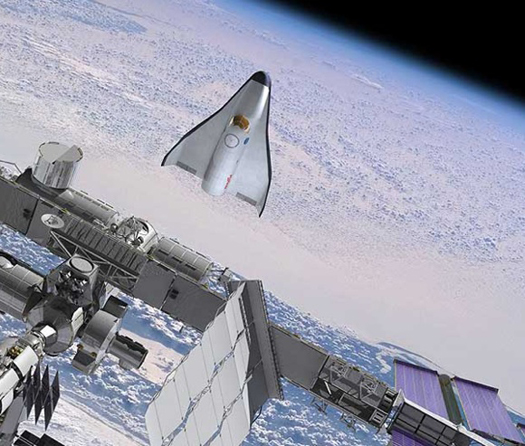
It seems not everyone is content to let the legacy of the space shuttle fly away over yonder horizon. Orbital Sciences Corp. has thrown its hat into NASA’s Commercial Crew Development (CCDev) program with a winged space plane concept very reminiscent of the Shuttle’s design intended to ferry crews to and from the ISS.
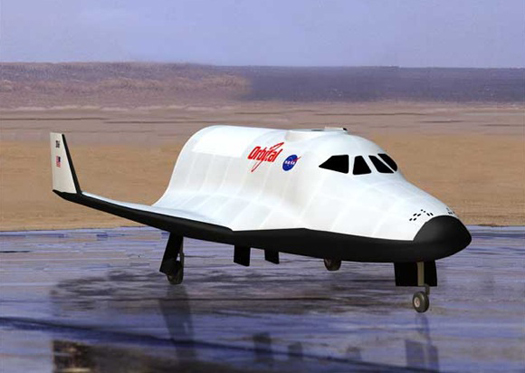
The space plane design is a departure from prevailing capsule-based designs favored by SpaceX and other big contractors like Boeing and Lockheed. At about one-quarter the size of the space shuttles, the unnamed space plane has no engines like the shuttles, and it can only carry a crew of four. Like the shuttles, it would ride into orbit on a rocket stack (specifically on an enhanced iteration of the Atlas V). It would dock with the ISS via a hatch in the rear, and after departing the ISS it would glide to a runway landing below.
Orbital sees a reusable space plane design as the cheaper and safer way to move crews to and from the ISS; its “blended lifting body” allows it to move from its orbital trajectory as it re-enters and place it’s point of landing where the pilot wishes. Capsules, of course, come screaming through the atmosphere more or less at their orbital trajectory and rely on parachutes to soften the “splash down” and a recovery crew to locate and pick up the crew.Both capsules and space planes have their advantages, and neither has a spotless safety record. But it will be interesting to see which mode NASA eventually selects for the next generation of ISS missions. For one, capsules have been fairly reliable since the 1960s, but during the development of the shuttle program the military was keen to have a craft with “cross range” – that space plane capability to move out of orbital trajectory – for possible strategic purposes. The shuttle never flew militarily, but it would be notable if such a consideration still played a role in NASA’s first post-Cold War crew vehicle.
Secondly, Orbital Sciences isn’t the kind of independent, private, “new space” enterprise as, say, SpaceX. It’s a consortium of defense and aviation heavy-hitters: Northrop would build the plane, and the rockets would be provided by United Launch Alliance (read: Boeing and Lockheed).
Of course, first Orbital has to build, launch, and prove out its space plane. SpaceX already has a comfortable head start, having already launched its Dragon crew capsule into orbit aboard its own Falcon 9 rocket and recovered the capsule intact. And SpaceX is wasting no time; the company plans to dock with the ISS on just its second full test-flight, expected sometime in the middle of next year. If it wasn’t already, it’s safe to consider the next space race well underway.

140 years of Popular Science at your fingertips.
Each issue has been completely reimagined for your iPad. See our amazing new vision for magazines that goes far beyond the printed page
Stay up to date on the latest news of the future of science and technology from your iPhone or Android phone with full articles, images and offline viewing
Featuring every article from the magazine and website, plus links from around the Web. Also see our PopSci DIY feed
The 6th annual Invention Awards are here, from an inflatable tourniquet to a better lobster trap to spring-loaded hocket skates. This issue is all about the celebration of invention.
Plus: Making synthetic biology breakthroughs in a garage, building a constantly-moving ping-pong table, and a ridiculously overpowered barbecue.
Good article, but some misconceptions need correcting:
"Both capsules and space planes have their advantages, and neither has a spotless safety record. But it will be interesting to see which mode NASA eventually selects for the next generation of ISS missions. "
NASA is following the National Space Policy directive to 'energize....a commercial space industry"; 'industry' by definition meaning more than one company. It is not NASA's intent to pick one and only one corporate 'winner' or 'concept'; but rather to in the end energize at least 2 or three companies to provide commercial taxi services to and from orbit.
Thus NASA could very will pick at least one capsule and at least one spaceplane concept. So far, we have multiple capsule providers and multiple spaceplane providers who have announced their intentions to compete. That is all to the good of jump-starting a competitive, American-led commercial space services industry that other aspiring space nations can purchase.
In fact, while SpaceX was successfully having its first joint mission with NASA, the other company NASA has selected to provide competing space cargo (ie, 'trucking') service - Orbital - is proceeding towards its first launch. (See: "Meanwhile in Virginia....", http://www.twitpic.com/3e4lq9).
"Secondly, Orbital Sciences isn’t the kind of independent, private, “new space” enterprise as, say, SpaceX."
While true now, one must remember that Orbital is the original 'newspace' entrepreneurial space company; started up by three friends in the '80s to do better than the Air Force or NASA was doing, and now a billion-dollar per year, NYSE-listed company. Though no longer small, they are certainly more innovative and nimble than other huge companies fighting such commercial space development, such as Lockheed Martin or ATK.
Dave Huntsman
Bay Village, Ohio
Good for them we need a 21st century spacecraft not one developed 100 years ago. However it is similar in design to the one I made in 2003 but I had folded wings and use sharp-ceramics TPS for under the spacecraft see here:
www.shineinnovations.com/6312.html
Ron Bennett
Would be interesting to see if they chose one company for a manned space plane and another for capsule based cargo delivery. Or who's to say they won't pull a US Navy and hire everyone after they lock down bargain prices.
Rib2, the technology may not be 100 years old....but at least 50. Ever heard of the X-20 Dyna-Soar?
History and technology DO repeat themselves....
Vexorg, yes I did and I am sure there were some of similar design in some of the sci-fi stuff of that age. Back then they didn't have the TPS, thermal protection systems technology that we have today.
My main point for the reason I designed it as shown from the link above wasn't talked about is to use newly developed high temperature sharp ceramics as a coating on the exposed surfaces of re-entry and folded wings to deflect the heat from re-entry. One of the benefits would be it can withstand higher temperatures than the heat generated for today's re-entry spacecraft and can be used as a way to use earth's gravity-well to accelerate faster than escape velocity towards the earth by skipping off of the atmosphere to re-route it towards the moon or another planet. Note the skipping off the atmosphere effect was also proposed before...
Ron Bennett
"The shuttle never flew militarily" may not be strictly true. Missions such as STS-27 had an all-military crew and carried classified Defense Department payloads.
True, Marcus; the shuttles first dedicated military flight was the fourth shuttle flight (STS-4); there were others. The biggest military use of the shuttle, though, was to fly the shuttle out of Vandenberg AFB on the West Coast. We were 100% set up to do that - almost $2b spent to convert Space Launch Complex-6 (SLC-6) at Vandenberg, we were all trained and simulated and ready - and then the Challenger accident happened. The USAF secretary, who had opposed USAF use of the shuttle all along because they didn't control it, immediately cancelled any additional military missions, and cancelled use of Vandenberg, in spite of the billions already spent.
What the author probably was thinking about was that the solely-military shuttle flights from Vandenberg ended up being cancelled; but there were military flights from KSC. I was on console for a couple of them.