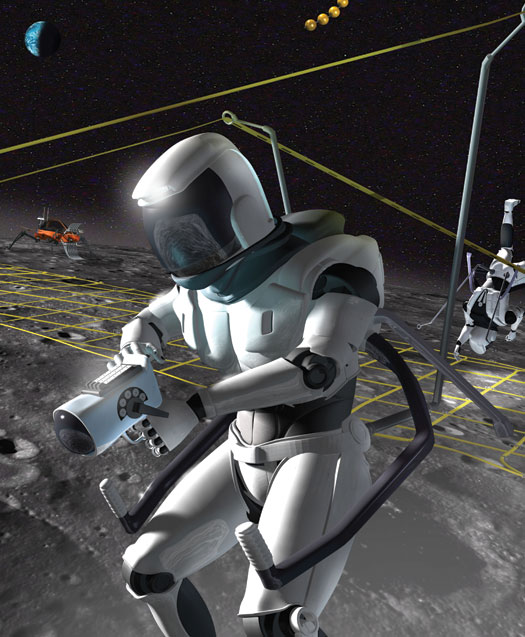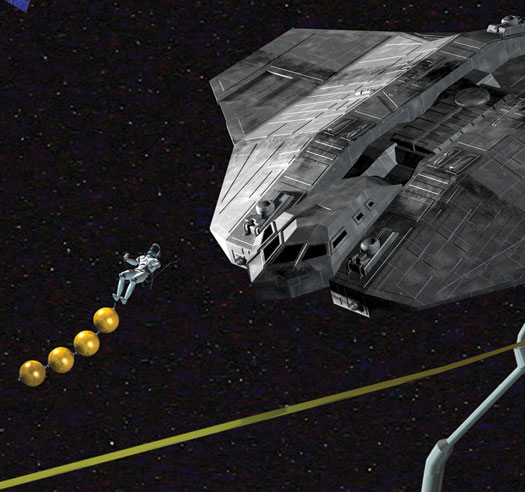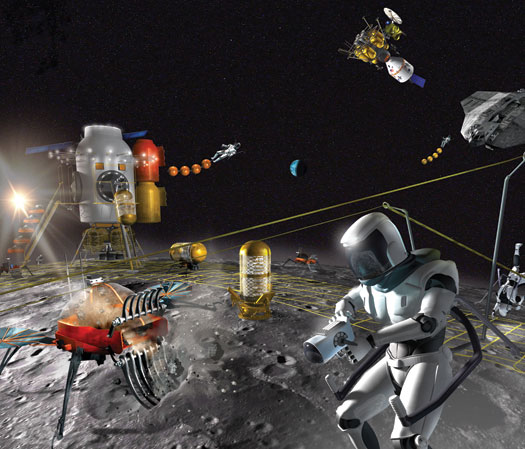
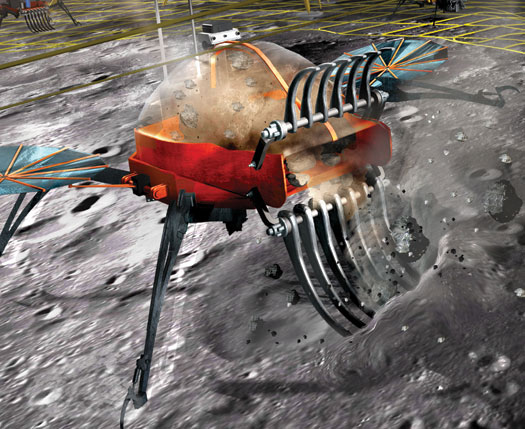
The prospect of great wealth will be one of the main draws of space exploration in the coming decades. A 650-foot-diameter asteroid (about average) can contain $1 billion or more worth of platinum-group metals and untold amounts of ice or water—which are perhaps even more valuable in space because they can be converted to fuel in situ. But extracting those resources will present some unique challenges. For example, the combination of asteroids’ near-zero gravity (because of their small mass) and quick spin (up to one rotation every couple of minutes) means that asteroid-nauts must attach everything, including themselves, to the rock, or risk floating off into space.
2001: NASA’s NEAR Shoemaker spacecraft is the first to land on an asteroid
2010: Japanese probe Hayabusa is the first to return asteroid samples to Earth
2011: Dawn starts orbiting the asteroid Vesta
2025: NASA plans to land a human on an asteroid
2035: Long space missions make producing hydrogen fuel on asteroids commercially viable
2050: Declining spaceflight costs make mining asteroids for metals profitable
Five amazing, clean technologies that will set us free, in this month's energy-focused issue. Also: how to build a better bomb detector, the robotic toys that are raising your children, a human catapult, the world's smallest arcade, and much more.


Online Content Director: Suzanne LaBarre | Email
Senior Editor: Paul Adams | Email
Associate Editor: Dan Nosowitz | Email
Assistant Editor: Colin Lecher | Email
Assistant Editor: Rose Pastore | Email
Contributing Writers:
Rebecca Boyle | Email
Kelsey D. Atherton | Email
Francie Diep | Email
Shaunacy Ferro | Email
I think we should Jump on this. why mine the planet and harm the environment and get very few materials. when space hold an untold amount of riches
In regards to your comment, Kryptos:
This planet is a starter planet for our race; a cradle for mankind, as many are apt to describe it. It is merely a stepping stone for the manifest destiny of Man that is the universe. By this, I mean we aren't active enough when it comes to our resources. We turn them into luxuries to help our passage into death, alone and unmourned in the great, immeasurable scope of time, when we could use them to claim what is rightfully ours.
In other words, those resources are out there. They are so much more precious than this little rock, this pale blue dot, this prison called Earth. If we must rape the planet to claim what is our birthright, then level its mountains and boil its seas. Plunder its riches with abandon to further ourselves. In the long run, Terra will be but a footnote in the annals of our glory.
Well that's an interesting view....however, Earth will always be our homeworld therefore we need to preserve it.
would be a good opportunity to start processing and manufacturing alloys in space in a Lagrange point near the asteroid belt. The biggest cost for space travel is overcoming gravity and getting the materials / structures needed for satellites/probes/stations into space.
Localizing processing and manufacturing in space needs to be prioritized first before mining becomes streamlined in the future
I wonder how long it takes before we cannot mate with ourselves anymore.. If we are to live on an other planet we sure are to differentiate from another. That would be pretty weird. For example in low gravity peoples bone structure or strength might change or people would get taller maybe less muscular. eyes might change because of different light intensity. Unfortunately I would be able to see this for myself. Nonetheless exciting times are ahead of us
Actually rather than building a station at a nearby Lagrange point as a gravitational anchor (like the INTL. space station), it would be better to base out of asteroid Juno or Vesta. It's cheaper, safer, and has a lot more room for infrastructure
zero-gravity is the ultimate condom, you need gravity for sperm to fertilize eggs properly
Infinion,
By the time humankind has millions of people living in space, we'll have artificial gravity.
save some money and build underground moon base. Get the astroid of interest and fly or nudge it to the moon, let it slam on the moon and mostly break apart. Then all the astro-naut have to do is go around and find whatever pieces they need, in their cool moon riders.
Moon has ice and water, which can be used for astro-naut survival and being underground kinda helps with the radiation, and moon has -----drum roll------more gravity than an ASSTROID.
Why go looking around in an expensive space ship with all that payload? you can build a robot ships that can survive without oxygen, food, water, and are not lazy. The robots job would be to navigate the astroid to the bullseye on the moon. BAM
I once heard that if we didn't stop with Apollo that we'd be on Mars today. In college a business professor said what is really going to push space exploration is the mining industry. If we could get a large mining operation to back something like this you'd really see it take off.
Science always asks "can we," but doesn't seem to ask "should we."
Wow... no one? Okay, I'll do it -_-
Or just jump into your Hulk or Retriever and start blasting the asteroids with your strip miners XD
Couldn't even guess at the cost of bringing 1 gallon of water back from a asteroid, but I will bet it will be a long time before it is economically possible.
It if is a 650 diameter asteroid (average) how is it has an untold amount of water and ice. I would think at MOST it could not exceed. There has to be a gross amount expectation of some kind and yes it can be minimal too?!
I want to be an asteroid miner too. Sign me up!!
@m3talc0re those strip miners better be t2
This article proposes the potential of a great many valuable recourses in asteroids. I think it would have been valuable fun supportive fact to also give their source of information for us readers. Otherwise all this optimism is vague at best for this article.
As it is, I give this article and it’s outerspace science fiction pictures a A+ for fantasy and optimism, but not for actually science.
Of couse, I adore science fiction and science both!
Readers may be interested in looking at an integrated approach to asteroid mining, through a series of papers at: www.asteroidmines.net/
The documents are listed at: www.asteroidmines.net/documents.html
Specifically, we have outlined a series of stages in outreach for mining in the 'Big Picture Evolutions', (an illustrated Excel spreadsheet), while a more in-depth review of the kind of mining equipment speculated upon can be seen in:
www.asteroidmines.net/documents/MiningRig/RigForMining.pdf
While NEAs are of particular interest to 'Asteroid Mines', how mining asteroids, in general, including the belt beyond Mars, fits in a general strategy for planetary exploration (and settlement), this is illustrated at:
www.eosmarsprogram.org/Page25-01-Belt.html
As even the global price of Earthside common metals is rapidly rising, with declining known reserves of many, it is envisaged that economic necessity will drive initiatives to exploit off-planet resources, through the increasing scarcity of strategic materials to maintain our technological infrastructure. Add to that the availability of the bonus PNG metals, gold, platinum etc. mined from the sky, then this all starts to look very attractive....
the beautiful thing about the earth is it was here before people and will be here after people. the earth, in time, will heal itself long after we have destroyed it and are gone.
Look i would love this as much as anyone, would fullfil all my sci fi dreams but the biggest hurdle to jump is of course economy of scale. The only way to get a company to mine in space is to create and prove a model where the upfront structure(ie. ships, launches, recovery, supplies etc.) is less expensive than the amount of goods that would be derived from this mining. In other words you need to spend less money mining than the amount of money you get for the stuff you mine. Companies will only go to space when they can make a profit. But its still to cheap to mine on earth. the only way i can see this happening is if the moon and other bodies in space are treated the way North America was treated in the 17th-18th century. groups of people and companies pulling money together to create colony groups to establish a working colony with the promise of profits. People would be given the materials and tools to establish colonies and then work free of charge for the company.
A group is sent to the moon to establish a colony then work on the colony sending goods back home (earth). The payment the workers get would be the privlege of living at the colony.
lanredneck,
Are you suggesting a Capitalistic approach to exploiting the recourses of outer space. GASP! This just may work! ;)
Where's the "Bored? - Let's go mine the stars" guy. Surely this article is his crowning moment?
Some people here are missing the point. We still have plenty of planet to work through, and mining the sea will be profitable looong before bringing asteroids back. This isn't going to be for the Earth. Mining the asteroids will be for whatever colony/space station system we eventually set up to put people on the Moon or Mars and beyond. It'll be a lot simpler to drag a good sized asteroid over to a Lagrange space station and strip it for resources than to try to shuttle everything back down to Earth.
@speedoflight,
Do you know the amount of energy it would take to redirect the flight path of an asteroid?
Force = Mass * Acceleration
To re-direct an asteroid to crash into the moon will almost ALWAYS cost MUCH more than simply landing on the asteroid and hauling away the valuables because the moon is not constantly bombarded w/asteriods (we would have to do a LOT of work to redirect any asteroids at it).
---
"Do not offer sympathy to the mentally ill.
Tell them firmly:
I am not paid to listen to this drivel.
You are a terminal boob." - William S. Burroughs
These HotelsInSpace are equipped to mine the asteroid belt and using the robotic arms, throw the nickel, copper, gold, etc. to any orbit in our solar system.
Youtube Tasha9503 to see the infrastructure.
It took 50 years and here we are.
In 1961, the first man went to space and back.
Fifty years later, Tasha9503 wants to lift 213 people per launch and reuse the hardware that lifted them as infrastructure in Space.
In 1969 man went to the moon.
In 1988 Trevor started looking for all the reasons why it is impossible to go the Asteroid Belt to mine, smelt and manufacture living accommodations on location.
In 1995 the last of the needed technology was becoming old, used and proven true.
In 2000 all the technology was found and designed into a facility that can be built with six launches.
Trevor just used the technology available to him to reshape the Saturn V rocket, update the life support systems, lower everyone’s launch costs and still produce profits, putting the general public in space by the hundreds.
In 2007, the internet was used to show the new design for a reusable Heavy Lift Vehicle at tasha9503.ca.
In 2009, it cost $20,000,000 to lift one satellite, Tasha9503 plans to lift six satellites per launch and charge $7,000,000 each. (2009 dollars)
In 2010, the internet was used to show everyone what we will have when we use the new design for the rocket hardware and attach 6 together after reaching orbital velocity. Interior decorating not included in the video.
In 2010, LivingInSpace.ca was produced to create the ability to sell 85% of the infrastructure Tasha9503 puts in LEO, offering time and profit shares to those who invest the start up expense.
We put together a business plan and added it to tasha9503.com.
We keep track of all contributors on the internet.
In 2011, LivingInSpace.org was added to open up communications.
Each link is different but all on the topic of HotelsInSpace by Tasha9503.
To make the infrastructure affordable and profitable it was designed to be multi functional.
As launch vehicles, they can lift multiple satellites and a 213 passenger landing craft.
As HotelsInSpace, each will sleep 216 people, lifting the needed food and water with each launch.
For AwayMissions, each HotelsInSpace can grow enough food to feed 36 people indefinitely, so a 12 person crew can pass the Moon on a 99 year AwayMission.
For part of the sales pitch Tasha9503 is offering time and profit shares to those who invest, with every launch lifting one randomly chosen investor. The day we begin collecting rent we are no longer for sale and your percentage of ownership is registered.
trevor@tasha9503.com
The story goes on.
Did you laugh at, or would you invest in:
Mark Coni? for dreaming of the radio. Alexander Bell? about the telephone? Christopher Columbus? Did he fall off the Earth? Henry Ford? Who needed a car? No roads anyway. Thomas Edison? The oil-less light bulb? Ben Franklyn? with his kite strings. Jay Edger Hover? and his dream of an electrical dam. Orville Wright? It will never fly Orville. Man was never meant to fly. Copernicus, the Earth not in the centre of the univerce.
May I go on? Most people knew better and laughed at these dreamers, knowing it will NEVER happen.
Edgar Alan Poe? Aristotle? Michel Angelo? Einstein? Samuel Morris? Leonard da Vinci?
We laugh at the people who see what we cannot and attempt to lift us to new heights.
We nailed one man to a cross for trying to teach us to love each other and stop cheating, lying and hurting each other.
Do you laugh at the design Tasha9503 wants to use as HotelsInSpace or the man who designed it?
Everyone told Trevor why it will take 50 years or it will never happen.
- 27,000 degree hot plasma, going right through you
- Bone and muscle degradation, body turns week
- lubrication, allowing to spin different sections
- food supply, everyone must eat
- profitability, people will not invest without the promise of a profitable return, and you can’t afford it.
- launch expense
- atmospheric cleansing
The list goes on.
- clients, who will afford to rent HotelsInSpace at $1,000,000/week
- Health, doctors, medication
- Human excrement
- Time, too much time to travel from one planet to another; imagine time to travel to another star.
And one by one business, scientists and farmers developed all the technology to fulfil all the restrictions.
Stories about all the needed tech was displayed on the Discovery Channel.
David Suzuki, Jay Ingram and a few others with their many co-hosts brought the needed information together that solve all the stoppers, allowing humans to fly off this nest called Earth, without the need to land on another planet.
- wiring, increases the mini magnetosphere to magnetically protect the inhabitants from solar plasma.
- spin parts of the infrastructure to produce 6 levels of artificial gravity using MAGlev technology
- lift the food requirements for each guest with the guest.
- grow food on board
- every six launches produces 1,278 Astronauts and another piece of infrastructure that can be rented out as HotelsInSpace with 72 units to produce profits
- the price for every launch is shared between 200 people and six satellite payloads
- updated air scrubbers from submarines, scuba and the ISS with six independent gardens
- a few large corporations buying large sections
- a few millionaires buying in to make profits
- a nickel mining organization decides to own 10% and use the 11th HotelsInSpace to begin mining the asteroid Belt.
- many people buying small time and profit shares at $25/week
- staff of 24 to care for guests
- gardening section with compost and potting soil preparation.
- we have a 10 generation life expectancy increasing plan
Want me to go on?
Being unfunded momentarily, we have a 50 year plan and a 7 year plan.
The 50 year plan is you tell two people and they tell two people.
The seven year plan is you tell 10,000 people and they tell 10,000 people.
If you want us to build, now, tell 100,000 people, twice. (ThatsCalledAdvertisingOrSpam)
Should ten million people tell the governments to adopt this design?
Should one million people invest $10,000 and each own a small percent at 12% return?
Should one organization own the whole thing?
Trevor found a way to get off this beautiful planet, mine the Asteroid belt, smelt and manufacture reproductions on location. But to afford the start up costs he has to sell 85% of the infrastructure Tasha9503 puts in space. Then use the infrastructure as 72 unit HotelsInSpace to produce profits. 1995 technology will mass produce these HotelsInSpace and lift 213 people per launch but not cover the walls with iPad technology. We need 1,000,000 people (Trekies) to subscribe for seven years or we need 1000 millionaires to invest $7,488,000 each.
We are selling the use of the units at $2,000,000 per week. Allowing the owners to use their time again every year.
52 weeks x 72 units x $2,000,000 = $7,488,000,000 start up costs.
Then you own the use of that unit for one week every year, pre paid.
We could build with one million people investing $25/week for seven years
1,000,000 people x $25 x 52 weeks x 7 years = $9,100,000,000 start up costs
$25/week will buy you time and profit shares with a subscription. Each launch will lift one randomly chosen subscriber. (lottery)
Should anyone decide to own 51% of Tasha9503, that would be good.
This is one solution to the dinosaur incident.
Trevor HM Cooper
PuttingPeopleInSpace
This reminds me of Eve Online. lol. Just make sure to update your clones if you decide to go asteroid mining in lowsec space.. :P