
In a simulation, a Titan-like atmosphere produces nearly all of life's building blocks

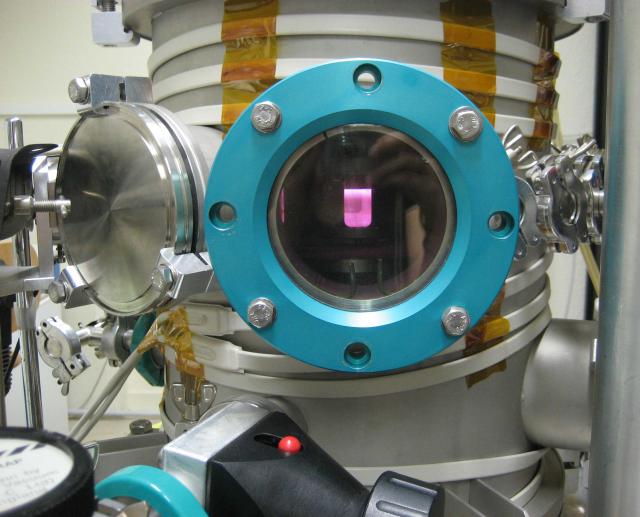
Titan Atmosphere Chamber Energized by microwaves, the Titanic gas mix inside the reaction chamber lights up like a neon sign. Thousands of complex organic molecules accumulated on the bottom of the chamber during this experiment, suggesting Titan's atmosphere is capable of producing the precursors for life. Sarah Hörst/University of Arizona

Scientists studying Titan’s atmosphere have learned it can create complex molecules, including amino acids and nucleotide bases, often called the building blocks of life. They are the first researchers to show it’s possible to create these molecules without water, suggesting Titan could harbor huge quantities of life’s precursors floating in its atmosphere. It’s a breakthrough that even has implications for the beginning of life on Earth.

Researchers at the University of Arizona built a simulated Titan atmosphere in a special chamber in Paris and blasted it with microwaves, simulating the effect of solar energy. The reactions produced aerosols, which sank to the bottom of the chamber, where scientists scooped them up for study. What they found was unexpected, to put it mildly: all the nucleotide bases that make up the genetic code of all life on Earth, and more than half of the 22 amino acids that make proteins.

Of course, this doesn’t prove Titan has life — this was a test chamber, not the actual moon’s atmosphere, for one thing — but it’s intriguing, at least.

“Our results show that it is possible to make very complex molecules in the outer parts of an atmosphere," said Sarah Hörst, a graduate student in the University of Arizona's Lunar and Planetary Lab, in a UA News story. She led the research effort with her adviser, planetary science professor Roger Yelle.

Titan is one of the most promising places for life elsewhere in the solar system. It has huge methane lakes and scientists recently learned that hydrogen is disappearing faster than it should at the surface, suggesting some sort of chemical reaction is consuming it.

The best data about Titan’s characteristics has come from the spacecraft Cassini, which has tasted some of the moon’s outermost atmosphere in a series of flybys since 2004. But Cassini was not designed to dip below 560 miles above the surface, much too far to really get a sense of what the moon’s atmosphere contains.

To truly test its capabilities, researchers would have to recreate the atmosphere in a lab, mixing the gases found on TItan and subjecting them to radiation. The microwaves caused a gas discharge, the same process that makes neon signs glow, which caused some of the nitrogen, methane and carbon monoxide to bond together into solid matter. These aerosols were levitated in a special chamber before they got heavy enough to fall down.

The prospect of small floating life forms in the Titanic atmosphere is intriguing enough, but the study also revealed some interesting possibilities about the genesis of life on Earth. Titan’s atmosphere might be chemically similar to that of the early Earth, suggesting that instead of emerging from a primordial soup, the building blocks of life might have rained down from on high.

Hörst said the most interesting aspect of the study was proof that you can make pretty much anything in an atmosphere — a finding with major implications for astrobiology.

"Who knows this kind of chemistry isn’t happening on planets outside our solar system?” she said.

8 Comments

Firsties!!!!!!!!!!!!!!!!

Lets get rid of the maybes and start a mission to land on the Titan moon. I wish there was a way to get nasa to start the landing mission. I would donate some to this mission.

@aerosphere

A great deal of consideration must go into a mission which may put life in danger. Even NASA admitted that they may have contaminated Mars with Earthly organics that clung to their equipment. There is such intense risk, cost, time and ingeniuity involved in such a mission, that it's possible we are just not yet capable of taking on something that epic.

I am of the opinion that humans should *currently* be more concerned with caring for real life on Earth than with groping about for possible life on other planets (an opinion I usually keep to myself since I am such a space case through and through). I absolutely love the idea of space exploration and seeking out strange new worlds, but I hatehateHATE the thought of doing it poorly...

"...suggesting that instead of emerging from a primordial soup, the building blocks of life might have rained down from on high."
i've been thinking about this for the past couple years now haha. what if human life can on the asteroid/meteor that wiped out the dinosaurs? sounds reasonable to me...
also, now that we know this, will scientist send a missle containing whatever else that makes life to titan?

As stated above lets go.

An ambitious robotic mission to Titan can happen within our lifetime. One mission can do three things. One would land on the surface then inflate a small balloon that will use Titans winds to move a surface rover hundreds of kilometers over its surface using a device called the Windsurfer. Not much lifting gas is needed for the balloon to be buoyant because the density of Titans atmosphere is about three times what it is on earth, a relatively small balloon can be used. See Windsurfer here:

www.shineinnovations.com/5812.html

Another one of the missions goals would place a communication satellite in orbit that will be loaded with instruments that would examine Titan atmosphere and its surface for years. The satllite would releases a probe just before orbital insertion that would fly though its atmosphere to gather samples of its way back to earth. All this can be done in one mission before the decommissioned ISS in 2020. The resultant sample should be studied in orbit.

Ron Bennett

I wonder what the current flight time to Titan is? I know its more than twice as far from the Earth than Mars. Im guessing decades before the craft returns to Earth from Titan.

Aerospace Engineering FTW !!!

@bbrooks37 Oh great logic.. and what brought the dino's in the first place, yet another asteroid?

Even if its true, then how life started on that "other place", finding itself on a rock floating in space?

Life as we know it started on earth just like they could start on Titan (with lots of luck, special conditions and time given), and slowly developed to the variety we have today thanks to evolution.


June 2013: American Energy Independence

Five amazing, clean technologies that will set us free, in this month's energy-focused issue. Also: how to build a better bomb detector, the robotic toys that are raising your children, a human catapult, the world's smallest arcade, and much more.


Online Content Director: Suzanne LaBarre | Email
Senior Editor: Paul Adams | Email
Associate Editor: Dan Nosowitz | Email
Assistant Editor: Colin Lecher | Email
Assistant Editor: Rose Pastore | Email

Contributing Writers:
Rebecca Boyle | Email
Kelsey D. Atherton | Email
Francie Diep | Email
Shaunacy Ferro | Email

circ-top-header.gif
circ-cover.gif
bmxmag-ps