We may earn revenue from the products available on this page and participate in affiliate programs. Learn more ›
They are road signs for your daily rituals-the instantly recognized symbols and icons you press, click, and ogle countless times a day when you interact with your computer. But how much do you know about their origins?
Gizmodo is the world’s most fun technology website, focused on gadgets and how they make our lives better, worse, and more absurd.
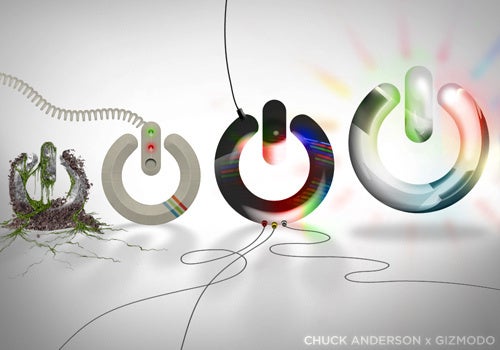
Power
It’s plastered on T-shirts; it tells you which button will start your Prius; it’s even been used on NYC condom wrappers. As far back back as WWII engineers used the binary system to label individual power buttons, toggles and rotary switches: a 1 meant “on,” and a 0 meant off. In 1973, the International Electrotechnical Commission vaguely codified a broken circle with a line inside it as “standby power state,” and sticks to that story even now. The Institute of Electrical and Electronics Engineers, however, decided that was too vague, and altered the definition to simply mean power. Hell yeah, IEEE. Way to take a stand.
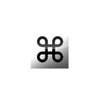
Command
What do Swedish campgrounds and overuse of the Apple logo have in common? A lot, according to Andy Hertzfeld of the original Mac development team. While working with other team members to translate menu commands directly to the keyboard, Hertzfeld and his team decided to add a special function key. The idea was simple: When pressed in combination with other keys, this “Apple key” would select the corresponding menu command. Jobs hated it-or more precisely the symbol used to represent the button-which was yet another picture of the Apple logo. Hertzfeld recalls his reaction: “There are too many Apples on the screen! It’s ridiculous! We’re taking the Apple logo in vain!” A hasty redesign followed, in which bitmap artist Susan Kare poured through in international symbol dictionary and settled on one floral symbol that in Sweden, indicated a noteworthy attraction in a campground. Alternately known as the Gorgon loop, the splat, the infinite loop, and, in the Unicode standard, a “place of interest sign,” the command symbol has remained a mainstay on Apple keyboards to this day.
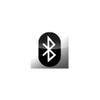
Bluetooth
You’ve probably heard the story of 10th Century Danish King, Harald Blåtand, as it relates to Bluetooth, right? He was renowned connoisseur of blueberries; at least one of this teeth was permanently stained blue; yadda yadda yadda. What you might not know is that the Bluetooth symbol is actually a combination of the two runes that represent Harald’s initials. It just so happens the first Bluetooth receptor also had a “teeth-like” shape, and was-you guessed it-blue. But the symbolic interplay doesn’t end there. As the Bluetooth SIG notes, Blåtand “was instrumental in uniting warring factions in parts of what are now Norway, Sweden, and Denmark – just as Bluetooth technology is designed to allow collaboration between differing industries such as the computing, mobile phone, and automotive markets.”
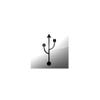
USB
Created as part of the USB 1.0 spec, the USB icon was drawn to resemble Neptune’s Trident, the mighty Dreizack. (But that doesn’t mean you should go around stabbing people or trying to domesticate dolphins with your flash drive.) In lieu of the pointed triangles at the tip of the three-pronged spear, the USB Promoters decided to alter the shapes to a triangle, square and circle. This was done to signify all the different peripherals that could be attached using the standard.
Play
While the Play/Pause symbols aren’t native to computers, they’ve made their way onto keyboards, media players (real and virtual), and every other device capable of playing audio or video. Unfortunately, neither the right-pointing triangle nor the double pause bars seem to have a definitive origin. They first appeared as tape transport symbols on reel-to-reel tape decks during the mid-1960s. In some cases, they were accompanied by the (double triangle) rewind and fast forward symbols. The direction of the play arrow indicated the direction the tape would move. Easy.
Pause
As far as the pause symbol goes, many have noted it resembles an the notation for an open connection on an electrical schematic. Some say it is simply a stop symbol with a chunk carved out of its center. We’d put our money on a more classical origin: In musical notation, the caesura indicates a-wait for it-pause.
Sleep
People were confused by “the standby state.” It seemed counter-intuitive for an electronic device to be neither on nor off. So, after the IEEE nicked the ICE’s standby button (remember?), it decided some rechristening was in order. The governing body re-named standby mode “sleep,” to invoke the state where humans are neither on nor off. Today, a crescent moon is the de facto sleep state symbol on devices in the US and Europe. Its metaphorical power is undeniable! Travel to Japan, though, and you’ll probably see the occasional Zzzz button.
At
Ah @, the only symbol on the list to earn a spot in the MoMa’s architecture and design collection. How has this fetishized symbol become so potent over the years? It probably has something to do with the net-ruling rune’s deep and mysterious origins. It has been known by many names: the snail (France and Italy), the little mouse (China), the monkey’s tail (Germany). In 1971, a Bolt, Beranek & Newman programmer Raymond Tomlinson decided to insert the symbol between computer network addresses to separate the user from the terminal. Prior to Tomlinson’s use, the @ also graced the keyboard of the American Underwood in 1885 as an accounting shorthand symbol meaning “at the rate of.” Go back even further and things start to get hazy. Some suggest that @ has its origins in the sixth century, when monks adopted it as a better way of wirting the word ad-Latin for “at” or “toward”-that was not so easily confused with AD, the designation for Anno Domini, or the the years after the death of Christ.
Firewire
Back in 1995, a small group at Apple-the main developer of FireWire-set about designing a symbol that could accurately reflect the new technology they were working on. Originally intended as serial alternative to SCSI, FireWire’s main allure was that it promised high-speed connectivity for digital audio and video equipment. So designers opted for a symbol with three prongs, representing video, audio and data. Initially, the symbol was red, but was later altered to yellow for unknown reasons.
SBBOD
This terror is known by many names: the hypnowheel of doom, the spinning pizza, the pinwheel of death, the SBBOD (spinning beach ball of death). Apple officially calls it “spinning wait cursor,” but most Mac users hail it with a simple expletive. It first appeared in Apple’s OSX and continues to indicate that an application is not responding to system events. As many have noted, the SBBOD is actually an evolution of the wristwatch “wait” cursor that the company first used in early versions of the Mac OS. While its design origins remain mysterious, Apple likely dropped the watch as it reminded users of the time passing as the program remained perpetually hung up. Despite this, the modern iteration has proved only one thing though: it’s entirely possible to despise a pretty, hypnotic spinning wheel.
Ethernet
Despite being “invented” many years prior, the thing we now recognize as the Ethernet port symbol was actually designed by IBM’s David Hill. According to Hill, the symbol was part of a set of symbols that were all meant to depict the various local area network connections available at the time. The array of blocks, which are purposefully non-hierarchical, each represent computers/terminals. While Hill makes no specific mention of Bob Metcalfe’s earliest Ethernet sketches, it’s easy to see how the modern symbol uses them for inspiration.