
Kingda Ka, the tallest roller coaster on Earth, drops its passengers a life-flashing 418 feet. Ferrari World’s Formula Rossa, the fastest, literally takes riders’ breath away at speeds of up to 150 mph. Though thrilling, these are phenomena of degree, not kind. BRC Imagination Arts, a Southern California design firm, has proposed something entirely new: a ride that creates the sensation of zero gravity for up to eight seconds at a time.
BRC drew its concept from the “Vomit Comet,” the plane NASA uses to train astronauts. The KC-135A aircraft flies a looping parabolic path, creating about 25 seconds of microgravity each time it zips up and over the parabola’s camelback hump. BRC’s proposed theme-park ride would travel a somewhat simpler trajectory—up and then back down a soaring steel edifice, similar to the existing “Superman: Escape from Krypton” coaster at Six Flags Magic Mountain in California. But unlike Superman and other open-car coasters, the vomit-comet ride would be fully enclosed. Rather than the thrill of hurtling forward to one’s perceived doom, riders would enjoy the illusion of floating within a stable chamber.
To create that illusion, a linear induction motor system would speed coasters up the track with unprecedented precision. As the coaster approached a top speed of more than 100 mph, it would suddenly and ever so slightly decelerate—just enough to throw the passengers up from their seats, like stones from a catapult—and then quickly adjust its speed to fly in formation with and around the passengers. (The ride’s calculations would correspond to the unique heft of any particular group.) As the coaster reached the top of the track and began to drop back down, the computer system would continue to match its speed to that of the falling passengers, extending the sensation of weightlessness for several additional seconds, and finally rapidly decelerate to a stop back at the base station.
Roller coasters typically cost no more than $30 million, but Bob Rogers, BRC’s founder and chief creative officer, says the zero-gravity ride would cost $50 million or more, in large part because the precision-response propulsion system is so complex. But if someone were to write a check today, Rogers says, his company could be sending riders on weightless journeys by the end of 2013—and the new owners could make money on the side by renting the coaster after hours to scientists who wanted to perform the tests they now run using NASA’s original Vomit Comet. Simply by heading over to the amusement park, they too will be able to experience the equivalent of eight seconds in outer space—which, Rogers says, “will feel like forever.”
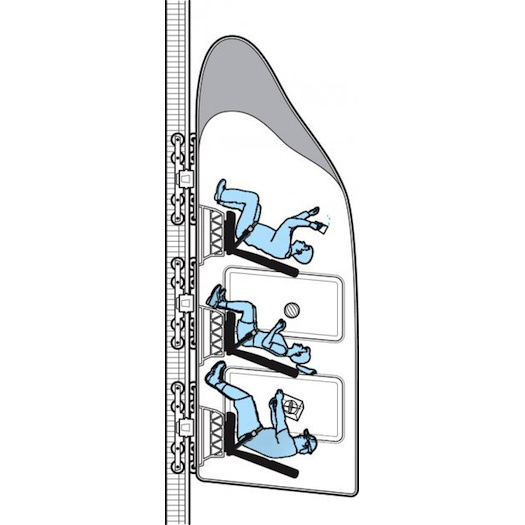
Passengers would enter the coaster through gull-wing doors, face forward, and sit upright, six to 16 to a car. They would buckle into simple two-point restraints, but the belts would be kept slightly slack so they would have room to rise out of their seats. Once aboard, they could remove from a small stand in front of their seats one of several tethered “scientific packages”—a cup filled with water, a ball, a gyroscope. In addition to experiencing weightlessness, they would be able to observe how the selected object changed properties in zero gravity. The cars would also be outfitted with drains. Should the ride live up to its nauseous namesake, attendants at the unloading stations would be ready with hoses.

Five amazing, clean technologies that will set us free, in this month's energy-focused issue. Also: how to build a better bomb detector, the robotic toys that are raising your children, a human catapult, the world's smallest arcade, and much more.


Online Content Director: Suzanne LaBarre | Email
Senior Editor: Paul Adams | Email
Associate Editor: Dan Nosowitz | Email
Assistant Editor: Colin Lecher | Email
Assistant Editor: Rose Pastore | Email
Contributing Writers:
Kelsey D. Atherton | Email
Francie Diep | Email
Shaunacy Ferro | Email
First Comment!
But anyways, I would love to try that out, and I think it would be a big money maker!
-Live life to the fullest, or don't live at all-
Can't wait to be the first to puke up on one.
What would make this even better would be to have a LED screen in the front that shows the curvature of the earth as if you are up in space.
Ron Bennett
Yeah I would love to see my own puke just float in front of my face during the 0 g's portion of the ride....and then watch it hit the person in front of me as we accelerate back down the track. Oh what fun it will be.
That looks very scary, and I agreevwith ajohnson1986. I don't want to see floating puke
this plans and theory about shuttle starts is older than 10 years. i read years ago in the german p.m. magazine about this.
sounds fun... but id be worried people would unbuckle their seat belt.
Man, I will get scared in that ride but at least, it is fun to last.
I despise the term 'zero gravity'.... it's a buzzword lazy writers use.
MasterGamer92,
Yea I am the 9th commentator! Woopee! Why do you believe it would be a big money maker?
rlb2,
Being the first one to puke in with the acceleration it will plaster the other people. Once you achieve zero gravity, the joy of your puke and by now everyone else’s will be bouncing around and around. Have a fun ride!
ajohnson1986,
Yea, what you said!
So knowing the puking will occur in advance, how much will you pay to ride this ride?
learningmachine. If you agree with ajohnson1986, he embraces the puke and you state in your words you do not want to see floating puke? I am confused?
snakes,
The reason you read about it from the Germans first is they get all their technology first from the aliens. They it spreads about to the rest of mankind.
Klmbo Y. Laurel,
It will be fun to last?! I am happy for you, I think?
shutterpod,
You despise the term zero gravity? How many bad experiences have you had with this term and what were they, I am curious? How would you describe not having gravity in a term?
I like the drawing and the space shuttle device flying it. I doubt it will ever be built. Though it so fun to dream! Have a nice day! ;)
.............................
Science sees no further than what it can sense.
Religion sees beyond the senses.
Someone please build this!
This ride was built 15 years ago, almost to the same exact specifications and it has even been upgraded since then to launch the cars backwards:
http://www.rcdb.com/140.htm
http://youtu.be/BnVcAVBjILk
The price tag in 1997 was $20 million for a prototype system, and even taking into account inflation, there's no reason why this ride should cost $50 million especially when the technology has been around for some time.
Physics 101 all objects drop at the same rate in free-fall. So the computer only needs to de-accel the coaster at a constant rate of 32 ft/sec*2(squared).
the weight of the passengers does not change the 'velocity profile' that the controller wants to achieve.
actually gravity will do most of the work- once the motor cuts off the car and the people will de.accel at 1g ( plus friction), so people will feel 'free-fall' ( they'll 'float' up out of the seat). when they reach zero speed at the top, gravity will pull the car down at 1 g, so the motor only has add just enough downward speed to overcome the effect of friction, and the people will feel free-fall.
IS ANYONE ELSE TIRED OF THESE FUCKING THUNDEROUS UNDERTONE ADS THAT CAN'T THEMSELVES BE MUTED ON EVERY PAGE ON POPSCI???
Gravity is an attribute of mass, anywhere there's mass in the Universe there is gravity, even if you were in intergalactic space with a golfball, you and the golfball would affect each other to each other's gravity.
The feeling of free-fall isn't zero-gravity, it's not even micr-gravity, whatever that term means.
This week’s successful docking of a SpaceX spacecraft with the International Space Station Friday is a case in point. <"http://airsoc.com/articles/view/id/4fc4681dc6f8faad0c000004/moondust-and-zero-gravity-memories?ev=10&evp=tl">