
We may earn revenue from the products available on this page and participate in affiliate programs. Learn more ›
Music is the lifeblood of a good party. Whether it’s a live performance by a great band, a skilled DJ, or even your cousin Sally and Aunt June going ham on a beat-up karaoke machine, it’s part of the soundtrack of our lives. If you’re a musician, you know the sweetness that comes from adding your own notes to that music, which is exactly where the JBL BandBox Trio comes in: the performer’s party speaker.
Pros
- All-in-one design can replace a party speaker, small practice amp, mixer, and karaoke box
- Built-in battery makes it easy to use away from an outlet
- Lighter and easier to carry than a traditional combo amp or head + cab
- Intuitive screen-and-knob interface keeps setup and tweaking approachable
- STEM AI tools make practice faster and more useful
- Guitar presets and editable signal chains offer solid plug-and-play flexibility
- Delivers full, fun sound for home use, small parties, and casual performances
Cons
- 135W rating overstates its real-world loudness vs. larger guitar amps
- Small drivers can sound crowded at higher volumes when several channels are active at once
- Amp and effects models are good, but not as deep or refined as dedicated gear
- Stock tuning leans bass-heavy and can need adjustment for clarity
- Extra battery costs more, though most users probably will not need it
The short version
The JBL BandBox Trio is a cleverly niche all-in-one for musicians who want one compact box to cover practice, parties, karaoke, and casual performance, and while it won’t outgun a real guitar amp or outclass dedicated modeling gear, it packs enough portability, smart practice features, and just-plain-useful versatility to make it a genuinely appealing grab-and-go option.
The build and purpose
JBL is best known for its wide range of speakers and headphones, and already counts among its catalog some of the best party speakers. The BandBox Trio and its smaller sibling, the BandBox Solo, represent a new step for JBL, directly toward solo musicians and performers. If those people happen to have a summer barbecue or office banger where raucous renditions of “Rockin’ in the Free World” are called for (karaoke style), or the “Cha Cha Slide” hasn’t yet made an appearance, well, that makes this all the better of an investment.
Because, yes, the Trio is a party speaker, complete with audio inputs for Bluetooth 5.4, USB, and 3.5mm sources. But it’s also a low-profile, small-footprint guitar amplifier, a mixer, and an effects processor. Each one of these comes with the settings and parameters you would expect, ranging from dialing in the EQ with simple Bass and Treble controls to setting up a full signal chain for an electric guitar, complete with categorized stomp boxes, amps, and cabs. This is the party speaker with versatility built into its DNA.
Its physical construction is robust, but it’s noticeably less so than that of a dedicated guitar amp at a similar price. It’s “party speaker” robust, not “touring rig” robust. On the flip side, the Trio is also much lighter, and that also includes a built-in, swappable battery, so you’re not tethered to an outlet. Even so, I still find it to be well-made and solid. Treated with care, it should last for years.
Part of the reason it’s smaller and lighter is that it uses a single 6.5-inch woofer and a pair of 1-inch tweeters instead of the single or even double 12-inch cones found in many comparable guitar amps. JBL says it can output up to 135 watts, and maybe it can, but don’t be misled: a 100-watt guitar amp with a speaker almost twice the size gets much, much louder and fills larger spaces far better than the Trio can. But for virtually any scenario at home, including the aforementioned summer get-together, it should get plenty loud.
And, to be completely frank, it is so much easier to travel with the Trio that I’ve been happy to leave my bigger amp at home unless I really need its power or precise tone.
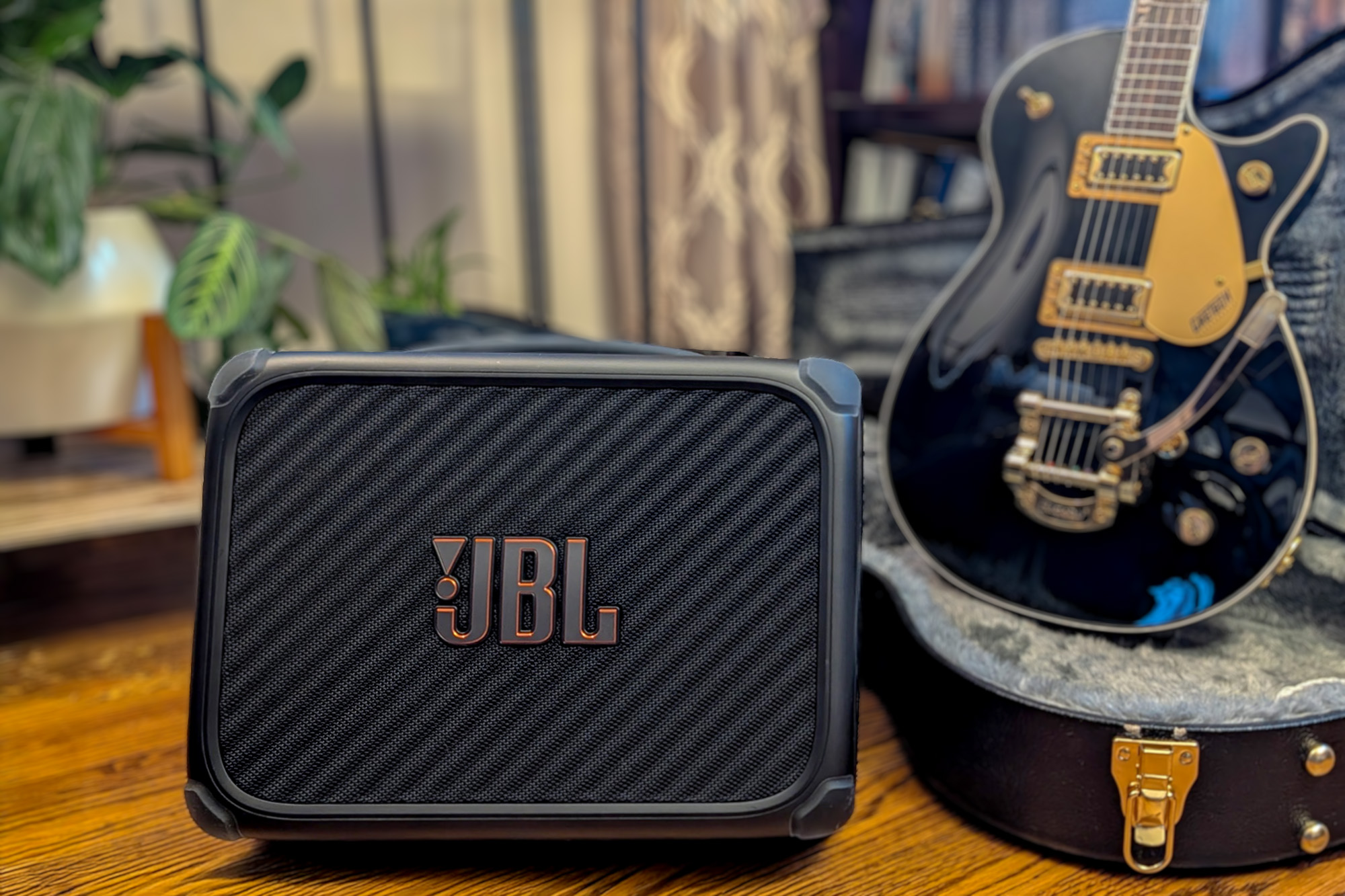
The Trio resembles a stage wedge, a low-profile monitor used by performers. The front face is all grille with a big JBL logo in the center. On top is a large silicone handle that is so much nicer to carry than a standard amp handle, and the control center.
Using the speaker is done with a larger, color display and a handful of buttons and knobs. The screen shows a mixing interface when you first turn it on, and it always labels its active controls, making it intuitive to use. The mixing panel shows four channels, each with its own physical button, and clicking into any allows you to adjust levels, change EQ, apply vocal and guitar effects (increasing reverb on a microphone or distortion on a guitar, for example), and change parameters. This is especially rich for guitar, where you can create a complete signal chain for a completely custom tone.
Around the back is the I/O panel. There are two multi-jacks that can support either XLR or standard 1/4-inch patch cables, plus a third instrument jack. And, like I mentioned up top, USB, 3.5mm, and Bluetooth. You can even use it as a speaker for your PC if you like to gig with a laptop.


Internally, it sports a big 68WH battery that JBL quotes as lasting up to 10 hours. That will depend heavily on how loud you’re playing, of course, but if you run it dry and can’t plug in, you can swap in a second battery. It’ll set you back another $110 and, in most situations where you’d be using the Trio, really isn’t necessary beyond peace of mind.
Finally, we get to the amp’s smart features. This is really where things get interesting. It comes with a selection of basic tools, like a tuner and metronome, a looper, a drum machine, and even AI. Yes, AI, but hold onto your scoffs for just a moment because this is one of the best implementations I’ve seen in a practice tool.
JBL calls it STEM AI. Using a combination of the app, onboard controls, or both, simply turning on this mode opens the door to some truly useful features—whether you’ve been playing for decades or just picked up the instrument last week.
The hallmark feature here is that STEM AI can, in real-time, separate audio into individual tracks for different instruments and vocals. You can turn these up or down, allowing you to hear parts better or remove them entirely so you can fill in yourself. Using the app, you can also pitch shift songs, so if you’re practicing a song in a different key than what was recorded, you can quickly adjust, isolate the part you’re learning, and play along.
It’s an incredibly useful learning feature for practicing licks at home, but it is also helpful for live performances, allowing you to use real songs and not “karaoke mixes” for your backing tracks.
The sound and performance
In the words of my favorite college professor, the Trio is trying to “wear many different hats” all at the same time. The fear, of course, is that when you’re a jack of all trades, you risk being a master of none and, for this particular speaker, finding yourself in the annals of music-tech history. And while there are definite sacrifices going with an all-in-one product, JBL kinda knocked it out of the park.
The Trio strikes an important balance between offering a quality feature set and performance-worthy acoustics while also remaining reasonably priced. At $600, it offers just enough in every area to make it worth considering, even while single-purpose alternatives may offer advantages in tone or capability.
As a guitarist and music lover, that’s where I spent most of my time. I used it as a speaker at my day job and carried it home to practice for that week’s worship set, amalgamating multiple guitar parts into a cohesive whole that I could play myself. That’s an important distinction because it requires versatility that simple systems struggle to maintain.
And while it won’t replace my Line 6 Helix and its deep processing capabilities for live or recorded work, I was surprised to find that the Trio isn’t just “fine” but has quickly become one of my favorite pieces of practice gear ever.
As a critic, I approach the Trio from a place that wouldn’t necessarily be charitable to it. The Helix, my daily driver, is an incredible, rich, and very expensive piece of guitar tech. But it’s a single piece of the sound chain. You can’t perform with just the Helix. And so the complications begin immediately, and quickly progress once you get into programming in custom sounds. You can do a lot, but it can take a lot to get there.
The Trio suffers none of that, for better and worse. It comes with a couple dozen preset tones, each the result of a half-dozen built-in effects and amp models dialed in to create a specific sound. You can use these as-is or take them as a starting point, swapping stomp boxes and settings to tailor your tone. “Just far enough” would have been offering tone presets, but being able to dive in and tweak each piece of the effects chain is that “small step farther” that makes this feel like a guitarist’s tool above anything else.


The thing is, you quickly come to realize that even though it does go the extra step of providing options within its effects chain, there aren’t very many to choose from, and so the tonal options aren’t as robust. You could spend hours tweaking settings on the Helix. With its presets, you get the sense that someone at JBL already has. Each tone is well-represented, from twangy country drive to clean and compressed straight through to blistering lead tones and chunky metal rhythms. Classic guitar tones ranging from the 60s to modern day all have a preset. From there, tweak settings like reverb, drive, and EQ to taste.
From a company that most people probably wouldn’t even associate with guitar, it would be fair to expect that JBL’s simulations of its different amps and effects might lag behind its more established competition, like Yamaha or Positive Grid. And you would be right. Compared with dedicated multi-effects hardware, where modeling is their only job, the sound quality and resolution of the different amps and effects aren’t as high. But they aren’t bad.
And when you consider all that this amp is trying to do, what it offers for simplifying practice and making more efficient use of your time, that in a pinch, you could take it to a coffee shop or summer party, turn it on, and go, exactly like at home—there’s real, tangible, and sometimes even financial value in that. The sounds it provides through its presets are varied enough to get you in the ballpark of most songs, including wah-soaked classics like “Voodoo Child.” Just be prepared to make some tweaks—like lowering the bass on pretty much everything when you’re playing guitar.
The Trio’s biggest challenge is its size. Though it supports four channels, it can sound a bit busy to my ear, like its small trio of drivers is overwhelmed trying to reproduce so much sound. But then, that also depends on what you’re trying to send through each channel. An acoustic guitar, a singer, and a background track are going to sound very different from an overdriven guitar on top of ’80s metal and pretty much any singer trying to butt in on that.
When used to its fullest within its limits, the Trio sounds great. For music, it’s full, weighty, and loud. Its half-inch woofer does a lot of work, and the out-of-the-box tuning definitely leans into the low- and mid-bass at the expense of clarity. Thankfully, this is an easy fix using the global bass and treble settings (something which also applies to guitar). Properly tuned, the Trio can drive a small party all on its own without sacrificing the mids to get there. For performance, with the right musician and singer, or pure karaoke enthusiast, it’s big enough to make you stop and second-guess that so much sound could be coming from such a small speaker.
The verdict
With such a blend of capabilities, the Trio is inherently a niche product, but it’s also unique and more than a little cool, given how well it’s put together. If you happen to fall within its crosshairs, it seems inevitable that you’ll find something to love.
That goes for more than just beginners. I’ve played guitar for more than 25 years, and the ability to quickly isolate the guitar and pitch-shift it to the proper key without a computer has been game-changing for my practice. While you shouldn’t expect the “best tone” or “deepest customization” from an all-in-one unit like this, what’s here is great for the less formal moments in life, be it bedroom or busking. The JBL BandBox Trio is about simplifying the progression from practice to performance and foregoing the need to purchase a separate amp, party speaker, and karaoke machine. And for those beginner guitarists and vocalists out there, this truly is an excellent investment that’s ready to grow with you for years into the future.
Tech Specs
| Spec | Detail |
|---|---|
| Form Factor | Portable stage-wedge-style party speaker / modeling amp |
| Best For | Practice, karaoke, small parties, busking, coffee-shop gigs |
| Speaker Configuration | 1 x 6.5-inch woofer, 2 x 1-inch tweeters |
| Power Rating | Up to 135 watts |
| Channels | 4 |
| Inputs | Bluetooth 5.4, USB, 3.5mm, 2 combo XLR/1/4-inch inputs, 1 instrument jack |
| Guitar Features | Preset tones, editable effects chain, amp, and cab sims, with mobile app support |
| Onboard Tools | Tuner, metronome, looper, drum machine, STEM AI |
| Battery Power | Yes, 68Wh removable rechargeable Li-ion |
| Battery Life | Up to 10 hours |
| Extra Battery Cost | $110 |
| BandBox Trio Price | $599.95 |
