On a clear day early next year, an unmanned aircraft painted in the dark gull gray of a Navy fighter jet will take off from a runway at Naval Air Station Patuxent River in Maryland, bank over the Chesapeake Bay and set a course toward an aircraft carrier, motoring several miles out over the Atlantic. As it approaches the carrier, the craft will open communication with air-traffic control, request landing clearance from the deck officers and establish a glide slope that accounts for wind velocity, ship speed and even the slight rolling of the ship’s deck. Pilots consider a carrier landing one of the hardest operations in all of flight. The X-47B will land without any pilot at all.
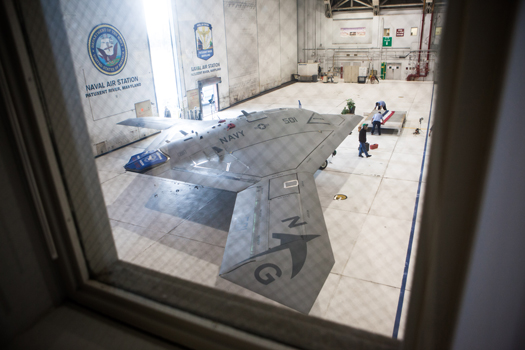
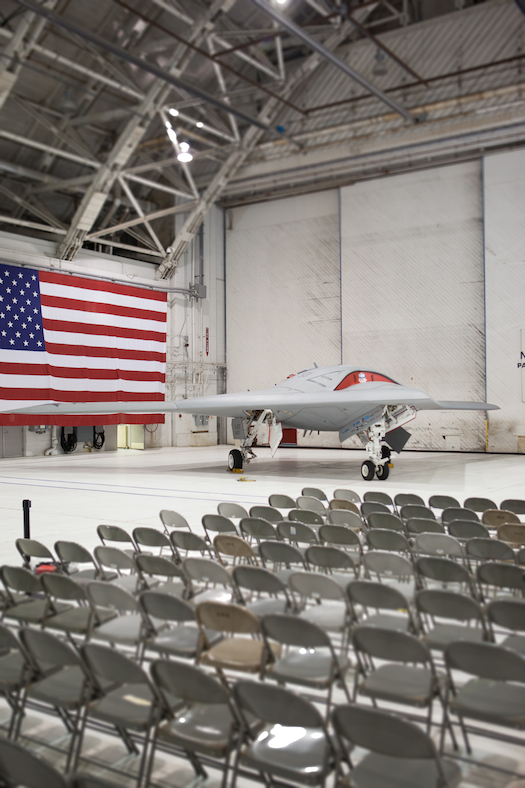
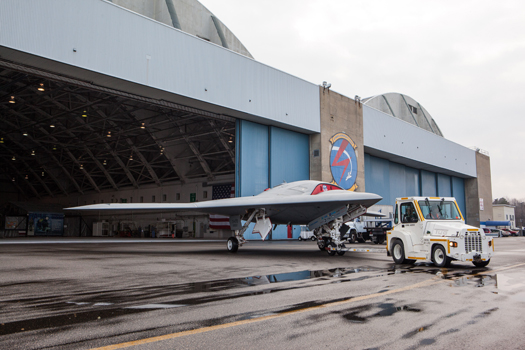
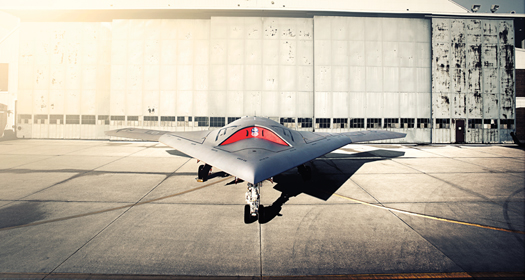
The X-47B is the world’s first autonomous warplane. From takeoff through landing, it flies with little or no direct control from human handlers. Although it is a prototype not intended for actual combat use—the Navy calls it a technology demonstrator—engineers designed it to slip into contested airspace, dodge antiaircraft defenses like cannons and surface-to-air missiles, and deliver strikes or perform reconnaissance. When it completes its mission early next year, the X-47B will be both the first tailless aircraft and the first unmanned one to ever land on a carrier. And it will mean that the Navy, armed with some future variant, will have the capability to order unmanned sorties from carrier groups anywhere in the world within hours of a clash.
The X-47B is also a big step forward in robotic flight. The U.S. military has roughly 10,000 unmanned aerial vehicles (UAVs), which ply the skies above places like Afghanistan, Pakistan, Yemen and, sometimes, the U.S. Engineers call such aircraft man-in-the-loop systems, and humans typically control them remotely, whether from a ground base nearby or a command post a continent away. The X-47B is a man-on-the-loop system: While people retain control over the general mission, the moment-to-moment decisions are left to the aircraft’s robot brain.
Outside of flight, man-on-the-loop systems are becoming increasingly common. Scientists have been using autonomous probes to map the ocean floor for the past decade. The U.S. Department of Energy recently deployed autonomous ground vehicles to patrol the Nevada National Security Site, a former proving ground for nuclear weapons. And farmers are starting to use self-driving tractors to till fields and harvest crops. What sets the X-47B apart from those systems is the nature of its environment. Rather than a deserted waste site or an empty field, the X-47B is designed to operate on and around an active aircraft carrier.
After five years of development, engineers at Northrop Grumman and within the Navy’s Unmanned Combat Air Systems (UCAS) group have created a robot brain capable of operating in such a complex setting. It can process vast amounts of flight data, make near-instantaneous decisions and guide an aircraft to a flawless, squealing halt on the deck of a carrier. Now the designers face a different kind of challenge: training the aircraft to work with people.
Robotic autonomy is fundamentally different from automation. Automated systems perform repetitive, preprogrammed tasks, and they have played a role in flight for decades. The Navy has employed a hands-off radar-based system to automatically recover F/A-18 fighter jets since the early 1990s. Autonomy connotes self-governance. It implies the ability to assess fluid situations and form dynamic responses. Some modern autopilot systems possess autonomous features—they can adjust throttle to optimize airspeed or move fuel between tanks to balance the aircraft’s weight without human permission—but humans still act as a backstop, sitting inches from the controls.
For the Army and Air Force, launching automated or semiautomated UAVs from ground bases into uncontested airspace has become instrumental to military operations. But on Naval carrier missions, they are all but useless. The common Predator and Reaper drones are too large and slow to take off from a carrier deck. They are also too bulky to operate as stealth craft and too cumbersome to dodge surface-to-air missiles or cannon fire, which means they can’t fly in contested space. And even if they could be made smaller, faster and nimbler, landing one on a carrier via joystick and video feed would be all but impossible.
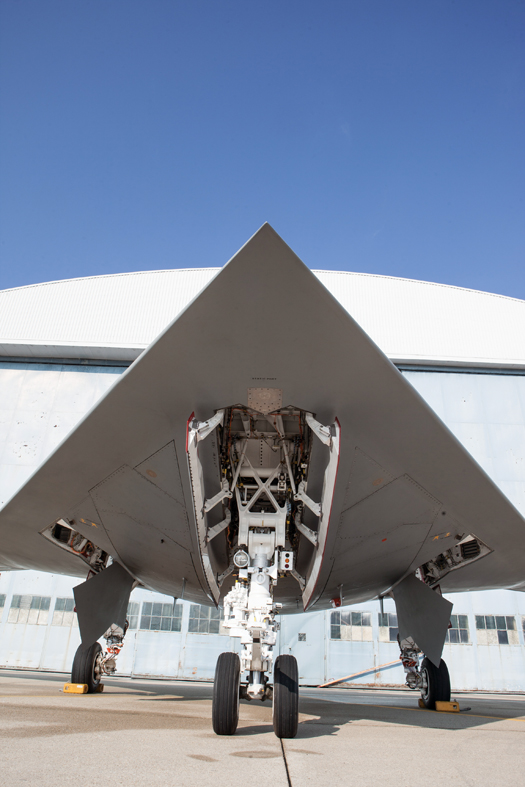
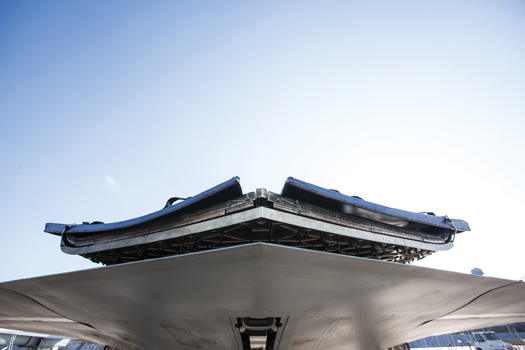
When the Navy awarded Northrop Grumman the development contract for the X-47B in 2007, it had three main requirements: The aircraft must be carrier-suitable, it should be able to evade enemy radar, and it should be autonomous, not simply automated. The team already had a stealth frame designed, a blended-wing configuration known as a cranked kite. It lacked sharp surface features that might return strong radar signatures. As they adapted it, they kept it small, just 62.1 feet across, and with wings that folded up so the finished aircraft would store easily on a hangar deck. They also managed to build in a Pratt & Whitney F100 jet engine—the same one that powers some F-15 and F-16 fighter jets—making the aircraft faster and more powerful than the propeller-driven Reaper or Predator drones.
Click here to see how the X-47B will land
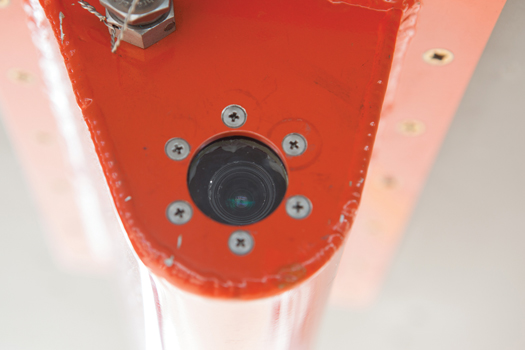
With the X-47B’s basic design in place, engineers began to develop the aircraft’s senses. They loaded it with GPS equipment, accelerometers, altimeters, gyroscopes and other classified hardware, all aimed at providing the flight-control computer with the information necessary to sustain autonomous flight. They also developed a high-speed data link capable of swapping digital information with a ground station or aircraft carrier across at least 50 nautical miles.
As one group of engineers worked on the hardware, another built a highly sophisticated autopilot system controlled by a layer of artificial intelligence. The software would translate the sensor data into decisions and commands for the flight computer. To train the X-47B, they ran its software though tens of thousands of virtual missions, pitting it against a range of simulated conditions and refining its code with every trial.
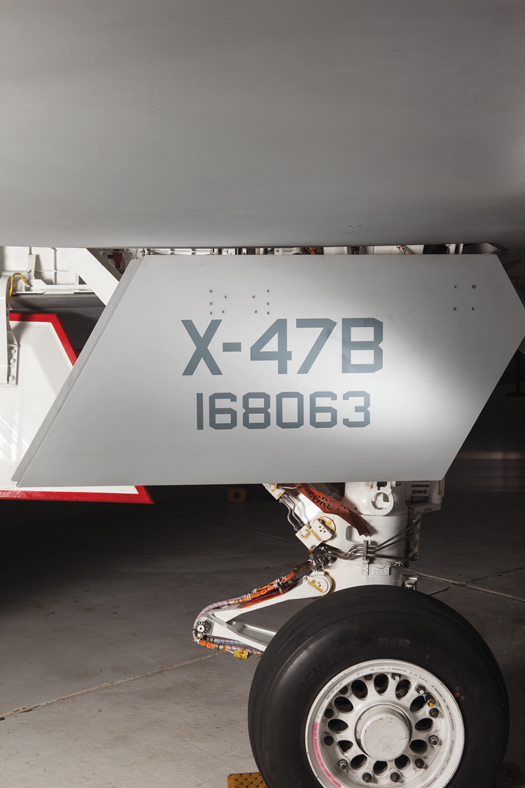
In July 2010 the team at Northrop’s manufacturing facility at Plant 42 in Palmdale, California, loaded the X-47B onto a trailer and towed it up the road to Edwards Air Force Base, where it would make its maiden flight the following February. Beneath a blanket of thin, high clouds, a mix of Northrop staff and Navy personnel watched as the craft screamed down the runway, lifted off and made a cautious 29-minute flight, circling the base at 5,000 feet while downlinking data to researchers on the ground. Engineers had planned to make 50 such flights to test the limits of the X-47B but it performed so well and so consistently, they stopped after just 16 trials. The next step was to get it ready for the carrier.
* * *
Engineers need to fold the X-47B into a fluid human system without disrupting it.When a pilot approaches an aircraft carrier, he is entering one of the most complex and least forgiving environments on Earth. Operations occur at hundreds of miles an hour, with a variable number of pilots, planes and deck personnel working on a bucking, wind-blown carrier deck. After a pilot radios his intention to land, air-traffic controllers either clear him for approach or direct him into a holding pattern. They also supply the pilot with weather and deck conditions. On the approach, the pilot typically relies on the landing signal officer (LSO) to guide him using light signals and visual cues. The air boss, an officer in the primary flight control tower, or PriFly, oversees the operation as well. Seconds before touchdown, the LSO makes a final landing determination, waving off the pilot for another try if the glide slope or course looks risky.
The process of landing planes on a carrier deck, called recovery, has not changed significantly since World War II, nor will it in the near future. The challenge, then, is how to fold the X-47B into a highly fluid human system without disrupting it. Engineers approached the problem in a few different ways. First, they automated much of the chatter that goes on between pilots and air-traffic controllers. Instead of verbally reporting fuel levels or altitude readings to air-traffic control, the aircraft beams that data directly over its link to the tower. Rather than relying on a verbal description of conditions, it downloads the carrier’s position, speed and pitch from sensors on the ship 100 times a second and adjusts its path to match.
Where direct communication between aircraft and human is unavoidable, designers translated verbal commands into a digital language. They started with the 100-plus-page carrier operations manual and boiled it down to 53 critical commands. Many involve taxi and takeoff, along with flight checks and other safety routines. Engineers then built a software interface that displays the commands. Working through the interface in the PriFly, air bosses can issue the same orders to the X-47B that they might to a pilot. The LSOs got a new tool, too. Designers updated the handheld device known as the “pickle,” which LSOs use to grant or deny final landing clearance, so that it can communicate directly with the X-47B.
The team also determined what would happen if communication were to break down. If the data link failed on approach, or the LSO waved off the X-47B from final landing, the craft would fly past the carrier and clear of other aircraft and settle into a wide loop that would bring it back around for another approach. If communication were irreparably severed, it would search for a terrestrial landing spot or, as a last resort, ditch into the ocean.
By the time the UCAS group developed the basic communication software and interfaces, the X-47B could technically have made a carrier landing. Even on a heaving carrier deck, researchers predicted, the margin of error during a landing would be within a few feet. The question was not whether the X-47B could work with people, but whether people could work with it.
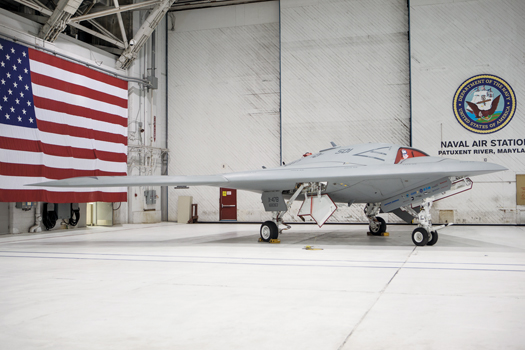
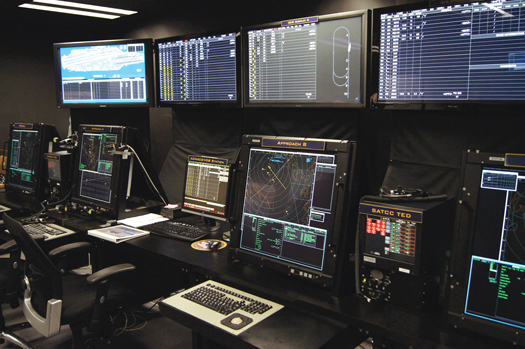
In December 2011 the Navy shipped the X-47B to Patuxent River, known as Pax River. The test facility is one of two in the world with a mock carrier deck, outfitted with a steam catapult and arresting cables. Engineers also built simulation rooms for working out software bugs and training carrier personnel. One is a replica of the air-traffic control center, complete with radar screens and communication equipment. The other is a re-creation of the PriFly, where four flat screens display the same view an air boss might see.
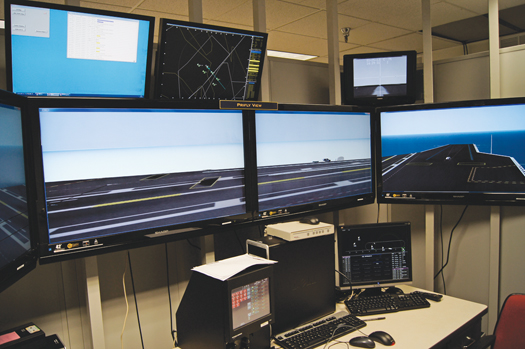
Until its first real carrier flight early next year, engineers at Pax River will run the X-47B through tests on the mock carrier deck, practicing catapults and arrested stops under a variety of conditions and with carrier personnel. At the same time, air-traffic controllers, air bosses and LSOs will run through virtual takeoff and landing scenarios in the simulation rooms, building the experience, confidence and trust that they will need for a successful operation. After completing the carrier landing, the X-47B will return to Pax River to train for the next milestone: an autonomous midflight refueling, which is scheduled for 2014.
* * *
At the moment, the X-47B program is scheduled to end sometime after its successful autonomous midflight refueling. It’s uncertain what will happen then. The Navy will not discuss plans for the prototype other than to say it will never see active duty. Each of its two weapons bays could carry a 2,000-pound bomb, but neither ever will; one is currently filled with data-gathering instruments and the other is empty. And the X-47B still has room for improvements. It cannot (yet) perceive hand signals or other visual cues, so humans need to control it directly during taxi and deck operations.
Yet even if the X-47B never develops beyond a technology demonstrator, the system that governs it could have a lasting impact on flight. Designers will almost certainly integrate something like it into future military aircraft and perhaps into commercial aircraft as well. In February Congress approved a four-year, $63-billion budget to implement the NextGen program, a plan from the Federal Aviation Administration to upgrade and digitize America’s national airspace, much as the Navy is digitizing the airspace around its aircraft carriers. In NextGen, engineers would replace radar with GPS. Planes would communicate over a data link with towers and other aircraft, both manned and unmanned (the budget includes a mandate to integrate civilian drones into the national airspace by 2015). The NextGen system could allow pilots to choose more-direct flight paths between destinations, reducing flight times and increasing efficiency.
Engineers have already proved that the X-47B’s autonomous system can pilot a conventional manned aircraft. Last summer, they plugged it into the avionics of an F/A-18 fighter jet. On July 2, the jet made 36 approaches, 16 touch-and-go landings and six full arrested landings on the USS Eisenhower. During the tests, a very trusting pilot remained in the cockpit as a precaution, but he never once touched the stick.
Clay Dillow is contributing writer at Popsci.com. His most recent story for Popular Science_, in June, was about a more efficient helicopter engine_.