
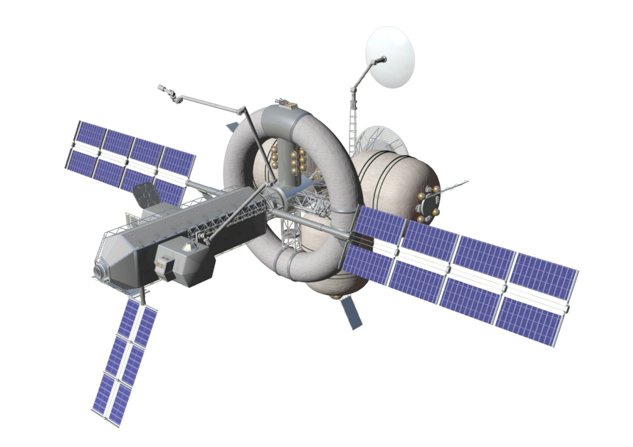
This tubular spacecraft could serve as a reusable vehicle for lunar and deep-space missions, holding a crew of six and enough supplies for a two-year expedition.
Dubbed Nautilus-X, for “Non-Atmospheric Universal Transport Intended for Lengthy United States eXploration,” this craft could be built in orbit and ready for space missions by 2020, according to a briefing by NASA’s Future In Space Operations group.
It would be assembled from expandable structures, such as the inflatable habitats proposed by Bigelow Aerospace. It would also contain a ring centrifuge to provide partial gravity, and radiation-mitigation systems that could include tanks of water or liquid hydrogen slush, reports the website HobbySpace.com.
Nautilus is a multi-mission space exploration vehicle, so it could incorporate mission-specific propulsion units, according to Edward Henderson of NASA Johnson Space Center. Theoretically, you could swap out engines and fuel depending on where you wanted to go. Such an all-purpose system would be simpler than building heavy-lift rockets for specific missions to the moon or Mars.Henderson described the system at a briefing on NASA’s Technology Applications Assessment Team, which is studying (relatively) inexpensive, quick-turnaround technologies for space exploration. Check out the PowerPoint slides here. HobbySpace has a nice roundup of the meeting, which also included a DARPA-funded geosynchronous satellite servicing project, in-situ water recovery on the Moon, a project that would demonstrate space-based solar power beams, a solar electric propulsion vehicle, and propellant depots floating in geosynchronous orbit.
Nautilus is by far the highlight, however, with pretty specific schematics and development estimates. Construction would take at least five years and require two or three rocket launches. It would cost about $3.7 billion.
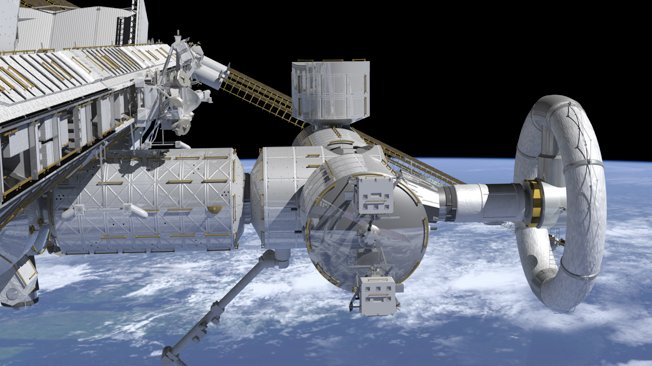
The centrifuge, which could help keep crew members healthy during a long trip, includes inflatable structures and pieces that must be launched into orbit. It would be fairly simple to test on the International Space Station — it would launch to the station on board a rocket, and if it works out, it could become living quarters for the station’s crew.
These are dreamy ideas, to be sure, especially in light of federal funding roadblocks. But the use of existing technologies like Bigelow’s modules, as well as the adaptability of a multi-purpose crew carrier, means a system like Nautilus could play a role in NASA’s future.

Five amazing, clean technologies that will set us free, in this month's energy-focused issue. Also: how to build a better bomb detector, the robotic toys that are raising your children, a human catapult, the world's smallest arcade, and much more.


Online Content Director: Suzanne LaBarre | Email
Senior Editor: Paul Adams | Email
Associate Editor: Dan Nosowitz | Email
Assistant Editor: Colin Lecher | Email
Assistant Editor: Rose Pastore | Email
Contributing Writers:
Rebecca Boyle | Email
Kelsey D. Atherton | Email
Francie Diep | Email
Shaunacy Ferro | Email
Something tells me that the name did not come before the acronym...
@DirtySquirties - I think that DARPA and others do that all the time
If the government doesn't build it then maybe a private corporation could. With specifics like "at least five years and require two or three rocket launches", interchangeable propulsion units, and a $3.7 billion price tag I would say that this would be doable if a consortium got together to build it. 2020 sure seems plausible for a target date if they started taking it seriously soon.
fantastic ideal, entirely possible to construct, but there are too many people that would have to be involved with separate space agendas for this to happen yet. besides, i dont buy their proposal for radiation shielding as adequate. +1 for innovation and forward thinking though
@10jacobf Why would NASA want to not use it or if they don't why would someone want to because that means something is really wrong with it.
@kokofan50 - It's not that. It's just that with NASA for sure to not get any new money of any kind and with manned space travel ruled out by the government for the foreseeable future, the only people left to do it at all is the private sector. That is, unless China gets it first (but I digress).
Personally, I think that this ship has all the nuts and bolts to be a workhorse of the future. But I just don't think NASA has the money or will power to do it right now. Besides, those Bigelow inflatables are a big piece of the ship's design, and that's from one private company right there. That's why I suspect that other companies could design the rest. Nothing against the design or NASA - just thinking numbers here.
@10jacobf I understand what you are saying but I disagree with you saying NASA has no will they just don't have a goal.
Strangely, this is similar to one of the sketches in my "If I ran [black]" notebook-except my sketch has a heat shield in order to aerobrake on the return trip to Earth. The heat shield also doubles as a radiation shield. I'm a mechanical engineer not a materials engineer so I have no idea if that is a good idea or not.
In my non rocket scientist opinion any serious interplanetary vehicle is going to need centrifuge gravity simulator. We need to test such systems in orbit before launching into the deep to see how the human body reacts. This test beed will likely have to not physically connected to the ISS because the vibration and angular momentum would negatively effect the type of experiments the ISS was designed for.
C. H. Olin
I WANT ONE NOW!!!!!!!!!!!!!!!!!!!!!!!!!!!!!!!!!!!!!
So, anyone have 4 billion dollars just kinda lying around?
@cholin3947
Or you could accelerate to one gee the whole way! There's something wrong with that idea.. hmmmmm...
Oh well! *explodes upon reentry*
Accelerating at 1 g is science fiction for now, but the idea is that you could do that halfway out, then turn the ship around and reverse the process.
Beside the point, though - on topic, that's a gorgeous ship (a real *ship* ship! A space ... ship!) and it'll be a crime if it's never built. That's how we need to do things this century....
I like it. I'll take two.
i wonder if they would look into plating it with dragonskin armor, or some kind of liner for the inflatable part like they use in self-sealing fuel tanks in aircraft, or both...
i would also like to know what kind of potential these have for being able to dock with one another and become one larger ship that can travel while connected, and become a space station when in orbit. this would allow for specialty modules (they will be highly modular, won't they?) that would allow for a sort of convoy. say you want to send a mars mission. you could send one giant ship made up of a bunch of these docked together, and when you get there, specialty modules would separate into separate orbits, perform their functions, regroup to share data, then depart for Earth. also, maybe there should be a larger engine module, that either stores extra fuel and replacement parts, etc., but also might have larger engines for the occasional extra "oomph" you *might* need to leave orbit.
@dirtysquirties
actually, i believe just the opposite. how likely do you think it is that they created a name for it, decided to represent it with an acronym, and took the first letter of almost every word in a title that makes somewhat less sense than SWORDS, randomly decided to not take the first letter of one word(instead taking the second, because it's an x not an e, and x is much cooler sounding than e), and finally came up with... wait. that's a really cool acronym! how did that happen?!?
@lord elliot the...
yeah, i think iv'e got an extra... oh, wait. i spent that on my new 10-petaflop desktop. you should see it calculate the last digit of pi! because its just so useful to say i can calculate a trillion more than you can! why do we even need to know that many digits, anyway? also, 1g is a measure of constant force applied to an object over time.not a constant speed, but a constant acceleration.
I have always wondered about these manned spacecraft designs that involve centrifuges. It seems a simpler and more reliable design would be to build your spacecraft in the shape of a tuna can and then spin the entire craft to create artificial gravity. You could orient the craft so that the solar panels still face the sun even when they spin with the rest of ship. Of course you still have the problems of making sure your communication and sensor packages remain pointed in the right direction, and I don't know how you would attach your propulsion unit if you wanted to travel at some oblique angle relative to the sun.
Another issue with the centrifuge is that in space you have nothing to hold the rest of your spacecraft steady against the reaction force once you start rotating the centrifuge. You either have to expend expensive fuel using stabilizer jets, or you have to have some powerful control-moment gyroscopes. I know the gyroscopes on the ISS can keep its orientation stable (when they are working), but counteracting the force of a big centrifuge is a whole 'nother ball game.
We as humans always think symmetrically, why not move the solar arrays from a perpendicular to a parallel with the main body of the ship and make them large enough to protect the entire ship? I am assuming that the flight path will be mainly perpendicular to the solar radiation. That way the solar arrays would act to absorb some of the solar radiation and still power the ship. They may need to be able to rotate depending on the flight path of the vessel or maybe not, just rotate the position of the ship. It would be flying "upside-down" in space but would simplify the design and lower the weight. No need to worry about air resistance. Someone smarter than me may even be able to use the design as a solar sail and lower the overall fuel usage at least for the trip there. A similiar concept would be like using an umbrella in a rain storm except the rain is solar radiation, the umbrella the solar array and you are the ship.
@HBillyRufus
Two centrifuges. One at each end to counteract the the other. Angular moment = 0
Problem solved
I think the main problem isn't the physics or the technical challenges, but rather the fact that the artificial gravity is meant for people. We have to remember that the Coriolis effect will interact with the inner ear in any such spinning space station, causing dizziness, disorientation, and nausea. In order to avoid that in people, you pretty much have to keep the spinning at less than 2 RPM, but preferably less.
Let's see how big (radius in m) this thing has to be to spin at 2 RPM and provide 1g.
R = 9.81g/((pi X rpm/30)^2)
R = 9.81*1/((3.14 X 2/30)^2)
R = 224m, which is a diameter of about 450m (almost 1500 feet)
That is a pretty massive structure to be building in space with a LOT of forces that need to be kept in check.
What if you only wanted partial gravity? Say a very small amount, 0.25g? Then you're still looking at a structure at least 350 feet across.
Unless you want your astronauts to be constantly puking, these types of structures have to be pretty massive, thus pretty expensive, and technically challenging.
How does this compare to the current ISS?
Using V=2pi^2Rr^2 to calculate the pressurized volume of the small ring (known as a torus) in the second scenario above (0.25g at 2 rpm), and assuming you have a 3m interior diameter to pressurize, the entire ring/torus, if pressurized, would total roughly 9400 cubic meters. How does that compare to the ISS? The ISS currenly has about 837 cubic meters of pressurized space. Which means that for just 0.25g at 2 RPM, you'll need a structure with more than 11 times the internal size of the ISS.
And if you were ambitious and wanted 1g at 2rmp, your intermal pressurized space jumps to almost 40,000 cubic meters, or almost 50 times the current ISS. Now granted, you don't have to enclose or pressurize the entire ring, but you do have to balance it out such that it has an opposing force on the other side.
Maybe what would be more practical is to have instead of a ring, 2 modules opposite each other, 450 meters apart, connected to the center. That would entail much less material, construction, etc, but still provide 2 separate artificial gravity environments. Still a technical and economic challenge, certainly, but much more doable while keeping astronauts from puking all the time.
WE all know that all that the effects on the inner ear would cause problems while standing up in such a small centrifuge would throw a person off.
Their feet would be experiencing a much different force of g than his head.
Astronauts live in space for close to a year and return to recover.
This just eliminates the recovery aspect.
If they spend their 'nights' sleeping in the centrifuge, their whole body will experience the same amount of g force.
SWEET though. Its about time. I think that private space firms will do it first though.. GO US! and Canada..
"federal funding roadblocks"
This is the problem with any advancement of our species. Stupid politicians who are more concerned with the next election cycle than our advancement. Move it all to the private sector and keep shortsighted politicians away from it entirely!
Don't take life to seriously! You'll never get out of it alive.
-Elbert Hubbard
It will be amazing if NASA's first manned deep-space explorer could be powered by nuclear fusion.
tinyurl.com/nuclear-fusion-starship
They need to also put an VASIMR system on board, a few drop pods, and make all of those expandable sections rotate.