
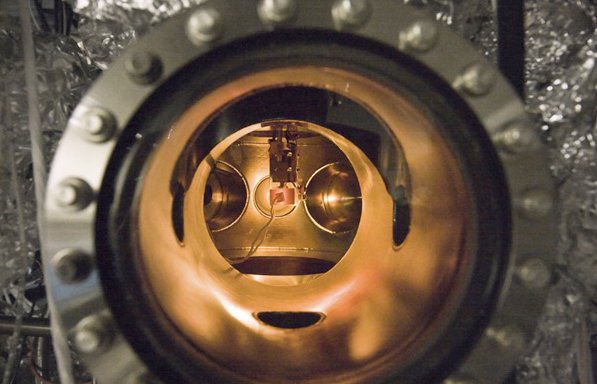
Though the sun offers us a couple options for exploiting its energy -- light and heat -- we've always had to choose to use one at a time, because solar-energy technology hasn't been able to capture both typs of radiation simultaneously. Stanford researchers say that's about to change, however. Their new breakthrough could put solar power on par with oil, price-wise.
Using readily available materials, a team of engineers has come up with the first solar technology to combine photovoltaic and thermal electricity generation.
Called "photon enhanced thermionic emission," or PETE, the process uses cesium to more than double existing systems' efficiency levels. PETE devices could be easily incorporated into existing solar collection systems, and they're cheap to boot.
Photovoltaic (PV) cells get less efficient as they get hot, which is one of the biggest problems in solar efficiency. What's worse, silicon -- used in most PV cells -- can only absorb energy from certain parts of the light spectrum. Ultimately, more than half the solar energy hitting each cell is wasted.
The Stanford system exploits the excess heat, turning it into extra electricity.Researchers led by Nick Melosh, an associate professor of materials science and engineering, coated a piece of semiconducting material with a thin layer of cesium. This allowed the cell to use both light and heat to generate electricity, Melosh says.
The team used gallium nitride in the tests because it can withstand high temperatures, but PETE systems of the future would likely include gallium arsenide, commonly used in household electronics.
The system has to get extremely hot in order to work -- the hotter the better, Melosh says -- so new PETE systems will be a better fit for huge solar farms than rooftop arrays. They will need to include solar concentrators, but that creates another layer of efficiency, because less semiconducting material will be needed. Melosh says each device would require about a six-inch wafer of semiconducting material.
When used with the heat-conversion process, PETE devices could reach 60 percent efficiency, Melosh says. But as Stanford's news release points out, even 30 percent efficiency would bring solar power in line with the price of oil.
This video from Stanford further explains the process.

Five amazing, clean technologies that will set us free, in this month's energy-focused issue. Also: how to build a better bomb detector, the robotic toys that are raising your children, a human catapult, the world's smallest arcade, and much more.


Online Content Director: Suzanne LaBarre | Email
Senior Editor: Paul Adams | Email
Associate Editor: Dan Nosowitz | Email
Assistant Editor: Colin Lecher | Email
Assistant Editor: Rose Pastore | Email
Contributing Writers:
Kelsey D. Atherton | Email
Francie Diep | Email
Shaunacy Ferro | Email
Interesting, interesting. Has some potential? Sure. Will it happen? Probably not. Dont get me wrong, I do like to hear about the progress of solar cell technology and this is good to hear but I do not like how the constraints are not mentioned in this article. Are the materials cheap? What are some operational costs? You get my point. All in all, it has to do with the economics these days, rather than the beneficial global impact.
-Suffer, learn and change.
could we get these put onto those big giant wind turbines? that way they can actually be really competitive against fossil fuels! and not only that we could probably put them on the fields below the wind turbines and get even more done! hooray!
What about combining this with the idea to embed durable photovoltaics in roads? The extra heat collected by the roads then could be put to use.
Well, why not build into rail lines? There are millions of miles of rail lines in America. They don't get the wear and tear that roads do. The trains run on the rails not on the areas between the rails. Coat them with solar cells!
It matters not if or when any of this comes to actually exist in a form we may benefit from. The powers that be will not ever allow us to be independent from their grasp. Current dependence on oil is to their advantage so until we vote out all incumbents and at some point in time gain some tiny control over the congress and the white house(notice no capitalization of them...they do not warrant respect) we can expect to whine like a dry bearing forever. We as a nation are either too lazy to vote or too apathetic to care until it rubs us raw. I can name four inventions of the last 7 years that have vanished....at least from the media. The media, ha what a damned bad joke.........Either vote 'em out or shut up whining. No reason for optimism here.
I know it is easy to be skeptical about new technologies but I feel like this one has a strong chance to succeed because it is being marketed as an ad on. I feel like most people are inherently put out by having to get rid of infrastructure they already have. In this case, this piece of technology is simply and upgrade and America loves upgrades! THe battle towards solar energy dominance needs to be viewed as a team potato sack race. The advancements in technology all have a leg in each others success and need to cross the finish line together to truly succeed. So this new PETE system coupled with a new breakthrough in solar cell technology such as this one seen in the video link below, which is not only flexible and cheap but 10,000 times more efficient than our solar standard, could be our green energy future.
http://www.ndep.us/Its-a-Small-World
@two:
Vote with your own money and do the research and then invest in the solar technology that works for you. Do not wait for "the powers that be" to do it for you.
I have been researching and taking classes in solar technologies for several years and built a solar heating system with 3 solar hot air panels that have reduced my heating oil consumption by over 400 gallons per year. This past winter was the third year that they have been working for me and the savings payoff has surpassed their $3000 cost. From here on out it is like getting at least 400 gallons of heating oil free each year.
Solar Hot Water is another technology that is worth the $4,000 - $6,000 investment with a 5 to 7 year savings payback.
Granted, solar electricity is still too expensive for many people, but the price is steadily declining. It will probably be another 4 or 5 years to make it really attractive for home owners to invest in Solar Electricity.
Line the inside of a fusion reactor with these...
What the hell? Cesium isn't cheap nor abundant and only recently has Gallium Nitride become economical to produce (ONE company found a way to synthesize macro-scale crystals). Also, unless that Cesium is sheltered from water at the molecular level, none of this technology is going to be waterproof. -__-
That being said, this is a pretty remarkable concept. It wasn't too long ago that nanomaterials were developed to convert thermal energy into electrical energy and combining these two concepts is a HUGE stride towards a renewable energy future. :)
This might be a great way to couple energy out of our nuclear reactors besides boiling water and turning turbines.
I wonder if the Carnot engine efficiency applies to a heat sink / gamma radiant collector.
The only problem might be the cesium / gallium activation at high radiation levels.
This would be a great used fuel energy collector.
no price is a high price when mere availability is at stake. All new technologies in the beginning look costly, dangerous etc and only in usage they have become over time safe and affordable. So called non conventional energy would be conventional one day, too sooner than anticipated
Chaolin-- Cesium is more abundant than tin & tungtsen; all of which are used freely in manufacturing. As the article said, gallium nitride is being used ONLY for the testing, gallium arsenide would be the production level component; it is used in infrared LEDs and other moderately common applications. Cesium costs about $30 per gram, which is fairly pricey, but less than gold, which we use for a number of industrial processes. True, cesium is highly reactive with water, however, when combined with other elements, such as copper, it is not soluble in water.
We need to see how this process can be switched to production before coming to any conclusions about its feasibility or profitability. It may be expensive to produce, however, it may well not be once a procedure is developed. At 30% to 60% efficiency it may well be economically competitive. If silicon solar cells are competitive in some applications, then these would be cost effective even at several times silicon cells, simply due to higher efficiency.
As this is an industrial type of application, due to the need for a concentrator and high temperature, environmental protection for the cesium would be easier. Also, due to the concentrator, relatively small amounts would be necessary. As noted in the article, a six inch disk would be effective, so comparatively small amounts of cesium would be needed.
Whether this pans out or not is more a matter of how it can be ramped up to production, than the process itself, it appears.
Great News Stanford !!!! Now comes the hard Part. Swear to Me you will Patent this and Exploit it to it's further reaches and Make Stanford Quadzillions of $$$ Dollars for the University Endowment. Oh and 1 more thing... Promise me you will NOT sell the Rights/Designs/Patents ETC... to The Energy Companies whom would like to Place Said Drawings/Technology into a big File Cabinet to be Conveniently "Forgotten" So they May Continue to Burn Fuels and COAL as they currently are.
PLEASE Prove Me Wrong and get this technology into the Hands and on the Roofs of the PUBLIC. !!!!!!!
Assuming it works, is the technology funded by grant money and, if so, does that mean that private patents won't drive the price up to a level that's not economically feasible. I think the invention fall under the ownership of the public domain if financed by grants, though not sure of the details.
Wow, thats amazing, Those dudes are pretty slick arent they?
Lou
www.remain-anonymous.at.tc
until efficiency reachs to the greater of 70% all bets are off that this is feasable and beneficiary to the world....i do like the fact that we have institues looking into various ways to produce insignificant amounts of power when compared to consumption. get on with the stupid races i want to see a finished product....and the weinner is Nuclear.
You can buy 40% efficient solar today.
"Their new breakthrough could put solar power on par with oil, price-wise." So solar power is about to get expensive as shit too? Are we gonna start fighting wars over solar power? lol
@ Dan Jenkins: My mistake, I was not aware that such alloys were inert with water. And yes, while Cesium is more common than about half the metals on the periodic table, the scale of materials needed for such a solar infrastructure would outstrip the rate at which Cesium is obtained. Then again, you could be right and the actual amount of Cesium could be much less than anticipated. Regardless, I just hope this research gets applied in the future.
"30 percent efficiency would bring solar power in line with the price of oil"
This just in, sun light keeps pouring into the nation's grid and no one can stop its flow. Thousands of fossil fuel workers are out of business and seeking finiacial aid.
@ender7718: Oil is ridiculously cheap when you consider the amount of energy produced compared to the price we pay for it. The following analogy is taken from www.chrismartenson.com/crashcourse/chapter-17a-peak-oil :
"And how much ‘work’ is embodied in a gallon of gasoline, our most favorite substance of them all? Well, if you put a single gallon in a car, drove it until it ran out, and then turned around and pushed the car home, you’d find out. It turns out that a gallon of gas has the equivalent energy of 500 hours of hard human labor, or 12-1/2 forty-hour work weeks.
So how much is a gallon of gas worth? $4? $10? If you wanted to pay this poor man $15 an hour to push your car home, then we might value a gallon of gas at $7,500."
I think you can make the assumption that this advance will make solar power a competitive alternative to oil.
Its interesting to hear peoples comments. Energy costs have increased so much over the years and yet people cant see whats happening. They are obsessed with oil as an energy source. I work in the energy conservation field designing ultra effecient homes, hvac, appliances etc and incorporate solar and wind projects in my jobs. When your electric bill goes to several hundred dollars a month,, will you say,,, we really need this ??? or will you say,,,it wont work.
Very interesting. The brightest point in its favour is the spread between the efficiency that can be achieved (60%) with that necessary to be price competitive with oil (30%). If that is really the case, we may be able to get off our petroleum addiction sooner than expected.
A promising development for large scale solar installations, but not the one I am most hoping to see work out. I mean, I will be happy if it works ... but ...
Idaho National Labs made a major step forward in capturing electromagnetic waves in the infrared spectrum and converting them to electrical energy. They did this by advancing antenna theory into nano engineered structures and by finding ways to cheaply produce millions of nano-scale antennas on an inexpensive and flexible substrate.
The remaining problem will take time to solve, and a number of labs are working on it. The issue is converting the Tera Hertz AC voltages from these nano-scale antennas into DC to charge batteries, or into 60 Hertz AC. No one has yet come up with a rectifier that is cheap and efficient at those frequencies.
When they do make that break trough in rectifier technology we will suddenly have a very high efficiency "Solar Panel" that works day or night. The reasons are simple enough - the Sun emits far more electromagnetic energy in the IR spectrum than it does in the visible light spectrum.
But of course it is not all about the Sun. Any heated object emits some of its energy as EM waves, or "Radiant Heat". The Earth does this all night long, releasing the heat gained during the day. So flip the panels over at night and you are still gaining energy from them.
Or use them to capture radiant heat from engines of all types.
They have the solution to capturing the energy with antennas, if they can find the solution to converting it into DC we will have an instant energy revolution on our hands.
I figure the last problems should be worked out sometime between lunchtime yesterday and a hundred years from now.
The suspense is killing me.
One point that seems to be underestimated is that this technology works best as the temperature rises. With any given rate of conversion of light to electricity, an increase in light might be expected to give an increase in electricity. So it would appear that using mirrors to concentrate additional light on a given solar cell should increase electricity. But of course the reflected sun light includes reflected heat which decreases the efficiency of the whole setup. The greatest benefit for small solar systems may not be the ability to convert heat to electricity but the ability to concentrate more light onto a smaller, less expensive, solar cell.