

We may earn revenue from the products available on this page and participate in affiliate programs. Learn more ›
Good audio products make you want to listen. Good consumer electronics companies make you feel you’re listened to. When designing the latest version of its flagship true wireless earbuds, Sony obviously heard user feedback and, much as the Japanese icon did with the 2025 redesign of the WH-1000XM6 headphones, it addressed pain points. A less awkward shape. Check. A less glossy, fingerprint-friendly finish. Check. More powerful processors for even more effective adaptive noise cancellation and audio customization. Check. Bose and Apple stole all the attention last year, but the WF-1000XM6 earbuds bring Sony back to the top of the ANC earbuds conversation.

The design
The blob is out. The bean is in. To me, the WF-1000XM5 (shown below, bottom left) was more polished river stone, whereas the WF-1000XM6 is matte pebble. The WF-1000XM5 was slippery, whereas the WF-1000XM6 has a soft, grippier texture. Tucking comfortably into the concha, it’s an ergonomic improvement in Black (above) or Platinum Silver (the rest of the images). One caveat: sleep earbuds these are not, so stay upright when you’re listening or you might wake up with an earache.


The wireless charging case, however, trades curves for edges. It’s less organic, more like a block from a child’s Shape Sorter, and it feels like it takes up more pocket space despite being roughly the same size as its predecessor. The upside is Sony’s usual practicality: battery life of 8 hours per charge, up to 24 with case.
Despite being 11% slimmer, the WF-1000XM6 packs in more microphones (four on each earbud, up from three), bone conduction sensors to improve calls/voice isolation, enhanced Bluetooth 5.3 radios (with LC3, Auracast, and Multipoint support), and next-gen. Q3Ne HD Noise Canceling Processors, plus the 32-bit Integrated Processor V2 first found in the WH-1000XM6 travel-optimized headphones.
The sound
A new driver design sits at the heart of the WF-1000XM6. While it’s still an 8.4mm dynamic transducer, a new “soft edge” surround helps it produce a deeper bass response, while the rigid dome achieves cleaner treble. It’s a distortion-reducing, resolution-improving combo, evident whether paired to a FiiO M27 DAP via LDAC or an iPhone 16 Pro via AAC. While the up to 24-bit/96kHz LDAC codec is undeniably superior in expression (but rarer in execution), even AAC exhibits a smooth, warm, but clear character. Much like with the WH-1000XM6 headphones, Sony seems to be pulling back on adding too much stank to the stock tuning. The WF-1000XM6 house sound leans fun, but still prioritizes texture and separation over mid-bass bloom or exciting but fatiguing treble.
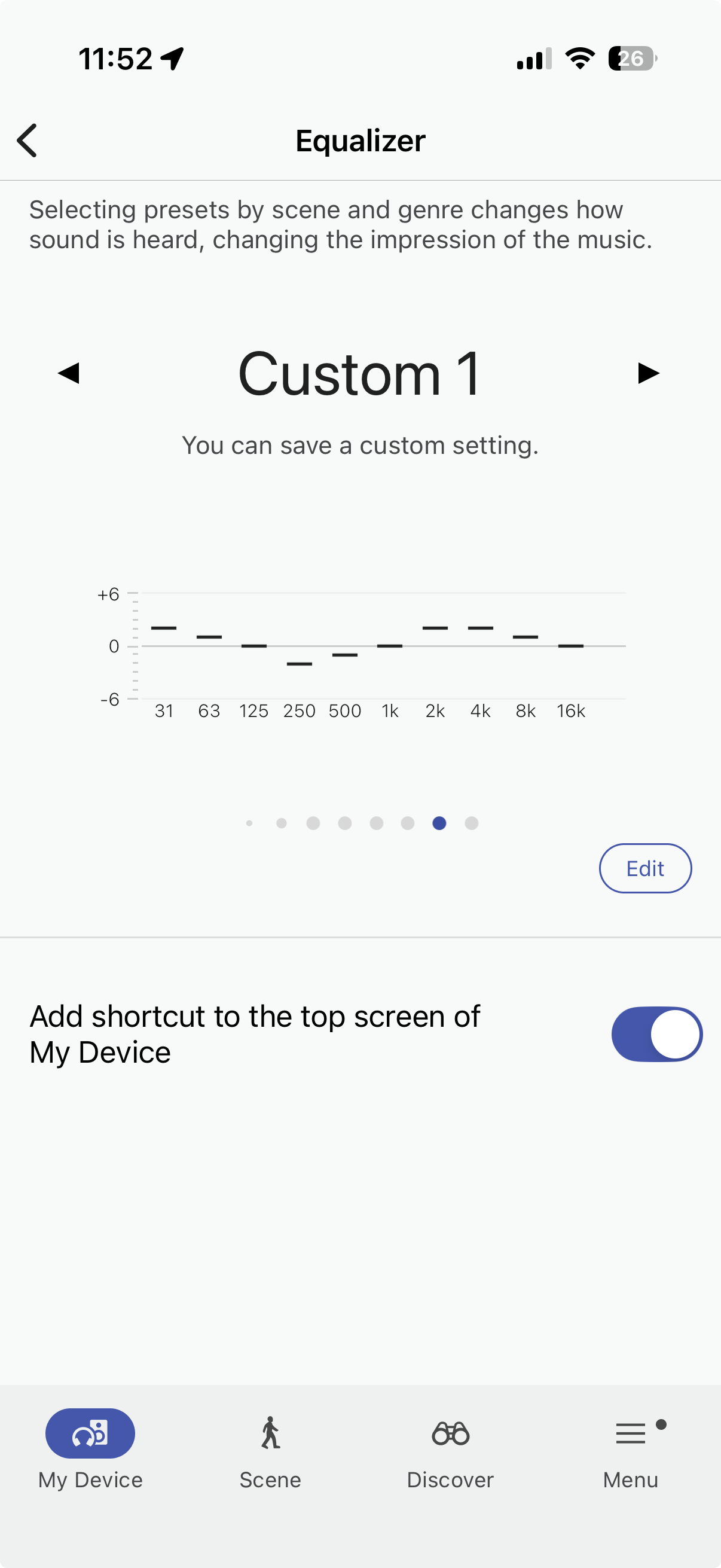
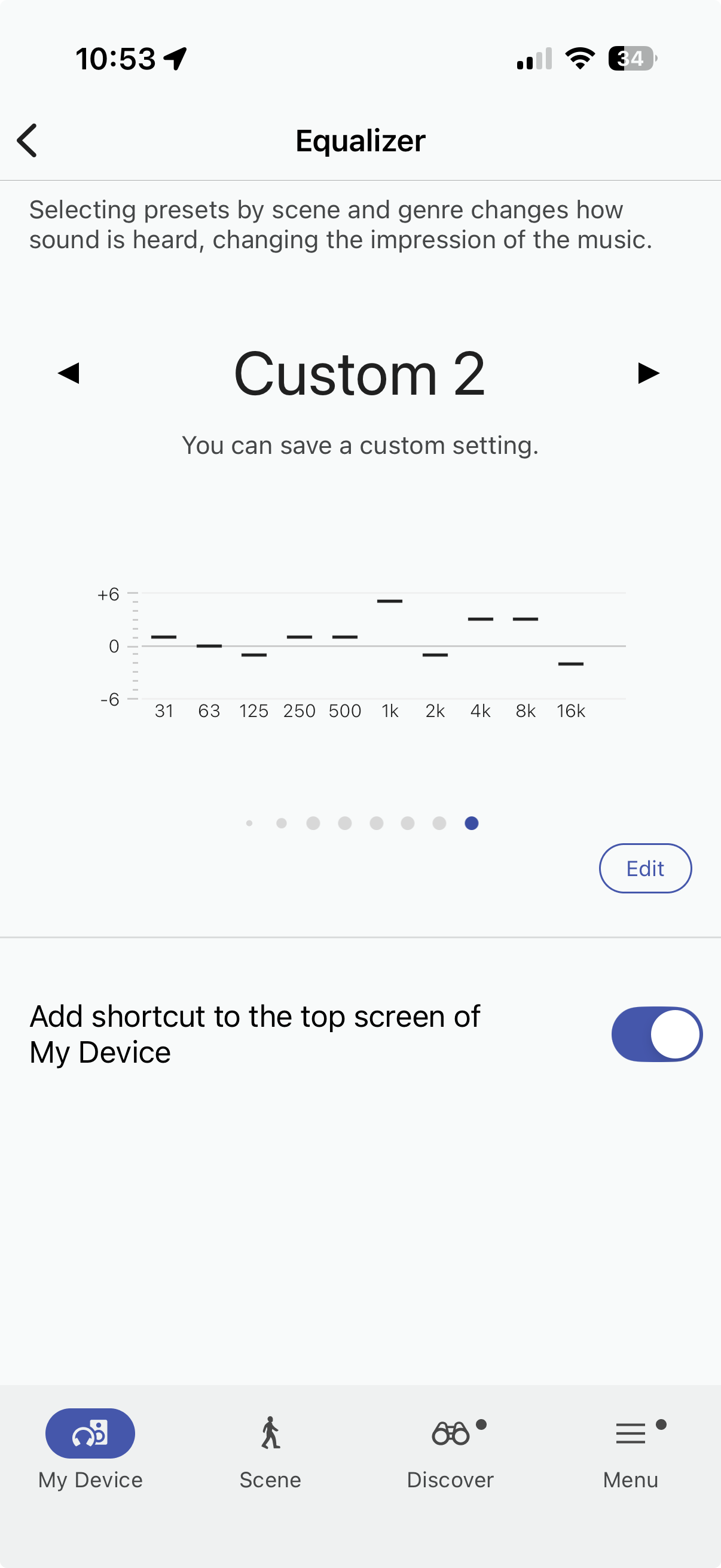
Like things more incisive? You’re in luck. The WF-1000XM6 now supports a 10-band (±6dB) EQ through the Sony Sound Connect app, so you can sculpt curves that suit your preferred vibe(s) and genre(s). That’s two to three times the bands that most of Sony’s direct competitors let you tweak. Personally, I found EQ really gave the WF-1000XM6 life, so I’ve shared two custom presets below. I really like the tight but not boxy Custom 1 with metal tracks, and the more mids-forward/sparkly Custom 2 with indie/pop—basically anything that needs more vocal intelligibility. YMMV. (Adaptive and Scene-Based Listening, as well as 360 Reality Audio, are modes we still need to explore following a firmware update.)
Making sure all this truth comes through is the ANC, now 25% stronger, according to Sony. And where the earbuds truly shine (or is that truly dull) is in steady low-frequency energy reduction. When it comes to airplane noise attenuation, the high-bass/low-mid range surrounding 100 – 200 Hz, the WF-1000XM6 is noticeably more effective with rumble than the previous model. And when it comes to chatter and clatter, the mids/treble band spanning 300 Hz – 3 kHz, voices were similarly pushed back. On a flight from DC to LA, conversations never intruded on my thoughts … or, at the best of times, my lack thereof. That ANC, combined with EQ, ensures all the cues and coos of your music are intact.
Where Sony lets itself (and by proxy us) down is in eartip shape and selection. Included are four sizes of silicone/memory foam hybrid marshmallows, which, for me, were somewhat finicky for something whose seal ANC hinges on. Once I got them settled, though, they were tight even in transit (your ears may only require a simple twist). Using some third-party pure-silicone tips proved more comfortable, even if not quite as effective at cutting out stray syllables. Plus, you have to consider whether replacement tips have mesh in the sound tube to keep earwax from getting in the earbuds. With their oval-shaped mushroom tips, Bose and Apple have the upper hand in absolute fit and perceived isolation.

The conclusion
The ANC TWS earbuds market is super-saturated, with options that appeal to any and every price point and sonic flavor. We’ll reach for Bowers & Wilkins and Technics, for instance, when in a certain mood. Yet the battle of the all-around best really boils down to Apple, Bose, and Sony. And the victor … depends on what you prioritize.
For pure comfort, it’s still the Bose QC Ultra (Gen. 2) for me, then Apple AirPods Pro 3, though the WF-1000XM6 has made strides in the right direction. Picking Bose or Apple, however, locks you into their tunings, which have more of a sub bass emphasis and tilt more mainstream appeal than balanced. So, sonically (especially if you are cool with EQ), the WF-1000XM6 is the standout choice. Conversely, Apple is the best choice for someone with an iPhone/iPad/Mac that just wants to listen with the least amount of friction (and enjoys Dolby Atmos Spatial Audio). As for ANC effectiveness, all three are within a few percentage points of each other, so the real differentiator there is what works best with your ear anatomy. Hush the world, though, and Sony’s WF-1000XM6 earbuds are the top pick when you want to really hear what you’re listening to.
The Sony WF-1000XM6 true wireless ANC earbuds are available to order for $329.99.
