
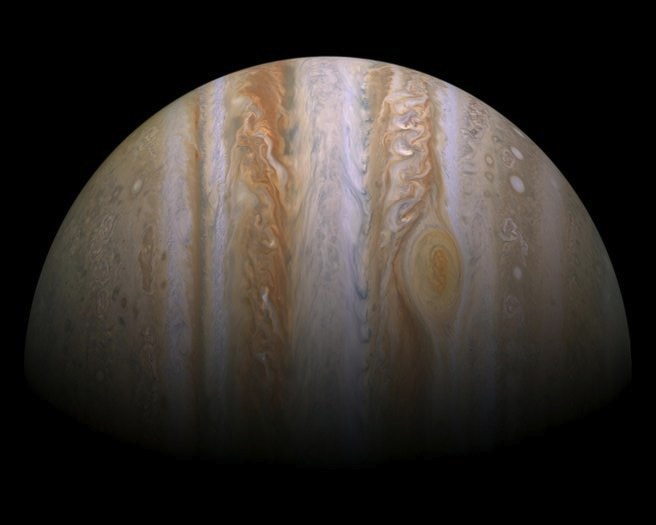
Despite its gusty reputation as a “gas giant,” Jupiter’s blood-red clouds hide a dense, rocky core that’s perhaps 20 times as massive as Earth. That core blocks any spacecraft’s passage through the center of the planet, but even a detour through the clouds would be a disaster.
Knowledge of Jupiter’s innards is scarce, mostly coming from the Galileo probe, which in 1995 plunged 100 miles into the Jovian atmosphere and relayed data until it vaporized an hour later. But here’s what we know: First, any spacecraft would need to make it through Jupiter’s instrument-scrambling radiation belts, the harshest of which extend 200,000 miles from the planet. Then it would face winds of up to 230 mph tearing across the surface of the planet’s turbulent hydrogen-cloud atmosphere and, if it survived those, gusts of nearly 400 mph starting about 28 miles into the atmosphere. In the first 100 miles, temperatures run to around 306°F, and scientists suspect that it’s up to 50,000° closer to the core. The atmosphere likely ripped apart the 1.2-mile-wide Shoemaker-Levy 9 comet when it hit Jupiter back in 1994. Just saying.
Some 9,000 miles farther in, sandwiched between the atmosphere and the hot, rocky core, the interior most likely consists of liquid metallic hydrogen. The highly conductive fluid can exist only under space-shuttle-crushing conditions like the planet’s 44 million pounds per square inch of pressure.
Five amazing, clean technologies that will set us free, in this month's energy-focused issue. Also: how to build a better bomb detector, the robotic toys that are raising your children, a human catapult, the world's smallest arcade, and much more.


Online Content Director: Suzanne LaBarre | Email
Senior Editor: Paul Adams | Email
Associate Editor: Dan Nosowitz | Email
Assistant Editor: Colin Lecher | Email
Assistant Editor: Rose Pastore | Email
Contributing Writers:
Rebecca Boyle | Email
Kelsey D. Atherton | Email
Francie Diep | Email
Shaunacy Ferro | Email
I am not mathematically inclined enough to crunch the numbers of how fast the vehicle would need to be travelling, or how close to the edge of the atmosphere it would need to fly, so that it would not be stuck in tight orbit on the inside of the planet. That's if it survives the trip to Jupiter, and can be built to withstand the outrageous conditions that exist there.
He who says it cannot be done, should not interrupt the one who is doing it.
And may I ask you "Who might be doing it?"
That would be anyone about to do something spectacular/unbelievable. Like climbing Everest, by Sir Edmund Hillary and Tenzing Norgay in 1953.
-He who says it cannot be done, should not interrupt the one who is doing it.-
Read "Tau Zero", by Poul Anderson. It's about a crew of a Bussard Ramjet spaceship that loses the ability to slow down. It continuously accelerates, reaching very high relativistic numbers (low 'tau'). As its effective mass increases, it needs more fuel, faster, so begins zipping through stars, including the cores.
So Jupiter would have been a breeze.
Hey, Brian H, I thought ramjets were only good till Mach 3.5.
Hey. I bet i can kick my soccer ball right through. Way cheaper than trying to do that with spacecraft
What about going to titan first?
Sorry guys, but ramjets (and subsequently scramjets for super/hypersonic) require air as the working fluid of the engine. Not feasible for travel outside the atmosphere which unfortunately would be required to cut through planets and stars.
When we develop netrino shielding then we can zip right through. OR maybe use a neutronium alloy. This is really slick stuff nothing will stick to it.
It's impossible for a spacecraft to fly through Jupiter clouds or even its rings. They are too dense.
dordor77@netvision.net.il
you would just get stuck.
One Question. WHY Would we want to fly through this???
You are forgetting Unobtanium from "The Core". It gets stronger under pressure, and turns heat into electricity. So why not! Even though it's a joke.
-He who says it cannot be done, should not interrupt the one who is doing it.-
"Bussard Ramjet spaceship"
It uses magnetic fields to absorb/collect gases from space. faster=more fuel.
I've never read the book though, might look it up.
I am going to have to read this piece of Sci-Fi.
-He who says it cannot be done, should not interrupt the one who is doing it.-
You can do it but you might lose your spacecraft while doing so. dordor77@netvision.net.il
While you ponder that, neutrino's could do it with ease, billions of neutrinos pass through your body every second without hitting anything. There's a good chance that most all of them will pass through the earth without hitting anything.
so, we just need a neutrino emitter and a splashscreen to register on. just a sec, think I got one in the crawlspace...
Was it an Arthur C Clark novell that speculated the core of Jupiter could be a solid diamond ? Any takers ?
Or you could just create a wormhole to bend time and space through Jupiter.
Perhaps something like tornado chasers use would work, a swarm of small inter communicating satelites, shot through the center of the giant red spot or through magnetic poles of the planet. Also it might work, if they could somehow use buoyancy and slow down the probe. They could send submarines under the deepest ocean, why not into Jupiter's atmosphere?
the gravity on Jupiter is so great that anyone crazy enough to go down there is gonna get crushed
Lets just get to Mars..
I flew right through Jupiter AND it's rings the last space trip i took with Mork!
Let's just build a giant tunnel of Dyson rings and move the gases somewhere else =P
hershko - Ummm...several spacecraft have flown through the very minute rings of Jupiter AND the massive rings of Saturn...just gotta do it carefully because they're mostly made up of dust and ice. I refer to the Voyager and Pioneer spacecraft, just to name the more well-known ones.
wowlfie - You say nothing in Nature can withstand those temps or pressures, but I put forth that the core of Jupiter has been doing just that for the past 4.6 billion years...or is the core of Jupiter man-made? Maybe I was dozing during that section of science class in high school? lol Either way, IF you could make a ship that was densely packed enough, and put a very small (compaired to the rest of the ship) hollow center in it, then that could withstand the temps and pressures. Of course, a big enough ship to do this would desentigrate, anyway, along with Jupiter as soon as the two massive bodies (the ship and the rocky core of Jupiter) came into contact with each other at pretty much any speed.
John.Mills - I believe it was Neptune (maybe Uranus, but pretty sure it was Neptune) that Clark referred to as possibly having a core of solid diamond. I thought it funny that everyone was thinking of becoming rich from it, all except one guy, that is. He had the idea of using it to make a space elevator. Problem with that is, even though diamond is the hardest substance known, it's pretty brittle and I don't think it could withstand the stresses put on it without some major reinforcement. What's also funny is, if he could make a space elevator out of the diamond, he would become FAR richer than the others who wouldn't make hardly a dime after they suddenly flooded the market with more diamonds than any other substance. After all, that's one of the few things that makes diamonds (and just about anything else, for that matter) so valuable - its rarity.
IF, and this is a big IF with today's or even the near future's technology, we could create an Einstein-Rosen-Podolsky bridge (commonly known as a wormhole) and aim it through Jupiter, then there ya go...problem solved. Of course, you'd go through it literally instantaniously and so you wouldn't see anything of the interior of Jupiter, even if it wasn't disrupted by the distortion of space-time that the bridge would probably cause. Best to just simulate a trip through on a computer...we've got enough of an idea of what it might look like if we were discorporal and traveled through it to be able to make a simulation.
"Imagination is the strongest tool, weapon, and defense the human race has or ever will have. For with it we can accomplish the impossible." - Me
What about some sort of super high speed "bullet"? Shoot it at Jupiter and have it record data as it impacts...
I dont know but that is my redneck scientist side thinking out loud.
Note to the author: Galileo didn't launch into Jupiter's atmosphere to disintegrate in 1995. It REACHED Jupiter in 1995 after having launched from Earth in 1989. It orbited Jupiter until 2003, when it was sent into Jupiter's atmosphere at the end of its mission, effectively destroying it.
Why are these other planets here..let alone, the other universes..there has to be more forms of life..if not, what's the purpose..especially the ones that are impossoble to intrude..why are they here..there has to be a reason..or maybe there is no reason..idk..just thinkin.
Can the PopSci authors please start using the universal language of science, that is metric units? Very few countries still use Farenheight, miles etc. Certainly, almost all technicians, engineers and scientists wolrdwide have discarded the old imperials long ago. And to say that it may be more familiar to the US public is somewhat meaningless when talking in numbers like 50,000°F.
NASA: "If you think in pounds and miles instead of kilograms and kilometers, you're in the minority. Only the United States, Liberia, and Burma still primarily use English units".
The confusion that can arise from using mixed units was highlighted by the loss of the Mars Climate Orbiter robotic probe in 1999, which occurred because a contractor provided thruster firing data in English units while NASA was using metric.
Note to BugSoup:
When they refer to "the Galileo probe" what they are actually referring to is "Galileo's probe," a probe that broke off from the main craft, penetrated Jupiter's outer atmosphere and relayed data through Galileo back home to us.
This probe separated from the Galileo main craft in 1995 6 months or so before reaching Jupiter, used its entry to Jupiter's atmosphere to slow it down and then popped a chute which allowed it to loiter at altitude and get carried by the wind.
Unlike the Huygens probe which rode to Saturn connected to the main Cassini probe, the atmosphere probe from Galileo didn't have a separate name, IIRC.
Thus, popsci did about as well as it could, save forgetting the 's, to accurately state what happened and how we got the data. Don't criticize them for that...or if you do, just do the grammar nerd thing and peg them on the possessive.
I'm sure that there's probably articles about the probe out there. I only know a little b/c I have a friend who builds mars probes @ JPL (one after the next for 15 years, interesting job, really). Someone else has to know a lot more than me.
...
@RealyQ: I'm with you. Every time popsci uses English units, I cringe a bit. Still, it isn't really a science magazine. It's a "pop" magazine and the popular culture they sell to uses English units all the time. They probably won't change until the federal US gov't changes over.
Which will be awhile.
--)->
The series by Arthur C. Clark that you are thinking of is the 20** series, where, I beleave in the 2012 book, the monoliths ignited Jupiter, turning it into a small sun. In the explosion, the planet's core was ejected, and it crashed on Jupiter's moons. There, it was discovered to have been a earth sized chunck of diamond. As for the space bridge, I think that might have either been a later book, or different series by him, where they used artificial diamond fibers to the bridge from space into constructed bases, so they could be used like an elevator.
