
Narwhal (Monodon monoceros) tusks may not really be magical, but they do have some mathematical magic. Their tusk is actually made up of two spirals (or helices) instead of one. The tusk’s outer structure twists to the left, while the interior twists in the opposite direction.
“The really special part is that these helices always have the same handedness—similar to if all [people] only had left hands,” Henrik Birkedal, a chemist at Aarhus University in Denmark, tells Popular Science. “This is, to the best of our knowledge, unique.”
Birkedal is a co-author of a study detailing the discovery published today in the journal Nature Communications.

What do narwhals have tusks?
While the narwhal tusks are technically one long tooth, they are very different from our teeth. Instead of enamel, or the tough outer part of human teeth, they have a material called dentin on the inside of their tusk. A thin layer of a material called cementum is on the outside of their tusk.
“In humans, this connects (cements) the tooth in the mandible,” Birkedal explains.
Tusks can grow over six-feet long, and there is still debate about their use. Most believe that they work as a sexual signal since most, but not all, males have them. They have also been spotted playing, foraging, and getting into other non-sexual fun with their tusks.
Some scientists have suggested that the tusk may be a way that these whales detect temperature, salinity, and chemical changes in the water or for fighting. However, evidence is lacking. It is also likely not a hunting tool, since it would make sense for females to have tusks as well.
Narwhals are also the only animals with tusks that usually have one instead of two, but some male narwhals have been known to develop two. It is also the only animal with a straight tusk instead of a curved one.

Small structures, big machines
Researchers have long known that the narwhal tusk’s left-handed shape must occur because of a particular organization of the mineralized collagen fibrils that give the tooth its strength. How these dental building blocks were organized remained a mystery, since it was impossible to map it out in three dimensions.
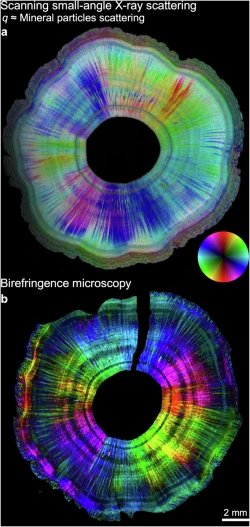
For this study, the team combined several X-ray imaging techniques, particularly a special 3D X-ray technique called tensor tomography. It works by sending powerful X-rays through the tooth and then analyzing how they scatter from the nanoscale (or one billionth of a meter) mineralized collagen fibrils in the tusk.
Because of the narwhal tusk’s large size and extremely complex structure,, the team needed to use the biggest technological tools available. They used several particle accelerator X-ray sources from three source—the MAX IV in Sweden, the Swiss Light Source in Switzerland, and European Synchrotron Radiation Facility (ESRF) in France. These enormous tools were the only way that they could obtain enough resolution and power to map out the tusk’s entire interior in three dimensions at the atomic, nano, and micro scale.
“No one has previously carried out such an advanced experiment of this type,” Adrian Rodriguez-Palomo, a study co-author, said in a statement. “We have only been able to do it by collaborating across several disciplines—namely chemistry, physics, materials science and biology. Without collaboration with the biologists at the Greenland Institute of Natural Resources, we would not have been able to interpret the results.” Rodriguez-Palomo was a PhD student at Chalmers University of Technology in Sweden, when he joined the project, and continued his study as a postdoctoral researcher at Aarhus University.
They found that while the tusk’s building blocks are primarily oriented along the length of the tusk, they systematically break off at small angles. This creates a twisted structure. In the cementum portion, the tusk’s fibrils form a left-handed spiral, while in the inner dentin part the tooth forms a right-handed spiral.
The two opposing structures meet at the transition point between dentin and cementum. The team says that this complex biological boundary appears even more intricate than previously believed.
Double spiral
The tusk’s double-spiral structure gives the tusk better mechanical properties. It makes the tusks more stable against bending and twisting than a single spiral or a straight rod.
The team also found that the double-spiral structure is preserved in the tusk’s annual growth layers. These are similar to tree rings and can be used to assess a narwhal’s age. The double-spiral structure also has a constant twist, which suggests that the left-handed growth pattern is genetic and remains stable throughout the animal’s life. Narwhals can live up to 80 years.
In addition to solving this natural science mystery, it provides insight into how nature builds advanced materials with extreme mechanical properties. It could help materials scientists design new materials in construction and medicine.
And like any good study, it ends with several questions to keep investigating.
“We are now working on understanding the annual growth layer patterns in the tusk with the hope that they can allow us to ‘map’ the life history of a narwhal through its tusk and thereby gain insights into living conditions for the whales in the arctic,” says Birkedal. “Additionally, we are hoping to be able to investigate the place in the skull where the tusk grows to understand its formation better.”