
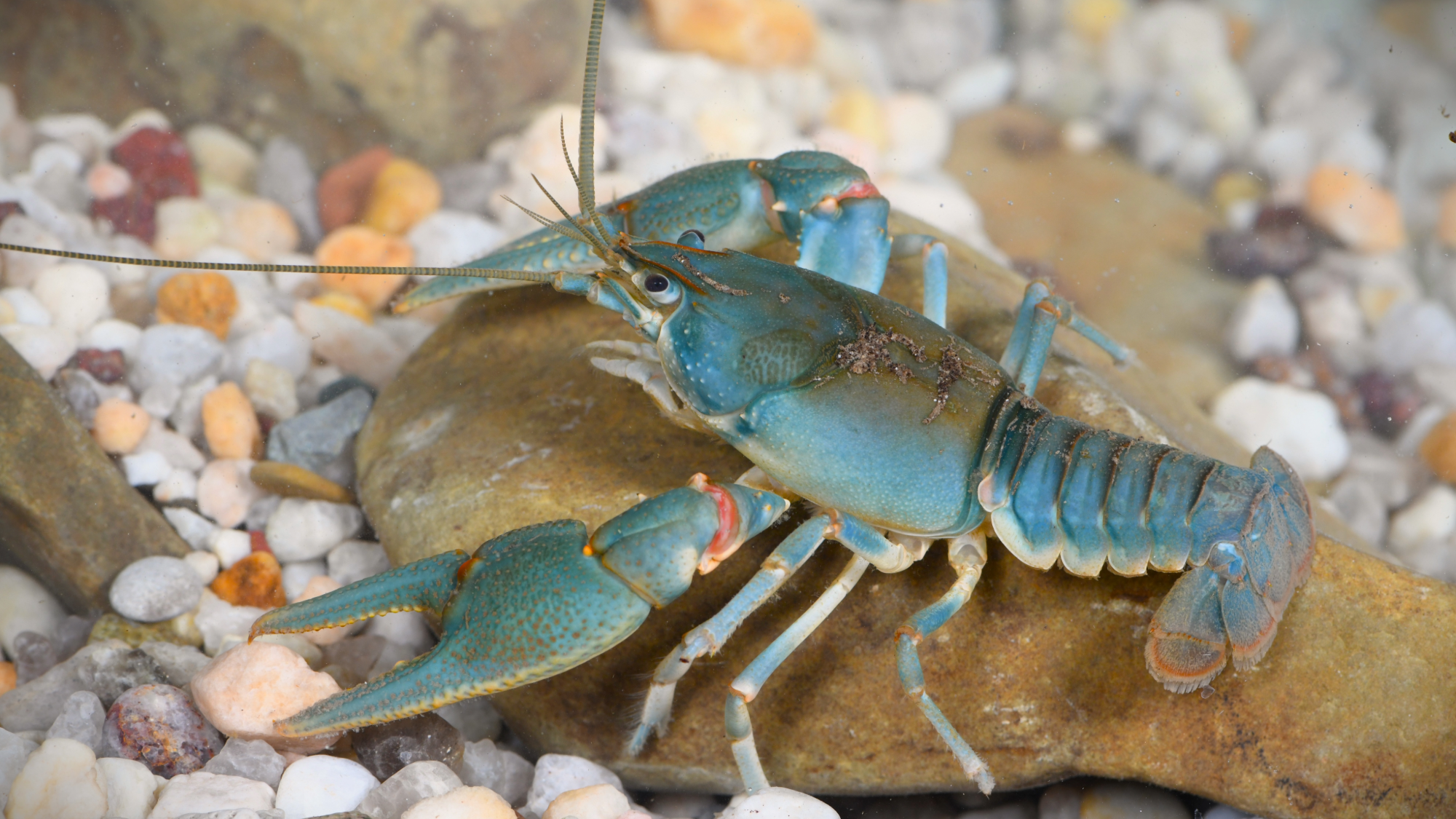
This back to school season, U.S. Fish and Wildlife Service (FWS) biologists are testing out a backpack of their own. But this one doesn’t carry notebooks and pens. It tracks crayfish movements and survival.
The trial is part of the FWS’ efforts to boost the populations of the Big Sandy crayfish (Cambarus callainus), a freshwater crustacean that lives in the rivers and streams of Appalachia. Since 2016, these four-inch long creatures have been considered a federally threatened species as water pollution and habitat loss have shrunk their range.
That’s why the White Sulphur Springs National Fish Hatchery in West Virginia is trying to propagate this rare species with the help of the West Virginia Ecological Services Field Office. The hatchery raises crayfish for one or two months, putting about a year’s growth into them in that time. Then, they’re released into their habitat in the fall.
“At that point, we need to be able to track them,” Andrew Phipps, a fish biologist at the hatchery, tells Popular Science. “We need to build on that, to go back to the creek, and say, hey, these little guys lived, or they didn’t live.”
Tiny fish, big river
Right now, Phipps and his colleagues use visible implant elastomer (VIE) tagging to mark the fish. They inject a colored tag under the crayfish’ pleon (a fancy way to say its tail region), which lets them know that a specimen is from the hatchery. “But it doesn’t give us an individual ID,” Phipps explains.
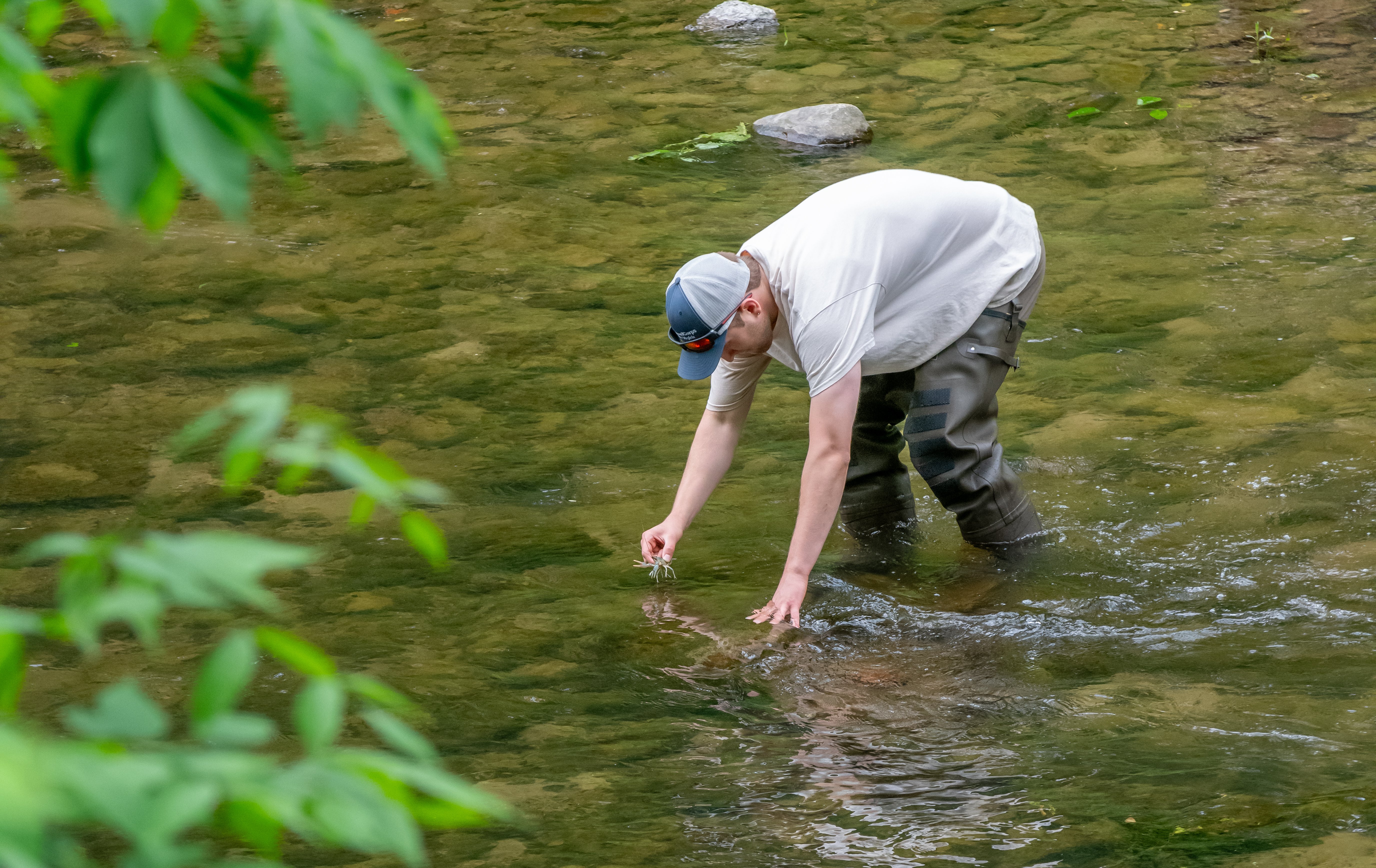
Phipps and his colleagues typically release nearly 300 animals with these tags, which also makes tracking them down a painstaking process. They have to go out in the crayfish habitats and keep sampling until they find one, a difficult task given that the crayfish are small and the river is not.
So, FWS biologists are developing a new tagging protocol for their Big Sandy crayfish. Other options, like the VI Alpha tag, allow researchers to individually identify specimens, but the crayfish would have to be a lot bigger. “If you put it in and they’re too small, it’ll kill them,” Phipps says.
Holding the crayfish over winter for them to reach the right size for the tag, however, is too much of a risk. “We’re looking for a happy medium,” Phipps explains—something safe for 25 millimeter crayfish.
A backpack built of superglue
That’s where the “backpacks” come in. They encase a Passive Integrated Transponder (PIT) tag, a tiny, batter-free microchip with a unique code that’s activated when scanned, since injecting it into the tiny crayfish would be too dangerous. And the key to attaching the tag onto the crayfish?
“We basically superglue that thing on there,” Phipps says.
First, regular superglue attaches the tag on the back of the crayfish. This glue is then covered in another type of more flexible superglue, and finally, the team squirts baking soda water on it to help the backpack system set more quickly.
The tagging system was first trialled in a common surrogate crayfish species, Faxonius sanbornii, to make sure it was safe. “We didn’t want to do a test on a listed species,” Phipps notes.
Biologists ran a two-and-a-half week study where they tagged 40 of the crayfish and left 40 untagged. They found that the superglue kept the tags in place without harming the creatures, and the animals still molted normally. Yes, the crayfish will molt and their tags will fall off. That’s actually a good thing.
“The purpose of the study isn’t to assess the long-term survival of these animals,” Phipps explains. It’s to make sure the released crayfish are surviving that first month after release—a dropped tag means the crayfish made it long enough to molt.
The data won’t be lost, because FWS can use their PIT tag readers to find them. “If you go out there with the reader, the tag’s gonna holler out to you, like ‘I’m over here! I’m over here!’” Phipps says. “Then we just go dig around in the dirt on the bottom of the river until we find the tag.”
The next step is to use the tag on Big Sandy crayfish this fall. “That’s when we’re gonna get the real data,” Phipps says.
