
And by 2020, the solar industry will have completely "paid back" the energy it took to produce the world's panels.

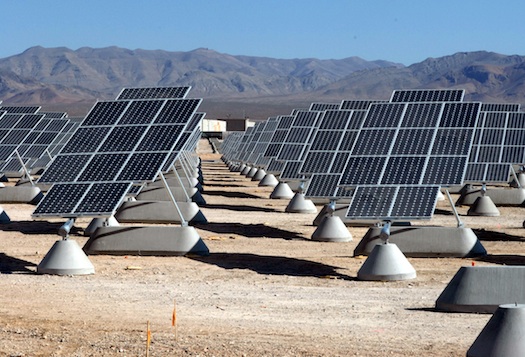
Mobile solar panels at the Nellis Air Force Base in Nevada
Mobile solar panels at the Nellis Air Force Base in Nevada Nellis AFB

Solar panels make energy, but they take energy to make, too. And, until about 2010 or so, the solar panel industry used more electricity than it produced, according to a new analysis. Now, the industry is set to "pay back" the energy it used by 2020.

The study looked at what went into building and installing solar panels all over the world, including everything from home installations to solar farms, says Michael Dale, a climate and energy researcher at Stanford University, in a Stanford-produced video. He and a senior scientist, Sally Benson, thought that because the solar panel industry was growing so quickly, it might actually be using more electricity than it produced. Instead, they found an industry at a crux.

"I think that this paper shows that actually the industry is making positive strides and it's even in spite of its fantastically fast growth rates, it's still producing, or it's just about to start producing, a net energy benefit to society," Dale said.

Most solar panels manufacturers now consume lots of electricity, usually pulled from coal or other fossil fuel-burning plants. Stanford News pointed to the example of melting silica rock to obtain the silicon used in most panels. The melting requires electricity to fire ovens to a temperature of about 3,000 degrees Fahrenheit.

Solar panels' energy balance is now tipping, however, because newer technologies reduce that electricity consumption. For example, some newer panels require less silicon, or waste less material in the manufacturing process. Researchers are also looking to replace silicon with more abundant affordable elements, such as copper, zinc, tin and carbon.

Dale and Benson published their full analysis in the journal Environmental Science & Technology.

[Stanford News via the Verge]

22 Comments

That is great news.

It's weird that it works like that.
A lot of businesses work that way too. The first three years, they are only breaking even or may be making below what they need to, then they make a profit later on.

This is lovely good news in deed!

Now if each home and business could be solar energy producing independent, would bring more freedom to all and a cleaner environment and yes create more jobs to maintain the solar producing equipment.

lanredneck

from Northfield, Vt

@aerosphere, learning curce, and economy of scale! Capatlism at its finest......

Call me crazy but why dont they crank out a bunch of solar panels to power the solar panel factory?

I do approve of course for solar power, and at the same time wish to protect the environment.

Here is an old article, (interesting enough using the same solar panel picture above ), writing about the effect of solar power on the environment:

www.motherjones.com/environment/2011/03/solar-panels-desert-tortoise-mojave

use the sun as long as it shins ^^

---
No facts, No response...

I thought Nellis AFB was in Nevada, not Arizona.

Nellis AFB is 8 miles from Las Vegas.

armymustang_67,
Yup, yup,

Nellis Air Force Base
4475 England Ave, Nellis AFB, NV

So... this is basically an admission that most solar panels made up until this point have been detrimental for the environment and a waste of money? Okay then.

Don't get me wrong. Solar power is abundant, and if we can efficiently tap it then there are areas like the US South West that get lots of sun and can make use of solar power. But to improve solar panels, you need research; not volume of production. Volume of production is just to increase profit for research investment money. If you're not actually making a profit... you're just scaling up the pace of wasting money.

If solar panels weren't yet efficient enough to - forget being competitive - but actually being energy-positive at all... then why the hell were companies being encouraged to make them, and us to buy them? Utter waste of money and resources.

Why not refuse to subsidize solar panels that are net-negative, and instead use the money that they wasted encouraging others to fund more material science research?

A lot of us were screaming "Stop subsidizing solar panel production. It's bad for the planet by your own standards, and bad for the economy and tax payers by ours." And now the admission is that we were right.

Thanks for letting us know. Hope you guys learn something. I doubt it though.

brian144,
You thoughts might apply to the support of batteries and electric cars or hybrid cars, perhaps subsidizing other companies as well. Yes, this point of view is food for thought.

Still, I think for all the money that is dumped into 'fusion-money pit' was put into more hopeful solar panels is still the way to go!

brian144,

your post confuses me. Everyone knew that solar panels were not gernerating more power than was used to create them. And yes, it was bad for the planet. This was all common knowledge.

But now, as the article states, all the "dirty" energy used to create the panels is about to break even. Very soon, solar panals will be producing more energy than all of the dirty energy used to create them.

This is how all technology works. The first computers were massive, used too much energy, were extremely expensive, and could only do simple calculations that you could do faster in your head.

I'm sure you wish someone was smart enough to stop computers before they wasted too much energy and money on them!

Didn't have time to read the full report. Is the point to show net energy payback within one year as other reports I have read indicate PV recoups its energy costs within at most 4 years.

http://www.nrel.gov/docs/fy04osti/35489.pdf

http://www.resilience.org/stories/2006-06-16/energy-payback-roof-mounted-photovoltaic-cells

armymustang_67, you're right! I've fixed the photo name. Thanks for the comment.

Is this a science magazine? How about getting some simple facts straight. I particularly liked:

"Researchers are also looking to replace silicon with more abundant elements, such as copper, zinc, tin and carbon."

Excuse me, but if you add up all the copper, zinc, tin, and carbon in the earth's crust you will find that there is about 450 times MORE silicon (by weight) than those four other elements combined!

Lets looks at the facts. Here are the percentages for the earth's crust and the percentages of those elements by mass:

silicon 27.7%
carbon 0.048%
copper 0.005%
zinc 0.0075%
tin 0.00022%

You might be able to make solar panels cheaper with those four other elements but they are NOT more abundant!

Ya correct me if I am wrong but upon skimming the report as well as a couple other reports I think this article is somewhat misleading. First, according the all three sources I reviewed I think the title is flat out wrong as on an individual basis panels have been producing more electricity than they needed to be made for years. What I think the study was saying was that the industry as a whole was a net consumer for years and now it is close to breaking even from all of the past years with negative net energy.

Since we have not one shred of any claimed facts, we can only assume that the panels may at some near time produce more electricity than it took to create them. That still has not addressed true life cycles of the products, effects of rain, hail and such. Still has no mention of storage and inverters used. Not one note of effect of total installed costs or side benefits of panels placed on roofs. Pretty sure replacing a roof would consume more money if one had to remove the panels. The so called claim of 20 year shingles are only in some very limited regions and under steep roofs. Most homes in warm climates won't have roofs lasting much more than 15 years. Unlikely you'd have a new roof and panels at the same time. More roofs would have leaks, more interior leaks and mold.

Guess the authors are trying to get a government grant.

Anyone pay attention to the last few solar companies that took tax dollars and went bankrupt?

I've heard it said that it takes more energy to make solar cells than they make. That's a lie. In theory, a solar cell could last forever. That's an infinite amount of time to collect energy. Infinity times any amount of energy the cell produces, is more than it took to make. Certainly, they would not last forever, but they can last a long time.

Another thought. The energy it took to make and install the solar cells is not free. It's built into the cost of the cells. So, once the cells has made enough energy to equal it's cost, then obviously the cell has produced more energy than it took to make. Otherwise, everyone involved would be going broke.

Yes they can last a very long time many panels have a 25 year warrenty and some panels that are over 35 years old still produce 80% of their originalout put.

The part that ages is not the cells themselves but the ecapsulation material.

PV solar cells may last for 25 years, but their performance starts to degrade in just a couple years. Commercial PV solar cells will lose 50% of their performance within a decade.

If you leave your solar panel running in your garage, no one will die. Some benefits to health and the environment are just a better trade off. We need to do a lot more development towards solar power.

Besides another product produces on the side, is JOBS. It takes more people to maintain solar panels, associated power supply systems and power storage systems. These type of jobs are technical in nature and pay better, thereby giving more people a higher level of money and yes medical benefits. And these benefits also apply to wind and hydroelectric power as well.

Solar, wind and hydroelectric systems do not pollute and are not cancer causing and create jobs with medical benefits!


140 years of Popular Science at your fingertips.


Popular Science+ For iPad

Each issue has been completely reimagined for your iPad. See our amazing new vision for magazines that goes far beyond the printed page


Download Our App

Stay up to date on the latest news of the future of science and technology from your iPhone or Android phone with full articles, images and offline viewing


Follow Us On Twitter

Featuring every article from the magazine and website, plus links from around the Web. Also see our PopSci DIY feed


April 2013: How It Works

For our annual How It Works issue, we break down everything from the massive Falcon Heavy rocket to a tiny DNA sequencer that connects to a USB port. We also take a look at an ambitious plan for faster-than-light travel and dive into the billion-dollar science of dog food.

Plus the latest Legos, Cadillac's plug-in hybrid, a tractor built for the apocalypse, and more.


Online Content Director: Suzanne LaBarre | Email
Senior Editor: Paul Adams | Email
Associate Editor: Dan Nosowitz | Email
Assistant Editor: Colin Lecher | Email
Assistant Editor:Rose Pastore | Email

Contributing Writers:
Rebecca Boyle | Email
Kelsey D. Atherton | Email
Francie Diep | Email
Shaunacy Ferro | Email

circ-top-header.gif
circ-cover.gif
bmxmag-ps