This post has been updated. It was originally published on January 23, 2013.
Do a YouTube search for pretty much any smallish animal you can think of and there’ll be several videos of a “tame” or “pet” version. Any feline, any canid, any mustelid (weasel), any procyonid (raccoon), any non-bonkers primate (baboons, which are completely terrifying, are exempt). “Look at my pet kinkajou, my pet genet, my pet fennec fox, my pet ocelot.” And then on the videos of cute furry animals in the wild, you’ll see the comments: “OMG I want it.” When the internet sees a video of a red panda, the internet wants a red panda. Even though a red panda is endangered and a wild animal.
In 1959, a Soviet geneticist named Dmitry K. Belyaev began somewhat secretively experimenting with breeding domesticated foxes. More than five decades, thousands of foxes, and one collapse of the Soviet Union later, the program continues at The Institute of Cytology and Genetics at Novosibirsk, Siberia. Belyaev wanted to unlock the secrets of domestication, the links between behavior and breeding and physical traits, but plenty of non-scientists are aware of the project for a different reason: foxes are adorable, and we want to hug them, and we want them to like it.
But domesticated foxes, which can only be found at that Siberian facility, are not horrible pets. They’re a little unconventional, and they require a little bit of extra attention, but if you want a pet fox, you can have a pet fox. All you need is $8,000 and the approval of Kay Fedewa, the exclusive importer of domesticated foxes in the US.
What is a domesticated fox?
Domestication is not like taming. You can tame many wild animals so they won’t try to kill you, by raising them from birth, but that’s just learned behavior; that animal is unlikely to exhibit what we know as affection toward you, and the behavior it does have is not passed down to the tamed animal’s offspring. Domestication is actually change at the genetic level: an animal repeatedly breeds, either through intentional human effort or not (or a combination of the two), to emphasize certain behavioral traits. In the case of animals that would, in the wild, be aggressive towards humans, those traits are easy to decide on: we want the most docile, least aggressive, and least skittish animal.
The Institute picked foxes on which to experiment for a few reasons. They’re canids, like dogs, so it would be easy to compare them to a domesticated species, but they’re not particularly closely related to dogs, so there’s enough separation to see how forced domestication affects a new species. Also, these foxes were already “tame”—they were picked up from fur farms in Siberia, so they had a jump-start in adjusting to humans. But theoretically, you could domesticate just about any wild animal: mink have been domesticated in Denmark, and some have proposed domestication of certain rare but cuddly animals, like red pandas, as a means to save the species.
The Soviet (and later, Russian) study out there in Siberia did eventually breed a domesticated silver fox (read: a red fox with silver fur) that’s pretty close to our dream fox. It loves and craves attention from people, it’ll lick your face, it’ll cuddle with you, it’ll wag its giant puffy tail when it sees you, it’ll play with toys in your house while you try to take the perfect Instagram picture of it. Wild foxes will not do this; they will either run away from you or attempt to bite your face off. Tame foxes may not flee or attack, but they also won’t cuddle. These domesticated foxes, on the other hand, have between 30 and 35 generations of selective breeding behind them, with careful monitoring to ensure a lack of inbreeding, and they’re not even close to wild—in fact, they probably wouldn’t survive in the wild.
After a few generations, the results began to get a little weird. The study found that though they were selectively breeding only for behavior, they began seeing new common physical traits. The animals developed different coat patterns, floppier ears, tails that curled over their backs—totally unknown in wild foxes. When we tried to breed a fox that would act more like a dog, we ended up with a fox that looked more like a dog. But they’re not as easy to acquire as a dog.

Loki the Red Fox running around the house
Where can you get a pet fox?
For a brief time, a company called SibFox was selling foxes bred at the Siberian lab. They were selling for about $6,000, but it’s not clear that anyone ever actually received one of these foxes. The Daily reported that two foxes that actually shipped to the States ended up confiscated at the US border and shipped to the Austin Zoo and Animal Sanctuary, where they are doing “wonderfully.” Apparently these foxes were kept in dog kennels, which is improper, and weren’t fed or watered properly—by all accounts, the SibFox people were not licensed and were inexperienced at importing exotic animals. The only upside is that the animals survived the journey from Russia. SibFox refunded the customers’ money, stopped responding to emails, and shut down their website. Until now, SibFox was the closest anyone in the US had gotten to receiving a domesticated fox.
Then there are breeders like Tiny Tracks Exotic Animals, located outside of Fort Wayne, Indiana, specializing in several varieties of fox (red fox, gray fox, and arctic fox) as well as supposedly tame raccoons, skunks, and coatis (a Central/South American mammal closely related to the raccoon). Want a pet arctic fox? That’ll run you $600. Red foxes are a little cheaper, at $400. That’s cheaper than a skunk ($450) and waaaay cheaper than something more exotic, like a kinkajou, which runs anywhere from $1,200 to $3,000. For comparison, a purebred Siberian husky can run you anywhere from $400 to $2,000, depending on its breeding and the reputation of the breeder.
But none of these foxes, the ones that cost a few hundred dollars, are “domesticated.” They are wild foxes. Wild foxes are not pets; they are wild animals. The word “tame” means essentially nothing here—it mostly means “nice when it’s a baby.” The foxes from Siberia are pets. Foxes from Indiana? Wild.
(Tiny Tracks repeatedly did not respond to requests for comment; Kay Fedewa described the people who run it as “not very nice people, really quite rude, even to the people they’re selling animals to.”)
[Related: How to pick the right wildlife trail camera]
Indiana is something of a promised land for exotic pet farms and owners, a libertarian wonderland where for a mere ten-dollar processing fee you can have a pet grizzly bear. Neighboring Kentucky, hardly a state you’d think would be prude about wild animals, is a fairly typical example of state laws: anything “inherently dangerous,” which includes venomous animals (snakes, lizards), huge animals (hippos, elephants), and animals that would prefer to murder you than let you pat them on the head (big cats, bears, baboons) are all outlawed. But so is any animal that has never naturally lived in Kentucky, mostly to avoid issues with invasive species. Most states simply ban any normally “wild” animal from being kept as a pet.
But not Indiana! Indiana has three classes of wild animals. Class 1 is mostly squirrels. Class 2 includes foxes, beavers, skunks, raccoons, coyotes, and weasels. Class 3 includes “venomous reptiles,” and all species of bear, big cat, and wolf. All three classes are legal! In fact, the only thing that separates Class 3 animals, which are banned pretty much everywhere else, is that a letter is sent to the hopeful leopard-owner’s neighbors. If 25 or more neighbors respond with a letter saying they are not interested in having a leopard on the block, the leopard is not allowed. Otherwise, no problem, sir. What’s your leopard’s name?
Even more insane is that Indiana provides no law preventing you from owning an endangered species. Here’s what the state document says: “Endangered species of wild animals will be considered Class I, II or III by the division director’s designee and must follow the same procedures accordingly for that class of animal.” So, basically, your local bureaucrat will decide if your pet western lowland gorilla is a Class 2 or 3 animal, then you give him a ten-spot for processing, and you’re all set, the proud owner of one of about fourteen western lowland gorillas. Maybe you can take it to see the home of former president Benjamin Harrison in the lovely Old Northside Historic District of Indianapolis.
It’s worth noting that Maine is even more lenient than Indiana; the only real law in Maine is that wild animals have to have an identification tag. Yet Mainers seem mostly uninterested in owning pet jaguarundis, at least in comparison with Hoosiers.
Foxes are only legal in a handful of states. This is a pretty good guide. In some the laws are a little flexible; in Michigan, where Fedewa lives, you can have only a native species, meaning the various colors of red fox. The grey fox, which is a totally different species more commonly found in the western and southern states, is not allowed, nor is the arctic or fennec fox. A few states simply ban taking foxes from the wild. But the laws are often vague and open to interpretation, which can lead to trouble for fox owners who may or may not be in violation.
Eric Mason currently lives in Arkansas, and is one of the most dedicated and visible fox owners on the internet. He posts dozens of videos of his pet red fox Rob (now deceased) on YouTube, and is very active on all kinds of pet fox forums. He’s also highly active on furry forums, where he posts under the name Albi Azul. His profile on FurAffinity.net says, “I live on the awesome furry and TF artwork of y’all artists here, but I have the privilege and responsibility to love and take care of my pet red fox Ron! Greetings from Mountain Home, Arkansas!” He has a mostly unused DeviantArt page and has posted many pictures of himself in a giant blue fox costume, along with trip reports from furry conventions. Exotic animal owners often end up in the furry community; the level of obsession and dedication needed to care for an unconventional pet is much higher than for a dog or cat owner, so exotic pet owners tend to make their pets a more prominent part of their lives than other pet owners. It’s also not everyone who wants an exotic so badly they’ll rearrange their lives around it; even Fedewa says these people tend to be “a little eccentric.”
Eric’s fox Ron is not domesticated, but is among the most tame I’ve ever seen. Watching videos of Ron compared to Fedewa’s fox Anya, it’s clear that Anya is more affectionate, more dog-like, less skittish and a little more easy to control and train than Ron. But Ron is still just about the best-case scenario if you’re going for a non-Siberian fox.
Eric’s compiled several lists exploring the legality of owning a pet fox in every state. I believe he at one point lived in Pennsylvania. Though the law states that foxes are illegal to own except for purposes of fur harvesting, Eric suggests talking to “Jason in the permits department” in Harrisburg because “otherwise, you will get conflicting stories.” But Eric and the breeders at Tiny Tracks are playing a very different game than Fedewa.
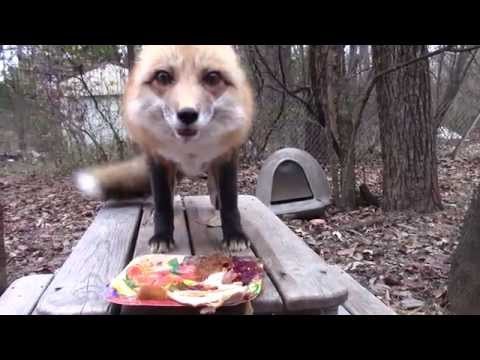
Happy Thanksgiving RonRon
Is it legal to breed foxes?
“I grew up reading Jack London and those kinds of animal stories,” says Fedewa. “And I also like comics, so I decided to combine them.” She had had an idea for a London-inspired comic about wolves while she was in middle school, and while attending the University of Michigan at Ann Arbor she self-published the comic, now called The Blackblood Alliance. It caught on with the furry community, which, says Fedewa, is why she started going to furry conventions (“furrycons”). “I’d wear a tail and ears to the furrycons,” she says. “I’m not really into that but when you’re in the cons, it’s fun, everyone’s dressed up, it’s like Halloween.”
But foxes had a special place for her. “I was always crazy about foxes,” says Fedewa. “It was the first animal I really loved, and I always wanted one as a pet.” But Fedewa, despite what I expected from a Siberian-fox-importer who writes wolf comics and attends furry conventions, is not an especially odd person. Fedewa is a 27-year-old Michigan native who works in the videogame industry, doing modeling, texturing, and user interface work for a company called Stardock. She speaks with a thick and charming Michigan accent, and talks about her love of animals with self-awareness and humor—she knows what it sounds like, investing years of her life into acquiring a rare domesticated Siberian fox, knows that it’s not something most people would do, but she’s not apologetic. “I like animals and I think it’s fun to take care of them,” she says. And it kind of is that simple. She wanted a fox! No big deal!
But she also has her own life and had no interest in attempting to wrangle one of the “tame” foxes from a place like Tiny Tracks. “I didn’t want to force myself on a wild animal that hates me, that I’m forcing to live with me,” she says. And that’s what you’ll get from a “tame” fox; there’s a huge range in personality, so you might luck out and get one that’s amenable to living with a human, like Mason’s fox Ron, but you might have one that wants nothing to do with you or even one that’s violent. Even worse, when wild/tame foxes age from juvenile to mature, they go through hormonal changes and can become extremely aggressive. (“They turn into real bastards,” says Fedewa.) That’s common to many animals; primates are well-known for this abrupt change. But a true domesticated animal doesn’t suffer this problem.
After she discovered the Siberian institute, Fedewa got curious. “I contacted the Institute last year,” she says, “and talked to them about [legally] importing one of the foxes. No one had ever done that before.” The way to do this legally is to find a licensed exotic animal importer—and she found her man in Mitch Kalmanson.
Is a domesticated fox the same as a tame fox?
“I have 34 tigers in my backyard,” Mitch Kalmanson told me, early in our phone conversation. “I picked [another] one up yesterday.” Also in his backyard, a 200-acre property just north of Orlando, Florida, are lions, cougars, leopards, a liger (a lion/tiger mix), a yak, minks, dogs, and assorted herd animals—horses, watusi (an African breed of cattle), zebu (an Indian breed of cattle), and emu. He also has three domesticated foxes.
“I have 34 tigers in my backyard.” Kalmanson is a professional exotic animal importer, licensed by the US Department of Agriculture, the Department of the Interior, and the Florida Fish and Wildlife Conservation Commission. Those different licenses cover the various jobs he has—he maintains exotic animals on his property, but he also ventures across the world to obtain animals for zoos, laboratories, private customers, and whoever else needs a herd of watusi or a couple of dolphins. He’s also a risk manager for Lloyd’s of London, the British insurance market, and insures exotic animals. He insures zoos, circuses, private facilities, labs—pretty much anyone who needs insurance on an exotic, they call Mitch. He’s also a high school dropout, though he’s since acquired a college degree and has taken many post-graduate classes. I got the sense he found traditional schooling a waste of time, an imprecise way to get where he wanted to go.
He is an off-putting person to talk to. Kay was chatty, friendly, funny; she was worried I’d paint her as a weirdo, which is the kind of thing no weirdo would ever think to say. I think Mitch Kalmanson might be a weirdo. That has absolutely no bearing on his professional aptitude, which is considerable, but makes for a curious phone conversation. Kalmanson speaks very quickly, very precisely; he does not elaborate, he does not add in anecdotes or facts or insight you didn’t ask for, and he has a very curious habit of saying his piece and then just falling silent and waiting for your next move. Most people, during interviews, if they finish answering a question and don’t immediately get a followup, will continue talking—they’ll try to fill the silence with more words, or questions, or something. Mitch does not; it was like he was reading a prepared statement and when he finished it, he was done talking. But he also knows his stuff very, very deeply. The effect of his odd conversational style is an impression of total confidence and competence.
He seemed much more comfortable talking dispassionately about his work and his facilities—when I asked for his opinion on these domesticated foxes, he hesitated, for the first and only time. “I got three at the house now,” he said. “They’re very smart, smarter than a damn dog. Unique and curious animals.” He forcefully corrected me when I referred to foxes bred by breeders like Tiny Tracks as “tame.” “They’re not tame,” he said—almost snapped, though he’s not rude, exactly. “They claim that because the babies are tame. But at 10 months, they’ll turn. That’s why they typically won’t show you any older animals.”
[Related: What does the red fox say?]
When Fedewa called him up and asked him about going to Siberia to retrieve domesticated foxes, Kalmanson did his homework, interviewed her repeatedly, and decided she was up to his standards. He stopped just short of saying “does not compute” when I asked if he liked Fedewa. “Like” is irrelevant. She was deemed an acceptable business partner. So last February, he got on a plane and flew out to Siberia. The laboratory there sold him a year-old domesticated female red fox for $3,200. The blood testing was done by a farm veterinarian out in Russia, though Mitch had to fabricate his own cage—he says a standard dog kennel isn’t up to the task of containing a fox. Then he flew back. His fee is high, between six and twelve thousand dollars, but in the future, he’ll be able to bring back up to seven domesticated fox kits at a time, which will be cheaper per fox. Fedewa plans to sell the foxes for about $8,000 each.
With Mitch’s help, Fedewa created The Domestic Fox, a project that she hopes will make yearly trips to Siberia to obtain fox kits for owners in North America and Europe. The foxes are available in several color morphs—these are all red foxes, Vulpes vulpes, but their fur can vary in color from the classic red to black to silver to white. If you contact her now, you can snag a fox born this spring, and receive it sometime in fall 2013.

Red Fox playing on the couch
Do domesticated foxes make good pets?
So what’s it like to have a domesticated fox as a pet? Not quite like a dog, says Fedewa—a fox isn’t a cool-looking dog, it’s a different animal with different behavioral quirks. “Foxes are highly intelligent,” says Fedewa, “and because of that they’re ridiculously curious.” Fedewa’s fox, Anya, is not very big—only about 10 pounds, the weight of a mid-sized cat, though with her fluffy winter fur, she appears much larger. Anya is prone to digging up potted plants and chewing on them; foxes have a much stronger digging impulse than domesticated dogs. They also need an outdoor enclosure. Fedewa’s cost a few thousand dollars to build and is filled with sand so Anya can dig. And fox urine is a major problem: Fedewa says you should “imagine cat pee, but a million times worse. It smells like skunk, it’s the most pungent thing in the universe. If it gets in your carpet, you need a special enzyme to break it down, so if your fox marks [your home], that’s pretty destructive.” Some foxes can be house-trained to use a litter box, but they will still sometime mark their environment.
Anya is also not quite as trainable as a domestic dog; she can obey some commands, but has a shorter attention span than most dogs. Going for walks is also tricky. Fedewa says Anya will walk on a leash, but doesn’t like it much—she thinks Anya feels exposed and is tense and nervous. Neighbors, too, have been a problem. Fedewa had to move once already. A neighbor called the city, who sent over investigators and told her she was not allowed to have the fox. This is not legally accurate, but the legal fees required to fight that battle outweighed Fedewa’s desire to stay put. So she moved, to a more forgiving property with about an acre of land in the southeastern corner of Michigan.
Those are minor hurdles for Fedewa, if they even are hurdles. That’s what comes with owning a fox. And in truth, those are very minor issues in the world of exotics. Anya is affectionate, which hardly any exotics are; she plays, she recognizes and craves attention from her owner. She has quirks, but she is, distinctly, a pet. Both Fedewa and Kalmanson are vocal about this distinction: exotic, non-domesticated animals are not pets, and during my interviews, both Fedewa and Kalmanson expressed disdain (mild from Fedewa, blunt from Kalmanson) for private citizens who want to make wild animals their pets. But Anya is a pet.
Why do I want a pet fox?
We as humans have a desire to make the cuter wild animals our pets, an impulse sometimes called “Bambi syndrome.” It’s a very peculiar impulse. Wanting a pet is not peculiar, of course. Stanley Coren, professor emeritus in the psychology department at the University of British Columbia and expert on the subject of the dog-human relationship, reminds us that even though city-dwellers tend to think of domesticated animals in terms of housepet companions, they’ve been incredibly important throughout human history. “Domestication did not likely begin,” he says, “because you really want a cute animal in your house.” The prevailing theory is that the domestication of the dog, for example, began as certain dogs found free discarded food around early human settlements. They bred with other dogs that could tolerate being around humans, self-selecting for tameness. Then humans found that these animals could serve a purpose, and bred them accordingly.
Domesticated animals are useful. Dogs are used for hunting, herding, and security; cats are used for pest control, horses for transportation, and a host of livestock animals (cows, sheep, goats, pigs) for food, milk, or fur. But for a large percentage of the first world, that kind of usefulness is mostly a bonus now, in our pursuit of owning a sentient warm cute furry thing that likes us. Your cat caught a mouse? Aw, isn’t that cute. Oh, and call the exterminator when you get a chance. Ech, mice.
Domestication of other animals is one of three traits most associated with humans as a species, along with tool use and “symbolic behavior” (language, art, rituals). A study by CalTech and UCLA found that when shown pictures of animals, neurons in test subjects’ amygdalas went nuts—regardless of the cuddliness of the animal. In fact, the amygdala, the part of the brain that processes memory and emotion, reacted much more strongly to pictures of animals than to pictures even of people. The theory is that reacting strongly to other animals—be they potential enemy, food, or friend—was an essential development for early man, one that’s still found in our brains today.
[Related: The story of Frasier the Sensuous Lion]
So, we react strongly to animals. But why do we have the impulse to domesticate wild animals?
They’re cute
Cuteness mostly comes from a particular configuration of facial features, along with other attributes like cleanliness and appearance of warmth. The sight of a cute mammal (and sometimes non-mammal, like certain bird species) triggers “releasing mechanisms.” It’s not complicated; we like things that look like babies (even if they’re adult things—that’s called “neoteny”), because it’s in our best interest to want to protect and care for babies. That usually means, compared to body size, we are drawn to very large eyes, a short nose, and a large round head. We like symmetry and we like a lack of blemishes, because a symmetrical and blemish-free baby is more likely to be a healthy baby. So, duh. Baby animals are cute, we want to nurture them. That explains the popularity of exotics like the kinkajou, which looks like a furry human baby, even though it’s closely related to raccoons than to primates.

Foxes Jumping on my Trampoline
Novelty and narcissism
Coren says, “There’s a real thing about novelty value with animals—everyone wants the most exotic breed of dog, for example.” In the same way that some might flock toward the All-American golden retriever, others might want, say, a rare Norwegian Lundehund. Your pet can be a reflection of yourself, and having a rare animal can emphasize your own uniqueness and individuality. And what’s rarer than a pet spotted genet or arctic fox? Exotic animals “reinforce your own identity and bring you social attention, which is very, very rewarding for human beings,” says Coren
“If I’ve tamed a tiger and it lives in my house, I’m really quite macho.” Going along with that is our own stupid vanity. Having a rare purebred dog doesn’t just say “I am a special snowflake with a cool dog,” it also says “I am rich as hell, and can afford to import a puffin-hunting dog from the remote fjords of Norway.” Take a look at this list of presidential pets. Back when a president was allowed to own up to his wealth and social standing without having to pretend to be a regular guy, presidents had insane pets. Herbert Hoover had two crocodiles. Teddy Roosevelt had a pet badger named Josiah. Benjamin Harrison had two opossums, perhaps the ugliest mid-sized North American mammal, and named them Mr. Reciprocity and Mr. Protection. Calvin Coolidge, if he tried to maintain his collection today, would be thrown in jail about twelve times over—dude had a wallaby, a duiker, a black bear, two lion cubs, a pygmy hippo, and a bobcat.
Not a one of those presidential exotics would make for a good pet. Probably half of them would have loved nothing more than to kill and eat its Commander in Chief. But having a pet bear says “I am tough.” Having a pet duiker says “I am worldly and informed.” Having a pet wallaby says … actually, I’m not sure what that says. Coolidge was a loony.
Aggression
There’s a dark, dominant side to our desire for exotic pets. “It’s a very male notion in some respects,” says Coren. “If I’ve tamed a tiger and it lives in my house, I’m really quite macho.” Even aside from atypical pets like foxes, many domestic-wild hybrids are increasing in popularity. Coydogs (dogs crossed with coyotes) and wolfdogs are more and more common. Hybrid cats are even more so—you can breed a domestic cat with almost any small wild feline and have yourself a pet that looks like it should be catching guinea fowl in the Serengeti. And it’s yours, in your house.
Tamed wild animals—because, almost exclusively, these are not properly domesticated animals, but merely wild animals raised by humans—are an even bigger sign of your dominance. That arctic fox in your family room? It curls up on your area rug and eats pet food from the bodega, because you have conquered it. You are not afraid of the wild; you have bent the wild to your will, and your will is for that arctic fox to watch New Girl with your family on Tuesday nights.
This reason is the darkest because it often turns dangerous. The US Humane Society considers wolfdogs wild animals—they are listed as the breed with the sixth-highest bite statistics, and given their relative scarcity, that’s something like 15-20 times higher than non-hybrid dogs. Tamed red foxes are incredibly destructive to property, often have a strong musk odor, and can be dangerous to strangers or other pets. And some animals just can’t really even be tamed; Adam Miklosi from Hungary once tried an experiment in which three-day-old wolf pups were given to testers. You’d think the wolves would grow up tame, calmer. Not even close; domestication is a genetic process, not a learned behavioral process, and after 18 months the experiment had to be shut down because a whole bunch of people had wolves in their homes.
So, I want a pet fox. But I won’t get one. Foxes do not make good pets; they have almost all of the bad traits in our Wheel of Exotic Pets. And in my current state of residence, New York, no species of canidae are permitted short of domestic dogs and fennec foxes. No pet red foxes allowed. So in the meantime, I will continue to go hiking here in the hills of the Northeast, where foxes are common, and I will take pictures of them and post them on my Facebook, and I will still probably talk about how much I wish it was in my living room. But I don’t, not really. Well, maybe a little.
Is your head constantly spinning with outlandish, mind-burning questions? If you’ve ever wondered what the universe is made of, what would happen if you fell into a black hole, or even why not everyone can touch their toes, then you should be sure to listen and subscribe to Ask Us Anything, a podcast from the editors of Popular Science. Ask Us Anything hits Apple, Anchor, Spotify, and everywhere else you listen to podcasts every Tuesday and Thursday. Each episode takes a deep dive into a single query we know you’ll want to stick around for.