Feature
A 21st century electric-car revival is under way. But the first challenge—building a cheap, safe, powerful battery—is the hardest

High Wire: General Motors is staking its future on building the Volt plug-in hybrid:  Courtesy General Motors

Anointing the vendor that will develop the miracle-box powerpack that could determine the fate of an entire company is not a decision to be made lightly. And so, for two weeks beginning in February 2007, delegations from eight battery manufacturers filed one after another, props and proposals in hand, into the massive glass-walled Vehicle Engineering Center on General Motors's Warren Tech Center campus. Start-ups and multinational giants alike, these companies had survived the initial cut in the Volt battery-supplier derby, a baroque process in which some 20 employees across almost every GM division, from engineering to finance, spent two months scrutinizing 27 proposals. They graded each company's batteries on energy and power density, temperature performance, safety, life span and cost. They weighted each metric by importance and factored in what Volt vehicle-line executive Tony Posawatz diplomatically calls "qualitative factors," such as, Are we going to hate working with these guys? Next, 30 reviewers voted on which ones to bring in and grill in a marathon series of four-hour pitch sessions.

Each supplier was in Warren to prove that its battery could do the following: Store 16 kilowatt-hours of energy. Drive the Volt 40 miles on electricity alone. Launch the car from 0 to 60 in eight seconds. Run for at least 10 years. Withstand 5,000 full discharges and lose just 10 percent of its charge capacity along the way. Fit in a 64-by-33.5-inch box capable of sliding into the tunnel that houses a conventional car's driveshaft. Weigh no more than 400 pounds. Cost as little as possible. And never, ever explode.

This is not an easy order to fill.

That's because batteries are unruly pieces of technology. Each is a brew of billions of molecules that work together to store electrical energy as chemical energy. Ions (charged particles) swim back and forth between the positive and negative terminals through an electrolyte, a solution that acts as a bridge between the two terminals. During discharge, this process produces electricity by knocking electrons loose from the negative terminal. Those electrons then flow up a current collector, out of the battery and through an external circuit before traveling back down into the positive terminal, where they start the loop again. Problem is, those billions of molecules form an infinitely complex system in which all manner of chemical-reaction mischief can take place. And few battery technologies are more prone to mischief than the one that every single semifinalist was presenting to GM: lithium ion.

Lithium-ion batteries are far lighter and more energy-dense than the lead-acid and nickel-metal hydride that preceded them (and that powered the two generations of EV1 cars). They are the batteries behind the incredible shrinking of consumer electronics over the past decade. But when overheated, overcharged or otherwise abused, lithium-ion batteries -- particularly those found in cellphones and laptops, which generally use some form of lithium cobalt oxide for the positive terminal, or cathode -- have an unfortunate tendency to start a chain reaction that can end in what battery scientists call thermal runaway. Search for "exploding battery" on YouTube, and you'll get the idea.

So before a carmaker can even consider using lithium ion in a mass-produced moving vehicle (every hybrid on the road today uses nickel-metal hydride), it needs to move beyond lithium cobalt oxide. Hence GM's elaborate vendor-elimination process. Since Sony developed the first commercial lithium-ion battery in 1991, researchers have created dozens of variations on the technology, primarily by changing the makeup of the cathode. Sixteen years later, GM was on the hunt for substrains of lithium ion safe and powerful enough to put in the highest-profile car in the company's 100-year history.

On June 5, 2007, at GM's annual shareholder meeting, Bob Lutz, the vice chairman of global product development, announced the two finalists in the Chevy Volt battery race: Compact Power, Inc. (CPI), the auto-battery arm of the Korean consumer-electronics battery giant LG Chem; and A123 Systems, a Watertown, Massachusetts, start-up that would be partnering with the German auto-parts manufacturer Continental to package its cells into fully functional battery packs.

CPI had been working for five years on a cathode chemistry called lithium manganese oxide, which is cheaper and safer than lithium cobalt oxide and has one major advantage for automotive applications: excellent power. Think of a bottle of water. Energy is how much water fits in the bottle; power is how quickly you can pour it out. A lack of power isn't a big deal for a laptop, but in a car, power equals acceleration.

Cobalt chemistries are low on power because they form two-dimensional structures that restrict the number of ways lithium ions can enter and exit the cathode, placing fundamental limits on how quickly the battery can discharge electricity. In contrast, CPI's manganese-based cathode is a three-dimensional crystal lattice that makes it easy for lithium ions to come and go quickly. Faster exchange of ions means more electrons pumped out more quickly, which means more power.

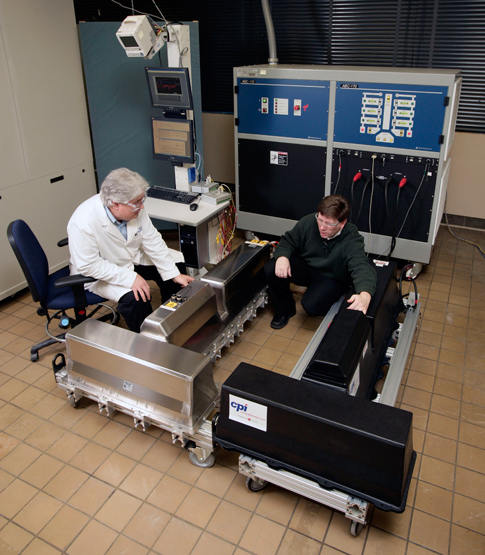
But to mold this raw technology into a battery fit for the Volt would take much more work. "We had to have a cell that effectively doubled the energy capacity of a typical hybrid cell," says Prabakhar Patil, the CEO of Compact Power. CPI's 70 staffers worked late nights and weekends for four months after the shareholder meeting. They then surprised the engineers in GM's battery lab by actually delivering their first finished battery pack right on time (somewhat ominously, on Halloween day).

Meanwhile, A123's first pack was hung up in Customs. The U.S. Department of Transportation considers lithium-ion batteries hazardous material, which made it difficult to get the pack delivered from Continental's packaging facilities in Germany. (It probably didn't help that the stainless-steel casing wrapped around A123's cells looked like a nuclear weapon from a Jerry Bruckheimer movie.) Appearances aside, though, A123's lithium-iron-phosphate chemistry is probably the safest around. The covalent double bonds in the phosphate -- the strongest chemical bonds in nature -- make it nearly impossible for these cathodes to start the reactions that can lead to exploding batteries.

Finally, in January, Customs released the batteries, and GM learned that A123's product would arrive any day. Jon Lauckner was in Washington, D.C., sitting on a panel on plug-in hybrids at the Center for American Progress, and he insisted he be told the very minute the battery reached the lab. Lauckner took the stage and began to field questions from the audience. "Where are you with the second battery?" someone asked. Lauckner looked down at his BlackBerry and replied, "It arrived in our lab five minutes ago."

single page
Want to keep track of the latest concept cars, automotive innovations, and more? Subscribe to Popular Science today, for less than $1 per issue!

74 Comments

Our company Micro Bubble Technologies Inc., www.microbubbletech.com has developed a new electrolyte and slight modification for lead acid batteries. We call it a CNT Battery. We have exhibited a 800% improvement in Reserve Capacity and a full charge time of 5-10 minutes. EG. we took a deep discharge marine battery that had a reserve capacity of 220 at 25 amps and a 10 hour recharge time.

After the modification and the addition of our new electrolyte the same battery exhibited 1,600 Reserve Capacity at 30 amps and a 5 minute recharge time. We performed over 1,000 full discharge and charge cycles to date without any lack of performance.

Modified batteries (13) will be employed in an electric car the Current (see web site under CNT-Battery). This car will go over 400 miles to a charge and a 5 minute recharge time.

Another important aspect to our technology is the fact that the CNT Battery will sell for 1/10 the cost of a similar lithium battery.

Michael Siegel
President
Micro Bubble Technologies Inc.

Some form of "competition" wouldn't hurt eh? (^_^)

It's best for us consumers to have lots of choices and the best pick that suits us from among those available choices.

Btw, I read somewhere that an American company is in the process of building infrastructure in Australia for the recharging stations for these types of electric cars powered mostly by "green" sources. Next up... for Americans - hopefully? Then next... for all of us around the globe?

This reminds me of the movie albeit for its title only - "Electric Dreams"... but the movie doesn't have anything to do with electric cars but the theme song is quite nice and I remember it quite well after all these years .... "...We'll always be together, together in electric dreams..."

But we're all awake now and it's not a dream anymore... hehehe. Gratz to everyone and let the battery / electric car race begin... "waits enthusiastically for further developments..."

Power is Everything...

Soon, we'll introduce another source of energy which will lasts for more than a year or decade without recharging...

Totally safe...NOT even a fuel cell or hydrogen stuffs...

Environmentally friendly...

Above all, its affordable ;)

GM is full of it. Even if you exclude the EV1, what about the t-zero and the Kaz? It is funny that they never talk about a car that had, in 1998 drove from southern California to Las Vegas Nevada on a single charge all the while getting there with a reserve of about 30 miles. The technology has been around for a viable EV for over a decade, the thing that has killed these projects have been lobbyist for the petroleum conglomerates. You don't have to believe me look for yourself. ANYONE who says the tech is not there is either ill informed or has a differing agenda.

Hey Guys and Gals,

Maybe we're thinking of this based solely on the power output of the batteries. One big constraint is how much "juice" does the car use in making it run... which puts a constraint on how many batteries that will be used for this electric car, which leads to designing more batteries to become more efficient....

Just a crazy idea.. what if we viewed it from another angle... the car would be needing lots of power from the batteries because it's so heavy that in order for it to move and keep on moving...it would drain the batteries power after a short amount of time has passed..

Anyways, I've read somewhere of a material made with nanotechnology which they call buckypaper. It's supposed to be stronger than steel and weighs far, far less than steel - stronger but lightweight. Maybe you could use this material for the car's chassis and body... thus making the car less, less heavier... thus reducing the need for a huge amount of power to be supplied by the batteries in order for it to move and keep on moving... I know this sounds crazy but... they call it buckypaper for some weird reason and they have lots of possible uses for it in the future. Why not try it out now... with an "electric" car....sounds crazy right?

But that doesn't mean that we should stop research and development on developing the best batteries out there...still has to improve on lots of areas for them batteries...

Kindly research the possible use of "buckypaper" for this please. Paralleled with R&D for the batteries, the car would hopefully be better than your "steel-gasoline/diesel" car...

Many people bring up these semi-mysterious diabolical 'oil industry lobbyists' as the enemy of the electric car. While the oil industry certainly has trillions of $ at stake and wields enormous power, there is one group with even more to lose, wields even more power. That's the US treasury department. Why? Because regardless of what country the oil is coming from or where it is going, it is ALL traded in US$. So before you can buy oil, you have to buy US$. Increased global demand for oil = increased demand for dollars.
That means that regardless of all other economic factors, the treasury department can create massive amounts of money with relatively little effect on currency values (I say relatively, compared to what would happen if another country tried to do the same thing).
That is how the government funds its massive budget deficits.
That is why US taxes are some of the lowest in the world.
That is what is paying for the massive US military ($515,000,000,000/year).
This also accounts for about 4% GDP.
My point? Balancing the Federal budget and starting to pay down the debt is crucial to weaning ourselves off a petro-economy. Running deficits only increases our reliance on oil. If the demand for oil goes away, so does the demand for US$, and so the government can no longer fund its deficits by printing money without massive currency devaluation. But if there is no deficit, we'll be able to weather the stormy economic transition away from oil.

Well, why bother using batteries to get 20 to 45 miles of transportation and at very high costs and limited recharging capacity....when you can use low cost technology as being developed and put into service in India of high pressure air...

That's right, use high pressure air, contained in a carbon fiber tank with 340 liters of air at 4350 PSI...

Rather than being limited to 25 to 35 miles, and limited recharging, you could have a reasonable range of 125 miles per fill up and save thousands of dollars over the expensive battery technology and I might also mention it wouldn't catch on fire...as a battery might...

Add to this the use of light, inflatable cars such as from XP Vehicles, such as the Whisper car that weighs just 480 and could travel 400 or more miles at 65 mph on a single charge, and the car is essentially an air bag, made from the same material used for the landing airbags of NASA's Mars Probes...

Sounds good to me...

I think our Congressmen must spend too much time with their female adjutants and not enough time reading Popular Science or Popular Mechanics, because these two magazines have clearly shown the way out of our energy problems, and yet those folks in Washington have yet to see the light...

What is their problem?

let not forget about the tesla roadster. 250 miles to a full charge. they should have made an economy version rather than a sports car. but at 100k thats not bad. charges in the amount of time it takes your cell phone too.

Ugh, I cant believe what weve done to get ourselves into this power struggle.

No1 ever thought about wat would happen in the years to come when they made cars so inefficient.

But i guess they r starting to see the problems with present designs and we r finally thinking about the future.

So yea....................^.-

-THE KID

The CNT battery sounds incredible. I noticed that a patent was issued for a CNT battery in March 2006 with similar specs to CNT battery of Micro Bubble Technologies.
When will this battery be available and at what cost....
If the cost is only double that of an unmodified lead acid battery but has 8 times the capacity and recharges in 5 minutes ....that would be a Major breakthrough in electrical storage costs
The website for the electric vehicle "the current" ...soon to be released makes no mention of the CNT battery and only mentions a lithium battery or a Nilar which I belive is a nickel metal hydrite battery......

Henry Ford could have built an electric car. Electric vehicles were in production at the time he came out with the assembly line Model T.
Go visit some of your rural museums, where actual vehicles of this period are on display, or ask Jay Leno.
Had the lid not been closed on the electric car, what would one hundred years of innovation have done by this time (2008)?
Nikolai Tesla must be rolling over in his grave.

Is it just me, or is the power cord coming out of the gas pump nozzle backward? I realize it's a metaphore, but if the gas nozzle represents the power source, shouldn't the female end of the cord be sticking out of the end of it?

The way it is in the picture, it looks like the car would be delivering power to the gas pump -- or to the power grid.

Or did I miss something?

Agree about lack of competition and lack of comparisons listed in this article - no context given - just a list of names, no specifics and mostly a GM tech-ad-vertisement. Poor job popsci. The article should have been titled "Power Struggle GM style"

Maybe popsci needs to review buyers guides like the new Plug-in Electric/Hybrid Buyers guide to see what consumers can order today from http://update-electric-cars-today.com

Learned how these "Battery Powered" vehicles run and how they are inefficient as of now. But how much electricity does it take to charge one of these "Volt" and it would be a necessity for local places to offer "charge stops" where you would have you pay to charge like you would pay at a pump. I would image these big batteries could have a tendency to have bad cells and such. It seams pricey but a good step up from straight gas.

Learned how beneficial battery powered vechiles are. I think that electrical power will go way better than gas powered because it produces less pollution and is way cheaper.

The thought of electric powered cars is kind of smart but what about the idea of cars that might get over heated an may blow up. The sound of having no gas cars sounds great because gas prices has sky rocketed and are ruining our economy leading us into a recession. Money is a huge importance right now in the world and if we think about it how much cheaper would this be. I like the idea of having electric powered cars but by reading the article it lets us know that regardless its still going to take a lot to get these cars up an going let alone thinking about how long these cars are capable of running. Electric cars "sound" like a good idea but should be further more researched!

I have learned alot about this article with this kind of technology we do alot better for the enviroment and save tons of money people spend on gas. Its cheap and affordable. Their would be flukes in this though like all great things that are new. Places to charge up that would be alot of problems. How long and of course they would try to make money off charging, how long or even how much your car needs.

My opinion is I will stay with my gas its efficient and reliable you dont know how some of these are going to react in other seasonal enviroment. And I dont htink itll work but if it does work it will end really quick.

The use of electrical batteries will be more beneficial to the environment. But at the same time, the price just to charge your car for about an hour for the day will be equivalent to the gas prices we pay now, if not more at that. In the article it states that a fully charged car will only last for 48 miles before having to be charged again. I feel electricity is a better method for the concerns of the environment but not the best method for safety, size and price.

I learned that the EV1 was the electric car that GM launched in 1996 and that they then had to destroy it.
I think if they can figure out a way to make these batteries less expensive and to last at least 5 years this would be a great step for us in the United States. I think that in time they are more than capable of accomplishing this.

Ive learned in this article just how hard it is to make an electric car. I say today there are so many things you can do with technoligy and you think it would be easy. Untill you try to make your thoughts come to be thats when you relize its not as easy as it seems. Mabey its just me but thats how I see it.

In my opinion, untill you get a better battery, The goerment would have to set up eletric outlets similar to parking meters in parking lots to make them succesful. That would reqiure tons of money and constuction that I dont see in the near future so keep up on that battery.

i think that this is a good idea......i think this because we would save on a lot of money tring to put gas in the car wen we can use electricity too.....thats pretty neat if u ask me!!!!!! the only thing that might be a huge downfall is how expensive it might be but other than that this is a great idea!!!!

I learned that cars that will use batteries will be very expensive.

My opinion is that it is a good idea to try to get rid of using gas for cars because of how bad it is for the enviroment but if we do that we have to be able to afford it.

I learned that there about 95% to see an electric car on the market in about one year.

I think that this is a very good idea and the authorities should help them achieve their wonderful goal and try to make it cheap and make it last a long time.

i learned that gm is going to come out with the first baterrie operated vehcile.
the teams goal is to make the car cheap and affordable with out losing qulaity of the car.
i belive that they can do it as long as they keep trying.

I learned that this car will take out carbon emmissions.

I think there goal is to make a car that is cheap and also does'nt hurt the environment. I think they can acheive this without loseing the quality of the car.

I learned that this car will take out carbon emmissions.

I think there goal is to make a car that is cheap and also does'nt hurt the environment. I think they can acheive this without loseing the quality of the car.

I think that in this modern day we do need to find a way to stray away. Natural resources are runing out fast and electricity is a man made source of power so it only makes sense to power a vehicle by that. If we can make a gallon of gas last over 100 mpg everyone will save money, natural resource usage will greatly be reduced. i learned that it is possible to power a vehicle off electricity. also the teams goal is to make a car that can go 150 miles on 1 gallon of gas. i think they can reach that goal. in this day we have the technology to do anything.

i learned that cars as we know it re going to be changed into electric powered cars instead of gas to save money and time. The teams goal is to make travel more convenient for everyboidy and i think they will acieve it

I think electric cars are a great idea but some of the technology to make an electric car that is cheap, has long range and has the preformance of a gasoline car is nor there yet. Until technology catches up I think that air powered cars are currently the best bet. Air technology is already here compressors are simple and not teribly expensive also advanced research into nanotechnology and complex physics and chemistry is not required to design an air powered car. One big thing is that air is clean, nonexplosive and Clean to produce.

the volt car is going to improve the economical aspect of the world and help the enviroment. However its unsettling to know that this tested battery can not run for long periods of time. 79% of Americans may drive less than 40 miles, but theres 22% unaccounted for. Also, what of the truck drivers who drive the furthest? will techonogly be able to cope with this without running the battery done. trucks are our biggest gasoline user, as are busses. So what about them? It sounds like a great idea, and it might work out in the future, but I dont know how that will effect the traffic and flow of the economy if its not everyone in use. what would happen if there was a power out and therefor no way to charge the cars?
-six

the volt car is going to improve the economical aspect of the world and help the enviroment. However its unsettling to know that this tested battery can not run for long periods of time. 79% of Americans may drive less than 40 miles, but theres 22% unaccounted for. Also, what of the truck drivers who drive the furthest? will techonogly be able to cope with this without running the battery done. trucks are our biggest gasoline user, as are busses. So what about them? It sounds like a great idea, and it might work out in the future, but I dont know how that will effect the traffic and flow of the economy if its not everyone in use. what would happen if there was a power out and therefor no way to charge the cars?
-six

Something new that I learned is that Lithium-Ion batteries are lighter and more energy dense than the last few generations od batteries used in the indusrty. The team's goal is to have the Volt on the market in November of 2010. I don't tink the team will be able to reach it. I think this because of all the kinks that still remain in the plan.

I have learned that there is some people who are trying to make a big difference in the world, by making some electrical cars that can be charged just like cellphones.
The team's goal is to create some electrical cars, that will decrease the carbone dioxide on the air (pollution), but they need some powerful electrical battery that can power up the cars, make it faster, more durable (hours/days) and most of all more safe (protection from overheat).
i think that they can reach there goal if they don't give up; and it will help the population a lot if they achieve it, by saving money and by decreasing the pollution

i learned that the battery may one day be better than the gasoline powewred cars that we have today. there goal is to have the same density and power of gasoline cars but in a battery

I learned that in 1996 Gm made an electric car (EV1) that failed and cost them nearly 1 billion dollars. Lithium batteries are light and energy dense but when overheated, have a bad thermal reaction that can lead to "thermal runaway". To test batteries they place them in a thermal chamber to see how well they'll work in about 10 years. They hope to reLEAse the new car by November of 2010. In my opinion i think it's a great idea that thier conducting all these expeirments to better our economy.

One thing that I have taken from this is that there actually is a fighting chance of electric power replacing gas and oil. This teams goal is to build a cheap, safe, powerful battery that will power the car. I can say yes I think the team will create a battery that will power the Volt. But for how long will it power it for, and how far the battery can take the car?

One thing that I have learned from this article about the new car that GM is supposed to come out with, which is the volt is that the battery will run almost 40 miles before running out of the juice to power this battery or car. I think that the teams goal is to find a way to power a car for a cheaper amount than cars are being powered today. I think that the team will not be able to do this because people will not buy this car because of what happened with the Hybird. This is all of my opions of this article.

Even with the battery in the car they still have to use gasoline for the Volt..but it is good and helps the environment more.

I think they will make their goal but it wont happen fo awhile. Maybe 10 years or 5 years

After reading this article i learned that we as Americans burn around 390 million gallons of gas everyday, which is 20 pounds of CO2 into the air!

my opinion of this article is that it is very informative and interesting.

in the above article i have learned that scientists go through a lot to make the world more efficient. They are going through great struggles to make electical cars and are taking many many years to assure that it will be a good, well working car.

The goal of the team is to make an electric car with the same energy density as gasoline or diesel fuel.
i think that with enough research, and hard work they will reach their goal easily.

I learned that americans burn 390 million gallsons of gas each day. That pumps carbon dioxide in to the air.

I think the teams goal is to make a hybrid car that the mostly on electricty and not gasoline.

I learned that these people are striving to help the economy by building an electric powered car. I believe the teams goal is to actually acomplish the electirc car to help the American people save money on gas. They also want to make this car affordable for the people who simply can't afford an expensive car.

I learned that a high percentage of americans drive less than 40 miles a day, making it unlikley to use the gas back-up on the hybrid cars.

The goal is to find a way to make a battery that is affordable and light weight.
The goal is to eventually rid out all gas powered vehicles by using electric- solar powered vehicles.

I believe that one day this will happen. The world is so deep in economic struggle and in such a hectic mess with global warming becoming such an issue, that this HAS to work. Technology has increased in so many ways the past years and i believe that this goal will, one day, be reached. We've already come so far.

i learned that it takes alot of effort to create a new car.
GM's goal is to make a more energy profcient vehicle by 2010. i think they will suceed because it seems like they have put a lot of thought into this car and are putting a lot of effort into making it and making it right.

i learned that americans burn 390 million gallons of gasoline every day each of which pumps 20 pounds of carbon dioxide into the air. I think that this car would be a good thing because it would make the air less polluted and would make it cheaper for everyone to drive. We also have to think about how much this car would cost because what if most people cant afford it than no one will buy it Also think about how much its going to cost to make it. Overall though i think that it is a great idea.

I still don't get it. What will the Chevy Volt have that many hybrids and all-electric vehicles don't already? And why is it taking GM so much time and money when there are already small companies converting hybrids to run on batteries alone and other companies like Tesla producing performance sports cars that can go 200 miles on a charge. If you ask me, GM is still suffering from the only-if-it-was-invented-here mentality and it is crazy to sell a car in California that can withstand a Michigan winter. Just like our power will eventually come from many different renewable and non-renewable sources, depending on where we live, cars should do the same. Millions of cars in the southern states have never seen a snowflake or sub-freezing temperatures and never will. Those market differences should be recognized in establishing design criteria if battery and hybrid vehicles are ever going to gain widespread consumer acceptance.

I learnd that 78% of people in the U.S drive less than 40 miles a day.
The teams goal is to make traveling easier and cheaper.
I think they will succeed at it once they sort out all of the problems that are/will happen/ing

I learned alot about cars in general, because it was never a strong suit of mine.
I believe the article should not be used for educational purposes because if you didn't understand the concept before the article would just confuse you insted of educating you...And if the article WAS used for the purpose of education it should be an advanced article insted of a beginner article.

I dont think they are going to suceed in the making of this car because if people were really wanting an electric car there would be lots of them running around out on the streets. Yes people were complaining about gas prices bein so high but now they are down. I would never drive an electric, I love my car and the power it has, no electric car will ever keep up with my honda! Im planning on sticking with my honda for a long time!
NO THANKS I WILL STICK WITH MY HONDA!!!!

I learned that electric is a good way to go but will make it hard if you have to charge every 50 miles.

I think that the ideal of electric cars is a good ideal but the vehicles themselve are just to inefficient. the ideal of hydro powered cars is a good ideal but havent got it engineered right. the way to solve the fuel problem rate now is to use bio-diesel it is efficient and you can refine used vegetable oil in your own garage so you never have to go to a gas station. Also the new study using ecoli to make bio-diesel will make the food prices cheaper because less bio diesel will be made with corn or soybeans.

one thing i learned was that 20 tons of carbonamishion is amited each year.my openyun on this artical is that it will be good for the invironment and will save from fuel costs

I learned that electric cars are so hard to make, but will be a great advance and use of technology once achieved.

I think that their goal is a great idea, and also a great way to get off of foreign oil dependencies and to gain a reliance on America instead of other countries. It will great American jobs and will help America be independent once again.

My one concern would be that electricity prices, whether using nuclear energy, coal, etc., that those prices would rise.

Electric cars will have to advance the length it can run on a charge, or else it definately will not do good with traveling families.

I still this the Prius is great, low gas costs, and still great gas milage of 44 mpg. I do not care for GMs dependency length.

Battery powered cars seem ideal but impossible to make. Its hard to produce such a large battery with not even much energy and people don't want such an expensive inconvenience to deal with.
I think one day they can make it more effective, maybe in some years.

I learned that The battery for the chevy volt weighs in at 400 lbs
I think that the goal of this article is to inform people about an energy crisis and also to tell about the movement to make a bette electric powerd car wich helps the enviornment by not using gas wich emits carbon monoxide wich in turn hurts the enviornment.

their goal is to have most cars to change from gas to electric, soon cars will have cheap batterey, that is also safe to replace the price of gasoline.

What about Air Conditioning, Heating, CD/DVD, GPS, and all the other stuff that gets plugged in for power in the car?
I don't know about everywhere, but here, we are stop and go, top speed 7 mpg in gridlock, in 90-degree weather for at least an hour each way.
This means 40 miles means diddly.
How long will this car run like this keeping the interior of the car about 75-degrees, charging my cell phone while I talk and listen to car stereo music and the GPS tells me to turn right up ahead? Will it make a 10-mile commute that takes an hour in this weather?
The articles NEVER mention this.
I can tell you, people will NOT buy a car without Air Conditioning down here in New Orleans Metro Area.

This artical said that "Americans burn 390 million gallons of gasoline every day, each of which pumps 20 pounds of carbon dioxide into the air," which is very harmful to the environment.
I think the electric powered car is somewhat good idea. Only somewhat, because there are always those few problems that may arise in the making of this hybrid car. Yes, the gas prices are high, well not now because of the election, but when people do start using the hybrid wouldn't that make our electric bill go up?
Morethanlikely the prices of electicity won't rise to the amount it takes to fill the tank but eventually it may...
You never know! But yes overall this is a great idea.

I feel that this article informed me greatly on the advancements in alternative fuel. Although the electric car is a more exspensive alternative, I feel it is well worth it. A couple extra dollars to help save our enviroment and keep it clean, is a great investment.

I learned that electric cars need more work and that it would just be better to stick with gas powered cars. It would be better to stick with gas powered cars because having to recharge your car every 50 miles would get annoying unless you drive less then 50 miles a day. i would rather just be able to drive as far as i want without having to worry about how far i can make it before my car runs out of charge. Then have to worry about where im gonna recharge it if it does run out before i get to where im going.

I learned that if you have an electric car you have to charge it every 50 miles. i also learned that a lot of people dont drive more then 50 miles in a day so for the people that drive less then 50 miles having an electric car probably wouldnt be so bad. though for me i think that sticking with my gas powered car would be better because i was homeschooled for a while and have friends all over ohio so i would probably drive more then 50 miles in one day and that would be a pain trying to figure out where i would recharge my car.

I learned that if you have an electric car you have to charge it every 50 miles. i also learned that a lot of people dont drive more then 50 miles in a day so for the people that drive less then 50 miles having an electric car probably wouldnt be so bad. though for me i think that sticking with my gas powered car would be better because i was homeschooled for a while and have friends all over ohio so i would probably drive more then 50 miles in one day and that would be a pain trying to figure out where i would recharge my car.

Reading this article has showed me that electric cars are not going to be a reality for the average person for quite some time. Assuming that one was able to afford one, and the battery, there would still be the problem of the short distance you get out of the battery before it needs charging again. While the article says that most people drive less than 50 miles a day, what would you do on the days when you had extra errands to run? You can’t have a car that only suits your needs some of the time. You would also have to make sure that your car has a safe place to charge while you are away. If, everyday, you went in to work and your car had been unplugged or someone has cut the wires when you returned there would be no point in having an electric car, you would just be wasting your money fixing it over and over and never get to drive it. For now, people should stick to trying to conserve gas while more research is done on electric cars.

i have learned that americans use up to 390 gallons of gas a day, we dont conserve it enough and that most americans dont even drive 50 miles a day and the car that only needs charged has to be charged every 50 miles so it would be good for those americans . i personally drive alot, i have family and friends all over so i dont kno if this car would be right for me.

i see where it comes in to play how we need to save on gas and that the next alternative is to go electric just to save on gas, but the price will still be up take in consider that if it uses a battery that you will have to pay for that and gas and if it plugs into the outlet that your electric will go up.I mean its a good idea to get started.

in the above article i have learned that scientists go through a lot to make the world better for use. They are going through great struggles to make electical cars and are taking many many years to assure that it will be a good, well working car.

The goal of the team is to make an electric car with the same energy density as gasoline or diesel fuel.
i think that with enough research, and hard work they will reach their goal easily.

I learned that the new companies are trying to save The U.S. money and hat if we did have these cars we wouldnt have to use gas at all because most only drive 40 miles a day. The goal may come true in the next few years.

i learned that the Volt's battery will have to carry a 10-year, 150,000-mile warranty, which is awesome because if anything goes with the car, you're set for a decade (:

i think that this idea of a car is great because it will save alot of money that you'd be spending on gas, and it will also help out the enviorment as well.

I learned that the electric battery powered car, is hard to make cause the power cost is too expensive and they are trying to find a cheaper way to help economy.

I think the team working on this car is eventually going to find a solution like half water and electric or some mix to complete goal.

As stated by several rational readers before, the nation's power grid is totally incapable of supporting an electric car for even 1/10th of the drivers. If the "5 minute charge, 10x capacity" lead batteries actually happen, we will fry every fuse in the power grid the first night trying to put 400 miles worth of electricity into a car in 5 minutes.

Here is a question for PopSci that needs to be addressed in an upcoming issue: Has anyone heard how heating and air conditioning will be addressed in electric vehicles or how the use of such accessories would affect the mileage? I am fairly electronically and mechanically savvy and I see a problem here that I don't recall anyone ever mentioning.

The "micro bubble" technology mentioned in an earlier post, IF it truly exists, will make the CAR practical. If 10% of us plugged in and tried to gobble up 400 miles worth of electricity in 5 minutes, we would pop every breaker and fuse in the power grid. There is no forseeable technology to deliver that much power that quickly from any source. You would have to be talking about THOUSANDS of amps!! The average house uses less than 200!

Lastly, a question: How are we heating and air conditioning these vehicles? Does anyone know? I never hear that mentioned.

Ok, Ok, OK - Mr Siegel2. Isn't your Carbon Nano Tube (CNT) electrolyte produced by growing the carbon tubes from petroleum derivative feedstock? Don't try to save the world using oil. Oil is evil.

What all of you are missing is OBAMA. He has "vowed" to bankrupt the coal industry and force electricity prices to skyrocket. Are you hearing the words coming out of his mouth?
"Hope and Change" baby, "hope and change".

i think that this idea of a car is great because it will save alot of money that you'd be spending on gas, and it will also help out the enviorment as well.
http://www.hedefnakliyat.com

The new lithium-ion batteries are definitely making the electric car a viable option. It's only a matter
of time before the electric car will replace autos powered by internal combustion.
Ditto the Honda Civic Hybrid is far from being Honda's first plug-in electric. That was the Honda EV Plus, a compact SUV (similar to its current CRV in design), leased to government agencies to test, also during the 90s.
http://www.monstertruckinc.com/chevy_trucks.php


June 2013: American Energy Independence

Five amazing, clean technologies that will set us free, in this month's energy-focused issue. Also: how to build a better bomb detector, the robotic toys that are raising your children, a human catapult, the world's smallest arcade, and much more.


Online Content Director: Suzanne LaBarre | Email
Senior Editor: Paul Adams | Email
Associate Editor: Dan Nosowitz | Email
Assistant Editor: Colin Lecher | Email
Assistant Editor: Rose Pastore | Email

Contributing Writers:
Rebecca Boyle | Email
Kelsey D. Atherton | Email
Francie Diep | Email
Shaunacy Ferro | Email

circ-top-header.gif
circ-cover.gif