Last summer, more than 1,000 environmentalists in the U.K. staged a weeklong protest in a “Climate Camp” at Heathrow Airport, where about 70 people were arrested. Their immediate purpose was to block a planned expansion of Heathrow, but the protests highlighted a growing complaint in Europe–that the ride to global-warming catastrophe is being fueled not only by coal-fired power plants and SUVs, but also by the ever-rising number of commercial jets. Now governments are starting to listen. In November, the European Parliament voted to bring airlines flying within or into Europe into their carbon-trading scheme, forcing them to reduce their carbon emissions by 10 percent by 2011 or buy carbon credits on the open market. Then, in December, the protests crossed the Atlantic: California joined four other states and New York City in a petition asking the Environmental Protection Agency to regulate carbon emissions from airlines. “We want the EPA to take their head out of the sand,” said California Attorney General Jerry Brown at the press conference announcing the petition.
Although the aviation industry claims that it generates only 2 percent of global CO2 emissions, it’s one of the fastest-growing carbon polluters around. The Federal Aviation Administration predicts that passenger levels will double in 10 years and perhaps triple by 2025. In 2004, air traffic grew at a rate of 14 percent, faster than at any time in the past quarter-century. All those extra miles in the air translate into more jet fuel, and every pound of jet fuel releases three pounds of carbon into the upper atmosphere.
The auto industry, braced for the regulations to come, plans to reduce its carbon footprint using a combination of hybrid technology and alternative fuels. But lowering the emissions of a jumbo jet is a more complicated proposition than slapping an electric motor behind the gas tank. The airlines argue that the high price of oil already compels them to burn as little fuel as possible. That defense might not prevent future regulations, though. And so airlines are trying to engineer their way to a low-carbon future.
The Fuel Question
The most visible crusader against airline carbon emissions has been, paradoxically, a billionaire airline owner. Richard Branson, the chairman of Virgin Atlantic Airways, has committed to spending all the profit from his trains and airlines over the next decade–an estimated $3 billion–on fighting global warming. Step one in that program is the Virgin Green Fund, a venture-capital effort that invests in alternative-energy companies.
Virgin Atlantic is also collaborating with Boeing research into biofuels, which generate less net carbon because the crops they’re made from consume carbon as they grow. The two companies, along with engine maker General Electric, have planned a demonstration flight for early this year that will “move biofuels forward and disprove the naysayers,” according to Dave Daggett, Boeing’s technology leader for energy and emissions. The 747 used for the demonstration will power one of its four engines with a mix of 20 percent biofuel combined with traditional jet fuel. The 10-year goal of the program is to fly with a mix that is as much as 50 percent biodiesel.
It is possible to fly a jet on 100 percent biodiesel. Green Flight International and Biodiesel Solutions proved that much when they flew a 1968 Czechoslovakian Delfin L-29 jet on pure biodiesel made from french-fry grease last October. The jet flew to 17,000 feet, about half the cruise altitude of a modern airliner, over the Nevada high desert. Green Flight International intends to attempt a round-the-world flight later this year.
Yet not everyone was impressed with the flight. “I’d put that in the stunt arena,” said Paul Adams, senior vice president of engineering at Pratt & Whitney. Adams noted that although jet engines will fly on almost any fuel for one flight, it doesn’t mean that such fuels are viable in the long term. “In heavy rain, does the fuel stay lit?” Adams asks. “Does it affect the fuel pump, the O-rings? Does it work under all temperature conditions? Does it have the same reliability as jet fuel?”
And that is the primary hurdle for biofuels: the effectiveness of the entrenched competition, the fuel known as Jet A. “Any possible alternative fuel must be measured against Jet A,” says James Hileman, a research engineer at the Massachusetts Institute of Technology and a member of the Partnership for Air Transportation Noise & Emissions Reduction group, or Partner, which is based at MIT. For half a century, this kerosene has been the fuel of choice in nearly every commercial airplane. Hileman cites some of its many virtues: “It’s safe to handle. If you have a spill, it won’t catch fire.” It also has a very low freezing point–something you want when flying at altitudes where temperatures can plunge below –40ºF.
But perhaps most important, Jet A packs more energy into a gallon than other fuels. That’s crucial because fuel makes up about a third of the weight of a commercial airplane. Energy-dense fuel means a lighter jet, which can fly farther on less fuel, which saves money. Jet fuel also doesn’t take up much space, so it can be stored in the wings and not in the fuselage, leaving more room for customers and cargo.
Energy density isn’t a problem with biodiesel, which holds almost as much energy per gallon as Jet A. (Ethanol, another widely touted petroleum replacement, fails this test: You need about 1.5 times the amount of ethanol to deliver the same amount of energy as Jet A.)
But biodiesel has other drawbacks. “It freezes at about the same temperature as water,” Hileman notes, and when biodiesel freezes, “it’s the consistency of the gravy the day after Thanksgiving.” Boeing and Virgin hope to avoid this problem with biodiesel and Jet A blends. The fuel won’t have the same carbon-fighting power as pure biodiesel, but at least the engines won’t conk out at 40,000 feet.
Billy Glover, a managing director for environmental strategy at Boeing, explains that the aviation industry could gradually make the transition from Jet A to a biodiesel blend. “We foresee that within 10 years, there will be certain airports with fuel tanks where this [biofuel] blend will be available,” he says. “When you fly to that airport, that’s the fuel you’ll get. When you fly to another airport, you might get a more conventional fuel.”
Of course, the future of global aviation will not fly on french-fry oil alone. We still need to find a source for all this biofuel. Boeing has teamed with Air New Zealand and engine maker Rolls-Royce to test-fly biodiesel from an unconventional source in a jet engine later this year. One option is to create this biodiesel from algae. But only a few gallons of algae fuel have been produced to date, and Daggett expects that it will be a decade before it could receive industry approval. Says Hileman, “If you’re a kid and you’re thinking, ‘OK, what can I do to save the world?’ Well, the one way you can save the world is to find new, growable sources of fuel.”
A New Way to Fly
On my flight out to Seattle to research Boeing’s advances, I pause as I leave the plane to ask the pilot if flying any differently could reduce the emission of greenhouse gases. He sets me straight. “It’s not about greenhouse gases,” he says. “It’s all about fuel burn.” From 2000 to 2007, the price of aviation fuel in the U.S. swelled by 115.6 percent, and fuel has topped labor as the number-one operating cost of the airline industry. Airlines, always concerned about fuel costs, are now obsessed with them. The nearest-term way airlines can reduce this expense (and reduce their greenhouse-gas emissions in the process) is to change how planes are flown.
Congestion in the air hurts fuel efficiency, just like on the ground. “On a good day, with nice weather, most airplanes fly efficiently,” says Ian Waitz, director of the Partner program. “Things get challenging when you have congestion or weather problems. You have airplanes circling and sitting in taxi queues.”
To mitigate congestion, the aviation industry is looking to adopt new flight patterns. In 2003, Congress created the Joint Planning and Development Office, which is building an entirely new air-traffic control system called NextGen, short for the Next Generation Air Transportation System. It’s a huge overhaul expected to cost up to $22 billion.
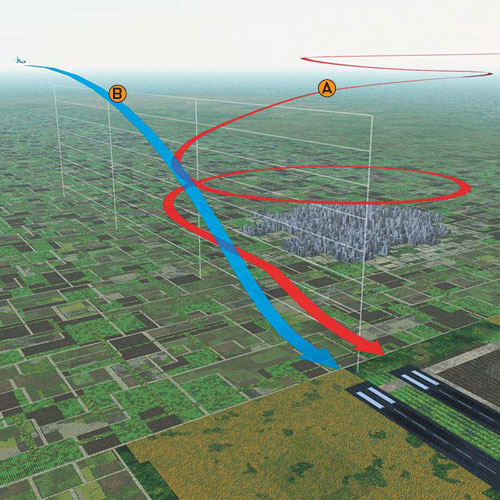
One part of the project aims to land airplanes more efficiently. Now, to maintain safe spacing from each other, airplanes typically speed up and slow down repeatedly as they land, descending in steps and wasting fuel. But sophisticated computer models are under development that will carefully pace the landing of aircraft, allowing each to glide in practically on idle, a process called continuous descent approach. In a flight simulator, this method saved an average of 100 gallons of fuel on every approach to Los Angeles Airport.
Another NextGen initiative is to ditch the national radar system, which is based on World War II technology, and replace it with a GPS-based system called Automatic Dependence Surveillance Broadcast. Touted as the “backbone” of NextGen, ADS-B can precisely map an airplane’s longitude, latitude, altitude and speed. The result will be more efficiently spaced airplanes flying faster on more direct routes. That saves fuel too. In 2005, NextGen reduced the mandatory vertical separation between airplanes at cruise altitude to 1,000 feet from 2,000 feet, a change that saves fuel by allowing more planes to fly at higher altitudes and avoid winds. The adjustment also opens up more lanes in the air, increasing airspace capacity by as much as 85 percent.
But NextGen is about increasing capacity, not cutting emissions. Although each flight may consume less fuel, the savings will be more than offset by the growth in traffic. “The whole point of [the program] is to develop the air-traffic system to allow the doubling of operations by 2025,” Carl Burleson, director of the FAA’s Office of Environment and Energy, tells me. “In the U.S. today, the issues blocking that growth are local air quality and noise. Greenhouse emissions haven’t been a constraint.”
The Light Option
Boeing’s hangar in Everett, Washington, just north of Seattle, is the largest building in the world. One of the airplanes it houses is the most heralded commercial jet in years, the 787 Dreamliner, advertised as a “green” jet. But the plane is still behind closed doors–no visitors allowed–so I’m escorted into the office of Jeff Hawk, the Boeing Environment and Certification director who has worked on the 787 since 2002. He says that before the Dreamliner, Boeing had been planning to build a faster plane. He pulls out an off-white model of the original design, the Sonic Cruiser, which looks like a cousin to the Concorde. The Sonic Cruiser, streamlined like a barracuda, was to fly at the edge of the speed of sound.
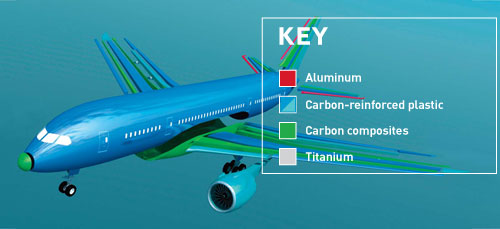
“On a transatlantic flight, it would save about an hour or two,” Hawk says. “It flew 20 percent faster but produced the same amount of fuel burn.” The design concept crumbled when the airline industry was blindsided by the September 11 attacks in 2001. Passengers avoided the skies, and the industry lost $25 billion in just three years. Meanwhile, fuel prices crept upward and fuel efficiency became a top priority. Boeing decided to divert technologies being used to build a faster plane into building a more fuel-efficient one. Composite material planned for the Sonic Cruisers–carbon-fiber-reinforced plastic that’s 70 percent the weight of aluminum–was carried over to the 787.
Engineers squeezed every efficiency they could from the airplane’s classic shape. Among other tricks, they created a longer and thinner wing to generate more lift and less drag. As one part of the airplane became more fuel-efficient, so did the next. “If you have a low-drag airplane, you can use a much more efficient engine,” Hawk explains. “That less-powerful engine is smaller. It’s lighter too. A smaller engine means less drag. Instead of 20 percent faster, we were 20 percent more fuel-efficient.” That efficiency has been a major selling point. Boeing has pre-sold 738 airplanes to 51 customers, making it the most successful release of a commercial jet in the company’s history. It’s also good for global warming, Boeing says, because 20 percent less fuel burn translates into 20 percent less greenhouse gas produced.
It sounds encouraging. But the 787 will replace other planes only gradually–Hawk estimates that Boeing will sell about 100 a year. He also acknowledges a more fundamental problem, which is that most jets aren’t scrapped when new ones are bought, but rather sold, like used cars. “You can’t just throw away a $50-million airplane.”
Growing Pains
And that is the core of the greenhouse-gas problem: growth. The global market forecast from Airbus, Boeing’s only major competitor, predicts that the number of passenger aircraft in service will more than double by 2025, from 12,676 at the end of 2005 to 27,307. Based on increased air traffic, the FAA estimates that aircraft greenhouse-gas emissions in the U.S. will increase by 60 percent in that time. (That might not be the worst part. Recent studies have concluded that water vapor from airplane contrails may have three to four times the warming impact of the carbon dioxide in the exhaust.) The extra demand means that just 4,500 of the airplanes currently in operation, about a third, will be retired; the other 8,200 will remain in service or be converted into freighter aircraft. Even biofuel blends, which appear to be at least a decade off, might not be enough to slow the increase in emissions.
Yet since air travel fuels the global economy as surely as it fuels global warming, few are calling for a hard limit on this growth. Thus technology will be asked to make quite a leap over the coming years, lest the skies grow unfriendly.

Whatever Happened to the Blended Wing?
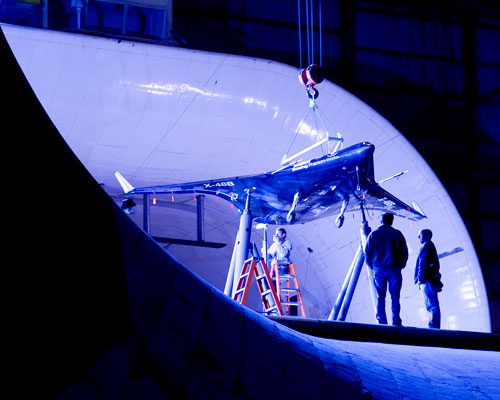
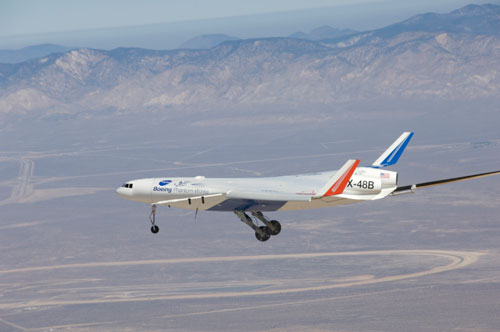
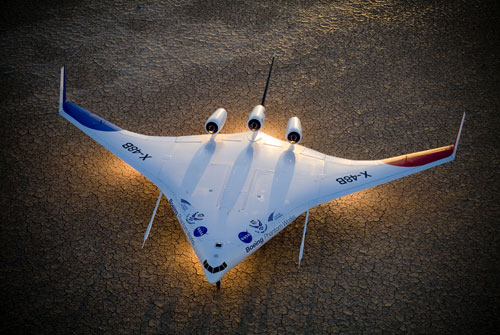
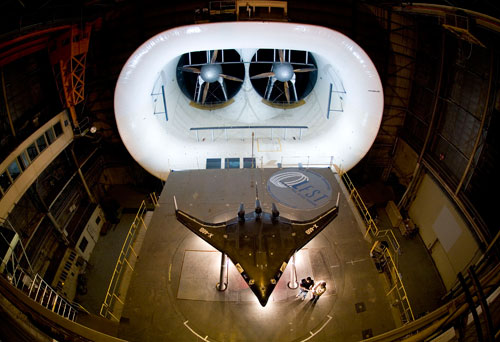
At the Future of flight, a museum just down the road from Boeing’s hangar in Everett, Washington, I spoke with Jeanne Yu, a director of environmental performance at Boeing, about radical airplane designs that might reduce greenhouse emissions. The classic example is Boeing’s X-48B Blended Wing Project, which turns the entire aircraft into a giant wing see the gallery here. The design reduces drag and accentuates lift, and a 2006 study from the Partner team at MIT and the University of Cambridge showed how the design would improve fuel efficiency by 23 percent. Yet Boeing has no commercial plans for the blended wing body; it’s developing the craft exclusively for military use.
I ask why, and before Yu can answer, another museum visitor, an Englishman who works for Rolls-Royce, one of the manufacturers of the Dreamliner’s engine, turns and says, “The biggest problem with blended-wing designs is that no one can see out a window.” Yu agrees. The designs place passengers in what seems to be a small amphitheater. Air travelers want to be able to see out windows and have easy access to an exit. “It’s part of human instinct,” Yu says. “We need to know where we are and see where we are.”
She thinks greenhouse-emission reductions will come from design improvements she calls “low-hanging fruit”–retrofitting existing airplanes with lighter landing gear or wing tips, for instance. As for other radical concepts, Boeing engineers “still haven’t found anything better than this platform,” she says, gesturing toward a Dreamliner nearby. But that doesn’t mean they’re going to stop looking. “We believe there are answers out there we don’t know about.”
Dennis Gaffney is a freelance writer based in Albany, New York. This is his first story for Popular Science.