
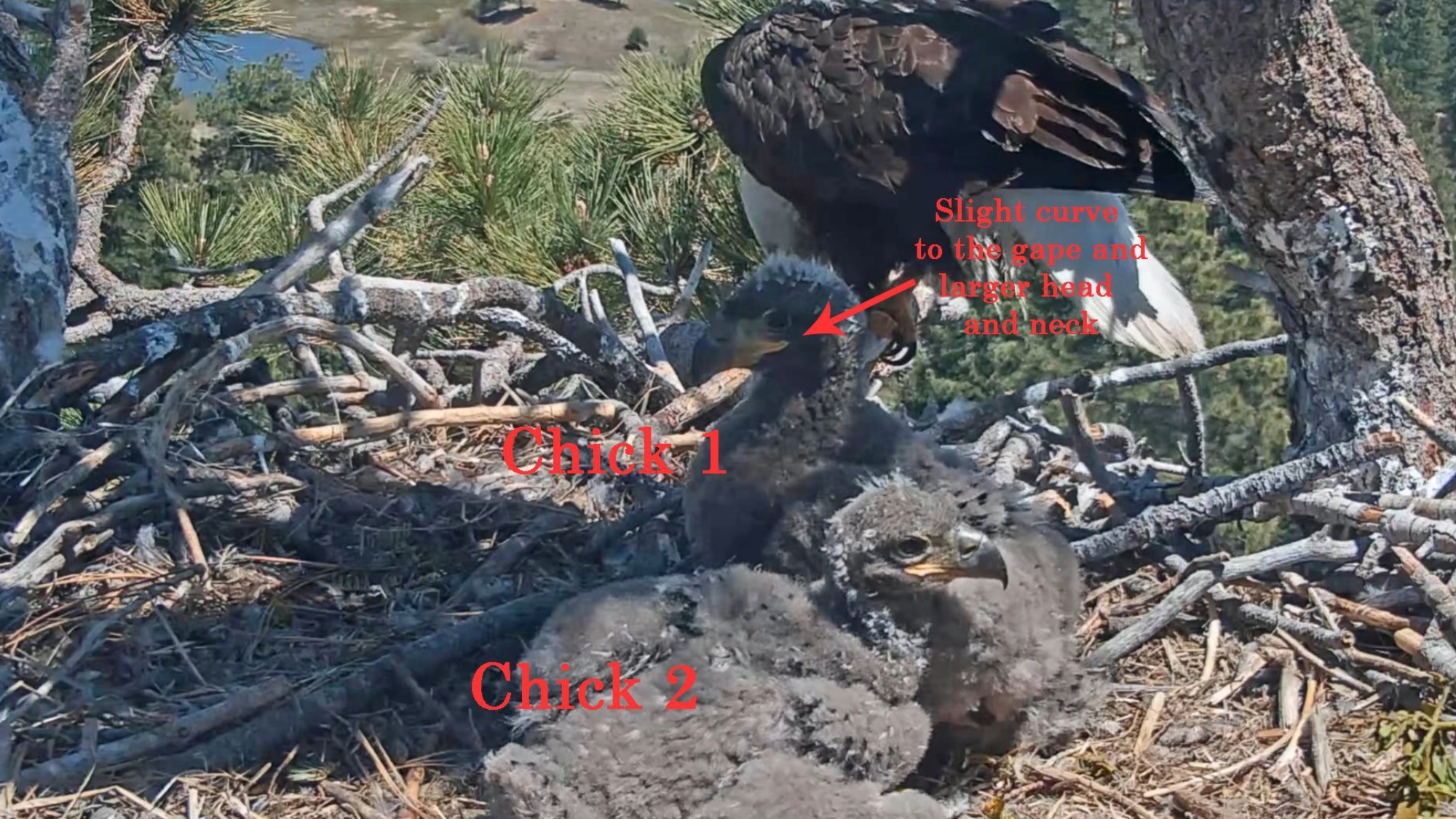
Jackie and Shadow’s newly named chicks Sandy and Luna are growing by leaps and bounds. While they pretty much look the same to the naked eye, there are some ways to tell them apart, according to Friends of Big Bear Valley (FOBBV).
Formerly called Chick 1, Sandy has a larger head and neck. It also has a slight curve to the interior of its beak. Sandy has also been the more submissive of the two so far. Luna (formerly Chick 2) is smaller and has a straighter beak. Previously, Luna has been a bit more aggressive, but their tussles or “bonking” have subsided and they appear to be bonding well.
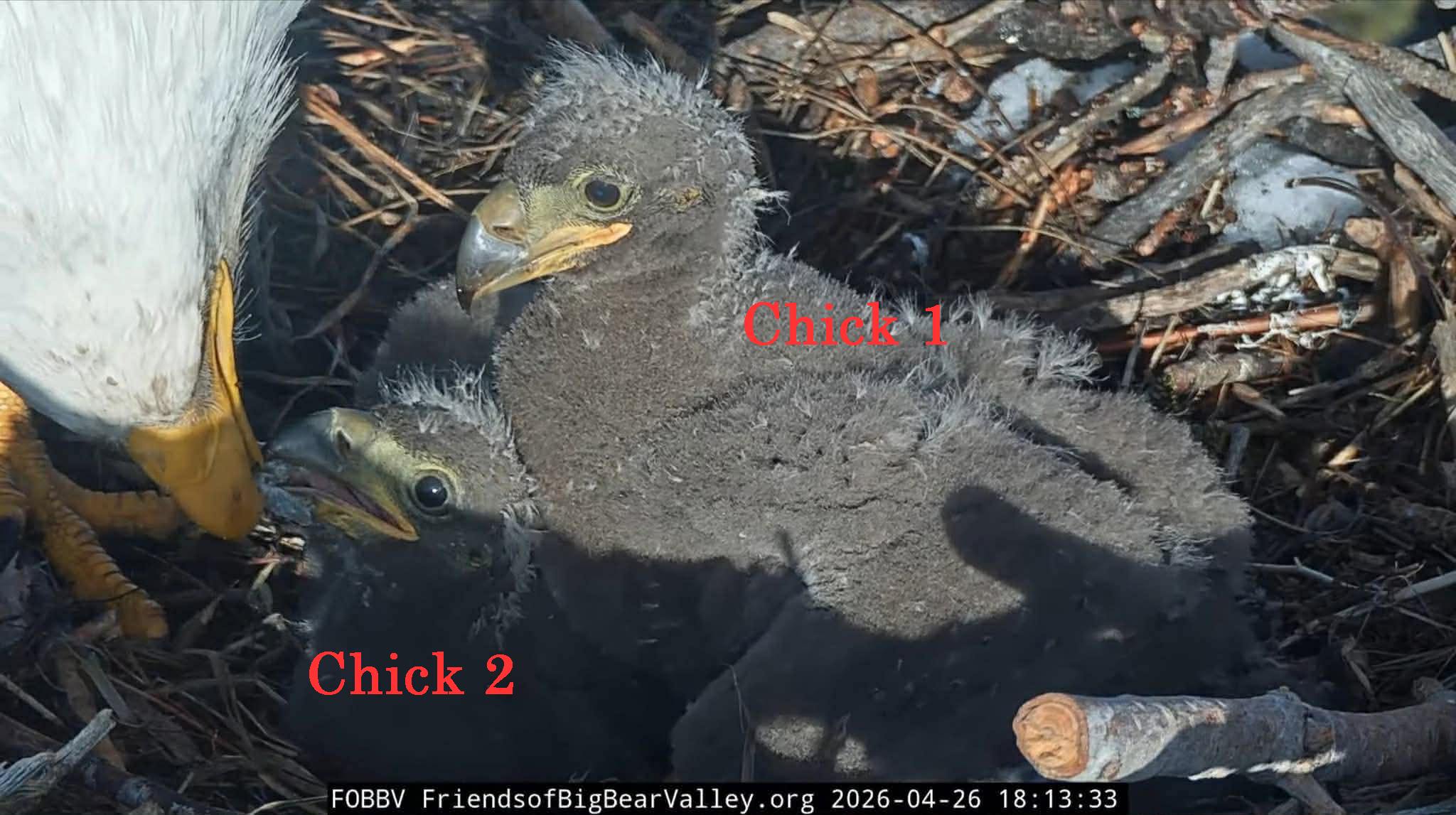
However, the noise they make when the poop can also help you tell them apart. Luna makes a quick whistle sound when it shoots out its white, liquid poop (called a poop shot). Sandy has been a more quiet pooper. The FOBBV cam caught some humorous poop shots on April 18.

4-18-2026 Cuteness Overload and Direct Hits
These subtle differences are likely to change as they grow and mature. They are expected to fledge sometime in June.
You can watch all of the flying, sleeping, eating, and pooping 24/7 with FOBBV’s live stream.
Big Bear Bald Eagle Live Nest – Cam 1
Jackie and Shadow’s 2026 babies: Everything you need to know
It’s been another roller coaster nesting season for Jackie and Shadow, a pair of internet-famous bald eagle parents living in San Bernardino National Forest in Southern California. After two of their eggs were destroyed by ravens in January, Jackie and Shadow laid two new eggs that have successfully hatched.
Chick 1 hatched on April 4 at 9:33 p.m. PDT, while Chick 2 followed on April 5 at 8:30 a.m. Their large nest in Big Bear Valley east of Los Angeles is livestreamed 24 hours a day by nonprofit Friends of Big Bear Valley (FOBBV) and has captivated millions.
How long will the chicks stay in the nest?
Chicks usually stay in the nest until 10 to 14 weeks of age.
What challenges do the eaglets face?
Before leaving the nest, the chicks face threats from other birds of prey, including hawks, ravens, other eagles, and owls. Inclement weather can also present challenges for the chicks. In 2025, a March snowstorm resulted in the death of one of Jackie and Shadow’s three chicks.
During fledging, only 70 percent of eaglets survive. One of the greatest threats is from cars that can injure or kill the birds while they scavenge for food on roadkill.
Who are Jackie and Shadow?
The pair first got together in 2018 and successfully raised chicks in 2019 and 2022. However, their eggs failed to hatch in 2023 and 2024. Only 50 percent of eagle eggs successfully hatch, so this pair has already beaten the odds.
What happened to Jackie and Shadow’s 2025 eaglets?
In 2025, Jackie laid three eggs that all hatched in early March. On March 13, a strong snowstorm dumped up to two feet of snow and battered the nest with strong winds. Only two of the chicks were visible on the live cam when the storm passed by the next morning. FOBBV later confirmed the passing of one of the chicks. The two surviving chicks were later named Sunny and Gizmo.
What happens after chicks fledge?
Young eagles usually fledge–or leave the nest and fly–when they can flatten their wings and have feathers capable of flight. This typically occurs when the birds hit 10 to 14 weeks of age. Males also tend to take their first flight a little sooner than females.
According to FOBBV, fledglings from Southern California have been spotted as far south as Baja California, as far north as British Columbia, and as far east as Yellowstone National Park.About 70 percent of bald eagles survive the fledgling stage. FOBBV does not tag their eagles, so it’s not possible to follow the chicks’ journeys after they flee the nest.
