
Sperm whales (Physeter macrocephalus) go deep. They can dive 1,300 to 4,000 feet-deep and also travel as much as 15,000 miles per year. These depths and distances make sperm whales and other whale species particularly difficult for scientists to follow and study.
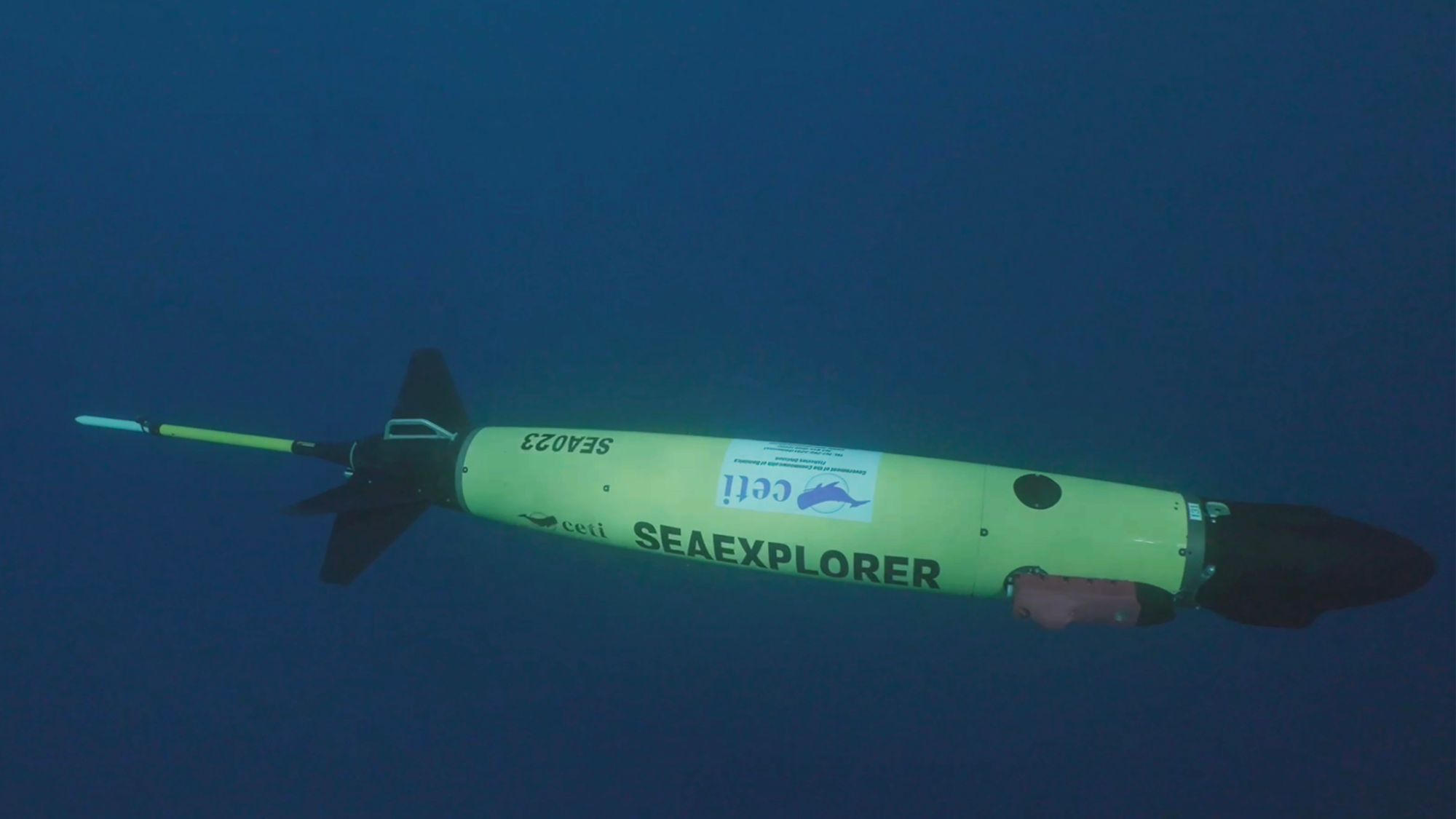
A new autonomous underwater glider system aims to make that trek a little easier. The glider from Project CETI (Cetacean Translation Initiative), detailed in a study published in the journal Scientific Reports, follows sperm whale vocalizations without getting in their way. AI is embedded directly into the glider, which allows it to react in real-time to the whale’s sounds while underwater.

Why gliders?
In addition to their long journeys and impressive diving, collecting long-term acoustic data has been difficult because traditional tags typically remain attached to the whales for only one to three days.
Autonomous underwater gliders are a more recent addition to whale tracking. They can detect the presence of whales while disturbing them as little as possible. According to the team, the new glider can actively follow whales based on their sounds. It could potentially monitor sperm whale populations and collect data for months at a time.
“This technology opens an entirely new dimension to studying whales underwater in their natural environment,” said David Gruber, the Founder and President of Project CETI. “We can now collect long-term communication information never before dreamed possible—like how a baby whale learns its clan-specific dialects as we can now listen to individual whales for extended periods.”
An actually helpful ‘backseat driver’
All underwater gliders have a navigation computer that controls its movement. In CETI’s new system, the team developed a custom “backseat driver” and acoustic sensing system with French ocean robotics company Alseamar. A second onboard computer is also equipped with a back seat driver. This computer processes acoustic data and runs detection algorithms that can recognize sperm whale vocalizations.
“With the new glider, we significantly extend ‘backseat driver’ capabilities by enabling complete mission changes (such as different dive plans),” Roee Diamant, Project CETI’s Underwater Acoustics Lead, tells Popular Science. “This allows fully autonomous control by the glider for tracking whales—a first for underwater gliders, like the Waymo of the underwater world.”
The glider also has four custom hydrophones so that researchers can find the source of underwater calls. Project CETI developed whale-detection and angle-of-arrival estimation algorithms that analyze the sounds in real time. This way, the system can pinpoint the source of the vocalizing whales and adjust the glider’s path. The individual navigation commands can also be updated via satellite every two to four hours when the vehicle surfaces. When the glider emerges above water, the computer transmits data, recalibrates onboard sensors, and can then receive new mission instructions before diving again.
Do not disturb
According to Diamant, the glider also limits the impact on the whales, a critical part of CETI’s mission of conducting “minimally invasive marine biology.” The glider is programmed to ascend once whale vocalizations are detected and then reposition itself to stay close to the vocalizing whales.
“On-whale biosensors are deployed by gentle tap-and-go methods via drones rather than approaching the whales with vessels,” he explains. “Here, we extend this minimally-invasive approach by using a self-guided underwater glider that operates quietly and with less disturbance.”
Currently, Project CETI conducts most of its fieldwork within a roughly 12-by-12-mile study area off the coast of Dominica in the Caribbean. There, they have witnessed a sperm whale birth, and also begun to decode the sperm whale alphabet and dialects. The new glider system may help the project expand monitoring beyond this one region, as the whales swim across broader ocean areas.
