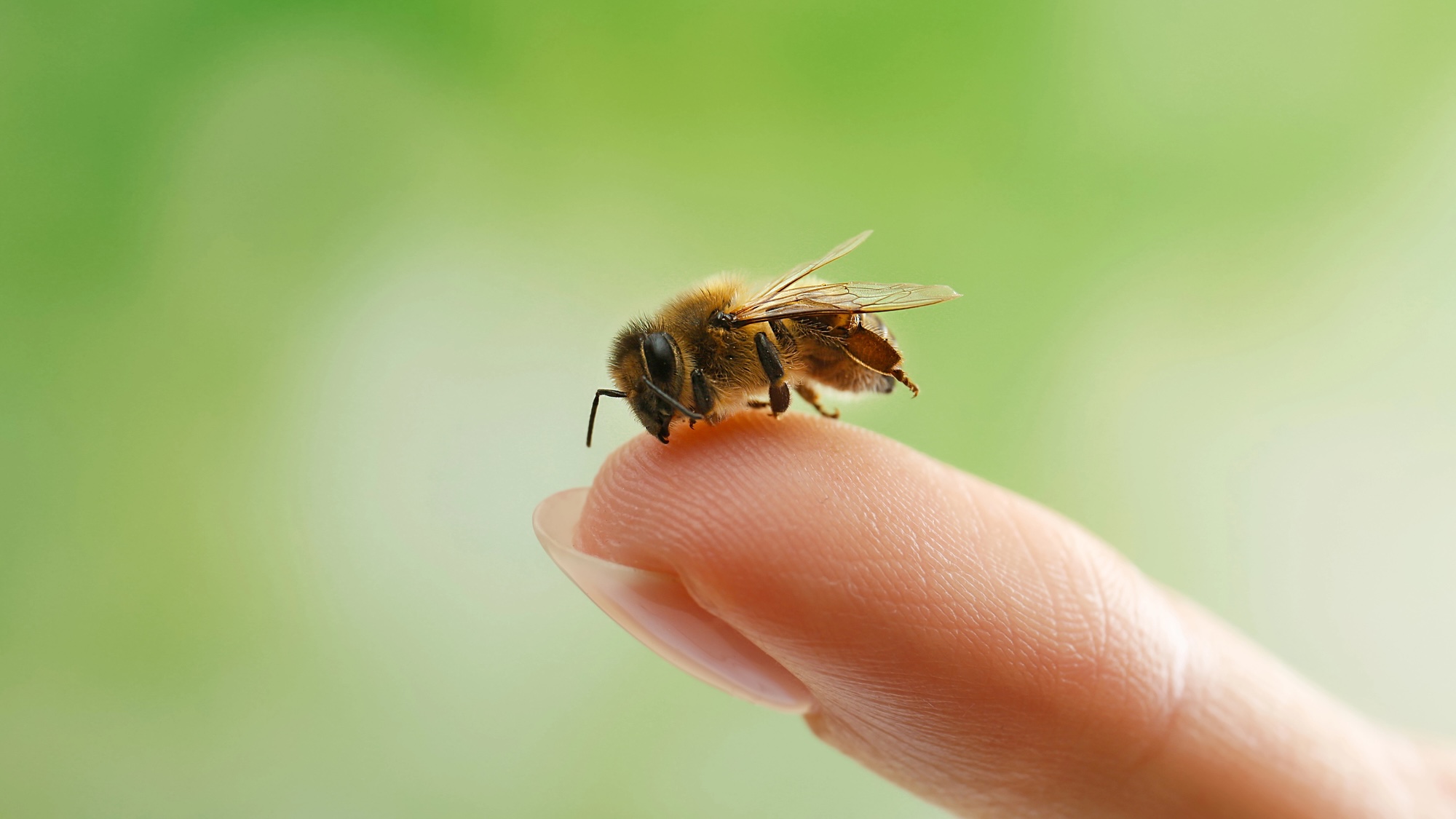
The brain of a honeybee (Apis mellifera) weighs less than one milligram and contains fewer than one million neurons, but that may be more than enough for surprisingly complex calculations. For decades, cognitive researchers and biologists have debated just how much the seemingly simple insects can comprehend. The answer may sound inconsequential, but it has major implications for how intelligence functions and evolves across species. Now, a team at Monash University in Australia says they have a definitive answer about bee smarts: Earth’s vital pollinators are pretty good at counting.
Previous work has indicated that bees understand addition, subtraction, and even the concept of zero. While skeptics countered with the theory that the insects are solely reacting to visual cues, some biological scientists including Scarlett Howard remained confident in their assessment.
“It can be challenging to put ourselves in the mind of a bee to imagine how they see the world, but trying to see the world through an animal’s eyes is an essential part of our work,” Howard said in a statement. “The bees always surprise us with how they move through the world, interpret our questions, and make decisions.”
To investigate the honeybee’s environmental comprehension, Howard’s team reviewed stimulus queues—in this case, increasing the varieties and quantities of black shapes on a surface—but with an added twist. They also included a blank surface to represent “zero” in their experiments.Using reward-based incentives, they then analyzed how well honeybees learned to comprehend and associate number frequency with shapes and numbers based on visual capabilities.
According to the team’s study recently published in the journal Proceedings of the Royal Society B: Biological Sciences, they eliminated the theory that honeybee choices are only influenced by low-level perceptual hints.
“This finding strongly suggests that bees were engaging in abstract numerical reasoning rather than relying on spatial frequency alone—something that a purely associative, frequency-based mechanism cannot explain,” the study’s authors wrote.
University of Trento neuroscientist and collaborator Mirko Zanon added, “Our results show that [previous] criticism doesn’t hold when you consider the biology of the animal.”
Outside of a laboratory setting, these cognitive skills may translate to a honeybee’s ability to count flower petals to determine and remember which plants are the most nourishing. The findings also may help improve artificial intelligence modelling, showing that in some cases, “less is more” when it comes to computational needs. Regardless, the team’s discoveries underscore the importance of appreciating nature’s wide, often surprising range of cognition.
“We see and experience the world quite differently from animals, so we must be careful of centering human perspectives and senses when studying animal intelligence,” said Howard.