
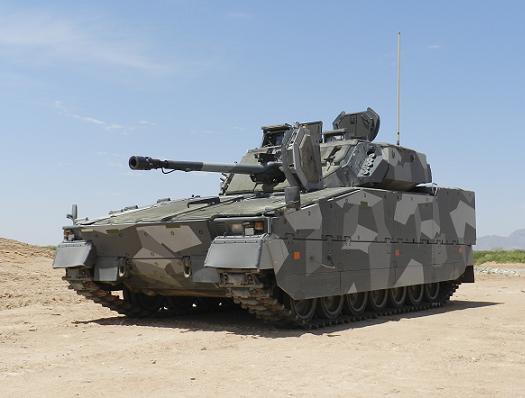
The new Ground Combat Vehicle weighs twice as much as the tank it's designed to replace, and it's massive enough to survive a roadside bomb.

Ground Combat Vehicle
The Ground Combat Vehicle U.S. Army

Heavy does not even begin to describe the U.S. Army's new tank. At 84 tons, the Ground Combat Vehicle prototype weighs more than twice as much as its predecessor, the Bradley Fighting Vehicle. The Bradley is designed to carry a six-man squad (and three-man driving crew) into combat, while the GCV will carry a larger, nine-man squad. Both vehicles will provide covering fire and damage enemy tanks. But the military has built the new GCV to withstand a kind of threat that didn't exist when the Bradley was deployed in the early 1980s: improvised explosive devices.

Part of logic behind the new tank's massive size is that soldiers inside a vehicle are more likely to survive an explosion if there's adequate space for them to wear armor while seated. The extra space also helps distribute pressure from the blast and thus lessens its impact. Another reason the GCV is so huge is that it's required to carry a larger gun than the Bradley does; the new tank will hold a 30mm cannon, probably the 344-pound Mk44 Bushmaster II. Finally, the GCV's extra weight means it will need to be manufactured from the start with a more powerful engine. (By contrast, the Bradley got heavier as the Army added armor to it in Iraq, and its original engine wasn't powerful enough to support the extra weight.)

The Ground Combat Vehicle is pretty much the opposite of the original plan to replace the Bradley. A high-concept proposal called Future Combat Systems aimed to make all U.S. Army vehicles lighter. But during the long ground wars in Iraq and Afghanistan (in which IEDs were the top cause of fatalities), it became clear clear that heavier, not lighter, was the better vehicle design. The U.S. canceled the Future Combat Systems program, and work on the GCV began in 2009. The Pentagon is scheduled to award the first contract to manufacture GCVs in 2019.

An earlier version of this piece misstated the transport capacity of the GCV as a six-man squad, instead of the correct nine-man squad. The 84 ton weight of the GCV only refers to the prototype, and the weight may easily change in the next six years of development.

25 Comments

No kidding, that is really heavy. Here are a few heavy tanks for comparison:

M48 Patton: 50 tons
T-90: 52 tons
Tiger I: 63 tons
M1 Abrams: 67 tons
Tiger II (King Tiger): 76 tons

The King Tiger was notoriously difficult to maneuver and easy to get stuck, but it was also underpowered.

Of course this new ground combat vehicle is intended as troop transportation, not as a first line against other tanks, but the weight and mobility issues will be the same.

Hopefully they have solutions for transporting these monsters (by land and sea), and have a powerful enough engine for it to overcome obstacles, and have a plan to provide sufficient fuel for a fleet of these.

My uneducated suspicion is that this new vehicle will provide better protection for the soldiers in it (which is good), but it will be less able to travel over rough or soggy terrain (which is bad).

Better contact that airship startup company they had an article about on here a few months back to move them. geesh.

Not actually a tank. This is an Armored Personnel Carrier. Tanks have greater fire-power. A 30mm Cannon is not a tank main gun, tanks have >100mm guns. Moreover, their primary role is not troop movement. Simply speaking: tanks go boom, this thing goes thunk thunk thunk thunk.
Also, mines existed back to 100 years ago. What has changed is the US's asymetric fight. When we engaged in asymetric fighting in the past, we were on the asymetric side. During conventional fighting, our forces would utilize specialized tanks/equipment to clear mines, so APC's only needed to offer protection from small arms and indirect fires.
I say all this as some background that the author should have done so as to not misinform his readers. FAS is a good resource.

Uh, I thought that we allowed procurement of the Stryker as replacement for the Bradley Fighting Vehicle? PopSci, we love it that you hang outside the wire just pantin' for the chance to get in there and give us the skinny on all the new gear, but don't get too anxious.

Thanks, bgdavison. Yeah, this is the new vision for the APC. Gotta have it's own oil refinery and a line of trucks to gas the thing. As someone else noted, the armor is a lifesaver, but not if they lose mobility. These get stuck in mud and people will have to abandon them.

We won at The Bulge for 2 reasons. They couldn't fuel their huge tanks. Shermans were fast, thus hard to hit. Does this vehicle takes us back in time, not forward?

Only issue I see with this, with more combat taking place in urban/city settings, will this carrier be agile enough?

Boom! There it is!

Boom! There it is!

Boom! There it is!

quasi44 I will agree with you that it's a big step backwards. I like the stryker because it was designed to do just troop carrying, but it's also found other uses that have made it the prime vehicle of choice in rough terrain. This feels like it's going overboard with the armor, and if the multiple inches of steel are penetrated then the small amount of ceramic plates on your person isn't going to help you in a blast.
I also have to wonder if it gets stuck how in hell are you going to get the armored door open? I will ride a flying aluminum can any day over this armored coffin.

So instead of burying 2 artillery shells and blowing them up they will just bury 4, 6, 12 shells. This idea that we have to FULLY protect soldiers has got to go...IT CANNOT BE DONE, it's called a war, people will die and be injured. This thing will be a giant fumbling wreck, what happens when it gets stuck? They will have to call Norway and rent a giant crane they use to erect oil rigs. Air transport? So now we have to up size our transport planes to carry one of these. My uncle was a forward observer in Germany during WW2, he drove a jeep, fast light enough for 4 guys to throw around. More people died in car wrecks in a year, than combat casualties, that says a lot, there is no need to do more. If it came to full out war with a Nation that knows what its doing, there will be no fuel to drive these around anyway.

in order to thank everyone, characteristic, novel style, varieties, low price and good quality, and the low sale price. Thank everyone

http://al.ly/AvJ

http://al.ly/AvJ

http://al.ly/AvJ

http://al.ly/AvJ

│\_╭╭╭╭╭_/│  
 │         │\|/  
 │ ●     ● │—☆—  
 │○ ╰┬┬┬╯ ○│/|\  
 │   ╰—╯   /  
 ╰—┬○————┬○╯  
  ╭│     │╮  
  ╰┴—————┴╯ sdgwegwe

They must be crazy.Even if it can withstand current IEDs,the enemy will just plant bigger ones.Better to go with something like the Cougar,a lot lighter and more manoeuvrable,which is designed to resist IEDs.Mount the anti-RPG Trophy defense system to protect against anti-armour missiles,and you're good to go.

They don't give it's dimensions here, but I think we can assume from it's weight and the fact that it carries 9 guys, that it's pretty big. I seem to recall in the early days of the last Iraq war, that one of the problems they had was that the M1 Abrams tanks was too big to fit in many of the narrow roadways in an urban setting so they could only rarely use it in a fight, even though it had the armor they needed. Won't this have the same issues? Maybe they just plan on using this for troop transport across the open areas between cities?

I wasn't going to comment at first, but I've got to go with the overriding sentiment. This is a pivot in the wrong direction.

This vehicle…84 tons? Something is not right here.

When I was in the army I was on an M-1 and I was the driver. An M-1 weighs 60 tons and has a heavier track configuration than that what is being displayed by this vehicle. Please see the picture in the link below
http://de.wikipedia.org/wiki/M1_Abrams

Another vehicle in this weight class is the M-88 tank recovery vehicle…70 tons for the M88A2. In the link below, note the track configuration.
http://en.wikipedia.org/wiki/M88_Recovery_Vehicle

and this is a M2 Bradly fighting vehicle
http://en.wikipedia.org/wiki/Bradley_Fighting_Vehicle

My first question is, how is the suspension of the Ground Combat Vehicle in the picture going to support a weight of over 80 tons under service conditions?

Second the power to weight ratio:
And M-1 has a power to weight ratio of 24,5hp/ton; a Bradly 19,7hp/ton. In order to match the bradlys ratio of 19,7 an engine of 1655 Hp is going to be needed. This is bigger than the M-1 engine of 1500Hp.

There are 4 people in an M-1…Gunner. Loader, Driver, Commander. According to the article, this vehicle will hold 3 crew members and 6 a six man squad…9 people. Where is an engine large enough to move an 84 ton vehicle and 9 people (plus equipment) going to fit in this chassis?

Unless there has been some very radical improvements in suspension performance and engine power/volume properties, something is not right here.

@Sogs

The old M2 Bradleys were build to protect their occupants from light machine guns and artillery shrapnel, not roadside bombs. The Army is protecting its soldiers against the most common threat, and injuries encountered on the battle field today. It seems rather prudent to me.

"So now we have to up size our transport planes to carry one of these."

No, If a Bradly fit in there, so will this new one. It is a design requirement for it to fit in the C-17.

"More people died in car wrecks in a year, than combat casualties" So during WW2, 30 to 40 million people died in car accidents? Amazing.

At 84 tons, the only way to transport it to most battlefields is by ship, which would take several months. While sitting on a ship, there is little possibility of it encountering an IED.

I agree we don't need this vehicle, this is not the future of combat. This is one solution to an existing problem, but it's not a good solution.

Have the enemy face this device a few times in combat, and it won't be long before they develop a specific strategy to overcome this vehicle.

Fuel is definitely one concern. Mobility is another.

More advanced drones and better more complete body armor would be areas that i think would be more important.

"The best defense is to stay out of range".

What about target identification? It seems to me that the biggest problem facing troops in afganistan or iraq is knowing who your enemy is. We need the ability to know if they are carrying a gun or a bomb under that outfit. We need to know who are responsible for laying these IED's on on the roads. We need to know and understand the people's allegiances and who can be trusted and who cannot. We need the ability to separate the civilian from the militant reliabily and accurately and immediately. this can be done with more advanced surveilence drones/technology and old-fashioned police work better than with a tank.

A big, heavy, fuel-consuming tank will not solve any of that.

SO Size Does Matter? Go Big or Go Home

It kinda reminds me of the Panzerkampfwagen VIII Maus.
It may survive an IED but it'll get stuck easily and is too heavy to airlift in short it may prove to be useless in action.

Too bad the Army doesn't want it...

The Army felt it's too big and heavy to be of much use in future combat situations, one of the main problems being it won't be able to cross bridges. It's also an issue with transporting.

But seems it doesn't matter what the Army thinks, politicians, (on both sides of the fence), support it because of those jobs they provide in their districts. Seems all the talk of wanting to cut the deficit only goes so far...

Heres an idea, lets just stop being the worlds police force and we won't even need this new vehicle......

A tank is a slow moving expensive bull’s eye target to blow up with missile.

The Abrams costs just as much as a Stryker(apprx. 4.2 mil each), but the Abrams cannot be airlifted and it is extremely fuel thirsty. I think the Army is better off putting its money into powered exoskeletons for infantry and light, fast combat vehicles like the Stryker or drones, not huge behemoths that were designed to fight in the Cold War style tactics against the Russians.

This new vehicle at 84 tons would not only be a huge target but unable to get out of its own way or be transported anywhere without special ships. It would take months to even get them to a battlefield.

The M1A1 Abrams tops out at about 68 tons and this thing is above 80 tons. One of the problems with the Abrams, not that isn't the best MBT in the world, is there are few bridges that it can cross due to total tonnage. Now they are building a troupe carrier to match.

wow, talk about building to spec for the last war. This is only workable if you have nice hard packed, dry, and/or paved roadways to move along. i.e. middle eastern desert.

This thing wont be able to cross rivers, go through any amount of boggy or muddy earth. Learn a bit from our enemies in wwI, wwII, and vietnam. If you can't move your tank, or your troop carriers, they will get hit.

Our problem with IEDs stems from not being involved in a military conflict, but a half baked occupation. We failed to be strict enough, to secure arms stockpiles when we invaded, and to have any workable disarming plan like we did for germany and japan.

The way to avoid IEDs is to avoid them being created by an angry, determined, well armed populace.


140 years of Popular Science at your fingertips.


Popular Science+ For iPad

Each issue has been completely reimagined for your iPad. See our amazing new vision for magazines that goes far beyond the printed page


Download Our App

Stay up to date on the latest news of the future of science and technology from your iPhone or Android phone with full articles, images and offline viewing


Follow Us On Twitter

Featuring every article from the magazine and website, plus links from around the Web. Also see our PopSci DIY feed


April 2013: How It Works

For our annual How It Works issue, we break down everything from the massive Falcon Heavy rocket to a tiny DNA sequencer that connects to a USB port. We also take a look at an ambitious plan for faster-than-light travel and dive into the billion-dollar science of dog food.

Plus the latest Legos, Cadillac's plug-in hybrid, a tractor built for the apocalypse, and more.


Online Content Director: Suzanne LaBarre | Email
Senior Editor: Paul Adams | Email
Associate Editor: Dan Nosowitz | Email
Assistant Editor: Colin Lecher | Email
Assistant Editor:Rose Pastore | Email

Contributing Writers:
Rebecca Boyle | Email
Kelsey D. Atherton | Email
Francie Diep | Email
Shaunacy Ferro | Email

circ-top-header.gif
circ-cover.gif