
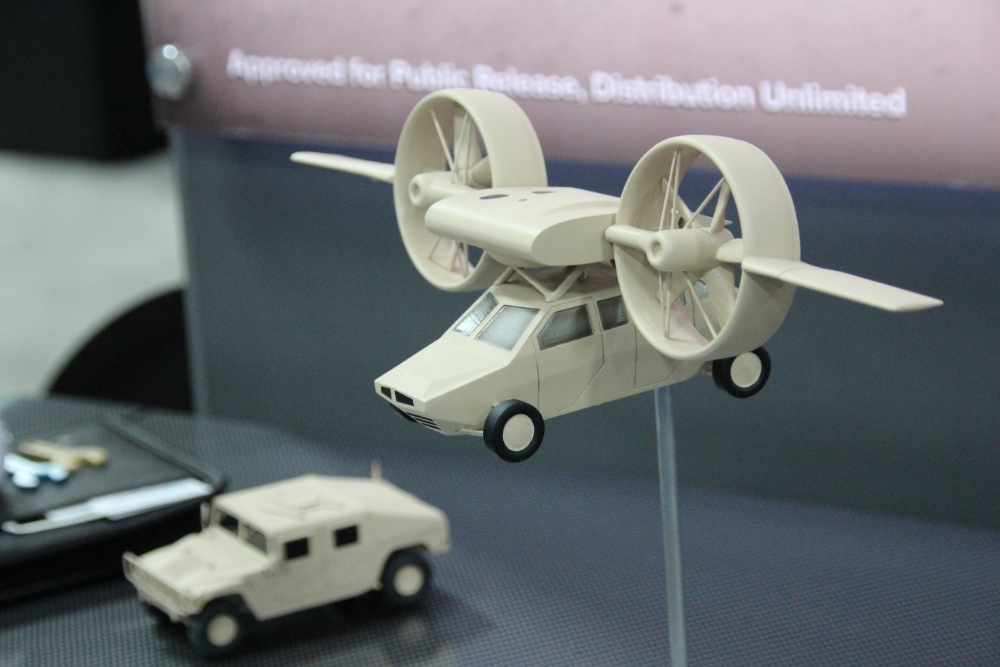
When DARPA launched its Transformer (TX) program back in early 2010, PopSci responded as most media did by applauding the ambition while simultaneously harboring serious skepticism. In essence the DoD was asking for a flying car, a “1- to 4-person transportation vehicle that can drive and fly,” capable of vertical takeoff and landing (VTOL), for troops looking to avoid rough terrain and IEDs. The very idea simply feels impossible--at least until you have a sober conversation with the guy building it.
“Weight is the number one challenge,” says Kevin Renshaw, program manager for Lockheed Martin’s Transformer development team. He says it like he’s designing a better golf club or a faster race car, simply tweaking something that’s otherwise a foregone conclusion. Actually, he says, weight is the number one problem after cost, which is difficult to contain when you’re trying to invent science fiction from scratch on a tight timetable. His team has designs to address the weight concerns, he says. Executing them within realistic budget constraints is another thing.
Lockheed’s design, like that of the other development team pursuing the Transformer contract at AAI Corp. (a unit of Textron Systems), is exactly that: a design. Neither team has actually begun building a prototype of its envisioned vehicle, though both have brought scale models here to AUVSI’s Unmanned Systems North America expo that are getting a fair amount of attention. This is the first time Lockheed personnel have talked openly about the status of their program (PopSci approached AAI about this at the unmanned systems show as well, but representatives there chose to remain silent on the issue beyond acknowledging that yes, the company is very much still in the competition, and yes, its design is viable).

It’s a good time to conduct a little PR. Both Lockheed’s and AAI’s projects recently passed a preliminary design review by DARPA, one that included computer modeling of the designs. Both designs passed muster. From an engineering perspective (albeit a theoretical engineering perspective), the modeling didn’t reveal any show-stopping flaws in either concept. For Renshaw and Lockheed, that means that for now they are on the right track.
“The car portion is pretty straightforward,” Renshaw says of his team’s design, which relies on two huge turbo-shaft fans and folding wings fixed to a turret atop the cab to provide the lift and thrust for the vehicle in flight. “It’s the flight that will be challenging, but computerized flight--that’s what Lockheed Martin is best at.”
He’s specifically referring to the flight computer that is going to make the airborne portion of the vehicle’s operation almost completely automated. The vehicle is designed to carry Marine or Army infantry rather than trained pilots, Renshaw explains. He envisions something like an iPad mounted on the dash that allows Marines to simply plot their course on a GPS interface when they switch from surface to flight mode: “I’m here, and I want to go here.” With a flight plan entered, the fans then rotate 90-degrees on their turret from their stowed positions just in front of and behind the cab to their in-flight positions on either side of it. The wings extend, and the computer takes over. Marines onboard would be able to alter course mid-flight or order it to the ground in an emergency, but the actual control of takeoff, landing, and flight would be performed by the computer.
And where does this super-sophisticated flight computer for the world’s (potentially) first flying car come from? From none other than the F-35 Joint Strike Fighter, the world’s (potentially) most sophisticated fighter jet.
“We’re pulling the baseline logic from the STOVL F-35,” Renshaw says (referring to the jump-jet-like short takeoff/vertical landing variant of the fighter designed for the U.S. Marines). It’s by no means the exact F-35 software, he explains, but it’s the foundation of the Joint Strike Fighter’s flight computer reconfigured for the aerodynamic profile of a four-door car. Working off a principle known as dynamic inversion, it basically evaluates moment-by-moment where the aircraft wants to be next, and works backward to where it is right now to determine the proper way to transition between the two.
Of course, the F-35 is over budget, behind schedule, and riddled with challenging design problems--and it’s an actual airplane, something Lockheed has designed and built countless times before (to be fair, it’s an extremely complicated aircraft to build). The Transformer program expires in 2015, and that’s when DARPA wants to have a working prototype of its flying humvee (the agency will choose which of the two designs will move forward into the prototyping phase at the end of this year after a further design review). And while both designs have their merits and demerits--Lockheed’s would maintain a controlled hover while AAI’s would not; AAI’s likely has more design leeway in terms of weight (and potential up-armoring) while Lockheed has a lot of weight sitting on top of the vehicle--neither is going to be easy, or cheap, to build.Renshaw describes the design process thus far as “a battle of details.” Each small problem requiring a small design tweak, and those often result in another small uptick in overall cost. When the program comes to fruition in 2015, the idea is that DARPA would hand it off to one of the military branches--presumably the Marines or the Army, or perhaps Joint Special Operations Command--but thus far no one has expressed overwhelming interest in shelling out for its further development.
The designs are marching forward and DARPA might just have its “flying car” in as few as three years. The question is: will anyone be able to afford it?

140 years of Popular Science at your fingertips.
Each issue has been completely reimagined for your iPad. See our amazing new vision for magazines that goes far beyond the printed page
Stay up to date on the latest news of the future of science and technology from your iPhone or Android phone with full articles, images and offline viewing
Featuring every article from the magazine and website, plus links from around the Web. Also see our PopSci DIY feed
For our annual How It Works issue, we break down everything from the massive Falcon Heavy rocket to a tiny DNA sequencer that connects to a USB port. We also take a look at an ambitious plan for faster-than-light travel and dive into the billion-dollar science of dog food.
Plus the latest Legos, Cadillac's plug-in hybrid, a tractor built for the apocalypse, and more.

Online Content Director: Suzanne LaBarre | Email
Senior Editor: Paul Adams | Email
Associate Editor: Dan Nosowitz | Email
Assistant Editor: Colin Lecher | Email
Assistant Editor:Rose Pastore | Email
Contributing Writers:
Rebecca Boyle | Email
Kelsey D. Atherton | Email
Francie Diep | Email
Shaunacy Ferro | Email
I guess they will change the name from High Mobility Multipurpose Wheeled Vehicle (HMMWV) to High Mobility Multipurpose Winged Wheeled Vehicle Aircraft (HMMWWVA)?
Why not just build a quad copter, why bother with all the extra crap, it's not going to go fast with ducted fans anyway, so why ruin stability for a few extra knots? Or rather than making it look like a freaking truck with wings ontop... why don't they design from the ground up. Take a science fiction designer, show them what they have to work with and let them do the rest... adding function without form ruins both.
Playing Devil's Advocate since 1978
"The only constant in the universe is change"
-Heraclitus of Ephesus 535 BC - 475 BC
What a complete waste of tax payer money.
I think AAI's concept is superior,as the stubby wing and rotor can be more compactly stored than with the other concept,which to me,at least,looks almost cartoonish.
Carter Aviation Technologies is developing modern gyrocopter aircraft-they should have entered the contest.Google: "CGT-100 Gyroplane" for a look at their transport concept.
Complete waste of money and time. It took our government nearly a century to get the osprey together and now they give us another pork barrel project to line the pockets of some eccentric engineers who are apparently part of the in crowd over at the military-industrial complex. This is a total waste. Whatever happened to the clear aluminum/glass the Air Force was developing that could defeat multiple rounds of .50 cal? I remember seeing that story a few years ago and now there is neither hide nor hair of that product on our shelves.
In my opinion, this is idiotic on all levels. For a variety of reasons. Let's start with the premise: you want to design a flying humvee- in order to avoid IEDs and roadside bombs. Why exactly does that chain of reasoning lead to "flying car?" Why not "IED-proofing for our hummers"? It's pretty common knowledge that hummers aren't well-designed to survive IEDs anyway. Why not start there? Or how about increasing protection and detection on the roads? Invest in a minesweeper? ANYTHING before you have to resort to FLYING CAR?
But okay, let's assume for the sake of argument that flying car is the only way to go. How exactly would that work? You're driving along most of the time anyway, and a car light enough to be an aircraft would be FAR more vulnerable when they DO roll over a bomb. You would have to literally know most of the time where the IEDs are in the first place so that you could fly over them. If you already knew where the bombs were.... Then WHAT, again, is the point?
But okay, let's assume for the sake of argument that flying car is the only way to go, and that they magically fly over IEDs reliably without even knowing that they're there. Now we come to the vulnerability issue: an aircraft, particularly one so ungainly and wasteful, cannot afford the weight of much, if any, armor. IEDs may be a problem, but in the meantime, what on earth are you going to do about RPGs and small arms fire? On the ground as well as in the sky? These things are absolute sitting ducks, and I guarantee you, any soldier that looks at it for more than a second will avoid that deathtrap like the plague.
Lastly, let's get to the inherent design issues. They are absolutely unavoidable. No amount of ruinously expensive funding or exhaustive over-engineering can compensate for the fundamental nature of the thing. By building a car that can fly, the car is going to suck at being a car because it has to compromise several of its design imperatives in order to fly. An aircraft that can drive will similarly suck at flying because it has to compromise on its design, and will end up being as slow, low-hanging and vulnerable as a winded sloth. And, in all probability, as stable as an alcoholic on a trampoline.
There is literally no avoiding these problems. It is inherent in the nature of the thing. Sometimes compromise works, particularly if there's a large, comfy niche between two things; things like amphibians, hybrid airships, the Subaru Outback and fusion cuisine are all excellent examples of this working very well. But as the gap grows wider and wider, it becomes an impassable chasm, where compromise is both absolutely necessary and absolutely ruinous. It's called being the "worst of both worlds," and this utterly asinine vehicle embodies it perfectly.
---
Always defer to facts rather than philosophy.
I looked at this when the idea came out. It was bogus then, and if anything worse now. Does anyone remember the Heller flying platform? No? Okay. I also want to draw attention to the Soviet "flying tank". THe concept has been tried before, and failed... fantastically.
Now SgtB, when was tyhe Air Force working on that? I would like to figure out if it can indeed be done.
J. James, nice way of calling DARPA a bunch of eccentric lunatics.
AAI's concept doesn't look aerodynamically correct. The ducted fan in the tail has a heavily obstructed intake by the body of the vehicle being right in front of it. In addition the fixed wing is going to obstruct the downward air flow from the rotor. It's inefficient at best.
The Lockheed design looks aerodynamically correct but I'm not sure what they would do with those bulky ducted fans when on the ground, they're going to make the vehicle too wide on the ground unless they can swing forward and aft or fold up.
How about a quad copter version of the sky crane they used to land the rover on Mars. Make it a drone so you can order one up any time you like.
instead build a pelican from halo and warthogs to be airlifted by the pelicans because the warthog can sustain an explosion of a missile from 100yd's