
New advances in quantum teleportation keep coming with greater frequency. Today, a team of European physicists sets the bar higher than ever before. After officially reporting teleportation across nearly 90 miles, through the turbulent ocean atmosphere of the Canary Islands, physicists could be ready to take on the greatest challenge yet — an attempt to teleport particles into space. But why?
Because quantum teleportation, though it’s as complex as the sky is blue, could be a useful, secure way to transmit information. Not people, unfortunately — Star Trek this is not. But in 2012, teleportation of data, in an unhackable, purely encrypted form, could be closer than ever.
On Thursday, Nature published an advance online paper by quantum wizard Anton Zeilinger and colleagues at the Institute for Quantum Optics and Quantum Information in Vienna. The team teleported photons 89 miles between the two Canary Islands of La Palma and Tenerife. And last month, the same journal published a Chinese team’s newest teleportation record, a total demolition of their own previous feat, teleporting photons across 60 miles. Both teams first reported these accomplishments within days of each other in May.
But the record-breaking masks the complexity of what’s really going on here. After all, the particles didn’t really, technically, go that distance.
Some photons did physically traverse the distance between the two places, but they were used only as a preparatory tool, to build up what physicists call an “entangled resource,” explains Philippe Grangier of the Institut d’Optique in Palaiseau, France. Then, the information describing the actual photons to be teleported — their polarization, especially, along with other characteristics — was moved. The teleported particles existed in one place, and then they existed somewhere else instead.
This is possible because the photons in a teleportation experiment share an inextricable bond, so tight that whatever happens to one particle happens to the other, no matter how separated they are. This is what Einstein called “spooky action at a distance.” Getting them entangled is a challenge in and of itself; more on that in a moment. Then teleporting them relies on creating a remote copy of one of them, Grangier said. Think of it somewhat like a fax, but one in which the original is destroyed — and in the moment the copy is received. You must relay the information somehow, and quantum entanglement makes this possible.
The method of entanglement you choose depends on the type of particle you want to teleport. If you want to teleport charged atoms, for instance, you would use entangled ions. For photons, you would entangle polarized photons. Or it may be a quantized state of light, which Noriyuki Lee and colleagues pulled off last year. The latter is an exquisitely complicated scenario, in which you’re teleporting a little packet of photons that is in two quantum states at once. (That’s called quantum superposition, and it’s best described by the example of Schrödinger’s cat — once placed in a theoretical box, it is both dead and alive simultaneously, until you open the box to check it, and then it’s only one or the other.) Whatever the subject, you’ve got to entangle some particles first, entwining their fates so they share the same outcomes no matter what happens to them.

This entanglement can happen in a number of ways, which are getting increasingly detailed and complicated with every new study. But more importantly, the entangled photons must not be interfered with, lest their entanglement be interrupted before your teleportation time. This is very hard to do when the teleportation covers tens or hundreds of miles — rain, clouds, sand and even wind can disrupt the transmission of light.
“The real-life long-distance environment provided a number of
challenges for the present teleportation experiment. These challenges resulted most significantly in the need to cope with an extremely low signal-to-noise ratio when using standard techniques,” Zeilinger and colleagues write.
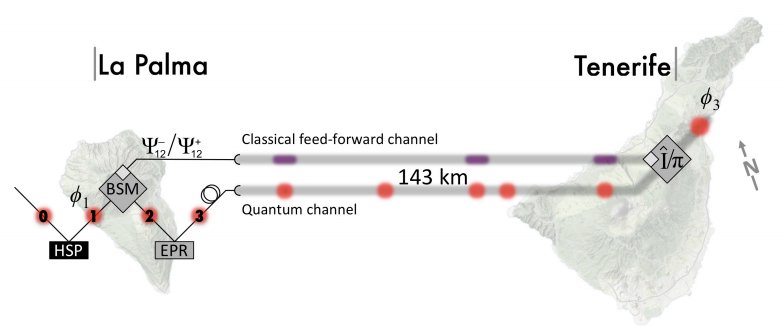
“For ordinary objects, the complexity of the entangled resource becomes just incredible and unmanageable, and it will be instantaneously destroyed.” In the Canary Islands experiment, Zeilinger and colleagues used two optical links, one classical and one quantum, across the islands of La Palma and Tenerife. They wanted to teleport the polarization of photons between two sites, usually referenced in information-transmission experiments with the alphabetized names “Alice” and “Bob.”
The classical link enables two photons to be sent, one to Alice and one to Bob, to create the entangled resource. Simply put, the photons are created with a sapphire laser and move through a fiber optic cable to A and B. The quantum link allows Alice and Bob to share the polarization information about these photons, which are called photons 2 and 3 (#1 comes in a moment). Alice has photon 2, and Bob has photon 3 — this is the “entangled resource.” Then a third party, “Charlie,” puts in photon 1. This new photon’s polarization is unknown to either Alice or Bob. Then Alice has to make what’s called a Bell-state measurement, the outcome of which will determine every photon’s fate.
“The result of the measurement destroys the initial system. What you get out of this measurement is one result, a numerical result,” Grangier said. “Then you send this result to the other side, where you want to recreate your new system.”
Alice’s measurement of photon 1 dictates how Bob’s photon will be transformed. Alice sends her measurement to Bob using that classical photon-relay channel. When Bob gets the information, he can perform the photon-transformation dictated by Alice’s measurement of photon 1, and then voila — Bob has photon 3, but now it’s in the same state as the newly inputted photon 1. It’s a perfect copy.
This forwarding of measurement info is called active feed-forward, and it’s also the technique Lee et al. used in the light-packet Schrödinger’s cat experiment last year. It has never been done before on this scale, Grangier said. The Canary Islands team also made a new breakthrough by synchronizing the clocks at both Alice’s and Bob’s locations, which improved the accuracy of their measurements.
“What’s original is the combination of everything, very long-distance feed-forward and high quality of the transmission,” Grangier said.
What’s the point of all this quantum confusion? Secure communications, Grangier explains. Teleporting photons in a specific, measurable state that can only be received when a proper transformation-measurement is made — that’s good security. Proving it can be done with high fidelity across the ocean is quite a feat, too. This research holds promise for future ground-to-satellite quantum relays, transferring encrypted data, Zeilinger and his colleagues say.
The distances achieved here are actually more difficult than those required to link Earth and a satellite, the team said. “Our experiment represents a crucial step towards future quantum networks in space, which require space-to-ground quantum communication,” they write. “The technology implemented in both experiments has certainly reached the required maturity for both satellite and long-distance ground communication.”
The only difficulty is that this only works inside very carefully controlled quantum systems. For instance, quantum teleportation might work as an internal “wiring” element, within a quantum computer. But it won’t work for physical objects.
To beam up a person, you’d have to create a suitable — but not easily conceivable — entangled resource, a second “person.” Then you would have to destroy the original self of the teleported living thing, Grangier said.
“It’s quite possible to teleport photons and ions, maybe many of them within a very carefully controlled quantum computer. But beyond that, the complexity of the resource and its vulnerability to decoherence make it completely impossible,” he said.
“For usual macroscopic objects, the complexity of the entangled resource becomes just incredible and unmanageable, and it will be instantaneously destroyed by decoherence.”
