
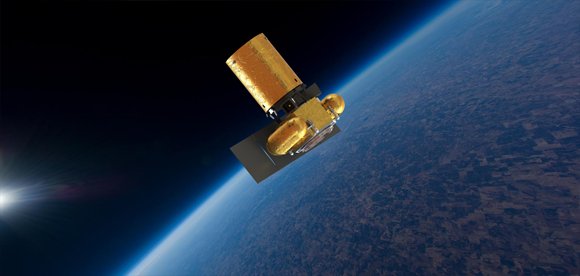
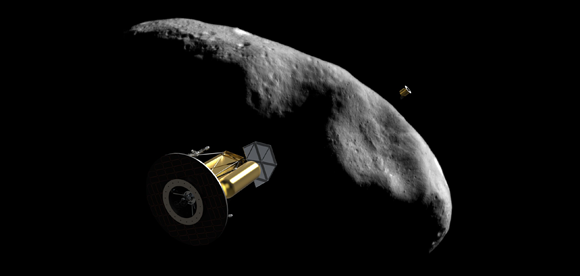
Billionaire-backed space startup Planetary Resources has officially unveiled its business plan to much fanfare and with few surprises. The company’s principals--which include X-Prize Foundation founder Peter Diamandis, Space Adventures co-founder Eric Anderson, and former NASA Flight Director Chris Lewicki--today pledged that Planetary Resources would make the abundant resources of space available here on Earth, and introduced a couple of the company’s own spacecraft that will make such space prospecting possible. The rush for space resources is officially on.
Planetary Resources envisions a future in which the value of resources extracted from near earth asteroids (NEAs) totals tens of billions of dollars annually as robotic spacecraft deliver precious metals to Earth and water ice to orbiting space stations, outbound spacecraft, or space depots that will serve as orbital “gas stations” by processing water into hydrogen and oxygen, two key ingredients for chemical propulsion (oxygen could also be siphoned off for breathable air supplies).
How will Planetary Resources pull it off? Details are a bit scarce at this point, as admittedly Planetary Resources itself hasn’t exactly figured out the entire process. (We speculated a few months back about possible approaches to space mining.) But the company is somewhat far along when it comes to laying the groundwork for the commercial space sector’s eventual push into deep space.

The company unveiled designs for two new spacecraft it intends to deploy in the relatively near term--the Arkyd Series 100 Leo Space Telescope and the Arkyd Series 200 Interceptor--the former being slated for launch within the next two years. Further robotic spacecraft will be developed to evaluate asteroids for their water and mineral content and to eventually mine and perhaps relocate them to orbits more amenable to mining.
Most importantly, Planetary Resources plans to do all this on the cheap. The first Arkyd Series 100 telescopes are expected to be relatively inexpensive, on the order of $10 million dollars each, and will hitch rides to low earth orbit aboard existing satellite launches. And the company’s philosophy is centered on opening up deep space and the asteroids that live there to exploration while keeping the company’s value proposition intact.

Doing so is not going to be easy, but it does have its economic allure. There are roughly 9,000 NEAs currently on record, and that’s estimated to be just one percent of the total NEAs out there larger than about 165 feet. A 1,600-foot diameter asteroid rich in platinum group metals--things like rhodium, palladium, osmium, iridium, and platinum itself--could yield the equivalent of all the platinum group metals ever mined on Earth, the company says.
A single asteroid could offer up billions or even tens of billions of dollars (depending on size and composition) in mineral wealth even if it cost a billion or two to mine. That’s not even factoring the water, which itself becomes a precious commodity in the decidedly dry climate of space. As such, initial exploration will focus on water-rich asteroids, as Planetary Resources appears to view its goal of establishing a means to harvest and supply water in space to be of equal importance to extracting precious metals. The H2O these NEAs provide will serve as a crucial enabler to further deep space exploration, and a linchpin in the in-space infrastructure Planetary Resources hopes to install at points beyond low earth orbit.
While Planetary Resources hasn’t thrown back the curtain on exactly how their mining operation will unfold, it’s important to note at this point that while some of this may sound like it’s on the fringe of what’s possible--and it certainly is--there’s no great reason to doubt the company’s ability to deliver on this goal. Planetary Resources has financial backing in spades, including the likes of Google’s Eric Schmidt and Larry Page and Ross Perot Jr., son of the former presidential candidate and billionaire. And with funds in place, practical aspects become less daunting. Caltech’s Keck Institute for Space Studies (KISS) released a report (PDF) just this month on the feasibility of retrieving an asteroid from its orbit in deep space and placing it somewhere more accessible and convenient--perhaps at one of the Earth-Moon Lagrange points where the gravity between the two larger bodies would hold it more or less stationary (relative to the moon, anyhow).
The KISS analysis concluded that not only would something like this be safe--any orbital instability would send the asteroid toward the moon rather than Earth--but that given the current pace of technology, we could reel in a 500-ton asteroid by 2025 at a cost of roughly $2.6 billion. Given the value of the extractable resources, that might not be such a high price to pay.Then there’s the value that can’t really be quantified with dollars. Planetary Resources is talking about cheaply and efficiently bringing vast supplies of platinum from space down to Earth. But the company is also talking about creating the technological and practical infrastructures needed to both establish a permanent presence at points far beyond low Earth orbit as well as to open up deep space for regular exploration via its in-space refueling stations. The company will also presumably hone humanity’s capabilities when it comes to charting, characterizing, and eventually moving NEAs--skills that might come in quite handy should Earth find itself in the path of a so-called killer asteroid.
But perhaps most intriguingly, should Planetary Resources succeed it will mark a true turning point for commercial space as an industry. Under President Obama’s mandate, NASA is scheduled to land a human on an asteroid sometime around 2025. But that mandate is somewhat nebulous, and looking in from the outside it’s difficult to tell if NASA is actively pursuing that milestone given its already full plate.
NASA has a storied track record and Planetary Resources merely has some interesting Powerpoint slides, some big-money backers, and a press conference under its belt. But the fact remains that a successful Planetary Resources could at some point out-NASA NASA by doing things with (and on) asteroids that even the world’s premier government-backed space agency hasn’t yet accomplished. If Planetary Resources manages to do half of what it aims to do over the next decade or so, it will truly be venturing where no one has gone before.
Five amazing, clean technologies that will set us free, in this month's energy-focused issue. Also: how to build a better bomb detector, the robotic toys that are raising your children, a human catapult, the world's smallest arcade, and much more.


Online Content Director: Suzanne LaBarre | Email
Senior Editor: Paul Adams | Email
Associate Editor: Dan Nosowitz | Email
Assistant Editor: Colin Lecher | Email
Assistant Editor: Rose Pastore | Email
Contributing Writers:
Rebecca Boyle | Email
Kelsey D. Atherton | Email
Francie Diep | Email
Shaunacy Ferro | Email
The moment you start mining them expect Europe, China, Japan, India, Russia and all the worlds nations to demand a share of profit on these resources that supposedly belong to all of mankind. Let the United Nations control it and share the profits with all the world. Like oil in nations like Saudi-Arabia and Norway is now shared within the nation state. But if companies keep the profit for themselves they could likely start a war. Especially with rising India, EU and China.
"....A single asteroid could offer up billions or even tens of billions of dollars (depending on size and composition) in mineral wealth even if it cost a billion or two to mine..."
I have asked the question before on a different article and got no response. Perhaps, a response will be found here.
Exaggerated expectations of,” THERES GOLD IN THEM COSMOS! YE'HA!”, what do we know factually are in the asteroids, that would for fact justify such a costly venture?
The only thing I have read is asteroids are mostly made of iron. Aaaa, isn't it much easier to get iron from the Earth?
So factually, what minerals, elements, exotic things would make a "GOLD RUSH" for outer space?
We have a clear history of some people wasting their live panning in the streams, hoping to find that rare gold nugget.
If it a private company doing the search, great. Please do not spend my tax dollars on this venture, unless you give me something factual and it will help everyone.
.............................
Science sees no further than what it can sense, i.e. facts.
Religion sees beyond the senses, i.e. faith.
Open your mind and see!
@Robot
Read this: "A 1,600-foot diameter asteroid rich in platinum group metals--things like rhodium, palladium, osmium, iridium, and platinum itself--could yield the equivalent of all the platinum group metals ever mined on Earth, the company says."
That seems pretty factual to me. Unless the company is lying, which seems a little doubtful.
dj-nate,
If they are sincere investors towards exploiting this asteroid, then yes, I believe them. Or are they promoting the USA government to give them tax dollars for a free ride of space exploration?
I like to find rare earth elements that will help USA become energy independent. (I mean any kind of element that helps us to be energy independent, with No harm to the environment.)
How much is platinum worth, if we are still dependent upon fossil fuels and other countries?
.............................
Science sees no further than what it can sense, i.e. facts.
Religion sees beyond the senses, i.e. faith.
Open your mind and see!
This is a great idea, simply put. BUT the question is "Will it actually happen?". Listen, if this actually happens you can bet I'll be the first guy to submit my resume to get a job somewhere off of this rock. But I want to know what the chances are of this working.
A little day dreaming\brain storming here: Is this just a general interesting POPSCI article or has "someone actually found something of great value in outer space" and they are putting feelers on all the legal questions that may rise later? Hmmmm?? Are they trying to gain advance legal and political information, prior to actually make this asteroid mining happen?
Well if somebody actually found something, we will know soon enough as it becomes publically aware to attempt and venture out towards those RICHES!
.............................
Science sees no further than what it can sense, i.e. facts.
Religion sees beyond the senses, i.e. faith.
Open your mind and see!
It would be cool if that asteroid glove they are showing would act as a crucible and a centerfuge as well. They could run an electric current through the asteroid, melt it, then spin the entire spaceship and siphon out what they don't want to keep. With a ship that heat resistant and flexible they could probably reform it while the metal was still molten into a landable shape let it cool and harden then parachute it to earth, depending on its size of the asteroid.
@dj-nate
"A 1,600-foot diameter asteroid rich in platinum group metals--things like rhodium, palladium, osmium, iridium, and platinum itself--could yield the equivalent of all the platinum group metals ever mined on Earth, the company says."
The key words there are "rich" and "could". This is not a factual statement is a conjecture statement.
Currently I do not think we know enough about the composition of these asteroids so say for certain that an asteroid exist that has a high enough concentration of those elements to be consider "rich"
bob clemintime,
Yes we are a ground concurring culture and once you acquire your castle and lands, yes you must fight to keep your castle and lands.
I made this point way up top. So if you find your riches in on an asteroid, great. But it is also up to you to fight to keep it and get it back to Earth.
Now if it proves worthy to find your riches on an asteroid, so it will be for someone else to pirate\steal it from you. In outer space there is no local police and if you get destroyed for your bounty, so it goes.
By the way, this article says an asteroid could be worth up to 10s of billions of dollars. Now since a company has done all the work to acquire it, then it would be an easy thing and valuable thing to steal. I say motivation would be on the extreme to steal it.
This brings us to another point. Any great riches need to be defended, so I see these outer space mining companies caring weapons too.
Now what happens if you platinum and other precious metals is not allowed on Earth, for fear of contamination of the planet. So there goes a several billion dollar investment bust....
Oh, some minerals are toxic too.... While we see rich mineral on those asteroids, what other things may they carry? Now we have a new governmental department: Cosmos Customs, lol.
.............................
Science sees no further than what it can sense, i.e. facts.
Religion sees beyond the senses, i.e. faith.
Open your mind and see!
What about the danger of bringing an alien pathogen back to the home world, against which the feeble earthlings have no resistance or immunity?
"Let the United Nations control it and share the profits with all the world."
That would be absolutely unfair. You're asking that the people and companies who do this assume all of the risk and cost of doing it, and then have to split the reward with everyone just "because". That's mafia bullshit. If private entrepreneurs sacrifice their time, resources and energy for this, they and their investors deserve it. The more you incentivize something, the more you get of it. If they have to divide it up and get basically nothing, they will not do it. Consider how tyrannical your viewpoint is.
If I see commercial space mining in my lifetime, that would be awesome. If humanity branches out into space, that would be lovely if you ask me, not to mention the advantages to having a "backup" in the event of WWIII or giant meteor.
While mining asteroids is probably theoretically not as difficult as it sounds, the main concern I have is that they'd have to create the entire infrastructure to do it. That's where the problem lies. Once you get up interplanetary "gas stations," space elevators, and whatever else might be useful/needed, space exploration and colonization is more than feasible. It's a matter of getting that infrastructure up that will cause them their problems. If they begin mining water and electrolyze it for fuel and keep it in large orbital repositories, all of a sudden, trips to the moon or Mars aren't so far fetched anymore.
Let's say that NASA and the ESA build elevators while this company sets up gas stations. The price of space travel would plummet drastically and that's certainly not a bad thing.
Well, I suppose it could be. Factions in space vying for resources seems to be the premise of a lot of sci-fi wars, but here's hoping that doesn't happen as treaties (currently) prevent militarization of space. Let's hope it stays that way.
@ComputerUser: I'd find that very unlikely. I suppose it is possible, but my guess is that most things would die either from the massive amounts of radiation in space or from being exposed to reentry. I'm not just talking about temperatures. The pressure difference or gravity might kill them. Who knows? My guess though is that it would be safe in that regard.
@low spender: outerspace resources belong to all mankind and the same model of companies from around the world coming into nations to drill for oil and gas applies. Most of the profit goes to the nation state, but more then enough is left for the oil companies.
Mr. Greenmatrix,
Lowspender has named your viewpoint that the development of outer space resources should be put under UN control and shared with all mankind as tyrannical. I would say it is more communistic.
Also, I do not share your view that as soon as a private company begins to develop these resources and keep the profits for themselves it will start a war. What is stopping Russia, China, India or the other countries from engaging in this enterprise themselves other than the lack of motivation? Just speaking of the asteroids, there are so many of them out there I do not see how it is possible to monopolize this resource.
Actually, I see outer space resources as being one of the biggest equal opportunity prospects that there is. It is there for whoever is smart and motivated enough to go and get it…and that goes for EVERYONE on the planet.
If a country or people has spent their time and resources on fighting amongst themselves or otherwise engaging in behavior that has not been conducive to their own advancement than that is their fault and nobody elses. For example, it is well within the means of the Gulf Oil States that you mention like Saudia Arabia (Also Abu Dhabi, who toss around billions for prestige projects like the world islands project…www.dubaimoves.com/9004/dubai-crisis-abu-dhabi-debt/) to finance an endeavour such as this if they had the motivation. Also, China is not lacking in financial resources and neither is Russia.
What are they going to do with the waste. If they hall a 500 ton asteroid to a mover convenient location for mining there will be 499 tons of waste. It wont take long before that convenient place will be ruined. That location will be filled with broken up pieces of the asteroid.
Why in heavens name would anyone think that a small asteroid would have anymore minerals than an equal sized piece of earth. We need a little reality check here. If you were going to mine on earth would you go to someone and ask for 2 billion dollars to mine a location which you haven't been to know nothing about and can't even tell your investors if there is anything worth mining at the location. That would be a very hard sell.
Asteroid mining is in our future, just not yet.
I imagine the first step of this project is to systematically and thoroughly study as many near earth asteroids as possible and try to determine their composition. After suitable candidates are identified, probably some cheapo robot craft would be sent to verify the objects' mineral content. After the minerals have been actually discovered, then a more powerful mining robot would be sent to do the real work.
It would be in the interest of the company to keep as much of this secret as possible, as they would not want someone else to get a mining robot to an object ahead of them, once a promising asteroid has been identified. Probably no wars will be started over this sort of thing, but I imagine that international courts will have to hear all kinds of disputes between companies arguing over space mineral rights.
Assuming all this works as planned, I wonder how they will get the valuable minerals back to Earth without burning up a significant portion during atmospheric reentry and scattering them everywhere upon impact. To use parachutes and make soft landings would require the goods to be broken up into many small pieces.
I like all these comments about pirates raiding and steeling the resources from them.
How are the pirates that use wooden boats and AK-47's going to find the funds needed to fly into space, hijack the goods and return?
Maybe when space travel is dirt cheap because of the fuel stations that are being planned. But even then, somehow I don't see that being very profitable.
Perhaps Russia or China might have the resources, but that would be like Russia taking an oil rig and steeling it from India.
While there wouldn't necissarily be acts of war involved, there would be immense backlash, and something tells me going up into space steeling resources and bringing them back is a little difficult to do without leaving some sort of trail...
Either way, I think while as entertaining as it is to think of turf wars in space, there will be no such thing, atleast not for a VERY long time. court battles? Yes, expect lots of those, and probably rather soon.
no one mentioned that this is very like the doomsday machine from star trek the original series.
you can look up The Doomsday Machine (Star Trek: The Original Series) on wikipedia
@Greenmatrix: There's an almost endless supply of asteroids. If mining them proves profitable, then other nations would be free to go and get some of their own. Wars are often started over scarce resources -- there is no scarcity of asteroids.
@Robot: Do some research before posting -- you might avoid embarrassing yourself. There is plenty of evidence that the valuable minerals (including water) are there.
@cfs3corsair: If it happens, the backers will become even richer than they are now. They got to be rich, because they were right more often than wrong; and they were willing to take risks and act.
@Robot (4th comment): Anyone, who could afford a pirate mission into space, could also simply go out there and grab a few of their own asteroids. You don't even write good science fiction.
@Volt: You make a lot of good points -- but, if asteroid mining works, there would be no reason to go to war over the resources. There's a virtually limitless amount out there. It would be easier, safer, and cheaper to just go and mine your own asteroid; rather than fighting other people for theirs.
@Greenmatrix: You have outlined a means for guaranteeing that none of the resources in space will ever be exploited. How does humanity benefit from that?
@hollycow: Perhaps you and Robot could share your research, and avoid embarrassing yourselves. There is abundant evidence that asteroids do contain concentrated valuable minerals (including water).
@D13: RTFA (read the flipping article). The exploration and mining would be done robotically -- no humans in space needed.
To all of the above: It's easy to see why the backers of this project are filthy rich, and you're not.
Boondoggle. But a cool one.
tundrasea,
LOL, thanks.
.............................
Science sees no further than what it can sense, i.e. facts.
Religion sees beyond the senses, i.e. faith.
Open your mind and see!
Note that the KISS study suggests 2.6 billion dollars just to bring a 7-meter rock to moon orbit ... by 2025. Not a 1600-meter platinum rich near-Earth object. Nor do they figure any additional costs for doing something with it (can't estimate the cost of technology that doesn't exist). That's just to bring a 500-ton rock here ... and we all know which direction that cost estimate will go.
Down thanks to SpaceX
I keep telling people this whole space thing is hoopla, you can't even move in space because there's nothing to push off of!
- this is a joke, much like many of these comments which ignore and omit scientific evidence. Look past where we're at now. Yes it is conjecture, so isn't litterally any other hypothesis thats ever existed!
What excites me are the possibilities that this architecture promotes besides asteroid mining.
1. Asteroid threat mitigation
2.Potential cometary threat mitigation
3. Survey telescopes could become an optical interferometer suite for deep space and extrasolar planetary observations
4.Open up wideband interplanetary communications and alleviate stress on DSN
5.If a large number of these compact space telescopes are deployed, they could be leased out for personal research, data gathering and observations.
6...and the list goes on....
Good luck the this team !
Mining asteroids still sounds crazy. What I think will actually happen is this:
1. Developments in Pulsed Power technology and capacitors will make antigravity technology increasingly practical. Reaching the asteroid belt will be done by short fast flights, and will be comparable to international aircraft flights today. There will be no need to store (or mine) huge quantities of food or water. See:
scripturalphysics.org/4v4a/CapacitorTests/CapacitorTests.html
scripturalphysics.org/4v4a/ADVPROP.html#MotionCancellers
2. Furthermore, there are indications that locations in space may be much closer than commonly thought. See:
scripturalphysics.org/4v4a/ADVPROP.html#GeometrySpaceTimeMotion
3. As for valuable metals, we already have a ready source: spent nuclear fuel (SNF). This could become a huge business opportunity if and when governments stop subsidizing commercial nuclear power and tell them to get rid of their own nuclear waste without government assistance. These companies will QUICKLY find ways of converting SNF into valuable (and safe) by-products. See:
http://scripturalphysics.org/qm/adven.html
Hence, a more "down-to-earth" focus is indicated. The REAL adventures are right here NOW on Earth!
Brian Fraser, Scottsdale, Arizona
@D13
You don't seem to get the fact that we don't do things because we have the means to do it; we build the means because we want to do something. Also you are lazy. You can't even look forward to doing something new and maybe making amazing discoveries because it takes some time. You're the the one who if wast their time because you add nothing of worth commenting.
@BrianFraser
1 Anti-gravity isn't real, and that invalidates the rest of one.
2 That doesn't really help us.
3"As for valuable metals, we already have a ready source: spent nuclear fuel (SNF)," but you forget that it costs more to make things like gold that way than the amount of money you will make from the gold. Also don't you think that if it could be done waile being able to make money off of it a counrty with nukes would have tried to make gold?
@D13 - Gravity!!? Haven't you ever heard of a Space Wheel. You build a space station in the shape of a bicycle tire, spin it and live on the inside of the rim at 1G and 1 atomsphere air pressure, just like on earth. Centrifugal force subs for gravity. That is the way the ISS should have been built. A private space company is planning to launch an inflatable space station (relatively cheap to build compared to the ISS) with the Space Wheel concept as it's design. A controlled artificial gravity field is presently Sci-Fi and may never be attained, but a centrifugal force based space habitat concept is basic, known physics and goes back to the 1800s. Ever hear of Space Colonies?
To the rest of you nay-sayers, if Columbus, Drake, Ford, Edison, etc. had listened to the equivalent of you folks in their day, they never would have accomplished anything. Anything worth doing involves risk. The shoot-down artists never do much except complain.
As for me, as soon as I have a little extra money, I’m going to invest in space mining! I might just make a fortune!
electric38
Commenters are correct. Like Mars exploration, rules need to be made by a world council. They need to do it now. Possible rules...
The ideas for exploration agreed on shall be approved by a world council. #1 nobody owns it or its minerals. #2 = no man made boundaries or separations of any kind will be allowed. #3 Everyone (worldwide) shares equally according to their needs with any profits from minerals or gasses. #4 The World Council shall rule on what language is spoken on Mars and everyone shall be required to learn that language. #5 Children born on the planet will become everyones responsibility upon birth. #6 No religion shall be imposed on any person in any form. Any religion that is found to cause any harmful differences in any two persons shall be barred from the planet. #7 There shall be no cost for health care for any person establishing residence on Mars. #8 There shall be no law made that entitles any person from profiting from their ideas (or patents). It is understood that everyone contributed to your intelligence and everyone shall share as their needs call for, in a fair manner. #9 Persons breaking these and other similar rules will be sent back to Earth as punishment. Sentencing will be according to seriousness of crime up to, but not limited to life. #10 Persons found to be lacking in a suitable sense of humor will be also be sent back to earth. #11 Fees for loaning money or supplies shall never constitute more than 10%. Every new year shall mark the end of every financial debt for each and every person. #12 Citizens will bear no weapons. Persons violating this rule will be subject to item #9.
@lschlesi
what are you suggesting ... that we all become Yes men?? No need to read the comments in that case.
For every good idea, there are many many bad ones. Even the good ideas often go bad for one reason or another. To suggest that we should not express thoughts about how this idea (or any other) might be bad or could go bad is just silly.
Luckily most folks will not be so quick to invest in such fanciful plans which have so little to back them up. Some might think that the founders of this new company are in for big losses but it is actually folks like lschlesi that will bare the greatest burden of the early blunders of space mining.
Mining asteroids will need several roundtrip at a tremendous cost, tons and more tons of ores, only with fusion-powered starship to turn up the mining asteroids more economically affordable, then it is needed to start mining the moon's regolith to seek for helium-3 to power the fusion reactor of the spacecrafts. www.youtube.com/watch?v=GSkxPghXTCg
The logistical hurdles are overwhelming.
There are half a dozen newly formed enterprises (some of on top of old companies) attempting to build the next crop of low earth orbit space launch vehicles; all of them using 700 year old rocket technology. "Light the fuse and run like hell", has been my description of space launch vehicles, and this technique has changed little since the Chinese used it 3/4ths of a millennium ago. Why do humans continue to use such an obviously primitive technology to achieve near earth orbit.
There is no shortage of novel ideas that forgo solid/liquid fuel rockets to boost payloads into NEO. And it certainly seems that humanity will be needing a more cost effective, frequent and reliable means of launching thousands of tons of material into space to build orbital platforms, base scavenger bots, assemble Mars mission craft, base asteroid mining from, etc. Yet no actual talk or action of moving to the next launch vehicle technology is progressing. The navy has demonstrated rail guns capable of launching small projectiles 100 miles - with a bit of expansion these could be used to launch modular payloads into LEO. Startram and maglev technologies (see wikipedia) teamed with scramjet technology could be used to launch half ton payloads. These technologies are build-able today. Other fringe ideas, space towers, elevators, etc. are too complex or challenging to approach now. But electro pulse rail/startram/maglev could be built tomorrow.
Why are they not? Why are we stuck using rockets to get stuff into space? If we can't get past using rockets as launch vehicles for transporting equipment/materials/fuel - asteroid mining will just be pure speculation.
The moon could be turned into a Death Star if a bunch of human controled asteroids were put into its orbit. In ability anyway.
Much of the resources mined in space would most likely remain in space.Iron and water if found in objects in space would be more valuable as building materials and resources for space travel and planetary exploration and colonization...should that happen.
Lets suppose there is a processing facility in orbit to mine asteroids and produce usable resources in space....Like fuel, solar panels, food grown in orbit, water mined from comets etc.
If you were planning an excursion to say mars.
It may take years to get there but if you had no need to send the water, food, fuel, most building supplies etc.you would only need to get some equipment and the crew into orbit.the rest would be waiting in orbit.there could also refuel stations or "pods" all along the route to mars.
This means we would not need to send people with all their water and food needed for the trip from the earth to mars.they would only need to stop and resupply at regular intervals en-route.That means no added weight to and consumed space on the craft.
There are many benefits to this enterprise.
the idea itself is not stupid
what's stupid and arrogant is the reason and motivation behind this idea.
you see, the earth and sun provides us with everything we need. WHY THE FUCK would you get MORE STUFF when you already HAVE SOOOOOO MUCH.
well its because of the stupid human greed and the stupid capitalist economy of today.
why do FAT people eat MORE and MORE? Lack of Self-Discipline, just a brainless consumption machine.
i'm totally against funding such a mission.
the reason is simple, we don't DESERVE the extra stuff. we can't even appreciate what we have. more will only increase the problems, not solve it.
when we reach a point where we learn to share everything, then we deserve and earn the respect as a community to do such mining.
other wise, focus on solving problems, please, not make more money.
I'm amazed by some of these comments; theysay doing this is too hard then say the answer is to make it even harder. No wonder we haven't gotten any were in space for 30 years. Also, I'm getting tired of the fools saying we have share it with everyone or offer some utopion rules about when and how we use what we get from NEOs because they aren' basing what they say on anything other than fantacy.
Speaking of Platinum or any rare and expensive resource, a large part of the price, is speculation because of its rarity, what would happen to the price if it was suddenly abundant?
I would not worry about these companies that mine asteroids,
they could become super powerful entities, like the Dutch or the British east India companies, the Hansa or the Hudson Bay company. Overruling and owning the governments of the day, conduct war and make treaties. They would likely be international, and people without access to space would just loose out. The last frontier is up for grabs to those with the clout.
I declare everything in the cosmos mine.
Now that I declared it mine, I now give it all away, equally shared to all!
All I ask in return is a box of Krispy Crème donuts.
Now since there is an actuall transaction, the deal is done.
Your all welcome, Bu-bye.
No fighting.
.............................
Science sees no further than what it can sense, i.e. facts.
Religion sees beyond the senses, i.e. faith.
Open your mind and see!
No more movies about aliens comming to earth to steal our resources.
Or why aliens should go to another start to kill an intelligent form of life just to steal their resources if they can take an asteroid and no one on earth will ever notice that
lol
I'm excited :)
I wonder if they're going to incorporate some of the more exotic ion engines I've heard about in order to go round up the asteroids.
I can't believe they may actually be setting up an infrastructure in space so soon, this is awesome! Not to mention the data that will be collected on our solar system by such an endeavor. We are truly living in amazing times.
psbecerra,
Aliens like our woman; they could care less of the minerals, sheesh.
Some of the ancient historic and biblical angels procreate with our woman often.
They liked them a lot!!!
.............................
Science sees no further than what it can sense, i.e. facts.
Religion sees beyond the senses, i.e. faith.
Open your mind and see!
@Robot
What does it matter what the cost is of mining asteroids? You and I, as tax payers, will not be funding this venture. This is a move by private corporations to exploit the resources of our solar system.
With that said, I would argue that any cost that gets us into the solar system to harvest the resources there is worth it. The resources of our solar system could be exactly what we need to move beyond our solar system and begin to explore the cosmos.
Anything that does that I, for one, am adamantly for.
lol @ unbreakable. Didnt really think about that, but now that you mention it...
Lets assume that there is no shortage on earth and anything we mine from asteroids/the moon will be much more expensive than earth sourced materials. So what good is asteroid/lunar mining?
Even if its more expensive on earth, if you're building a space station, lunar or asteroid sourced building materials and consumables might just be less expensive than lugging the same up earth's gravity well
To the victor go the spoils...
If a company is enterprising and resourceful enough to make asteroid mining both successful and profitable, then why shouldn't they stand to profit from their work and investment?
Why punish success by trying to mandate that their mined materials be subject to the whims and machinations of a governing body that wasn't brave enough or smart enough to attempt a similar venture of their own?!
Farmers share their crops in exchange for revenue, not because their respective communities demand it.
my roomate's aunt makes $83/hr on the laptop. She has been without work for 8 months but last month her pay was $8682 just working on the laptop for a few hours. Read more on this site...NuttyRich.com
What a thread! The spam troll, with his tale about his roomate's aunt, makes more sense than half the posts. (You know which half.)
There would be many challenges, yes, but the innovations and inventions required to achieve the goal could later find many different uses in a broad variety of fields, totally unrelated to space travel, to improve our quality of life; it would drive progress in 21st century sciences that could one day permeate every aspect of our day to day lives, from the revoloutionary to the mundane. You can't say it's a greedy capitalist venture and not sound like a whiney teenager. It requires the super rich to open their pockets yes, but it's a noble venture and if you have more money than sense there are many more insensible things you could do. This is no ordinary investment. It is, in itself, the ultimate in reward to creativity and endevour, to imagination and ingenuity. If you can mine asteroids for all the materials necessary to build a space station, or a lunar station, then you can build these things in space, and overcome the biggest obstacle to space travel: the enormous fuel cost of escaping Earth's gravity well, and if you can mine all the materials to build a space station in situ, it follows that you can build a machine that can replicate itself. That and so, so much more. There's hope for us yet, just believe it.
