
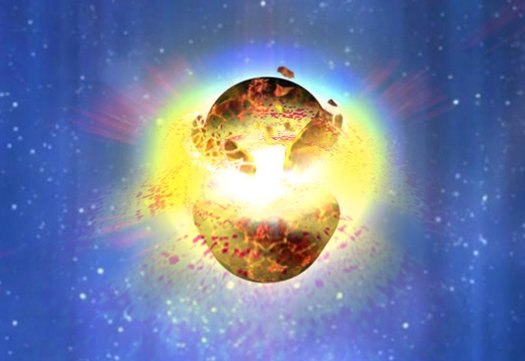
Last year, Japanese scientists found evidence that, in 775 AD, Earth was hit with a sudden blast of high-intensity radiation--a blast carrying about 10,000 times the energy of the atomic bomb dropped on Hiroshima.
Clearly, something catastrophic had occurred in Earth's cosmic neighborhood, but whatever it was, it apparently went undetected by the 350 million people living on our planet at the time: the historical records contain no mention of strange celestial events that year, catastrophic or otherwise.
The event is recorded, instead, in the amount of radioactive carbon trapped in the annual growth rings of some of the world’s oldest trees. Carbon’s key radioactive isotope, carbon-14, forms when energetic particles enter Earth’s atmosphere and collide with nitrogen atoms. Since trees take in both carbon-14 and its stable relative, carbon-12, the relative levels of carbon-14 in their growth rings give scientists a way of measuring the amount of high-energy particles entering Earth’s atmosphere in a given year. When analyzing two ancient Japanese cedars last year, the scientists found that the amount of carbon-14 present in their 775 AD growth rings was shockingly large.
It’s normal for levels of carbon-14 to fluctuate--they rise and fall on an 11-year cycle with the waxing and waning of solar flares. But for the entire 3,000-year record, there are no other spikes as steep as the one in 775. So what could have caused the massive burst of radiation and the high influx of energetic particles that led to the elevated levels of carbon-14 in the atmosphere? At first, two possibilities seemed the most likely: The radiation either came from an especially intense solar flare or the explosion of a nearby star.
The scientists ruled out the solar flare hypothesis for two reasons. First, flares of the required magnitude would have sparked an unforgettable display of the northern lights, but, as mentioned, no such phenomenon was recorded. Second--and perhaps more importantly--such flares would also have destroyed the Earth’s ozone layer, exposing all of life to harsh radiation and probably setting in motion a mass extinction event.
On to the next possibility. A nearby supernova would have sent gamma rays flying in all directions. Those rays would have created high-energy particles in our atmosphere, which could then go on to form the carbon-14 present in such abundance in the Japanese cedars. But in order to send out enough gamma rays to do the trick, the supernova would have had to be bigger and brighter than other historical bright spots that were, in fact, documented. Yet, again, no record of a 775 supernova exists.
And, even if people had somehow missed an exploding star, that star’s remnants would still be out there today, giving out a faint glow that could be picked up by telescopes. Scientists have already identified 11 such remnants in our Galactic neighborhood, but none are the right age to have caused the 775 spike.
When they found that neither solar flares nor supernovae could explain the carbon-14 anomaly they had found, the researchers published their discovery and let the mystery stand.
But now, a group of researchers from Germany has come up with a plausible cause: a short-duration gamma ray burst, produced by the collision of two nearby neutron stars. Though immensely powerful (we’re talking two 10-mile wide boulders, each with the mass of our sun), the collision would only have been visible from Earth for about a day, which could explain why the event wasn’t recorded.
The scientists have identified five neutron stars that could have caused the massive burst, and their step is to take a detailed look at those candidates.

140 years of Popular Science at your fingertips.
Each issue has been completely reimagined for your iPad. See our amazing new vision for magazines that goes far beyond the printed page
Stay up to date on the latest news of the future of science and technology from your iPhone or Android phone with full articles, images and offline viewing
Featuring every article from the magazine and website, plus links from around the Web. Also see our PopSci DIY feed
Engineers are racing to build robots that can take the place of rescuers. That story, plus a city that storms can't break and how having fun could lead to breakthrough science.
Also! A leech detective, the solution to America's train-crash problems, the world's fastest baby carriage, and more.


Online Content Director: Suzanne LaBarre | Email
Senior Editor: Paul Adams | Email
Associate Editor: Dan Nosowitz | Email
Contributing Writers:
Clay Dillow | Email
Rebecca Boyle | Email
Colin Lecher | Email
Emily Elert | Email
Intern:
Shaunacy Ferro | Email
Wait! So the formation of radioactive isotopes isn't a steady process?
This could cause us to change our assumptions about dating methods.
Or not, because naturalism is about taking the evidence to where you want it to be instead of following it to where it points.
"...But for the entire 3,000-year record, there are no other spikes as steep as the one in 775..."
Why is the record 3000 years; no longer or shorter; why 3000?
"...the collision would only have been visible from Earth for about a day, which could explain why the event wasn’t recorded..."
How do they know, this is why the event wasn’t recorded? Are they sure, no one notice?
Interesting article though!!! ;)
HULK SMASH
@bagpipes
While I applaud you for your strict adherence to the skepticism of the scientific method, I would caution you that there is a line to be drawn between keeping critique of a scientific theory or process open so as to continual improve it and/or quantify it's shortcomings... and obstructionism aimed at killing theories and tools because they are not perfect or cannot be empirically proven through testing. I've watched a number of the discussions you've had here providing very strong views about the inadequacies of some scientific theories and processes, and I've often gotten the impression you don't think they should be used at all until they can be proven beyond doubt. Of course, I think anyone in the business of science prefers directly observable, testable theory, but that just simply isn't possible or practical in many situations. I hope you understand this reality, and the necessity to move forward with the '90% solution' on occasion, as little as we like it. You often make it very difficult to agree with you, as much as I understand what you're trying to say.
With this article as well, I cant help but feel you're latching on to any variable or unknown and waving it around like a flag saying "you're methods are incorrect!" Well yes... in the most basic sense they are wrong, much in the same way every applied science is wrong; every technique, tool, instrument we use in applied science and engineering requires some level of assumption to bring the tool to a practically usable level. That is why we quantify the known variability in our instruments and techniques... but we do not disavow them until they are shown either entirely wrong or less accurate than is needed to support the function we use them for.
With that said...
It has already been known for quite some time that certain radiometric dating processes (of which C-14 is only one) are susceptible to error from external variables, and that there are mechanisms by which additional radiological material can be added to the sample which we generally assume as a closed system. This is not a new revelation, so I'm unsure of the 'gotcha!' tone of your comment. There are various calibration curves to account for the varying presence of solar radiation and other known sources. As anomalies like the one detailed in this article are found ,they are incorporated if they have an appreciable effect.
This article, in fact, is a perfect example of just one of the many controls used to limit error from these kind of fluctuations; tree ring studies and sedimentary cores can often be used to identify variations in the atmospheric concentrations of whichever isotope is being used, and estimate and/or control the resulting error. This is less helpful in dating on more geological time scales, but the various radiometric dating techniques used on those scales have other means of control, but result in a much less accurate estimation of age in spite of those controls. All the same, an error of a million years may be acceptable if you're dating out in the hundreds of millions, or billions of years.
While I agree that there are a number of variables that we simply cant capture in radiometric dating techniques, and that we make educated assumptions in order to complete the tool with a reasonable level of accuracy, I don't see that this invalidates the techniques or their results, as you often insinuate in your comments on these articles (please correct me if I read you wrong).
Otherwise, you may be horrified at how your car, the airplane you may have flown in, or the building you work in were designed. Engineers LOVE assumptions.
Layla. I agree that Wanda`s bl0g is impossible, last monday I bought a gorgeous BMW 5-series after having made $7872 this-past/4 weeks and-just over, ten k this past-month. without a doubt it is the most comfortable work I've had. I started this 10-months ago and practically straight away began to bring home more than $84, per/hr. I went to this site...NYDaily5.Buzz70.com
Robot, i guess the record they were speaking of is the one from old Japanese Cedars. Cedars are known to reach 2,000+ years, even in other parts of the world. 3,000 years must be pretty much the max though.
The reason they would assume the event to be recorded is most likely because of the chinese astronomers. For many hundred years, the chinese governement had a large number of clerks dedicated to astronomy. Their (spotless and perfect) records mostly survived until this day. They pretty much never missed any phenomenon. Imho, even if it was visible for just a day, it should show up i their records. Maybe not if it happened to a location close to the Sun during daylight during summer though.
iambronco, still there are many flaws to C14 dating. i am not saying it is wrong to work with it, or that it doesn't work, but it is not as reliable as many believe it to be. C14 works on the assumption that everything always was the same way it is now, especially solar activity and our atmosphere. However, there were many changes in both solar activity and our atmosphere. And then, there are still local variances. i have heard of live animals to be tested as 2,000 years old (though i have no reference). That does not neccesarily mean that C14 is worthless, but imho, you can only rely on it if you have a second dating method confirming your calculations.
Also, part of the problem is scientists reporting findings based on flawed research as fact. Since most people do not look into the details of a study or other body of research they do not question it.
It would be better if media reported scientific findings along with the limitations of the test/report/study/research
I, for one, was largely unaware of the limitations of carbon 14 dating until recently. The scientific community should correct media outlets when data are reported as fact when it may not be. Until something is proven without a doubt it is still a hypothesis.
Or perhaps they think it is better the way it is. This way their work is published as fact among the lay people of the world, therefore funding is easier to secure and people are more likely to believe the results. In other words, it is in the order of self preservation that they allow the media to contort their words.
Also, notice how quickly the scientific community responds when the media get something wrong which hurts said community.
Prove me wrong.
@Addl
The "2,000 year old" live animals you cite was from testing mollusk shells. The carbon in mollusk shells is from calcium carbonate dissolved in water. Thus the measurement was an average of when the carbon formed, not the age of the animal. For this reason, radiocarbon dating only works for organisms that obtain their carbon from air via carbon dioxide. Even organisms that eat aquatic organisms should be calibrated to account for this (for example, a seal that was dated to be 1400 years old).
Shouldn't it be pretty easy for them to expose some 775 A.D. soil in the neighborhood of their 3000 year old trees and do a direct uranium timeline abstract from that? Seems logical that any structures in Japan from that era?? that are still standing are likewise good places to look for corroborative or disqualifying evidence. There should be an expected spike or radical drop in the magnetic field of local pottery from that time as well, correct?
4.54 Billion Earth has been here. 3000 years is such a tiny gap of time, lol.
soy sauce was first reported being used in Japan in 775 :)
@Robot --I think the way I stated the "3000-year record" was misleading. The tree-ring record actually goes back 12,000 years, and includes measurements from thousands of currently living forests, as well as lots of long-dead trees that have been preserved in bogs and other decay-proof environments.
I mentioned the 3000-year record because, for this study, the researchers had to be able to see how carbon-14 levels changed from one year to the next, but the 12,000-year record has only a five year resolution (measurements were taken from every fifth tree-ring; my guess as to the reason why is that carbon-14 dating is quite expensive, and the purpose of the record is actually to help calibrate radiocarbon dating, so they didn't need to have annual resolution). Over the past 3,000 years, there have been 3 sharp spikes in carbon-14 levels over a short period of time. Scientists have already gone back and obtained annual tree-ring data for those other two events, and it turned out that the carbon-14 spikes occurred over a few years and could be explained by solar activity. Not so, of course, for the 775 spike.
Also, @monkeybuttons, while it's true that carbon-14 dating isn't perfectly precise, this study was based on tree rings, which doesn't suffer from the same uncertainties. Yes, they were measuring the carbon-14 in tree-rings, but they weren't using the carbon-14 to tell them how long ago the event happened. They were measuring the relative change in the isotope from one year to the next. As a side note that may interest @Bagpipes100: the reason scientists amassed this giant carbon record from trees in the first place is so that they could find out how carbon-14 inputs changed over time, and then build a calibration curve to make radiocarbon dating more accurate. Before 12,000 years, that record consists of data from marine sediments. This method not only allows scientists to get more accurate ages, but also to say exactly how certain they can be. All carbon-14 dates are given with a "plus or minus x years."
EmilyElert,
THANK YOU, for the information!!!! ;)
No one even noticed.....except for the poor time traveller that was trapped back then due to the EMP of that sucker.....
nightawkich,
If he is timetravel, more likely he has an extreme life span too. You should look him up and see how he is?
LOL