
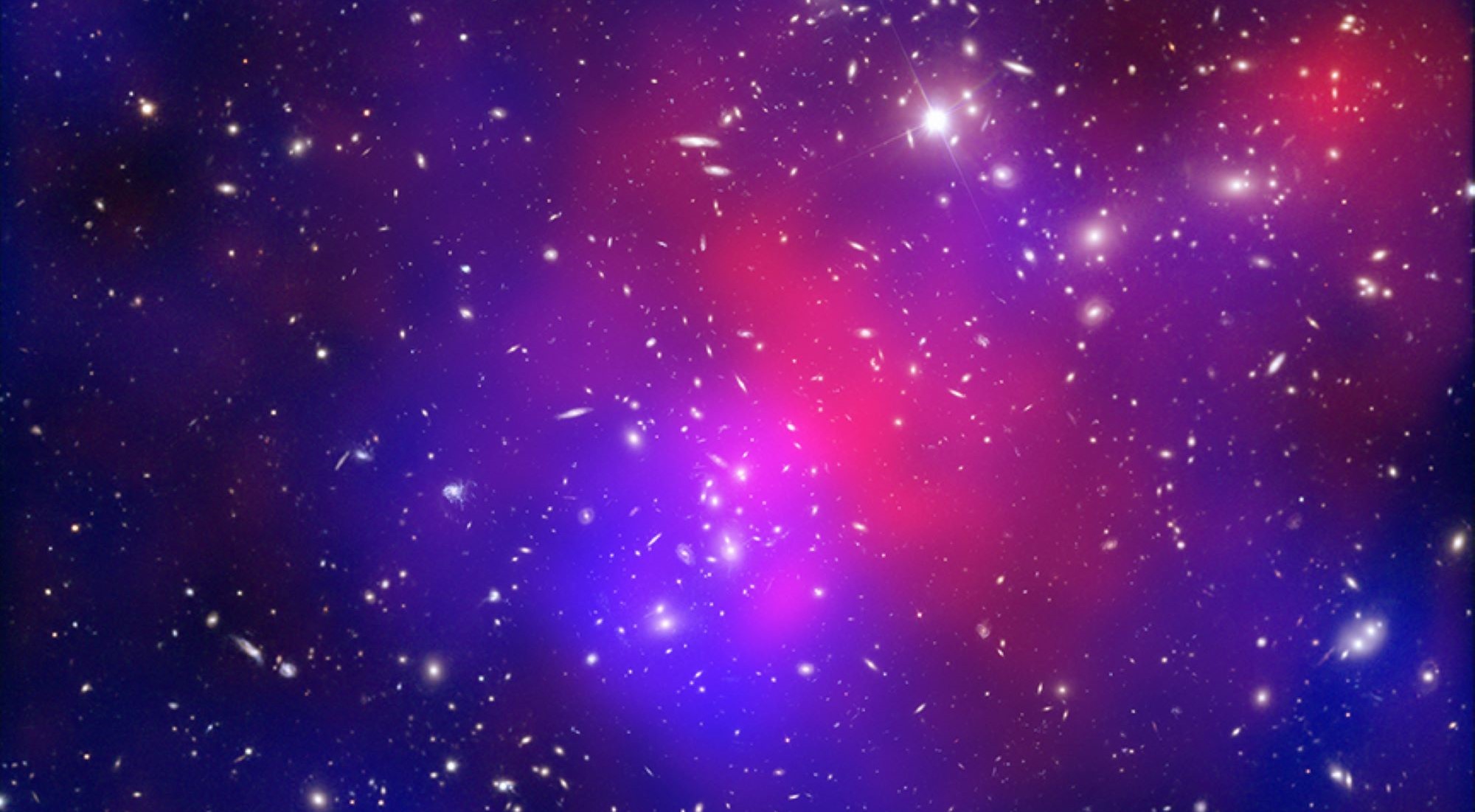
The universe has a dark side—it’s filled with dark matter and dark energy. Dark matter is the unseen mass floating around galaxies, which physicists have searched for using giant vats of ice, particle colliders, and other sophisticated techniques. But what about dark matter’s stranger sibling, dark energy?
Dark energy is the term given to something that is causing the universe to expand faster and faster as time goes on. The great puzzle facing cosmologists today is figuring out the identity of that “something.”
“We can tell you a lot about the properties of dark energy and how it behaves,” says astrophysicist Tamara Davis, a professor at the University of Queensland in Australia. “However, we still don’t know what it is. That’s the big question.”
How do we know dark energy exists?
Astronomers have long known that the universe is expanding. In the early 1900s, Edwin Hubble observed galaxies in motion and created Hubble’s Law, which relates a galaxy’s velocity to its distance from us. At the end of the 20th century, though, new detections of supernovae in far-off galaxies revealed a conundrum: The expansion of the universe isn’t constant, but is instead speeding up.
“The fact that the universe is accelerating caught us all by surprise,” says University of Texas at Austin astrophysicist Katherine Freese. Unlike the attractive force of gravity, dark energy must create “some sort of repulsive behavior, driving things apart from one another more and more quickly,” adds Freese.
Many observations since the 1990s have confirmed that the universe is accelerating. Exploding stars in distant galaxies appear fainter than they should have been in a steadily-expanding universe. Even the cosmic microwave background—the remnant light from the first clear moments in the universe’s history—shows fingerprints of dark energy’s effects. To explain the observed universe, dark energy is a necessary component of our mathematical models of cosmology.
[Related: Dark matter has never killed anyone, and scientists want to know why]
The term dark energy was coined in 1998 by astrophysicist Michael Turner to match the nomenclature of dark matter. It also conveys that the universe’s accelerating expansion was a crucial, unsolved problem. Many scientists at the time thought that Albert Einstein’s cosmological constant—a “fudge factor” he included in general relativity to make the math work out, also known as lambda—was the perfect explanation for dark energy, since it fit nicely into their models.
“It was my belief that it was not that simple,” says Turner, now a visiting professor at UCLA. He views the accelerating universe as “the most profound problem” and “the biggest mystery in all of science.”
Why does dark energy matter?
The Lambda-CDM model, which says we live in a universe that consists of only 5 percent normal matter—everything you’ve ever seen or touched—plus 27 percent dark matter and a whopping 68 percent dark energy, is “the current paradigm in cosmology, says Yale astrophysicist Will Tyndall. It “rather ambitiously seeks to incorporate (and explain) all of cosmic history,” he says. But it still leaves a lot unexplained, including the nature of dark energy. “After all, how can we have so little understanding of something that supposedly constitutes 68 percent of the universe we live in?” adds Tyndall.
Dark energy is also a major deciding factor in our universe’s ultimate fate. Will the universe be torn apart in a Big Rip, in which everything is shredded apart atom by atom? Or will it end in a whimper?
These scenarios depend on whether dark energy changes with time. If dark energy is just the cosmological constant, with no variation, our universe will expand eternally into a very lonely place; in this scenario, all the stars beyond our local cluster of galaxies would be invisible to us, too red to be detected.
If dark energy gets stronger, it might lead to the event known as the Big Rip. Maybe dark energy weakens, and our universe crunches back down, starting the cycle all over with a new big bang. Physicists won’t know which of these scenarios lies ahead until they have a better handle on the nature of dark energy.
What could dark energy actually be?
Dark energy shows up in the mathematics of the universe as Einstein’s cosmological constant, but that doesn’t explain what physically causes the universe’s expansion to speed up. A leading theory is a funky feature of quantum mechanics known as the vacuum energy. This is created when pairs of particles and their antiparticles quickly pop into and out of existence, which happens pretty much everywhere all the time.
It sounds like a great explanation for dark energy. But there’s one big issue: The value of the vacuum energy that scientists measure and the one they predict from theories are wildly and inexplicably different. This is known as the cosmological constant problem. Put another way, particle physicist’s models predict that what we think of as “nothing” should have some weight, Turner says. But measurements find it weighs very little, if anything at all. “Maybe nothing weighs nothing,” he says.
[Related: An ambitious dark energy experiment just went live in Arizona]
Cosmologists have raised other explanations for dark energy over the years. One, string theory, claims that the universe is made up of tiny little string-like bits, and the value of dark energy that we see just happens to be one possibility within many different multiverses. Many physicists consider this to be pretty human-centric in its logic—we couldn’t exist in a universe with other values of the cosmological constant, so we ended up in this one, even if it’s an outlier compared to the others.
Other physicists have considered changing Einstein’s equations for general relativity altogether, but most of those attempts were ruled out by measurements from LIGO’s pioneering observations of gravitational waves. “In short, we need a brilliant new idea,” says Freese.
How might scientists solve this mystery?
New observations of the cosmos may be able to help astrophysicists measure the properties of dark energy in more detail. For example, astronomers already know the universe’s expansion is accelerating—but has that acceleration always been the same? If the answer to this question is no, then that means dark energy hasn’t been constant, and the lives of physics theorists everywhere will be upended as they scramble to find new explanations.
One project, known as the Dark Energy Spectroscopic Instrument or DESI, is already underway at Kitt Peak Observatory in Arizona. This effort searches for signs of varying acceleration in the universe by cosmic cartography. “It is like laying grid-paper over the universe and measuring how it has expanded and accelerated with time,” says Davis.
Even more experiments are upcoming, such as the European Euclid mission launching this summer. Euclid will map galaxies as far as 10 billion light-years away—looking backward in time by 10 billion years. This is “the entire period over which dark energy played a significant role in accelerating the expansion of the universe,” as its mission website states. Radio telescopes such as CHIME will be mapping the universe in a slightly different way, tracing how hydrogen spreads across space.
New observations won’t solve everything, though. “Even if we measure the properties of dark energy to infinite precision, it doesn’t tell us what it is,” Davis adds. “The real breakthrough that is needed is a theoretical one.” Astronomers have a timeline for new experiments, which will keep marching forward, recording better and better measurements. But theoretical breakthroughs are unpredictable—it could take one, ten, or even a hundred-plus years. “In science, there are very few true puzzles. A true puzzle means you don’t really know the answer,” says Turner. “And I think dark energy is one of them.”
