
A possible victory for Einstein

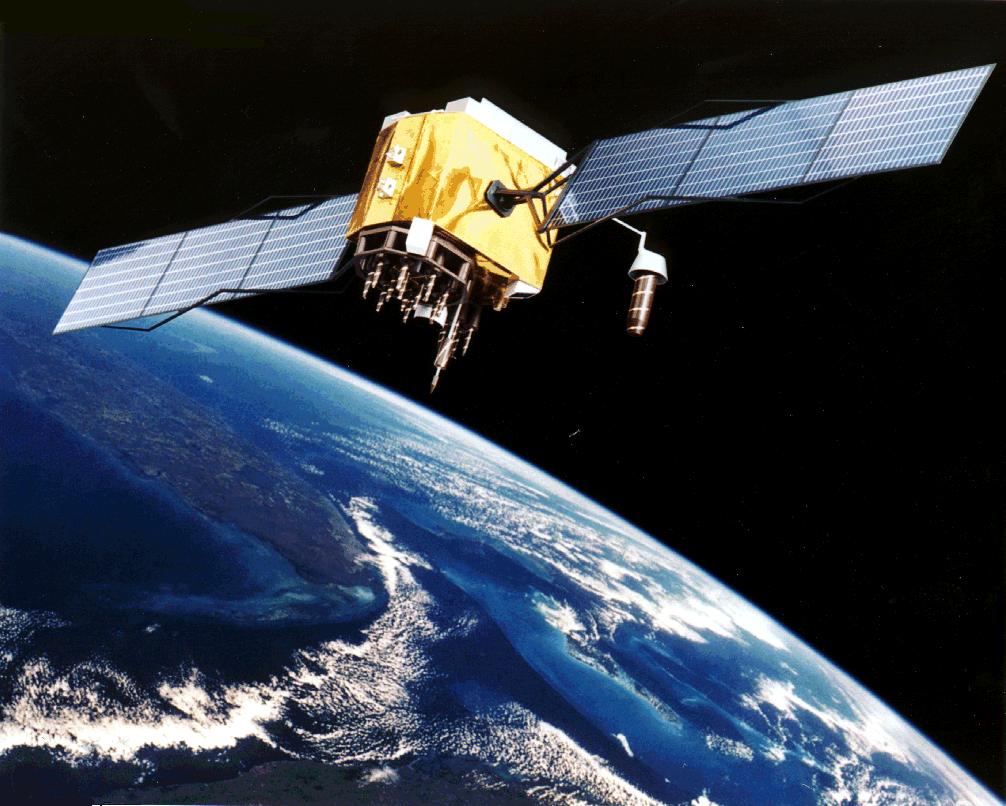
GPS Satellite NASA/Wikimedia Commons

So it turns out that Einstein may not have been wrong about the universal speed limit. Not only is special relativity safe, it provides an explanation for those faster-than-light neutrinos. They’re not breaking the light-speed barrier; they just appear to be, thanks to the relativistic motion of the clocks checking their speed.

As we all remember, a few weeks ago some scientists at CERN set the physics world on fire when they shared data showing neutrinos were moving faster than light. Specifically, they were showing up at a distant neutrino detector about 60 nanoseconds faster than the time in which light would make the same trip. But the rules of physics said this could not be. The Oscillation Project with Emulsion-tRacking Apparatus team (which was not looking for this result, by the way) calibrated their clocks, measured their distances and crunched their numbers in search of an explanation.

Flummoxed, they dumped their findings on the larger physics community, which proceeded to eviscerate the experiment. In the three weeks since, almost 100 papers have shown up on the preprint server arXiv trying to make sense of it all. Physicists have blamed everything from poor geodesy to ill-timed clocks, and other particle physics observatories are hard at work trying to replicate the results.

Now a Dutch physicist says it’s really very simple — the OPERA team overlooked the relativistic motion of their clocks. Technology Review's arXiv blog highlights the paper here.

OPERA was studying neutrino oscillation, in which these ghostly particles switch from one type to another. They were firing off muon neutrinos from a neutrino beam at CERN and sending them to Gran Sasso, Italy, where researchers counted how many of them had become tau neutrinos. Along with careful Earth-measuring, this experiment required super-precise synchronization of clocks at the two locations. The team did this with GPS satellites, which broadcast a time signal as they orbit about 12,500 miles above the Earth. The OPERA team had to calculate how long it takes for one of these time signals to reach the Earth. But they did not account for the clocks’ relativistic motion, according to physicist Ronald van Elburg at the University of Groningen in the Netherlands.

The radio signals travel from the satellites at light speed, which has nothing to do with the satellites’ speed. This is one of the central tenets of special relativity: “Light is always propagated in empty space with a definite velocity c which is independent of the state of motion of the emitting body,” as Einstein put it himself.

But because the satellites are moving, from their point of view, the positions of the neutrinos and the detector are changing. The neutrinos are moving toward the detector, and the detector appears to be moving toward the neutrino source. So the distance between the origin and destination appears to be shorter than it would if it were being observed on the ground.

“Consequently, in this reference frame the distance traveled by the [particles] is shorter than the distance separating the source and detector,” van Elburg writes. This phenomenon is overlooked because the OPERA team thinks of the clocks as on the ground — which they are, physically — and not in orbit, which is where their synchronizing reference point is located.

Using the altitude, orbital period, inclination to the equator and other metrics, van Elburg calculates the error rate: “The observed time-of-flight should be about 32 ns shorter than the time-of-flight using a baseline bound clock,” he writes. This is done at both clock locations, so double that, and you get an early-arrival time of 64 nanoseconds. That pretty much accounts for the OPERA anomaly.

“This paper shows that Coordinated Universal Time (UTC) happens to be less universal than the name suggests, and that we have to take in to account how our clocks are moving,” van Elburg writes.

Of course, his paper has not yet been published, and is subject to the same scrutiny and peer review as the OPERA folks, so we can’t accept van Elburg’s theory just yet. But it’s certainly a handy explanation. And it’s a lovely piece of irony, too — not only was Einstein’s special theory of relativity right all along, it even provides a reason why.

[via Technology Review]

29 Comments

I came across an article covering the same explanation this weekend. It some how saddens me. I was hoping for a huge break through because of the neutrino phenomena, but it just seems we found a glitch. Not as exciting.

Is this article serious? I just lost a bit of faith in our scientists no wonder we can get crap figured out....

From the paper:
"A key feature of the neutrino velocity measurement is the accuracy of the relative time tagging at CERN and at the OPERA detector. The standard GPS receivers formerly installed at CERN and LNGS would feature an insufficient ~100 ns accuracy for the TOFν measurement.
Thus, in 2008, two identical systems, composed of a GPS receiver for time-transfer applications Septentrio PolaRx2e [16] operating in “common-view” mode [17] and a Cs atomic clock Symmetricom Cs4000 [18], were installed at CERN and LNGS (see Figs. 3, 5 and 6).
The Cs4000 oscillator provides the reference frequency to the PolaRx2e receiver, which is able to time-tag its “One Pulse Per Second” output (1PPS) with respect to the individual GPS satellite observations. The latter are processed offline by using the CGGTTS format [19]. The
two systems feature a technology commonly used for high-accuracy time transfer applications[20]. They were calibrated by the Swiss Metrology Institute (METAS) [21] and established a permanent time link between two reference points (tCERN and tLNGS) of the timing chains of CERN and OPERA at the nanosecond level. This time link between CERN and OPERA was independently verified by the German Metrology Institute PTB (Physikalisch-Technische Bundesanstalt) [22] by taking data at CERN and LNGS with a portable time-transfer device [23].
The difference between the time base of the CERN and OPERA PolaRx2e receivers was measured to be (2.3 ± 0.9) ns [22]. This correction was taken into account in the application of
the time link.
All the other elements of the timing distribution chains of CERN and OPERA were accurately calibrated by using different techniques, further described in the following, in order to
reach a comparable level of accuracy"

Q

I knew it!

Just kidding. I have not a clue. But it sure is interesting reading. Go science and a better understanding of our
own tools.

Seriously... so technically measuring this its 64ns difference on the clocks, so apply that to measuring light and its also 64ns slower than its speed... So in turn really this paper proves little to nothing and if anything actually proves the neutrinos are actually moving faster than or equal to light which still is a big deal since light is supposedly the speed limit and here something else is matching it.

Did no one else catch this mistake or do the clocks somehow not have a 64ns delay when it measures the speed of light.
Too many people being too quick to try and disprove a claim without really looking at the whole picture.

@twizztedbz81,

Yes, both light and neutrinos WHEN MEASURED WITH THOSE CLOCKS would have resulted in a 64ns difference.

This in fact proving special relativity... wtf are you talking about?

---

"Do not offer sympathy to the mentally ill.
Tell them firmly:
I am not paid to listen to this drivel.
You are a terminal boob." - William S. Burroughs

i knew there had to be something over looked, i didn't actually know this was it but assumed it was some relativistic short-cut, neat that the short-cut is because everything is relative to the observer, gps satelites being one set of observers and the individuals on the ground another set, of course the event being timed would be seen differently, brilliant!

What really intrigues me is that something this simple hasn't reared its head before. From the very beginning, Experiments dealing with matter that travels at or near the speed of light (including the one that gave us the speed of light to begin with) took place over long distances in which this phenomenon would have had an effect as well. Anyway, the search for FTL travel goes on, and when the secret is finally revealed, it will probably seem every bit as simple as this!

If this theory holds up, I will use this as an example of how science works the next time I get into a 'debate' about the difference between science and faith.

It would be a shame for it to be an experimental error (and one that seems pretty obvious - the need for GPS satellites to correct for relativity is often given as an example of relativity in practice) as it would have been cool if it had been true, but thus is the nature of science. Evidence must always win over coolness...

Q

Ok, this article and subject is really kind of new as you think about it, the year 2011. And it began from some of the smartest people around. To be fair to them, they also asked the outside world for confirmation. So, I was just thinking, if the previous calculated speed of the neutrinos maybe wrong then would it would it be important to go back and check the speed of a proton, the speed of light. It kind of implies that a little adjustment may have to be made to it as well of how fast a proton moves from point A to point B.

Wouldn’t it be odd, if they do go back and check the speed of light, they end up reducing its number too and then after all the adjustments have been made, the neutrinos come back to be faster than light!

D13 and twizztedbz81 should possibly first understand what the original experiment did before criticizing the dutch paper. But doing some research is tiresome, I know.

No "light" was sent and no light was measured.

Neutrinos were travelling through solid rock over 730km and the maximum expected speed for such a trip was "c" due to the nature of neutrinos: almost no interaction with matter.

Obviously if the 64ns analysis holds, this amount has to be substracted to the time of flight of "neutrinos" which are the only particles that went through the rock.

"c" would still remain "c". And if you care to read: "c" is constant and not by itself the "speed of light", but the maximum expected speed of light in vacuum if the photon is ever confirmed to be massless. Of course and for any practical purpose today, "c" can be considered the speed of light in vacuum.

@D13...they timed the neutrinos only (not light traveling the same route) and compared the neutrinos' speed to the speed limit derived from the speed of light in a vacumm--@Q...the speed of light doesn't need to be re-checked, as mementum states, cheers

are neutrinos traveling the speed of light or is light traveling the speed of neutrinos?

Satellites themselves wouldn't work if they didn't account for relativistic motion and I'm pretty sure somewhere in the paper they explain that they did account for this factor. Not only that but they were calibrated by two methods on the ground and cross checked by two independent institutes using atomic clocks. This was accurate into the nanoseconds and all these factors were addressed. This kind of thing is done all the time by these same people, so I'm pretty sure they know what they're doing by now.

what a second... is this correct? "The radio signals travel from the satellites at light speed" Last I checked.. radio signals didn't travel at light speed... if they did, wouldn't it not be a radio wave?

Playing Devil's Advocate since 1978

"The only constant in the universe is change"
-Heraclitus of Ephesus 535 BC - 475 BC

@artnel,

Both are traveling at "C"--which is the speed of light in a vacuum.

@CodeZero,

Radio and light are both "electromagnetic radiation" and both travel at the same speed.

---

"Do not offer sympathy to the mentally ill.
Tell them firmly:
I am not paid to listen to this drivel.
You are a terminal boob." - William S. Burroughs

@iaeonsfromutopia,

Have you looked at the original paper? I have.

It does not explicitly state that they account for the motion of the satellites, only that the time-synchronization at both ends TO the satellite was verified independently by third parties...

---

"Do not offer sympathy to the mentally ill.
Tell them firmly:
I am not paid to listen to this drivel.
You are a terminal boob." - William S. Burroughs

@D13...you must just be trolling, they obviously didn't use light during their experiment because it wouldn't reach the speed limit based on light traveling through a vacumm and since the neutrinos didn't travel through a vacumm during this experiment than the light wouldn't either if it traveled the same path of the neutrinos (besides the obvious fact that light can't travel through rock), negative cheers

@CodeZero...radio signals and light would travel at the same speed in a vacumm, they would both slow down moving through any medium, cheers

@Delkomatic -
This might have weakened your faith in those particular scientists perhaps (although they are also fallable human beings), but it surely must give you even more faith in the scientific method in general... The fact that any discovery or observation is subjected to critical evaluation, testing and research. The fact that the entire world's diverse scientific community comes together to clarify things and make sure we get them right. It's a beautiful and ultimately ideal method.

This article should leave you like it does me, happy and hopeful :)

@iaeonsfromutopia

The synchronized the timing system using "common view" and this synchronization was done by the PTB and ...

This type time sync using GPS was developed by NIST to have 2 locations very well synchronized to tag events and then later compare the time tags. Obviously, NIST was not expecting the method to be used to time the flighpath of a particle travelling at approx "c" where relativistic effects are significant.

But the most important thing: "common view" has to use 1 satellite to achieve the best synchronization. In fact this converts a single GPS satellite in a moving clock for this experiment.

Coincidentally, as pointed out in the dutch paper, the flighpath of GPS satellites is almost parallel to the CERN-OPERA baseline.

Suddenly you have a moving clock tracking the motion of a particle ... it sounds a lot like Special relativity with relative motion coming into play.

And yes, GPS clocks are adjusted (statically) for SR and GR (before they are launched and then later adjusted to compensate for inaccuracies in the height of the orbit). If you use several satellites, the motion effect is blurred because they follow different paths ... BUT in this experiment and quoting the paper: "common view" (and therefore only 1 satellite) was used.

An interesting question is: "why hasn't the simple dutch paper not been refuted by CERN/OPERA and/or any other scientific highness?"

As it is explained it makes clear sense, I just never went into the real data and didn't realise the original guys never accounted for this. Just assumed they did. Glad someone found out why in the end. But it is a shame that there wasn't some new discovery here, once day something will be found, there is still the illusive Tachyon particle I guess LOL

@d13,

Neutrinos DO interact with other particles. If not, they could not be detected. And we have not started to detect them just yesterday.

Neutrinos are only affected by gravity and the weak force and the detection is difficult because they have to directly hit a nucleus (weak force) to interact and therefore generate a detectable pattern

Neutrino oscillation (changing from one type of neutrino to another) has nothing to do with the above.

A base experiment with light as suggested by D13 could have been done to verify the method used in the OPERA experiment. In this experiment two points on the earth which are visible to each other and about 200 miles apart ( may be between two mountain peaks) can be be used. First measure the the distance with light (laser), then use the GPS method used in the OPERA experiment. If the measured distances must match exactly or we can be sure that there is some error in OPERA findings.

And how do you create a vacuum between those 2 mountain peaks to ensure that photons travel at "c"?

And which measuring method do you use with the laser? A metric tape? You measure the (roundtrip) time. But isn't that part of the problem itself because of the relativistic effects?

Yes the neutrino-faster-than-light experiment will NOT stand. So "If nothing travels faster than light then Einstein's theory is right!" Nice rhyme... most mediocre minds (i.e. just about everyone in today's world of physics) would dance to the line. A dance of the non-thinking crowd!

Reality is more complex -- a COUNTER-EXAMPLE exists that PROVES that (though Einstein's postulates are correct), Einstein's claim of having derived the Lorentz transformations is wrong, yes a COUNTER-EXAMPLE -- and at least one Nobel prize winner takes this realization seriously.See physicsnext.org for details, a very simple read, but majority be warned... facing physics reality regarding the foundations could disturb a mediocre mind and make you react emotionally...for example, Howard Georgi got very angry!


June 2013: American Energy Independence

Five amazing, clean technologies that will set us free, in this month's energy-focused issue. Also: how to build a better bomb detector, the robotic toys that are raising your children, a human catapult, the world's smallest arcade, and much more.


Online Content Director: Suzanne LaBarre | Email
Senior Editor: Paul Adams | Email
Associate Editor: Dan Nosowitz | Email
Assistant Editor: Colin Lecher | Email
Assistant Editor: Rose Pastore | Email

Contributing Writers:

Kelsey D. Atherton | Email
Francie Diep | Email
Shaunacy Ferro | Email

circ-top-header.gif
circ-cover.gif
bmxmag-ps