

Chaser Mark Olencki via Daily Mail

Bet your Christmas puppy won’t be able to do this. Actually, you’d better hope it can’t, because your dog-toy needs might break the bank.

A border collie named Chaser has learned the names of 1,022 individual items — more than any other animal, even the legendary Alex the parrot.

Psychologists Alliston Reid and John Pilley of Wofford College in Spartanburg, S.C., wanted to test if there was a limit to the amount of words a border collie could learn, so they taught Chaser the names of 1,022 toys, one by one, for three years. New Scientist reports that they got her to fetch the toy and then they repeated the name to reinforce her understanding.

They regularly tested her on her vocabulary by putting random groups of 20 toys in another room and having her fetch them by name. Chaser, now 6, never got less than 18 out of 20 right, in 838 (!) separate tests over three years.

It takes 16 plastic tubs to hold all the toys.
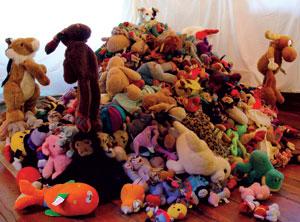
Mine. All Mine: Chaser the border collie's head can be seen at the top of her mountain of toys. She can identify each toy — all 1,022 of them — by name.  Journal of Behavioural Processes

Watch Pilley give Chaser some impressively complex commands — combining three verbs with three nouns — in the video below. She understands the verbs “nose,” “get” and “paw.” Her reward is playtime with “Blue,” a little ball she chases across the room. For a whole collection of Chaser videos, click here.

She learned common nouns that represented categories, such as “ball,” and she learned to infer the names of objects by their association with other objects.

Rico the border collie, from the Max Planck Institute in Leipzig, Germany, was previously top dog — he had a vocabulary of about 200 words. Chaser’s feats are chronicled in the journal Behavioural Processes.


[New Scientist]

16 Comments

My dog can't even remember "Busch Lite"

@nonethewiser -- maybe your dog just has better taste in beer ;)

Why is it that this seems to put all the emphasis on the dog's intelligence, when it seems to me that the method of training, combined with the skills and patience of the trainer and the dog's total interest in the chosen 'skill testing medium'; not to even mention the all important relationship between animal and trainer are all much more important than the 'intelligence' of the dog? Seriously, has there been anything definitive to have us believe that Alex the parrot has an attention span or intelligence quotient or memory beyond that of all other animals except this dog? Were any of these animals tested in any innate intelligence experiment against a wide range of other animals, both of their own kind and not; that could be considered conclusive proof of higher IQ BEFORE being trained? Further, could the stuffed toys be washed in bleach and water a few times and get results this high and that would help to eliminate the possibility of scent marking that would invalidate the comparison against dogs having no such advantage? We already know that dogs can hold in memory very high numbers of scents; far more than the numbers spoken of here. I'd be very surprised to find that this was not being implemented here.

I know no one likes to hear the word "2012", but the Mayan said that during this new Earth cycle, which I believe started in 1812 because of the incredible advancements we've made in the last 200 years - we advanced from riding a horse to landing on Mars...incredible, that all mammals and animals of Earth will increase in intelligence and abilities 1,000 times and we will see and do things that will blow your mind. I think Chaser is proving their predictions are true. I am waiting for my boxer, Herkules, to give me the formula to the hyper-space engine so we can go out and explore the stars and planets where we came from.

@quasi44
The average human adult wouldn't be much smarter than a dog (if that!) without all the training we undergo (Google 'Rumanian orphanages' and 'child neglect' if you don't believe me) so that objection that we're seeing training rather than intelligence is meaningless.

The point of videos like this is NOT that Chester is smarter or more trainable than average, but that these particular animals PROVE certain things about how dogs and parots really think. We are seeing two things here. Proof that two dogs have learned a clever trick. And because it's happened twice, we can assume all dogs (and many other animals) have the mental ability to do this trick; that is the ability to catigorise hundreds of individual objects and REMEMBER THEM months later. Scent or sight is irrelivent to that.

That kind of long term memmory is a vital component of intelligence, and up until very recently, it was unclear if any non-primates could do it. It's just another nail in the coffin to the belief that the human mind is completely unique in nature.

We've got to get this dog working on global warming!

It's just another nail in the coffin to the belief that the human mind is completely unique in nature.

yeah, especially when he solves global warming.

global warming is not real

@Aldrons Last Hope
You are wrong. Global warming is an actual recorded process. But "Man-made" global warming is not real.

But in light of the artical I agree that many other animals could do the exact same thing as this dog if they had enough training.

The dog cant be too smart. After all, his reward is chasing a blue ball.

@ ANTIcarrot; I'm glad that you try to take a higher message from this article. I often try to look past the things actually said in them as well; but that's almost never what's actually being sold here. If you have the realistic oversight to see this message that it infers to you, then you know what I'm saying here. We knew that many animals could perform very complex tasks as long as we could make them understand what it was we wanted back when Johnny Weismuller was starring in Tarzan movies, or Roy Rogers on Trigger, or Rin Tin Tin, or Lassie or Flipper. My position in this is that there has been no equal measure applied across these animal types that so many millions are spent on evermore esoteric and abstract tasks, that would be a realistic quantifier for the actual intelligence quotient of species. Yet that is exactly what is being sold-and purchased, here. And it will be sold for many millions of dollars regardless of it's ambiguity, and regardless of how little is gained. I say that little is gained because these animals, and indeed almost every living thing on this world, has shown itself to be at least willing to meet man in what can be loosely considered to be middle ground. If there were only ONE GOAL, to be able to learn how to converse with all animals; that is something I could accept. But that's not what's being sold, or purchased here. We learn little from Koko the Gorilla except how tolerant she was of our (from her perspective) insane demands that we then teach people in Africa little to nothing of so that they may truly co-exist with these animals. Even our own schoolchildren know nothing of Koko other than the most general things that any idiot should already know about giving an animal it's space. How many millions did that cost? And how much of what we HAVE found out could we have just believed in lessons freely given by native peoples? Plain and simple; almost any animal on this world will work with man if it has been shown that we will also work on it's behalf. If it can SEE we aren't destroying what it needs to live. Are these people trying to teach the dog to steal toys with stealth from humans that are perhaps stronger, but maybe slower? No? Then the dog, nor the human, has learned much of consequence. Because it means nothing to the dog to have learned it. Maybe people think they are doing an animal a favor teaching it something that it cannot use to save it's own life in the real world it lives in? Because THAT'S what's being sold here.

I'll put it another way. What did Flipper, or his family, or it's specie, get in hard value exchange for the MANY MILLIONS made off of that stupid 'stock shot' of the recorded sound he made? No less of his kind have been killed by man in the years since. Any year we killed less of his kind they killed none of ours. So what did he earn for his stupid animal trick that earns us so much more than the total of a few buckets full of fish? Animals, even horses or dogs, gain nothing for their kind that they could not have without our interference; and until we take on that issue, we have accomplished nothing more than we would pouring a cup of water into another cup and back and forth. Manipulation for our amusement.

These videos demonstrate that dogs are capable of even greater intelligence than we’d dreamed. The comments denying human-caused global warming, despite overwhelming mountains of evidence, demonstrate that humans are capable of even greater stupidity than we’d feared.

@ John Mayer; If we begin holding humans responsible for what our various constructs do independently of our knowledge in order to provide us plausible deniability we would soon realize all those naysayers are correct.

Wow, i cannot tell if i agree or disagree with anything quasi has said. My head hurts.

However, I do beleive that there is a great deal of value in evaluating the inate potential intelligence of other species. As a species, we humans seem to believe we have the monopoly on higher cognitive function, and that this higher funtion seperates us from the rable of nature. By demonstraiting that our intelligence (or maybe more importantly our emotive capabilites) is not so unique, we blur the millinea old distinctions that have allowed us to so poorly treat animals. I am willing to wager that flipper did pay huge dividends for his kind in the form of raising awareness of the intelligence (ie in our world view the humanity) or dolphins. this is evidenced from the large shifts in public opion about whaling, the existance of dolphin safe tuna, etc. I agree that it is sad that this is the case, that we cant see the inate value of life without this exposure, the exposure has indeed helped.


140 years of Popular Science at your fingertips.


Popular Science+ For iPad

Each issue has been completely reimagined for your iPad. See our amazing new vision for magazines that goes far beyond the printed page


Download Our App

Stay up to date on the latest news of the future of science and technology from your iPhone or Android phone with full articles, images and offline viewing


Follow Us On Twitter

Featuring every article from the magazine and website, plus links from around the Web. Also see our PopSci DIY feed


February 2013: How To Build A Hero

Engineers are racing to build robots that can take the place of rescuers. That story, plus a city that storms can't break and how having fun could lead to breakthrough science.

Also! A leech detective, the solution to America's train-crash problems, the world's fastest baby carriage, and more.


Online Content Director: Suzanne LaBarre | Email
Senior Editor: Paul Adams | Email
Associate Editor: Dan Nosowitz | Email

Contributing Writers:
Clay Dillow | Email
Rebecca Boyle | Email
Colin Lecher | Email
Emily Elert | Email

Intern:
Shaunacy Ferro | Email

circ-top-header.gif
circ-cover.gif
bmxmag-ps