
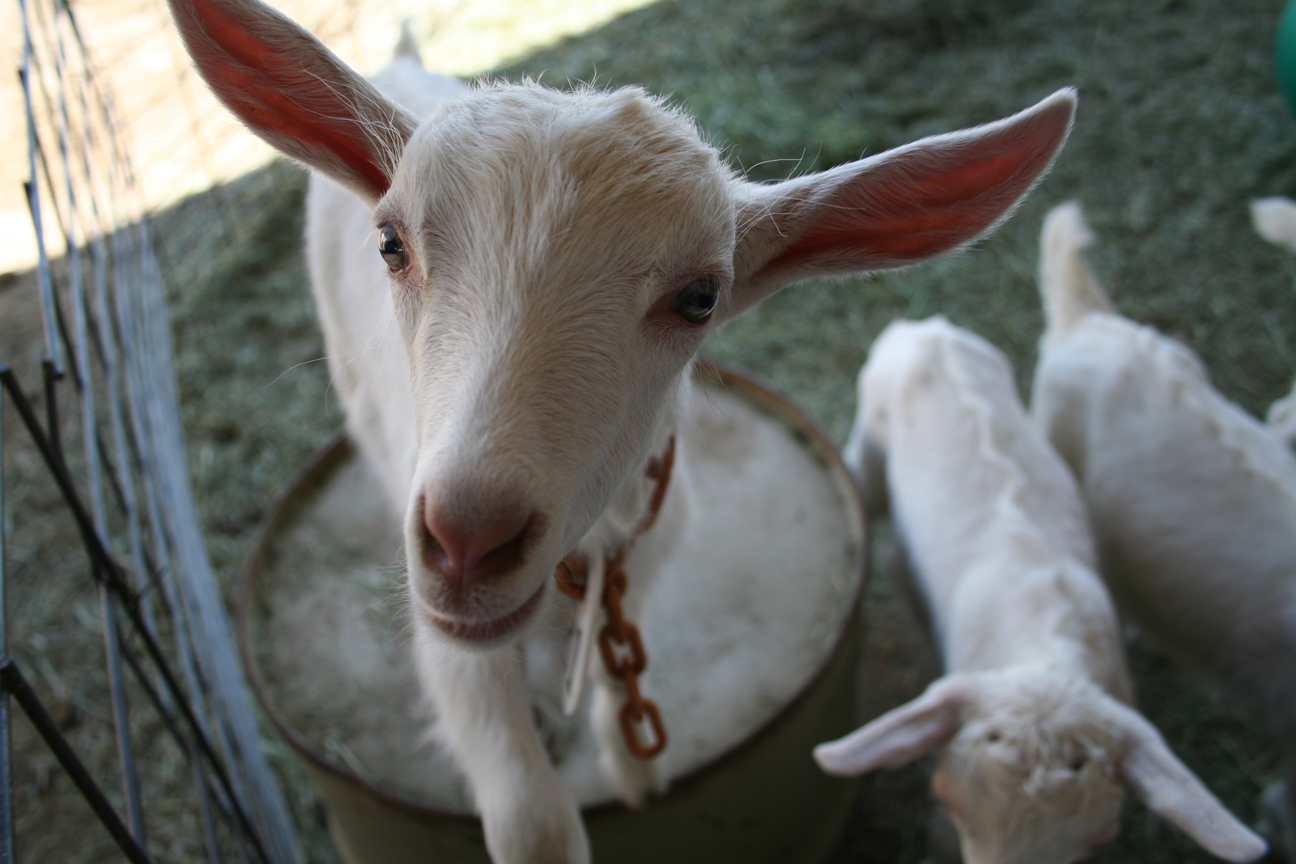
Mutant silkworms can produce miles of super-strong silk, in a new breakthrough that could lead to mass production of tough, flexible spider-silk material. Thanks to the efforts of these genetically modified spider-worms, along with spidergoats and spider-alfalfa, spider clothes may soon be upon us.
Randy Lewis, a molecular biologist at the University of Wyoming, has been milking his spidergoats for a couple years now, and he’s been trying to improve yields of genetically engineered spider-silk alfalfa. He’s researching improved synthetic spider silk genes, and he hopes to start growing spider cotton in the near future. With his latest research, spider fabrics might only be a year away.
Last week, Lewis and Malcolm Fraser at the University of Notre Dame announced they bred silkworms that had been genetically engineered to produce spider silk.
“From our perspective, there are huge advantages to the fact that the fiber is already spun,” Lewis said. “You don’t have to purify the protein, you don’t have to take it and spin fibers.”
Lewis said the study, which has not yet been published, proves the concept of engineering and breeding transgenic silkworms.
“The real question is going to be, can we make the necessary improvements in the mechanical properties of the silkworm silk by incorporating the spider silk in it? If we can do that, then obviously it makes a whole lot of things possible in terms of the amount of material you can make.”
A single silkworm cocoon contains more than a half-mile of silk thread, so colonies of transgenic silkworms produce plenty of silk, said Fraser, a molecular biologist at Notre Dame. He believes industrial production of engineered spider silk could happen within a year.
Spider silk is one of the most valuable materials in nature. It could be used for a vast array of products, from artificial ligaments to super-strong wound dressings or even body armor. Lewis envisions spider-silk replacement tendons, parachute cords and more.
Silk could even be used to transport drugs or act as nanoscale transistor scaffolds. In a study last year, scientists at Legacy Clinical Research & Technology Center in Portland, Ore., demonstrated that silk-based brain implants containing adenosine can suppress seizures in rats. In a paper published in the journal Science in July, Tufts University researchers said silk could be used to build flexible and degradable displays or even implantable optical systems for medicine.
“There’s lots of things you can do with fibers that you can’t do with something that comes as an amorphous blob or a solid,” Lewis said.
Nano-fabrics could be even stronger than spider silk, but as of now they’re impossibly small. Last week, Canadian researchers reported building the longest-ever polyyne chain — polyyne carbon-carbon bonds are even stronger than those in graphene — but it was only 44 carbon atoms long.Nano-sized fibers are still limited. “We can make textile quantities of the silkworm silks,” Fraser said. “Nanotechnology is certainly something that has some awesome potential, but I don’t know how soon that potential will be realized, and even if it is realized, I’m not sure that it would replace many of the medical applications of natural silk fibers, which are considerable.”
Lewis has been working on those applications for two decades. It’s been 12 years since he first isolated the genes that produce high-performance spider silk, and he garnered international attention for his transgenic goats, whose DNA has been altered to produce the proteins necessary to make spider silk. When the goats give birth and start lactating, they produce spider silk proteins in their milk, which is collected, purified and spun into silk, Lewis said.
It would be easier to milk spiders than mutant goats, if only spiders were not so murderous and territorial. As it is, spider farms have not proven a successful venture, whereas there are long traditions of farming both silkworms and goats. Scale makes a difference too: Lewis can get half an ounce of silk from every quart of milk. It would take 100 spiders to obtain that amount.
Transgenic silkworms could be even more productive. Breeding them involved some sneaky DNA, however. Kraig Biocraft Laboratories Inc., a Lansing, Mich., firm, partnered with Fraser, who discovered and patented a DNA transposon called “piggyBAC.” The transposon can insert itself into a cell’s genetic material. The researchers used piggyBAC to incorporate snippets of spider DNA into silkworm embryos, resulting in silkworms that spin a hybridized part-silkworm, part-spider silk.
The researchers wanted to be sure they could breed the spiderized silkworms, so they also added fluorescent protein to the spider DNA. The mutant silkworms had glowing red eyes, and their silk was fluorescent green.

Fraser said he is completing molecular analyses before submitting his study to a research journal. Meanwhile, he hopes to continue improving the snippets of spider DNA — especially if scientists obtain a sequence for a brand-new spider just discovered in Madagascar. The Darwin’s bark spider makes the largest webs in the world, spinning silk that is 10 times stronger than Kevlar.
Fraser also studies HIV and hepatitis, and he hinted that piggyBAC-hacked silkworms might be useful for other applications: “Silk isn’t the only protein that silkworms can produce,” he said.
Lewis said his highest priority is figuring out the fastest and most efficient way to produce large quantities of silk. He also hopes to continue isolating new spider silk genes and incorporating them into his formula. As of now, his formula is a blend of several different spider proteins, mainly from the golden orb weaver.
Lewis also hopes to start breeding cotton plants that contain the protein necessary to make spider silk. Cotton seeds already contain protein, and they’re considered a waste product, Lewis said.
“If we can take and use something that nobody is going to eat and that doesn’t have much value, and use that as a production system, then we have very little impact on food and fiber, and we can use the methods that are already out there,” he said.
Then spider clothes might not be far off at all.

Five amazing, clean technologies that will set us free, in this month's energy-focused issue. Also: how to build a better bomb detector, the robotic toys that are raising your children, a human catapult, the world's smallest arcade, and much more.


Online Content Director: Suzanne LaBarre | Email
Senior Editor: Paul Adams | Email
Associate Editor: Dan Nosowitz | Email
Assistant Editor: Colin Lecher | Email
Assistant Editor: Rose Pastore | Email
Contributing Writers:
Kelsey D. Atherton | Email
Francie Diep | Email
Shaunacy Ferro | Email
The cotton industry will ream him if he tries to grow such drastically altered cotton. They've already pushed organic growers in many states, especially colored cotton. This might give them a heart attack since it can't just be bleached out.
Quit messing with Nature.
all we need to do is coat it with grapine, and we'll have mithril.
or, instead of using mutated silk worms, we just use spiders!
The problem with using spiders is that they don't take to threats like silk worms. If you put a gun to a silk-worms head, it's all like, "oh, how much silk do you want me to produce?" Spiders - not so much.
i'm excited!
Sorry, msmith, but we've been messing with nature since the dawn of agriculture and animal domestication. If we were to remove all the "messing" we have done up to this point, the greater part of the human race would need to find another planet to live on.
The biological breakthroughs mentioned have extrordinary potential for creating fibers that could have a wide range of applications. And they would come without the -- perhaps valid -- objections to transgenic foods...unless one is in the habit of eating her sweaters.
I am interested in how the goats taste.... think they are stringy?
Messing with nature is fine and dandy with me. The threat that nature poses to mankind is overblown nonsense. What I don't get is this avoidance of hemp.
Americans need to grow up and grow hemp. I used to be one hundred percent dead-set against legalizing hemp but I would say that I'm now about 45% for it.
Can these spiders be bred larger? I would thing that a bigger spider, say, the size of a cat, could produce a great deal more web.
-------------
www.anamericanlion.com/
@NormanRogers - Hemp is illegal because people think it has something to do with pot. It absolutely SHOULD be legal.
Could you imagine what a factory of spiders would be like? And I wonder what it feels like for a goat to "milk" out silk... *shudders*
@NormanRogers
"Can these spiders be bred larger? I would thing that a bigger spider, say, the size of a cat, could produce a great deal more web"
LOL, that is until a few escape and we end up with a bad scene from the Lost in Space movie. Oh wait, that entire movie was a bad scene.
I can hardly wait to start catching flies with my sweaters.
M.Hat
lnwolf41 Make bigger spiders!? Eight legged freaks muliplied how many fold? Some activist would break in and set them free.
Also bigger spider means bigger food to feed it. So giant crickets anyone?
Ya know that it's not spiders making this silk, it's silkworms with a particular spider gene.... goats that have the spider gene, etc...
... or maybe you guys are just having fun...
"The Darwin’s bark spider"
No way! So was Darwin the first guy to blame a fart on a barking spider?
I seem to recall a similar article (probably in PopSci) some years ago along the same line, with "production expected immediately!". Guess Immediately has a revised meaning.
@skeptikor- granted, we've been mixing "beans" with other "beans" for a long time, I think the valid concern is that when you start mixing "beans" with things that just DONT mix naturally under any circumstances that valid fears and concerns arise. Biologically speaking DNA is infinitely more complex than any computer program, and let’s just say if you start combining code you're unfamiliar with and so far you've been able to make it do some neat tricks that also means that you may also inadvertently mix some pieces of code together that might so some decidedly NOT neat tricks aka: virus, biological blue screen of death? Etc. Now, my thought on this is that the "oh sh*&" moment isn’t going to come from any two direct combinations of changes, but from 5 or 6 unrelated changes, and this having a compound effect. This is by all accounts, unknown territory, and every step into exacerbates the risks. What happens when the spider goat works so well we need to add a few MORE genes to increase production, strength, colors etc? So now we have jellyfish proteins, spider proteins, just for fun, let’s add some sonar! Point is, are the potential risks WORTH the rewards, in this case, potential biological nightmare vs. "10x better than Kevlar?" Of course it almost doesn’t matter what you put at the end of that statement, even: potential biological nightmare or life saving vaccine, doesn’t work for me. In case you think I’m being an alarmist, I would submit that we have a track record, none of it good, that shows exactly what happens when we start taking things out of their natural habitat or introducing species to “cure” problems. In Florida we have the air potato vine, as well as kudzu, but check out this handy list:
http://webecoist.com/2009/12/15/incoming-the-worlds-10-worst-invasive-species/
I suspect animals/plants etc have built in barriers to the limits of their travel radius as well as their cross breeding for good reason, short circuiting the first has proven disastrous, the second may be horribly dangerous. Anyway, thoughts welcome….
The mutations are mild at best, and while its never "right" to change animals persay, we have to do it to continue with our population growth. Eggs, Cattle, Pork, etc etc all receive mutations / hormones / chemicals to produce unnaturally. Also the goatsilk / spiderworms, produce cotton like fabrics that are as strong as steel, yet soft as cotton. This can be used to produce clothing that lasts for decades. Your cloths would basically never ever wear out. The could be some color distortion etc, but the material itself wouldn't wear out, would be damage resistant and could be used for a wide range of applications in medical, electronics, consumers. Granted as soon as Spiderwear hits the market all clothing industry will be up in arms, mainly cause it can / will change how people by clothes, 10 pairs of socks will be all I ever need to by again.
Hemp is great but it's slow to grow, costly to harvest, and net yields require large areas to grow and consume large amounts of nutrients. Silkworms require fractions of the space / resources required. Also spiders don't produce much webbing, nor would making them larger help them produce more.
@mtcoder- "The mutations are mild at best"- Mild by who’s definition though? If we honestly don’t know what might trip a biological incident who are we to say? Even if they are, I'm postulating that the danger is in the compounding of these "mutations"…but in fact they aren’t mutations, that would mean the scrambling/rearranging of existing genetic information, this is the actual addition of outside genetic information" gene splicing" if I have my terms correct. (why does that sentence sound so snarky? I don’t mean it too…)
"we have to do it to continue with our population growth"
Is it really a fact that we would really starve if we switched to more a more organic and less hormone based way of agriculture? I would contend that Organic farming is both desirable and feasible. Granted, It costs slightly more, but the more widely it's accepted, the price will go down. Where i live, the price of Organic products have gone down significantly in the last five years for this very reason, I’m assuming others have noticed this trend? Supply and demand out to work in our favor here.
"Your cloths would basically never ever wear out" vs….. potential genetic disaster
think i'd rather replace my cotton socks every year ;)
Can we agree that just because something CAN be done hardly means it should be done, or that it's worth the risk of doing.
No doubt there would be some conveniences gained, but I'm saying, is the risk worth it? It’s a matter of record what we've already done to the environment and ecosystems of many places (mostly Australia for some reason) by us trying to "help".
As I see it, there are three categories of persons that will precipitate this and every other disaster.
The chivalrous-ignorant, the careless-corrupt, and the nefarious.
Every objection i've listed so far as been mostly addressed to the first sort: the chivalrous-ignorant. I’ve been sort of pointing out that the "road to hell is paved with good intentions", but of course, we ought to consider the other two since it’s equally paved with carelessness and plain ole evil.
The careless corrupt: The more a technology is explored, refined, documented, accepted, and ultimately patented, implemented and distributed the less control the creators have over how it’s used and less original intent matters. I’m no anti-capitalist, but lets be honest, for some companies safety is NOT job #1. Need I point out how short sighted or just plain sloppy SOME corporations can be about health risks where there is large amounts of money to be made? So forget the white knight scientists trying to solve the worlds problems for a moment or even the responsible corporations and think of the money-at-all-cost corporations and what kind of deep sh&^ they have,could, would and WILL get us in.
So much for the ignorant but well intentioned and the greedy careless, and on to the purposefully evil:
The nefarious: If History shows anything, it’s that those things that are” beyond top-secret” technology in first world countries today will be top secret (ie. No secret) in third world countries 20-30 years from now or less. Look at how little time has passed since the A-Bomb was created and now we’re worrying about Iran having one? Third World Countries having once top secret VX and Sarin gas? Not to mention China isn’t exactly a third world country and neither does their Government have the same reservations about experimentation as ours does, or at least, pretends it does. Do we want advance this technology knowing what it could and will (intentionally or not) do eventually? Is this worth “socks that never wear out?”
Great comments. Fly swatter sweater.., bark'ing spiders, size of a cat, mithril... fun stuff.
Nature has been creating transgenic experiments for half a billion years. 99% of them failures. Humans are the ultimate mad scientist (Mom Nature), transgenic product. We've got loads of fish, amphibian, reptile, mammal, simian genes all stitched together in our DNA. Yet are we transgenic humans the scourge of the Earth? Wait, don't answer that. Hmm, maybe this transgenic thing is not such a good idea...
Leximize your word!
Oh man I want a spider-goat!
well hell, how long til we get spider silk n graphene composite materials? just think of all the possibilities for that! the auto industry alone would be a multi billion deal, space tech would change forever, robotics....ooo yea come on guys speed things up!!!!
. . . Spiderpig, spiderpig, does whatever a spiderpig does . . .
Don’t eat the glowing worm, rule space with it. So, who ever can steal the spider silk worms first wins a big place in space, because they can make the first sky hook or sky pipe. Modification of the sky hook into the sky pipe or the superconductor hydrogen wheel would result in lift capacities of over a million tons annually of fluid, gas, water or fuel into space. Then we drop that fuel down to be picked up by plane for regular safe flights into space. Small reactors do exist that can be lifted into space and placed in an inflated vehicle capable of rotating is few inches of water around the outer edge to protect form solar radiation. The artificial gravity and plentiful water would make several year long space journeys as common as nuclear submarines.
NASA has already deployed a 20 mile long space tether and spider silk is ten times as strong. The well known and well established sky hook concept could be deployed with the same weight and similar cost for a 300 mile long space tether. It would be capable of modest supplies to the international space station right now, but adapted as a 300 mile long gas tank would put its lift capacity via 2,000 tons per second refueling tanker to millions of tons of fuel, water and oxygen annually. The hydrogen wheel uses a superconducting ring that is cooled by liquid hydrogen as continuous aircraft use magnets to align themselves up to spray more hydrogen into the wheel, but it’s a complex concept.
People should really just get over the whole 'going to space' dream... until we find something other than simple chemical reactions to power our vehicles, we'll never get out of the solar system.
Spidergoats? Great, juuuuuust great. Now all I need is to see goats spinning their disgusting webs on my front porch.
is that goat standing in soapy water? o.O