
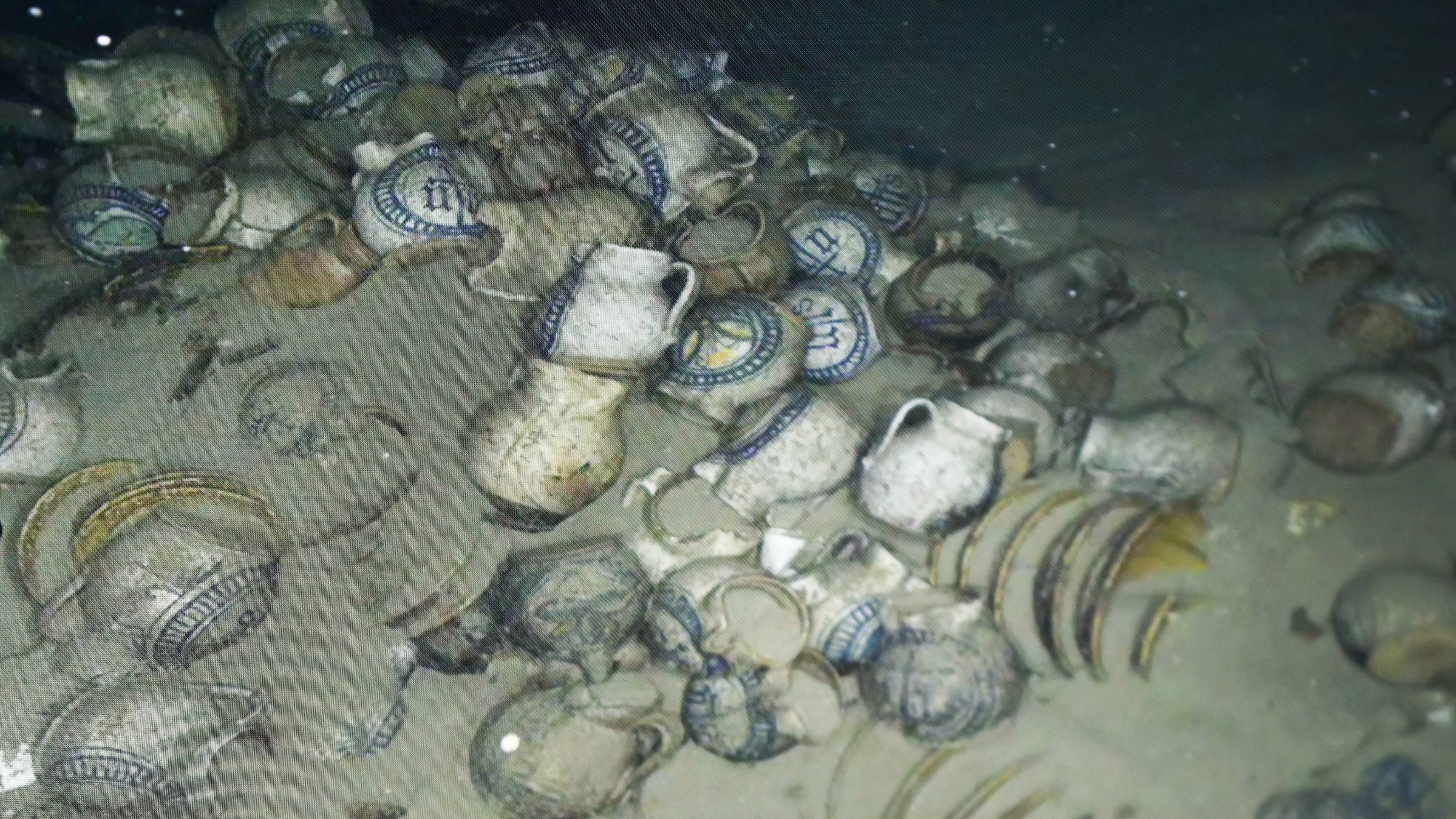
An intrepid sub-sea robot recently dove nearly 1.5 miles below the Mediterranean Sea off the coast of southern France. The remotely operated vehicle (ROV) went down to examine the wreckage of a merchant ship that dates back to the 16th century. There, it found hundreds of ornately decorated ceramics, jars, and jugs strewn across the sand. From the boat, a French navy sailor remotely controlling the robot plucked these treasures up ever so gently with the robot’s pincers. Despite centuries of ocean burial, the artifacts still maintained the bold blue and yellow geometric designs they had when the ship mysteriously capsized. But the ship’s discovery was mostly due to luck, and its current exploration is only made possible by modern advances in robotics.
Archaeologists are officially calling the site Camarat 4. It sits roughly 30 miles off the coast of Ramatuelle, but French authorities are keeping the exact location secret to prevent unauthorized visitors from nosing around. Camarat 4 was initially discovered during a routine French navy survey of the region last year, and the wreckage is now considered the deepest shipwreck in French territorial waters. The record for the deepest shipwreck ever found belongs to the USS Samuel B. Roberts. The navy vessel lies about four miles deep off the coast of the Philippines, according to the Guinness Book of World Records.
But reaching 1.5 miles isn’t a day at the beach either. To get down there and explore the mysterious vessel, archaeologists worked alongside the navy and reportedly used the largest robot in their arsenal.The robot is capable of diving down to 8,202 feet and was equipped with several cameras and a pair of pincers capable of grabbing objects. When the robot was deployed, it reportedly took a full hour just to reach the sea floor.
When it did, the cameras revealed the shipwreck in greater detail than ever before. They captured 66,974 images, snapping pictures at a rapid clip of eight photos per second. Those images clearly showed the ship’s six cannons, an anchor, and 12 cauldrons. Strewn across the seabed nearby were a small building’s worth of ceramics, one of which had the first three Greek letters of Jesus Christ’s name inscribed on it.
Archaeologists say that the cannons and the cargo reinforce the idea that this was a merchant ship. Though researchers have traced its origins to somewhere in northern Italy, it remains entirely unclear where its final destination was or what caused it to meet its watery grave.
All of the photos taken by the robot will help create a 3D model of the wreckage, which could aid further research. The robot was also able to grab and recover three pitchers and a plate from the site, though it’s unclear how many others may have been broken in the process. Using a modern robot’s giant pincers to grab nearly 500-year-old, decaying artisan works isn’t exactly a foolproof recovery method.
Exploring the sunken Italian ship isn’t just a matter of mere curiosity. Archaeologists involved in the excavation say that detailed historical records about Mediterranean merchant ships from this period are scarce. Knowing more about why this ship was there and where it was going could shed greater light on trade routes of the time.
Related Shipwreck Stories
Robots bring long lost ocean sites within reach
Ironically, the sunken Italian ship’s sheer inaccessibility is also what makes it such a valuable site to explore. Its depth and remoteness mean it has been completely untouched by looters or previous explorers. Even so, modern humanity has managed to leave its mark on the ancient vessel in the form of garbage. Beer cans, plastic containers, and old fishing nets were all spotted near the cannons and ceramics.
“After the awe of the discovery comes the sadness of finding such things,” DRASSM director Arnaud Schaumasse said in an interview with Le Monde.
Trash aside, the Camarat 4 expedition highlights the promise of future deep-sea exploration made possible by increasingly capable robotics, some of which are being designed to operate autonomously. By diving deeper than ever before, archaeologists will have the tools to explore mysteries that would otherwise have been left to rot in the ocean’s unforgiving darkness.
